
Updated June 2026 · Reviewed by Billy Forte
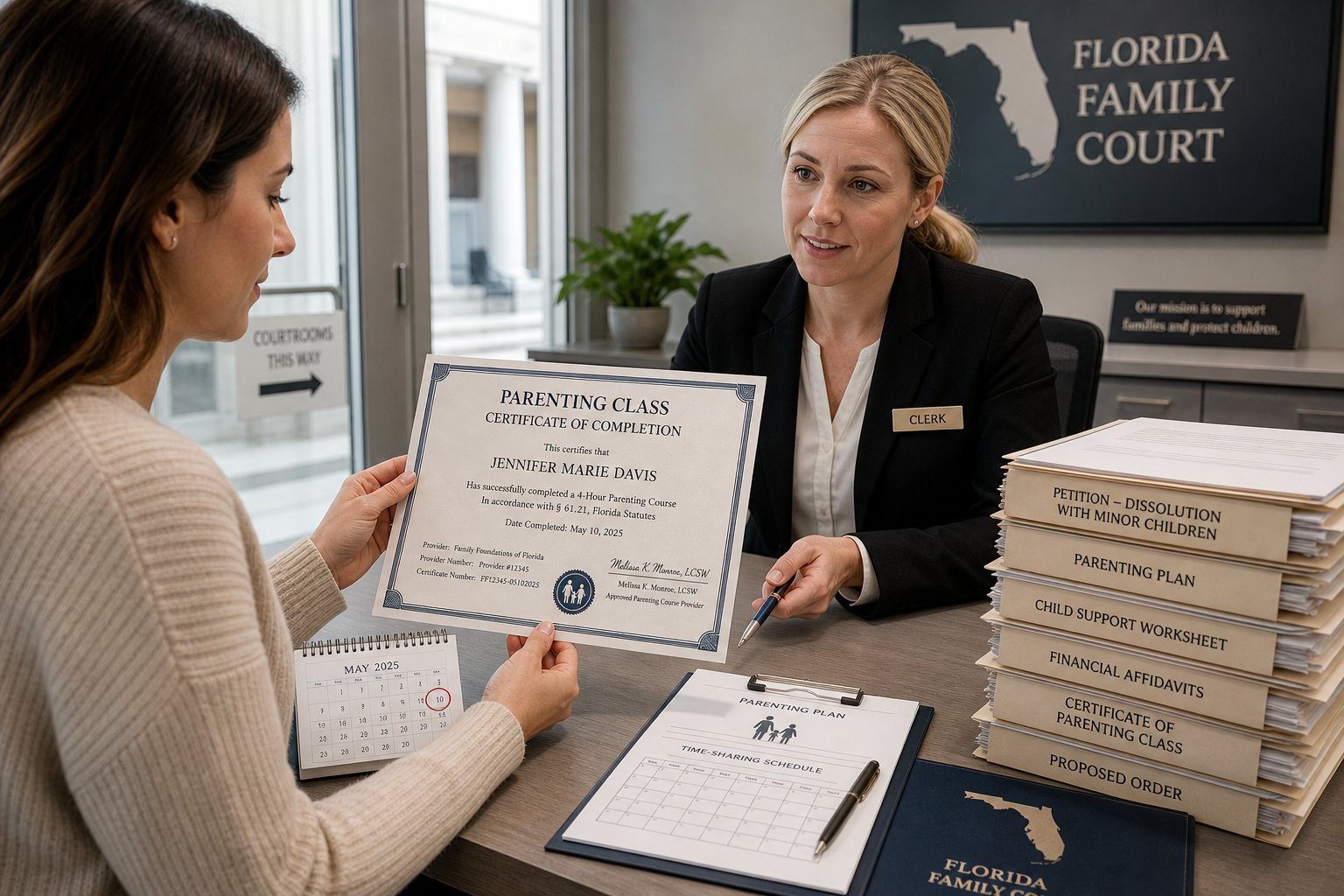
A Florida parenting class certificate typically shows the parent’s legal name, the course name, the DCF-approved provider, and proof of completion, and it may include your case number when your court or provider requires it. The most important thing is that your name and any case details match your family law case exactly, so the filing connects correctly. This guide explains what the certificate usually includes and what to double-check before you file it.
Applies to the Florida Parent Education and Family Stabilization Course (Fla. Stat. 61.21). Requirements and acceptance can vary by court, county, judge, and case type, so review your court papers and official Florida sources.
Key Facts
- Your legal name: Should match the name on your case exactly.
- Course and provider: The Parent Education and Family Stabilization Course and the DCF-approved provider name.
- Proof of approval: Indication that the provider is DCF-approved.
- Completion details: Confirmation you completed the required course.
- Case number when needed: Some courts or providers include your case number — add it if your court asks.
- Accuracy matters: Mismatched names or case info are a common reason filings get questioned.
What A Parenting Class Certificate Is And Why Florida Courts Require It
A parenting class certificate is proof that you finished Florida’s Parent Education and Family Stabilization Course. It is not the class itself. It is the record you use to show the court that you completed a course from a DCF-approved provider.
Under Florida Statutes section 61.21, Florida generally requires this course in certain family law cases involving minor children. The goal is to reduce harm to children during divorce, paternity, and related disputes. The course is at least 4 hours long and focuses on how separation affects children and parents.
Florida courts care about the certificate because the case often cannot move forward smoothly without proof of completion. In some courts, missing proof can delay hearings or slow down final steps in the case. The court may also tie course completion to issues that matter in family cases, such as a parenting plan, parental responsibility, and time-sharing.
The certificate usually includes core details such as:
- Your legal name
- Completion date
- Course provider name
- Proof the provider is approved
- Sometimes your case number, if the provider asks for it
But one point causes confusion: completing the course is not the same as filing the certificate with the court. You can finish the class and still need to take one more step with the Clerk of Court or follow your judge’s instructions.
If you are unsure what your court wants on the certificate, check your order, your county family court page, or your clerk’s filing instructions first.
Who Needs A Florida Parenting Class Certificate
In Florida, parents usually need this certificate when they have a family law case involving minor children. That often includes divorce cases and some paternity or custody-related matters. Courts use the course to support better co-parenting and lower conflict.
A common rule is simple: if your case affects children and the court orders the class, each parent may need to complete it. That can include the petitioner and the respondent. In many cases, the requirement applies even if the parents were never married.
You may need a Florida parenting class certificate in cases involving:
- Dissolution of marriage with minor children
- Paternity actions involving parenting issues
- Cases about time-sharing
- Cases involving parental responsibility
- Other family law matters when the court orders the course
Still, not every case works the same way. Requirements can depend on the court, county, judge, and case type. One county may post clear filing steps online, while another may rely more on the judge’s order.
That is why you should read all case papers closely. Look for the case style, court name, and deadline. Then confirm whether your court wants the certificate filed by you, sent by the provider, or both. The safest path is to match your court’s written instructions and keep a copy of everything you submit.
How To Know If An Online Parenting Class Will Be Accepted
An online class is more likely to be accepted if the provider is approved by the Florida Department of Children and Families for the Parent Education and Family Stabilization Course. That is the first thing to verify. If the provider is not approved, your certificate may not meet the court requirement.
Start with the official source. Florida DCF maintains provider information for approved courses through its family safety and prevention resources. You should also review your local court’s family division page because some courts give extra filing directions or name local preferences.
Before you enroll, check these points:
- The provider says it is DCF-approved for Florida
- The class is the Parent Education and Family Stabilization Course
- The course is for Florida cases, not another state
- The provider explains how you get your certificate of completion
- The provider gives support if your name or case details need correction
A provider like DivorceParentingClass.net offers a Florida online course built for this exact requirement. But even with an approved provider, you still need to follow your local court’s filing rules.
DCF Approval And Local Court Acceptance
DCF approval matters most, but local procedure still matters. In general, courts accept a certificate from a provider approved by DCF. Even so, a county or judge may have specific directions about filing, deadlines, or the information that should appear with your case records.
Use these official resources to confirm details:
- Florida Department of Children and Families
- Florida Courts family law resources
- Your county Clerk of Court website
When To Take The Course And What Happens If You Wait Too Long
You should take the course as early as your case allows. Many Florida courts set a deadline after the case is filed. If you wait too long, the court may slow your case or refuse to move to the next step until the requirement is met.
The exact deadline is not the same in every county. It may appear in a standing order, summons packet, family law handbook, or judge’s order. Because rules vary, you should check your own case papers first.
Waiting can create real problems. Depending on the court, late completion may lead to:
- Delayed hearings
- Delayed final judgment
- Extra court directions to complete the class
- Other sanctions allowed by the court
There is another issue too: mistakes on the certificate can cost time. If your name, case number, or court information is wrong, you may need a corrected certificate before filing. That is why it helps to enter your details carefully when you register.
If you already completed the course, do not assume the court has proof. Some providers only issue the certificate to you. Then you must file it with the Clerk of Court, unless your county or provider states otherwise.
Take a few minutes to compare your certificate with your petition or court papers. Make sure the spelling, case number, and county are right before you submit anything.
What The Parent Education And Family Stabilization Course Covers
Florida law describes a course of at least four hours. Topics often include the effect of divorce on children, how conflict harms children, and how parents can communicate better. Many providers also explain court-related topics in simple terms.
Common course topics include:
- The impact of divorce or separation on children
- Children’s stages of growth and common stress signs
- Better co-parent communication
- Ways to reduce conflict
- Building and following a parenting plan
- Understanding time-sharing and parental responsibility
- Community resources for support
Some courses also explain practical steps, such as how to keep children out of adult disputes and how to use calm, direct communication. That matters because courts want parents to focus on the child’s needs, not just the conflict between adults.
If you need a flexible option, DivorceParentingClass.net’s Florida course is designed for online completion on a phone, tablet, or computer. Before you enroll, confirm that the course fits your case and local court instructions.
How You Receive Your Certificate After Completion
After you finish the course, the provider usually gives you a certificate of completion. Many online providers let you download it right away or send it by email. Some may also offer filing help, but you should never assume the court already received it unless your provider and court clearly say so.
This is where the main question matters most. The certificate should show the correct parent name, and if your court requires it, the correct case number and matching court information. Use the same case number and court details that appear on your family law papers.
Check these items before you file:
- Your full legal name matches your case documents
- The case number matches exactly
- The county or court information is correct for your case
- The completion date is shown
- The provider name appears on the certificate
Then follow your local filing process. In many counties, you file the certificate with the Clerk of Court. In others, there may be e-filing or extra instructions from the judge.
Also remember the two separate steps:
- Complete the course with a DCF-approved provider.
- File proof with the court if your court requires you to do that.
If you still need the course, you can start the Florida Parent Education and Family Stabilization Course online at DivorceParentingClass.net.
FAQ
What information is on a Florida parenting class certificate?
Typically your legal name, the course name, the DCF-approved provider, and proof of completion. It may also show your case number when your court or provider requires it.
Does my case number need to be on the certificate?
Sometimes. Some courts or providers include it; others don’t require it. If your court asks for the case number, make sure it’s added and correct before filing.
Why does the name on the certificate matter?
Because the certificate has to connect to your case. If the name doesn’t match your family law case, the court or clerk may question the filing, causing delays.
What should I check before filing?
Confirm your legal name is correct, the provider is DCF-approved, completion is shown, and any required case information matches your court papers.
Conclusion
The certificate isn’t complicated, but accuracy is what makes it work: your name and any case details need to match your case so the court accepts the filing without friction. Before you file, give it a quick check against your court papers. A correct certificate from a DCF-approved provider is what keeps this step from slowing your case down.
You can complete the DCF-approved Parent Education and Family Stabilization Course online and receive a certificate with the details your court expects.
Related Articles
- How to Get Your Florida Parenting Class Certificate
- How to Submit Your Parenting Class Certificate to a Florida Court
- What If the Court Rejects My Parenting Class Certificate?
- Lost Your Florida Parenting Class Certificate? How to Get Another Copy
Sources
Billy Forte is the founder of Divorce Parenting Class, which offers a Florida DCF-approved online Parent Education and Family Stabilization Course. The brand focuses on clear, supportive, plain-English guidance to help Florida parents complete the court-required class and file their certificate.
This article is general information, not legal advice. Florida family-law requirements and certificate acceptance can vary by court, county, judge, and case type, so review your court papers and official Florida sources, or consult a family-law attorney, before acting.