
Updated June 2026 · Reviewed by Billy Forte
For Florida parents with minor children, a divorce involves tracking several moving parts: residency and filing, service and response, financial disclosures, a parenting plan, mediation, and the required Parent Education and Family Stabilization Course. This checklist organizes those steps so nothing slips, with special attention to the course requirement and its certificate, since a missed deadline there can hold up your case. Specific rules and deadlines vary by court, so use this as a guide alongside your own court papers.
Applies to the Florida Parent Education and Family Stabilization Course (Fla. Stat. 61.21). Requirements and acceptance can vary by court, county, judge, and case type, so review your court papers and official Florida sources.
Key Facts
- Confirm filing basics: Residency, the right county, and the correct case type.
- Track service and response: After service, the other spouse generally has 20 days to answer.
- Parenting plan: Prepare a parenting plan covering time-sharing and parental responsibility.
- Parent education course: Complete the DCF-approved course and file each parent’s certificate.
- Watch the course deadline: Often set early; it depends on your judicial circuit and local court procedures.
- Keep copies: Save your certificate and key filings, and confirm details with the Clerk of Court.
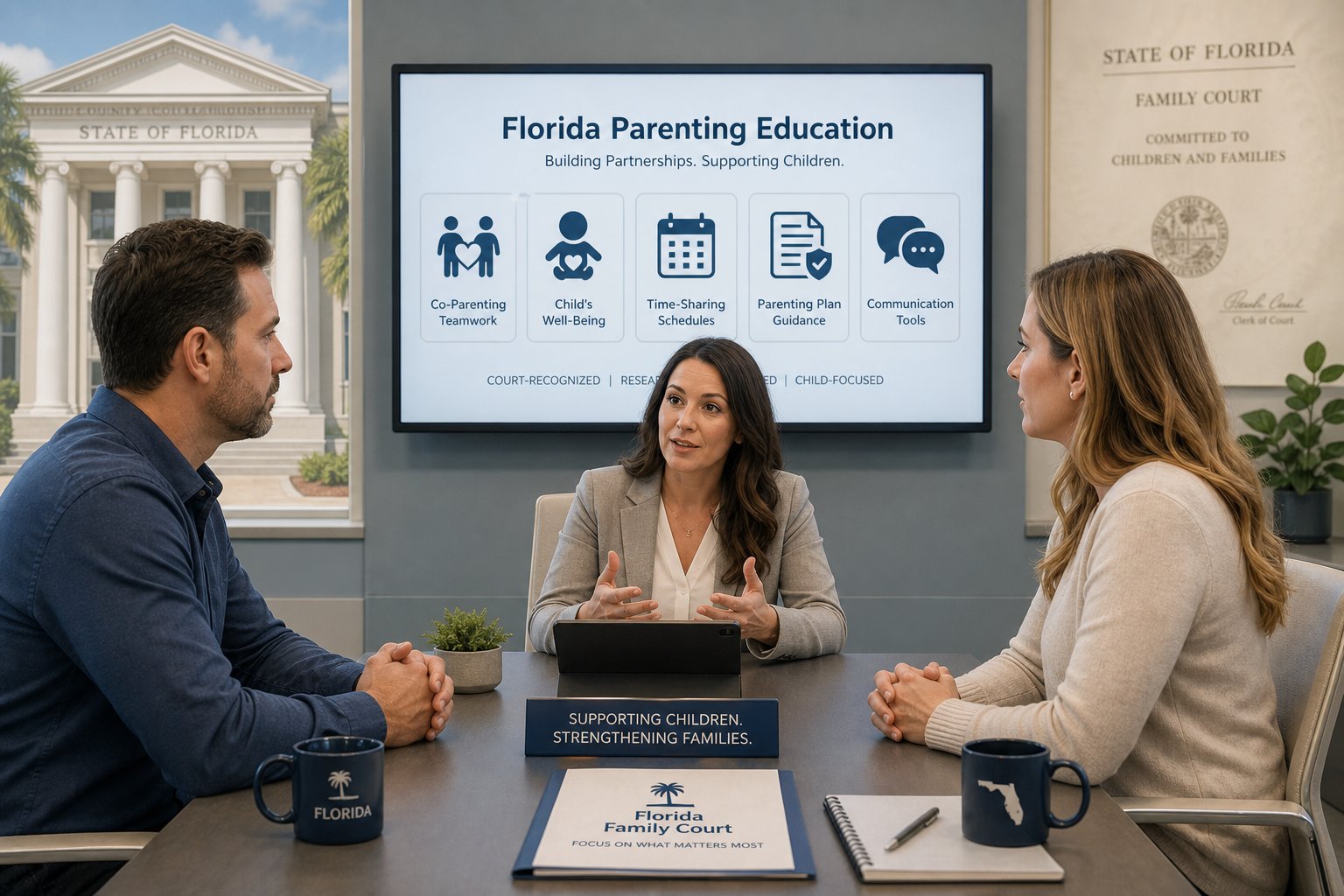
What The Florida Divorce Parenting Class Is And Why Courts Require It
The Florida divorce parenting class is the state’s Parent Education and Family Stabilization Course. It is a minimum 4-hour course approved by the Florida Department of Children and Families. The class teaches parents how family change can affect children and how to lower conflict.
Florida courts use this course to support better co-parenting during divorce and other family cases with minor children. The goal is not to punish parents. The goal is to help parents make safer, calmer choices for their children while the case moves forward.
A DCF-approved provider must offer the course if you want the court to accept it. That matters because not every online parenting class is approved for Florida court use. If you take the wrong class, you may have to take another one and pay again.
The course often covers:
- How divorce or separation affects children at different ages
- Ways to reduce conflict between parents
- Better parent-to-parent communication
- How to support a child’s routine and emotional health
- Basic court terms tied to parenting issues
Florida courts also connect this class to the bigger goal of stable parenting after separation. In many cases, the class helps parents understand parental responsibility, time-sharing, and how a parenting plan works. For many families, it is one of the first required steps after a case begins.
You can review court information through Florida Courts and local county court or Clerk of Court websites if you need the exact rule for your case.
Who Must Take The Parent Education And Family Stabilization Course In Florida
In Florida, parents usually must take the course when a family law case involves minor children. This commonly applies in divorce cases. It also often applies in paternity cases and other cases where the court must decide parenting issues.
In many Florida cases, both parents must complete the course. That means the person who filed the case and the other parent usually each need their own certificate. One parent cannot take it for both people.
The exact rule can depend on:
- Your case type
- Your county
- Your judicial circuit
- Your judge’s order
- Local court procedures
That is why you should read every court paper closely. Look for language about the Parent Education and Family Stabilization Course. Also check your summons, standing order, or case management documents.
Florida law and court practice generally tie this requirement to cases where children are affected by family change. If your case includes questions about a child’s living schedule, decision-making, or parent communication, the course may be part of the process. You can start with Florida Statutes and your local court site for the rules that apply to your case.
If you are unsure, ask the Clerk of Court, court administrator, or your lawyer what your court requires. Then write down your deadline and the name of the course your court will accept.
What The Course Covers: Co-Parenting, Communication, And The Impact Of Divorce On Children
The course focuses on how parents can reduce harm to children during divorce or separation. It explains that children often react to conflict, change in routine, and stress between parents. The class gives simple tools to help you respond in a steadier way.
Most approved courses cover three big areas.
Effects on children and parents
You learn how children may react by age. Some children become quiet. Some act out. Some worry about where they will live or whether the breakup is their fault. The course also explains how parent stress can shape a child’s behavior.
Co-parenting and conflict reduction
The class teaches ways to lower conflict between parents. That can include using calm language, sticking to facts, and keeping adult disputes away from children. It may also explain why children do better when parents avoid asking them to carry messages.
Communication and court-related parenting topics
You also learn the basics of parenting plans, time-sharing, and parental responsibility. The course does not replace legal advice, but it helps you understand the terms the court uses. That makes it easier to follow orders, share information, and build a workable routine for your child.
A good course is practical. It should help you think about school schedules, exchanges, health care updates, and how to talk with your child without adding fear or guilt.
How To Take The Class Online And Get Your Certificate
Many parents take the Florida course online. A 100% online option lets you use a phone, tablet, or computer and work at your own pace. That can help if you are managing work, child care, or a court deadline.
Before you enroll, make sure the provider is a DCF-approved provider. Start with the Florida Department of Children and Families and confirm the provider appears on the state’s approved list. Then check your county court or ask your court staff if your court has any extra instructions.
A typical online process looks like this:
- Register with your name and case details, if needed
- Complete the required course lessons
- Finish any quizzes or knowledge checks
- Download or receive your certificate of completion
- File or present the certificate as your court requires
If you want an online option, DivorceParentingClass.net offers a Florida Parent Education and Family Stabilization Course designed for court use. The site says its course is DCF-approved and fully online, with access by phone, tablet, or computer.
After you finish, keep copies of your certificate. Save a digital copy and print one if possible. Then follow your court’s filing rules through the Clerk of Court or your attorney’s office.
When To Complete The Class And What Happens If You Miss The Requirement
You should complete the course as early as you can after the case starts. In many Florida cases, a common deadline is within 45 days of filing if you are the petitioner or within 45 days of service if you are the respondent. Still, local rules can differ, so your court papers control.
Do not assume every county handles timing the same way. Some courts state the deadline in a standing order. Others put it in a notice or case management order. Always check the documents from your court and the county website.
If you miss the requirement, the court may not move your case forward the way you expect. Depending on the court, that can mean:
- Delay of the final judgment
- Extra hearings or compliance steps
- A contempt finding
- Problems tied to time-sharing or shared parental responsibility issues
The court’s response depends on the facts, the judge, and your case history. That is one reason this step matters so much. The course is short, but missing it can create a much bigger problem.
Your next step is simple: find your deadline in your case papers, confirm the approved provider, and complete the course before the court has to ask again.
How The Parenting Class Connects To Parenting Plans, Time-Sharing, And Other Family Law Issues
The course connects directly to the parenting topics Florida courts use in cases with children. Florida courts often require a parenting plan and a time-sharing schedule. The class helps you understand what those words mean in daily life.
A parenting plan usually covers how parents will handle key parts of the child’s routine. That can include school matters, health care, exchanges, and how parents will communicate. The course helps you think in concrete terms instead of vague promises.
It also helps explain parental responsibility. In Florida, courts often expect parents to focus on the child’s best interests and share child-related information in a useful way. The class may show how conflict, late replies, or poor communication can make co-parenting harder.
This does not mean the course decides your legal rights. It does mean the class can help you better understand the court process and the practical work that follows court orders. That includes things like:
- Keeping a stable routine for your child
- Sharing school and medical information
- Handling exchanges with less conflict
- Speaking to your child without blaming the other parent
For official court forms and family law resources, review Florida Courts family forms. Those materials can help you see how the course topics fit into the papers your case may require.
How To Choose A Florida-Approved Parenting Class That Your Court Will Accept
Choose a class only after you confirm that it is approved for Florida and fits your court’s rules. The safest first check is the Florida Department of Children and Families. If the provider is not on the official approval list, stop there.
Next, confirm local acceptance. Courts can have their own instructions, and requirements can depend on the court, county, judge, and case type. A provider may be approved by the state, but you still need to follow any local filing or proof rules.
Use this checklist before you register:
- Verify the provider is DCF-approved
- Make sure the class is the Parent Education and Family Stabilization Course
- Confirm it is accepted for your case type
- Check whether your court allows online completion
- Ask how you receive the certificate of completion
- Review filing steps with the Clerk of Court
You should also look for a course that is easy to use. Clear lessons, mobile access, and fast certificate delivery can make the process less stressful. DivorceParentingClass.net provides an online Florida course built around that requirement and may be a useful option if it matches your court’s instructions.
FAQ
What should be on a Florida divorce checklist for parents?
Residency and filing, service and the 20-day response window, financial disclosures, a parenting plan, the parent education course and certificate, any mediation, and the final judgment.
When should I complete the parent education course?
Early in the case is safest. Many courts set a deadline tied to filing or service, but it varies by judicial circuit and local procedures, so check your court papers.
What if I miss the course deadline?
It can delay your case or affect how the court proceeds. If a deadline is close, complete a DCF-approved course promptly and confirm where to file the certificate.
Who can confirm my specific requirements?
Your court papers, the Clerk of Court, court administration, or your attorney can confirm exactly what your court requires and by when.
Conclusion
A checklist turns a stressful process into a series of manageable steps, and for parents the parent education course belongs near the top because it’s both required and easy to complete early. Track the filing and response steps, prepare your parenting plan, and get the course and certificate done so they’re never the holdup. Since local rules vary, pair this checklist with your court’s specific instructions.
Check the course off your list early with a DCF-approved Parent Education and Family Stabilization Course online and keep your certificate ready to file.
Related Articles
- Divorce in Florida With Kids: Deadlines, Course, and Certificate
- How to File for Divorce in Florida With Minor Children: The Parent Course Step
- Florida Parenting Plan vs. Parent Education Course: What Is the Difference?
- Florida Parent Education Course FAQs for Divorce and Family Court
Sources
Billy Forte is the founder of Divorce Parenting Class, which offers a Florida DCF-approved online Parent Education and Family Stabilization Course. The brand focuses on clear, supportive, plain-English guidance to help Florida parents complete the court-required class and file their certificate.
This article is general information, not legal advice. Florida family-law requirements and certificate acceptance can vary by court, county, judge, and case type, so review your court papers and official Florida sources, or consult a family-law attorney, before acting.