
Updated June 2026 · Reviewed by Billy Forte
For a Florida divorce with minor children, a short checklist keeps the parent education course from becoming a last-minute problem: confirm the requirement applies, complete the DCF-approved course early, and file each parent’s certificate before the final judgment. The course is required under Florida Statute 61.21 unless a judge excuses a parent for good cause. This checklist walks through the course-related steps and where they fit in your case.
Applies to the Florida Parent Education and Family Stabilization Course (Fla. Stat. 61.21). Requirements and acceptance can vary by court, county, judge, and case type, so review your court papers and official Florida sources.
Key Facts
- Confirm it applies: Cases with minor children generally require the course — check your court papers.
- Complete early: Many courts expect it within about 45 days of filing or service; timing varies.
- Both parents: Each parent completes the DCF-approved course separately.
- File the certificate: Submit each certificate before the final judgment, per your court’s steps.
- Exceptions are limited: Only a judge can excuse a parent, for good cause.
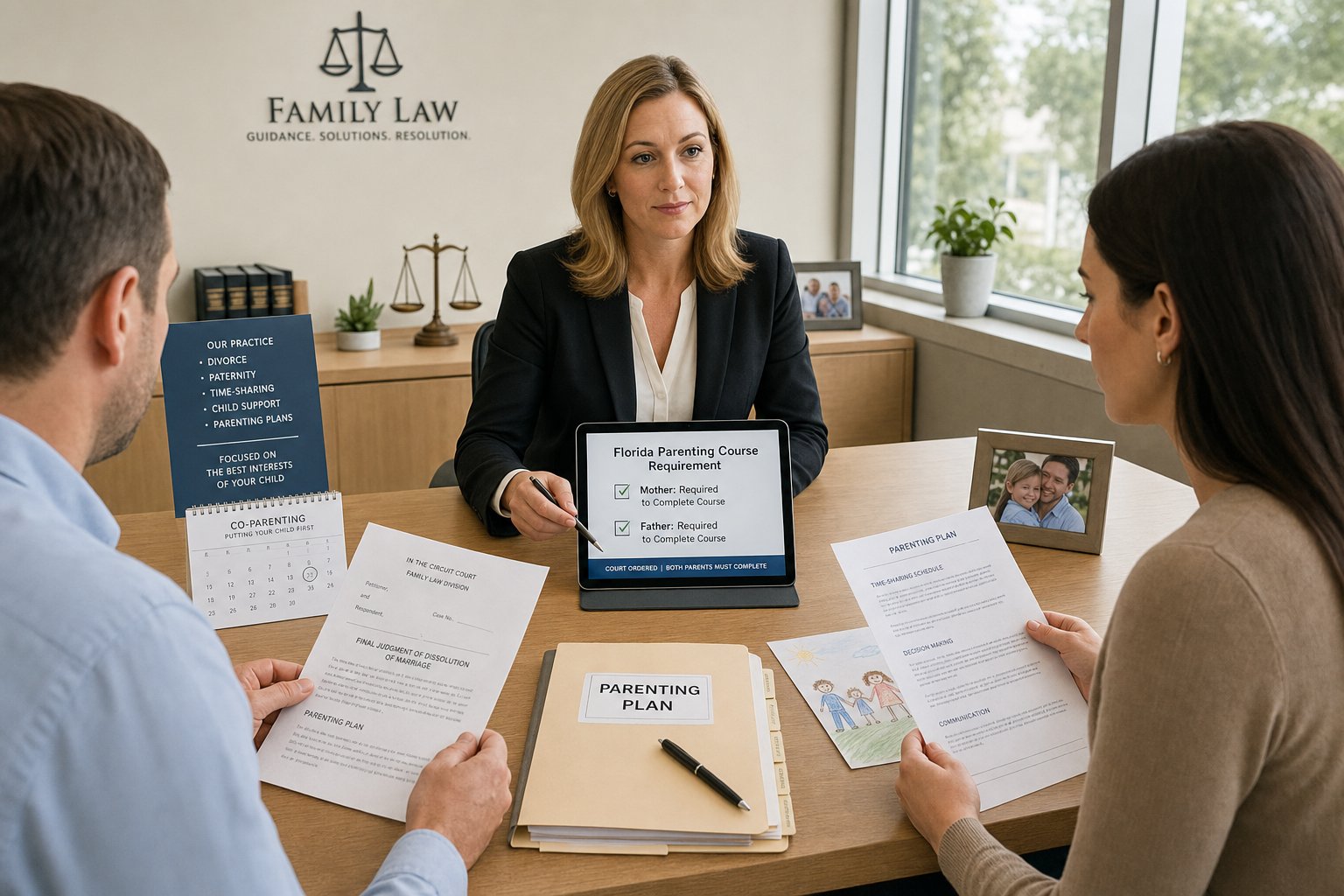
Who Must Take The Florida Parent Education And Family Stabilization Course
Florida generally requires both parents to complete the course when they are parties to a divorce with minor children. That rule comes from Florida Statutes section 61.21. In plain terms, if you are ending a marriage and you share children under 18, the court will usually expect each parent to take the class.
The same requirement can also apply in paternity cases that involve issues like parental responsibility, time-sharing, or child support. In some cases, a court may also order the class during a later case about changing a parenting plan or time-sharing schedule. That means the need for a florida divorce parenting class is not always limited to the first divorce filing.
A judge may excuse a parent for good cause, but that is not automatic. For example, courts may review hardship or other case-specific facts. You should not assume you are excused unless the court says so.
A few points matter here:
- Both sides usually must complete it
- The rule often applies to the petitioner and respondent
- The exact requirement can vary by county, judge, and case type
- Court papers may give added local directions
If you are unsure, check the family case instructions from your local court through Florida Courts or your county Clerk of Court.
What The Class Covers And Why Florida Courts Require It
The course must generally be at least 4 hours and be approved by the Florida Department of Children and Families. Florida law sets the broad topic areas. The goal is not just paperwork. The goal is to help parents reduce harm to children during family change.
Most approved classes cover topics like:
- The effect of divorce or separation on children and parents
- Parenting plans and child-focused decision making
- Conflict and how to lower it
- Communication between co-parents
- Financial duties to children
- Abuse, neglect, and domestic violence awareness
- Issues tied to children with special needs
Florida courts require this because children often feel stress during separation. A structured class can help parents focus on the child’s needs instead of the conflict between adults. That fits with Florida’s emphasis on the child’s best interests.
The class also gives basic information about terms you may see in your case, such as parental responsibility and time-sharing. It does not replace legal advice, but it can help you better understand what the court is asking parents to do. In many cases, that makes later steps in the case easier to follow and less confusing.
Online Vs Local Options: How To Choose A Court-Accepted Class
The safest choice is a DCF-approved provider that matches your court’s rules. Florida’s approval system matters because not every parenting class will meet the state requirement. Before you sign up, verify the provider through the Florida Department of Children and Families.
Some parents take a local in-person class. Others use an online option when their court accepts distance learning. Online study can be simpler if you need flexible access from a phone, tablet, or computer. But you still need to confirm that the class is approved and accepted for your case.
When you compare options, check these points first:
- Is the provider DCF-approved?
- Does your court or judge allow online completion?
- Is the course clearly listed as the Parent Education and Family Stabilization Course?
- Will you get a certificate of completion after finishing?
For parents who want an online option, DivorceParentingClass.net offers a Florida course designed for this requirement. Even so, you should still follow any local court instructions because acceptance rules can depend on the county, circuit, or judge.
If anything is unclear, ask the Clerk of Court or review your county family law forms before you enroll.
When To Take The Class And How Completion Works
Florida law says parents should begin the course as expeditiously as possible. In many divorce and paternity cases, the petitioner must complete it within 45 days after filing, and the other parent must complete it within 45 days after service or acknowledgment. You can review the statute directly at section 61.21.
Because local practice can differ, read your court papers closely. Some courts repeat the deadline in standing orders or family law packets. Missing the timing can create avoidable problems later.
Most classes are built around a four-hour minimum. The exact format can vary by provider. You may see reading sections, short quizzes, or a final check of understanding.
In general, the process looks like this:
- Choose a DCF-approved class
- Register with your correct case-related details
- Complete all required course parts
- Download or receive your certificate of completion
- File or submit proof as your court requires
If you have a final hearing set, do not wait until the last minute. Finish the course early enough to handle certificate filing and any local processing steps.
Certificates, Court Acceptance, And Common Approval Questions
After you finish the class, you should receive a certificate of completion. That certificate is the proof the court wants to see. In many Florida family cases, a copy must be filed with the court before final judgment unless the judge has excused the requirement.
A common mistake is thinking course completion alone is enough. It may not be. You are usually responsible for making sure the court has proof in the right form and at the right time. Some providers may offer filing help or send documents, but you still need to confirm what your court expects.
Parents often ask the same approval questions:
- Is the class DCF-approved?
- Does my county accept online courses?
- Do I file the certificate myself or bring it to court?
- Does the judge need anything else besides the certificate?
Use official sources first. Check the Florida DCF, your local court website through Florida Courts, and your county Clerk of Court page. Those sources can help you avoid choosing a class that does not fit your case.
If you use an online provider, keep a saved copy of your certificate. That way you can produce it again if the clerk, court, or attorney asks for it.
How The Course Connects To Parenting Plans, Visitation, And Co-Parenting After Divorce
The course supports the practical parts of parenting after separation. In Florida, parents often need a parenting plan that covers time-sharing and decision-making for the child. The class helps you understand the child-focused habits that support that plan.
Florida now uses terms like time-sharing and parental responsibility rather than older terms many people still say in daily speech. Because of that, the class can help parents understand the language used in forms, court orders, and hearings.
It also teaches skills that matter after the case ends, such as:
- Clear communication with the other parent
- Lower-conflict child exchanges
- Keeping children out of adult disputes
- Supporting routines across two homes
- Making choices based on the child’s needs
This matters because a court order is only one part of co-parenting. The day-to-day work happens in texts, pickups, school events, and schedule changes. A parent education course cannot fix every conflict, but it can give both parents the same basic framework.
If your case later involves changes to time-sharing or a parenting plan, a court may look closely at how each parent supports the child’s stability. That is one reason the course has value beyond checking a box.
If you still need an approved online option, take the Florida Parent.
What Happens If You Do Not Complete The Required Parenting Class
Not completing the required class can delay your case. Florida courts generally will not enter a final judgment in required cases until each parent completes the course or the court formally excuses that parent. That alone is a strong reason to take the deadline seriously.
Other consequences may include:
- A delayed or continued final hearing
- A contempt finding
- Other sanctions the court finds proper
- Negative effects on issues tied to shared parental responsibility or time-sharing
The exact response can depend on the judge and the case facts. Still, the basic pattern is clear: if the class is required and you do not complete it, the court may stop your case from moving forward.
If you are not sure whether your course meets the rule, do not guess. Confirm the provider’s approval status and check local court instructions. If you have not enrolled yet, start with a DCF-approved provider and review your filing directions with the Clerk of Court.
FAQ
What should be on my Florida parenting-course checklist?
Confirm the course applies to your case, complete the DCF-approved course early (many courts expect it within about 45 days, though timing varies), have both parents finish separately, and file each certificate before the final judgment.
When should each parent finish the course?
As early as practical. Many courts expect completion within about 45 days of filing or service, but the exact deadline depends on your court and county, so check your papers.
What if one parent won’t take it?
Each parent is generally responsible for their own completion unless the court formally excuses that parent. If the other parent doesn’t complete it, that’s a matter to raise with the court.
Where do I file the certificate?
With the Clerk of Court, or through your attorney, following your county’s filing steps. Keep a copy for your records in case it’s requested again.
Conclusion
Treating the parent education course as an early checklist item — confirm, complete, file — keeps it from stalling an otherwise smooth case. Both parents finish the DCF-approved course separately, and the certificates go in before the final judgment. Because deadlines and filing steps vary by court, pair this checklist with your own court papers to nail down the specifics.
You can check the course off your list early with the DCF-approved Parent Education and Family Stabilization Course online.
Related Articles
- Florida Divorce Parenting Class Requirement: Who Has to Take It and When
- When Should You Take the Florida Parenting Class During Divorce?
- What Happens If You Do Not Complete the Florida Parenting Class?
- Is the Florida Parenting Class Required for an Uncontested Divorce?
Sources
Billy Forte is the founder of Divorce Parenting Class, which offers a Florida DCF-approved online Parent Education and Family Stabilization Course. The brand focuses on clear, supportive, plain-English guidance to help Florida parents complete the court-required class and file their certificate.
This article is general information, not legal advice. Florida family-law requirements and certificate acceptance can vary by court, county, judge, and case type, so review your court papers and official Florida sources, or consult a family-law attorney, before acting.