
Updated June 2026 · Reviewed by Billy Forte
In most Florida divorce and family cases with minor children, both parents must complete the DCF-approved Parent Education and Family Stabilization Course, usually before the final judgment. The course is required under Florida Statute 61.21, and courts commonly expect it early in the case, though exact deadlines vary by court and county. This guide explains who has to take it, when it’s typically due, and the limited circumstances where a judge may excuse it.
Applies to the Florida Parent Education and Family Stabilization Course (Fla. Stat. 61.21). Requirements and acceptance can vary by court, county, judge, and case type, so review your court papers and official Florida sources.
Key Facts
- Who: Both parents in most Florida cases involving minor children (divorce, paternity, custody).
- Legal basis: Required under Florida Statute 61.21.
- When: Before the final judgment; many courts expect it early, commonly within about 45 days of filing or service.
- Deadline varies: The exact timeframe can depend on your court, county, judge, and case type.
- Waiver is limited: Only a judge can excuse it, for good cause — it isn’t automatic.
- Certificate: Each parent files their own certificate of completion with the court.
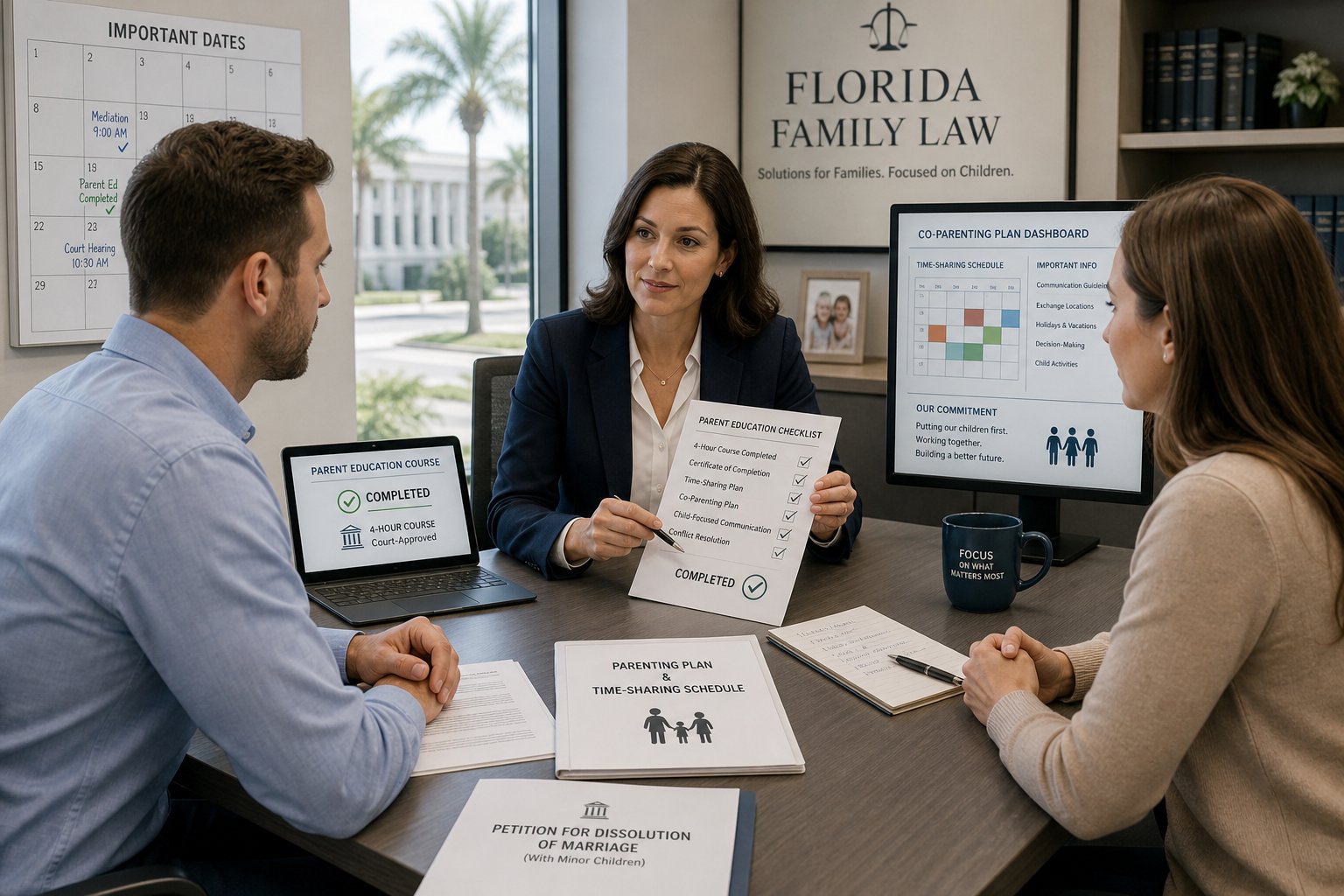
What The Florida Divorce Parenting Class Requirement Means
Florida’s parenting class rule is not just a suggestion. In many family law cases, it is a court requirement.
Under Florida Statutes section 61.21, parents in certain cases involving minor children must complete a Parent Education and Family Stabilization Course. The course must be at least 4 hours long and must come from a DCF-approved provider.
The goal is simple. The class teaches parents how family breakup can affect children and how to reduce harm during divorce or separation.
It usually covers topics like:
- Parental responsibility and parenting decisions
- Time-sharing and how conflict affects children
- Better parent communication
- Ways to lower stress for children
- Basic co-parenting skills
This requirement matters because Florida courts use it as part of the case process. If the course applies to your case, you should treat it like any other deadline.
Still, local practice can vary. Your court, county, judge, and case type may affect how the rule is enforced and how proof must be filed.
You can review the statewide court system at Florida Courts and the approved course rules through the Florida Department of Children and Families.
Who Must Take The Parent Education And Family Stabilization Course
In Florida, both parties usually must take the course when the case involves minor children.
That often includes:
- A dissolution of marriage case with minor children
- A paternity action involving support, parental responsibility, or time-sharing
- Some cases to change a parenting plan or time-sharing order
If you filed the case, the rule still applies to you. If you were served and did not start the case, it may still apply to you too.
This is why many parents ask whether only one person has to do it. In most Florida cases that fall under the statute, the answer is no. Each parent must complete the course unless the court excuses someone for good cause.
There can also be special course needs. If a child has special needs or serious emotional concerns, the court may expect a course that fits that situation.
Because local rules differ, always check your court papers and county instructions. Helpful places to confirm details include your local Clerk of Court and county family court page.
If you still need an approved online option, you can take the Florida Parent Education and Family Stabilization Course through DivorceParentingClass.net, which states that its program is approved by the Florida Department of Children and Families.
When You Need To Complete The Course And What Happens If You Do Not
For many Florida cases, timing is the big issue. You may need to finish the course within 45 days.
In general:
- The petitioner must complete it within 45 days after filing
- The other party usually must complete it within 45 days after service or another triggering event in the case
This 45-day rule appears in court and county instructions across Florida, but exact timing can depend on the kind of case. That is why you should read your court order and local rules closely.
What if you do not finish on time?
The risk is real. The court may:
- Delay the case
- Refuse to enter a final judgment
- Order compliance by a set date
- Impose sanctions allowed by law
- In some cases, consider noncompliance when deciding issues tied to parenting
That does not mean every late filing leads to the same result. But it does mean you should not ignore the deadline.
If you think you may miss it, review your court order right away and check your county court or clerk website for filing steps. For example, county clerk pages often explain where documents go and whether e-filing is available.
You can also read the statute directly at Florida Statutes section 61.21.
How To Choose A Florida-Approved Online Or In-Person Course
The safest choice is a course listed by the Florida Department of Children and Families. If a provider is not approved, your court may not accept the class.
Start with the DCF provider information. Then confirm the details that matter for your case.
Look for these points:
- DCF-approved provider status
- A 4-hour minimum course
- Online or in-person format that fits your needs
- English, Spanish, or other language support if needed
- Accessibility help for disability-related needs
- A version for special needs situations if your court requires it
- Clear certificate instructions
Online courses are common because they are easier to fit around work, child care, and court dates. But online does not mean any site will work. You still need a Florida-approved provider and you still need to follow local filing rules.
A course like the one at DivorceParentingClass.net may be useful if you want a Florida-focused online option you can take on your own schedule by phone, tablet, or computer. Before you enroll, compare the provider’s approval status with your county’s instructions if your judge or clerk has posted extra steps.
That small check can prevent filing problems later.
What The Class Covers And How The Course Works
The class is meant to help parents protect children during family change. It is not just a box to check.
Florida law says the course should cover key topics tied to divorce, paternity, and co-parenting. Common subjects include:
- The effects of separation and conflict on children
- The effects on parents
- Time-sharing and parenting decisions
- How to lower conflict
- Better communication between parents
- Ways to support healthy child adjustment
Many online programs are self-paced. That means you sign in, read or view the lessons, complete short checks, and finish a final step to show completion.
The exact format depends on the provider. Some use quizzes after each unit. Some include a short final exam. Some let you log in and out as needed.
The main point is that the course should meet Florida’s required subject areas and time length. It should also give you a record that you finished.
For many parents, the practical value is in the plain guidance. The class can help you see how children react to conflict, schedule changes, and messages passed between homes. Even small changes in how you speak, text, or hand off the children can reduce stress.
That is one reason courts keep this requirement in place.
How Your Certificate Is Issued And Accepted By Florida Courts
After you complete the course, you should receive a certificate of completion. In many online programs, the certificate is available for download right away.
But getting the certificate is only part of the job. You usually must file proof of compliance with the court.
That often means one of these steps:
- Uploading or e-filing the certificate with the case
- Filing it through the Clerk of Court
- Following a county or judge-specific instruction for family cases
Florida courts do not use one single filing method for every county. Some counties have detailed e-filing instructions. Others may direct self-represented parties to the clerk’s office or a local portal.
That is why you should check both:
- Your county Clerk of Court website
- Any order, notice, or family law packet in your case
If the provider gives instant access to the certificate, save a copy right away. Keep a paper copy too if possible.
For court system resources, start with Florida Courts. Then find your county clerk through local court links. If you still need to complete the course, you can use DivorceParentingClass.net and then follow your county’s filing directions for the certificate.
Special Situations In Divorce, Paternity, And Time-Sharing Cases
Florida’s rule reaches beyond a standard divorce with children. It can also apply in paternity and some other family cases.
For example, the course may be required when the case involves:
- A paternity action with support, parental responsibility, or time-sharing
- A request to change a parenting plan
- Other child-related family cases where the court orders the class
The timing can still follow the same general 45-day pattern, but the exact trigger may differ by case type. That is why case papers matter.
There are also limited situations where a court may excuse a parent for good cause. A hardship issue may matter, but only the court can decide that. You should not assume the requirement is waived unless the court says so.
If your case includes special issues, such as a child with special needs, a judge may expect a course that better fits those facts. And if you moved counties, filed after an older order, or are in a modification case, local practice may shape what proof is needed.
The next step is simple. Check your court order, confirm your county filing rules, and choose a DCF-approved provider. If you want a Florida online option, start the Parent Education and Family Stabilization Course at DivorceParentingClass.net.
FAQ
Who has to take the Florida divorce parenting class?
Both parents in most Florida cases with minor children — divorce, paternity, and custody matters. The requirement comes from Florida Statute 61.21, and your court order confirms whether it applies to your case.
When do I need to complete it?
Before the final judgment, and many courts expect it early — commonly within about 45 days of filing or service. The exact deadline varies by court and county, so check your court papers.
Can the requirement be waived?
Only a judge can excuse it, for good cause, and it isn’t automatic. A provider can’t waive it, and parents can’t waive it by agreement.
Do both parents take it separately?
Yes. Each parent generally completes the course on their own and files an individual certificate of completion with the court.
Conclusion
For most Florida parents with minor children, the requirement is straightforward: both of you complete the DCF-approved course and file your certificates before the final judgment. The timing is usually early in the case, but because deadlines vary by court, your own court papers are the most reliable guide. Take it early and the requirement stays a simple step rather than a last-minute problem.
You can complete the DCF-approved Parent Education and Family Stabilization Course online and file your certificate before your court’s deadline.
Related Articles
- Who Has to Take the Florida Parent Education and Family Stabilization Course?
- When Should You Take the Florida Parenting Class During Divorce?
- What Happens If You Do Not Complete the Florida Parenting Class?
- Can the Florida Parent Education Course Requirement Be Waived?
Sources
Billy Forte is the founder of Divorce Parenting Class, which offers a Florida DCF-approved online Parent Education and Family Stabilization Course. The brand focuses on clear, supportive, plain-English guidance to help Florida parents complete the court-required class and file their certificate.
This article is general information, not legal advice. Florida family-law requirements and certificate acceptance can vary by court, county, judge, and case type, so review your court papers and official Florida sources, or consult a family-law attorney, before acting.