
Updated June 2026 · Reviewed by Billy Forte
Most parents with minor children in a Florida divorce, paternity, or custody case must take the Parent Education and Family Stabilization Course, with each parent completing it separately. The requirement comes from Florida Statute 61.21 and generally applies whenever a case affects minor children, unless a judge excuses a parent for good cause. This guide breaks down exactly who is covered and the case types where it applies.
Applies to the Florida Parent Education and Family Stabilization Course (Fla. Stat. 61.21). Requirements and acceptance can vary by court, county, judge, and case type, so review your court papers and official Florida sources.
Key Facts
- Divorce with minor children: Both parents in a dissolution involving minor children generally must take it.
- Paternity cases: Parents in paternity actions affecting minor children are commonly required to take it.
- Custody and time-sharing: Cases deciding parental responsibility or time-sharing typically require it.
- Each parent separately: Both parents complete the course on their own and file individual certificates.
- Limited exceptions: Only a judge can excuse a parent, for good cause — it isn’t automatic.
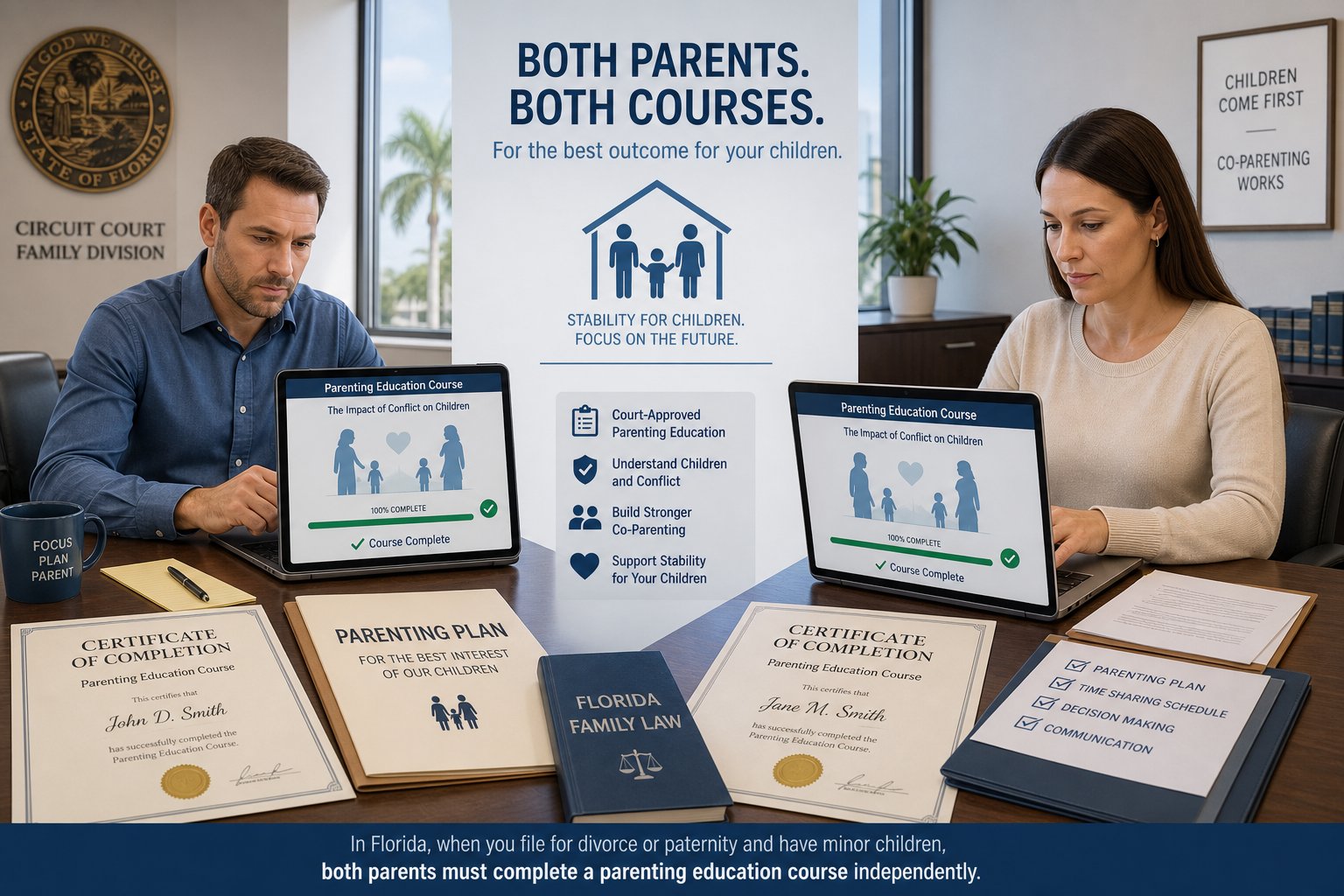
Who Must Take The Course In Florida
The short answer is simple: both parents usually must take the course in a Florida divorce case with minor children. That is the main group covered by Florida Statute §61.21. If you and the other parent are ending a marriage and you share children under 18, the court will often expect both of you to complete the class.
The same issue can come up in other family cases too. In many counties, the requirement also appears in cases about:
- Paternity
- Time-sharing
- Parental responsibility
- Parenting plan changes
- Temporary custody
- Some adoption or child-related matters when ordered
That said, not every case works the same way. Florida has statewide rules, but local practice still matters. A judge may order the class in one type of case, while another court may handle the same issue with different instructions.
A few points are easy to miss. First, each parent takes the class alone. One parent cannot take it for both people. Second, you need your own certificate of completion. Third, the course is about the effect of family conflict on children, not about picking sides in a case.
If you are unsure whether your case triggers the rule, check the court papers you received and the local family court page for your county. Helpful starting points include the Florida Legislature text of §61.21 and the Florida Courts family law resources.
When To Complete It And What Happens If You Do Not
In many Florida family cases, the course must be done early in the case. A common deadline is within 45 days after filing if you are the petitioner, or within 45 days after service if you are the respondent. Still, your judge or county may set a different deadline, so the safest source is your court order or local clerk instructions.
Do not assume you can wait until the last hearing. In many cases, the court will not enter a final judgment until both parents file their certificates. That can slow the whole case down.
If you do not complete the class on time, the court may respond in several ways, depending on the facts and the judge. Possible results can include:
- A delay in the final hearing or final judgment
- An order to complete the course by a new deadline
- Contempt issues for not following a court order
- In some cases, concern about time-sharing or shared parental responsibility
This does not mean every missed deadline leads to the same result. But it does mean the course is not a small formality. Courts treat it as part of the case process.
So, once you confirm the requirement, schedule the class as soon as you can. Then save your certificate and follow your county’s filing steps with the Clerk of Court or through your lawyer, if you have one.
What The Course Covers For Parents And Children
The Florida Parent Education and Family Stabilization Course is meant to help parents reduce harm to children during family change. It is not a therapy session and not a legal strategy class. Instead, it focuses on practical topics that courts want parents to understand.
Florida-approved courses must cover core areas tied to child well-being and co-parenting. These often include:
- The effects of divorce and conflict on children
- Child development and age-based needs
- Ways to lower stress for children
- Co-parenting skills
- Communication between parents
- Conflict reduction
- Basics tied to time-sharing, parenting plans, and family court process
A good class explains how children can react in different ways. Some become quiet. Some act out at school. Some blame themselves. Parents often think children do not notice tension, but they usually do.
The course also teaches simple habits that help. For example, parents may learn to keep adult conflict away from children, use calm and direct messages, and support a steady routine across homes. Those ideas sound basic, but they matter a lot in real life.
Because the class is required in many Florida cases, it also helps parents understand terms they may see in court papers, such as parenting plan, time-sharing, and parential responsibility. The goal is not to turn you into a lawyer. The goal is to help you make safer choices for your children while your case moves forward.
Online Vs Local Options: How To Choose A Provider
You can often take the course online or through a local in-person provider. For many parents, online is easier because it fits work, school, and child care schedules. But the best option is the one that matches both DCF approval and your court’s rules.
Start with the most important check: Is the provider approved by the Florida Department of Children and Families? If the answer is no, stop there. A course that is not approved may not meet the requirement for your case.
Then compare the practical details. Look at:
- Whether the provider is on the official DCF-approved provider list
- Whether your county court gives extra local instructions
- Class format: self-paced online or scheduled session
- Price and any extra certificate fees
- Language options
- How the certificate of completion is delivered
- Device access on phone, tablet, or computer
For many families, a self-paced online class is the easiest path. DivorceParentingClass.net offers a Florida DCF-approved course that you can complete online on your own schedule. That can help if you need flexibility and want to avoid travel or class times.
Even so, approval matters more than convenience. Check the provider first, then confirm any county-specific rules. You can review state information through the Florida Department of Children and Families and local filing details on your county court or clerk website.
Approval, Court Acceptance, And Certificate Requirements
A course should be approved by the Florida Department of Children and Families before you sign up. That is the basic starting point. In many cases, that approval is what shows the course meets Florida standards for the Parent Education and Family Stabilization Course.
Still, approval and court handling are not always identical. Some courts may have local instructions about how to file the certificate, where to submit it, or whether the judge wants proof before a hearing. That is why you should check both the provider and the court process.
After you finish the class, you receive a certificate of completion. In most cases, you must then file it with the Clerk of Court or provide it through your attorney. Some online providers make the certificate available right away, while others may send it after final review.
Before you enroll, verify these points:
- The provider is DCF-approved
- The class is the correct Florida course
- You will receive an individual certificate in your name
- The provider explains how completion is recorded
- You understand your county’s filing process
Some programs also require you to complete all modules and pass a quiz or exam before the certificate is issued. That is common. Read the course details before paying so you know what is required and how your proof of completion will be delivered.
How The Class Works From Registration To Completion
The process is usually simple. You register with a provider, complete the course, finish any required quiz, and get your certificate. Most parents can do this without much trouble if they pick the right provider at the start.
Here is the usual step-by-step path:
- Choose a DCF-approved provider.
- Create your account.
- Pay the course fee.
- Complete the required 4 hours of material.
- Take any required quiz or test.
- Download or receive your certificate of completion.
- File it with the Clerk of Court or give it to your lawyer.
Many online providers let you log in from a phone, tablet, or computer. Some allow breaks, so you do not need to finish all four hours in one sitting. That helps parents who are balancing work and child care.
If you want an online option, you can take the Florida Parent Education and Family Stabilization Course at DivorceParentingClass.net. The site offers a Florida DCF-approved course and explains how the certificate works after completion.
Before you begin, make sure the name on your account matches the name you need on your court paperwork. Small errors can create filing problems later.
Common Florida Divorce And Custody Situations That Trigger The Requirement
The most common trigger is a divorce with minor children. In that setting, the requirement is widely used across Florida courts. If your case is a dissolution of marriage and you share children under 18, you should expect the course to come up.
But divorce is not the only setting. Courts may also require the class in other cases involving children, especially where parenting decisions are part of the dispute. Common examples include:
- Paternity cases with time-sharing or support issues
- Cases about a parenting plan
- Requests to change time-sharing or parental responsibility
- Some temporary custody matters
- Certain adoption or child welfare cases, if ordered
The key question is usually this: Does the case involve minor children and a court process about parenting rights or responsibilities? If yes, the course may be required.
Because practice can vary, check three places:
- Your initial court papers or summons
- Any standing order from the judge
- Your county court or Clerk of Court website
That extra check matters. One county may state the rule clearly on its family law page, while another may put it in a case management order.
FAQ
Who must take the Parent Education and Family Stabilization Course?
Most parents with minor children in Florida divorce, paternity, and custody cases. The requirement comes from Florida Statute 61.21 and applies whenever the case affects minor children, unless a judge excuses a parent for good cause.
Does it apply to paternity cases?
Commonly, yes. Paternity actions that affect minor children typically require the course, though whether it applies can depend on your specific case and court.
Do grandparents or non-parents have to take it?
The requirement centers on the parents in the case. If you’re a non-parent party, check your court order or ask the court whether it applies to you.
Can both parents take it together?
Each parent must complete the course separately and receive an individual certificate, even if they take it around the same time.
Conclusion
The short version: if your Florida case involves minor children, both parents are generally required to take the course, whether the case is a divorce, paternity, or custody matter. The exceptions are narrow and decided only by a judge. Confirm your case type against your court papers, then complete the DCF-approved course so each parent’s certificate is ready to file.
You can complete the DCF-approved Parent Education and Family Stabilization Course online, with each parent receiving their own certificate.
Related Articles
- Florida Divorce Parenting Class Requirement: Who Has to Take It and When
- Florida Parenting Class for Paternity, Custody, and Time-Sharing Cases
- When Should You Take the Florida Parenting Class During Divorce?
- Can the Florida Parent Education Course Requirement Be Waived?
Sources
Billy Forte is the founder of Divorce Parenting Class, which offers a Florida DCF-approved online Parent Education and Family Stabilization Course. The brand focuses on clear, supportive, plain-English guidance to help Florida parents complete the court-required class and file their certificate.
This article is general information, not legal advice. Florida family-law requirements and certificate acceptance can vary by court, county, judge, and case type, so review your court papers and official Florida sources, or consult a family-law attorney, before acting.