
Updated June 2026 · Reviewed by Billy Forte
The best time to take the Florida parenting class is early in your divorce — often soon after the case is filed or you’re served, since many courts expect completion well before the final judgment. A commonly cited timeframe is within about 45 days of filing or service, but the exact deadline depends on your court, county, and case type. This guide explains how to time the course so it never holds up your case.
Applies to the Florida Parent Education and Family Stabilization Course (Fla. Stat. 61.21). Requirements and acceptance can vary by court, county, judge, and case type, so review your court papers and official Florida sources.
Key Facts
- Earlier is safer: Completing the course early keeps it from delaying your case.
- Common timeframe: Many courts expect it within about 45 days of filing or service.
- Deadline varies: The exact timing depends on your court, county, judge, and case type.
- Before final judgment: Proof of completion is generally needed before the court finalizes the case.
- Check your papers: Your court order or local rules confirm your specific deadline.
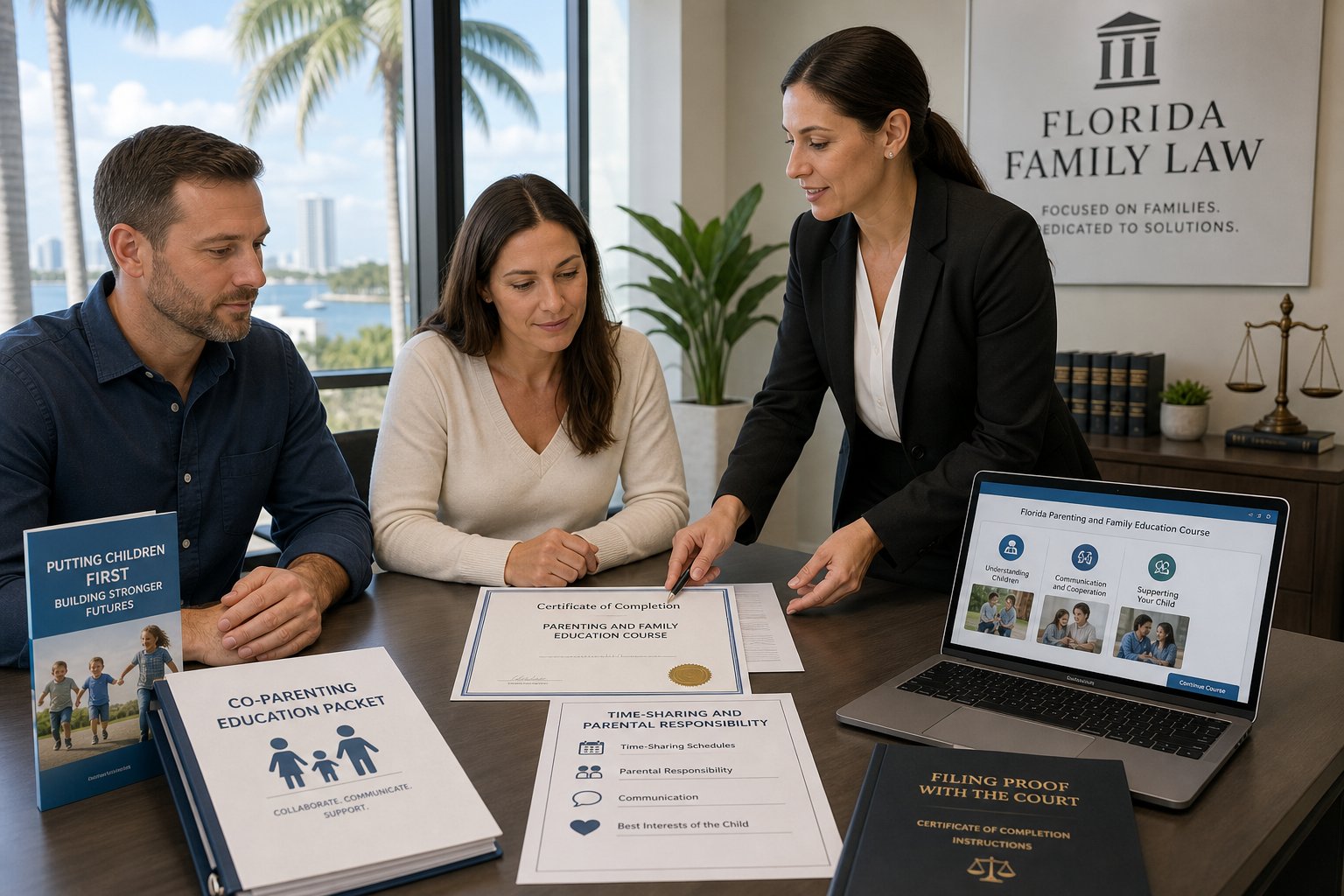
What The Florida Parenting Class Is And Why Courts Require It
Florida’s parenting class for divorce is the Parent Education and Family Stabilization Course. It is a state-required course in many family law cases that involve minor children. Under Florida Statutes section 61.21, the course is meant to help parents understand the effects of divorce, separation, and family change on children and parents.
The Florida Department of Children and Families approves providers for this course. DCF states the class must be at least 4 hours long. You can review provider information through the Florida DCF.
Courts require the class because parenting decisions do not stop when a case is filed. Parents still need to deal with:
- time-sharing
- parental responsibility
- communication with the other parent
- the child’s stress and adjustment
- conflict around schedules and exchanges
The goal is education, not punishment. The course teaches basic co-parenting skills and helps parents focus on the child’s needs during a hard time.
It is also important to keep two things separate: taking the course and filing proof with the court. Completing the class gives you a certificate of completion. But the court may still require you to file, upload, or otherwise provide that certificate to the Clerk of Court or follow a judge’s order about proof.
Who Must Take The Parent Education And Family Stabilization Course
In Florida, parents often must take this course when a divorce or certain other family law case involves minor children. That commonly includes divorce cases with children and many paternity or parenting cases. Court forms and local court instructions often repeat this rule, but the exact requirement can still depend on the court, county, judge, and case type.
In simple terms, if your case asks the court to decide issues like a parenting plan, time-sharing, or parental responsibility, you should expect the course to matter.
People who may need the course include:
- the parent who files the case
- the parent who is served with the case
- parents in paternity matters involving children
- parents in other family cases where the court orders it
Florida court resources explain that both parents may be required to complete the class, not just one. For example, county court materials and family law packets often say each parent must complete an approved course within a set time. You can check the Florida Courts family law forms page and your local county court site for case-specific directions.
If you are not sure whether your case requires it, review your petition, any court order, and your county family court instructions right away. That is the safest next step.
When To Complete The Course And What Happens If You Miss The Deadline
The best time to complete the course is soon after your case begins. Do not wait until the end of the divorce. In many Florida divorce cases, the parent who files must complete the course within 45 days after filing, and the other parent must usually complete it within 45 days after service. In some paternity matters, the timing may connect to acknowledgment or adjudication of paternity, or another court event.
That means the answer to the common timing question is usually this: take it after filing, or right after you are served, and do not wait until final judgment unless a court order or local rule says something different. If final judgment is getting close and you have not done it, complete it as soon as possible and follow all court instructions.
Missing the deadline can cause real problems. Depending on the case and the judge, failure to complete the course may lead to:
- delay in your case
- a court order to complete it
- contempt of court issues
- possible impact on decisions tied to parenting matters
That does not mean the same result happens in every county. Still, waiting is risky.
Also, remember the deadline may apply to course completion, while a separate deadline may apply to filing the certificate of completion. Read your order closely. Then check your county court or clerk page for filing steps.
How Long The Class Takes And What Topics It Covers
Florida requires a course that is at least 4 hours long. That is the minimum standard for the Parent Education and Family Stabilization Course under DCF approval rules. Some providers break the class into short lessons or modules, while others use a more linear format.
Most courses cover the same core subjects. The point is to help parents make better choices during and after divorce or separation.
Common topics include:
- the effect of divorce on children
- the effect of divorce on parents
- child development basics
- co-parent communication
- conflict reduction
- family stress and adjustment
- parenting plans and routines
Some providers also include quizzes or a final exam. That part depends on the provider’s format. You should review the course details before you register.
For many parents, the practical value is in the day-to-day skills. The class may help you think about pickup times, school contact, health decisions, and how children react when parents argue. Those are not small details. They often shape how a parenting plan works in real life.
If you want an online option, DivorceParentingClass.net offers a Florida DCF-approved provider course you can take on your own schedule by phone, tablet, or computer.
Online Vs Local Options: How To Choose A Florida-Approved Course
You can often choose between an online course and a local option, but the right choice depends on approval and local acceptance. Start with the provider’s DCF approval status. Then confirm whether your court accepts that format.
A DCF-approved provider meets the state approval standard. But that does not automatically mean every county or judge will accept every delivery method in every case. Some local materials show that options may include:
- in-person classes
- online courses
- phone-based formats
- mail-based formats
For statewide approval information, review the Florida DCF. For local practice, check your county court and clerk pages. For example, county family court pages may list approved methods or filing instructions.
Online courses are popular because they are flexible. That matters when work, child care, or travel make in-person attendance hard. But flexibility should not be your only test.
Before you sign up, check four things:
- Is the provider DCF-approved?
- Is the course the Parent Education and Family Stabilization Course?
- Does your county accept that format?
- How do you get the certificate of completion?
If you want a self-paced online option, you can review the Florida course at DivorceParentingClass.net and then compare it with your local court instructions before you enroll.
How Approval, County Acceptance, And Certificates Work
Approval, acceptance, and filing proof are related, but they are not the same thing. This is where many parents get confused.
First, approval usually refers to the provider. A DCF-approved provider has met Florida’s approval standards for the course. That tells you the course itself is recognized at the state level.
Second, county acceptance is about local court practice. A court may have its own instructions on accepted formats, when proof is due, and where to send it. That is why county and judge-specific rules still matter.
Third, the certificate of completion is your proof that you finished the class. Getting the certificate does not always mean it has been filed with the court. In some places, you may need to upload it through an e-filing portal, file it with the Clerk of Court, or bring it to a hearing if ordered. In other situations, your lawyer may handle filing.
To avoid mistakes, verify:
- who must receive the certificate
- whether filing is required
- the filing deadline
- whether the clerk needs a paper or electronic copy
Authoritative court information is available through Florida Courts and your county clerk or family court website. Always match the provider’s certificate process to your local court’s instructions.
What To Expect During Registration, Completion, And Final Steps
Most parents follow the same basic path: register, complete the class, get the certificate, and then follow court filing instructions. The details depend on the provider and your county.
Registration usually means creating an account and paying the course fee. Some courts or providers may also have information about fee waivers or low-cost options, if available. Use your legal name and correct contact details so your certificate of completion matches your case records.
During the course, you will usually move through lessons at the provider’s required pace. Some platforms are self-paced. Others may include checkpoints, quizzes, or an exam before the certificate is released.
After you finish, download, print, or save the certificate if the provider allows it. Then review your court order, county court page, or Clerk of Court instructions to see what comes next. You may need to keep a copy for your records even if someone else files it.
If you are ready to complete the requirement, you can take the Florida Parent Education and Family Stabilization Course online through DivorceParentingClass.net. The site offers a DCF-approved online option for Florida parents.
FAQ
When should I take the Florida parenting class?
As early as you reasonably can, often soon after filing or being served. Many courts expect completion within about 45 days, but the exact deadline varies by court and county, so check your court papers.
Can I take it before the case is filed?
Usually yes, and it can be a helpful head start, as long as the course is DCF-approved. If there’s a long gap before your case, confirm with your court that an earlier certificate will count.
What’s the latest I can take it?
Generally before the final judgment, since proof of completion is usually required first. Waiting until the last minute risks technical or scheduling problems, so earlier is safer.
Is the deadline the same in every county?
No. A timeframe around 45 days of filing or service is common, but the exact deadline depends on your court, county, and case type. Your court papers are the reliable source.
Conclusion
Timing comes down to a simple principle: take the course early so it’s done well before your court needs it. A roughly 45-day window after filing or service is common, but since the exact deadline varies, treat your court papers as the final word. Completing it ahead of time means the certificate is ready when the case moves toward final judgment.
You can complete the DCF-approved Parent Education and Family Stabilization Course online at your own pace and file your certificate early.
Related Articles
- Florida Divorce Parenting Class Requirement: Who Has to Take It and When
- What Happens If You Do Not Complete the Florida Parenting Class?
- Who Has to Take the Florida Parent Education and Family Stabilization Course?
- Florida Divorce With Minor Children: Parent Education Course Checklist
Sources
Billy Forte is the founder of Divorce Parenting Class, which offers a Florida DCF-approved online Parent Education and Family Stabilization Course. The brand focuses on clear, supportive, plain-English guidance to help Florida parents complete the court-required class and file their certificate.
This article is general information, not legal advice. Florida family-law requirements and certificate acceptance can vary by court, county, judge, and case type, so review your court papers and official Florida sources, or consult a family-law attorney, before acting.