
Updated June 2026 · Reviewed by Billy Forte
If you don’t complete the Florida parenting class, the court may delay your case and generally won’t enter a final judgment until the required course is finished and the certificate is filed. The specific consequences depend on your judge, county, and case, but missing the requirement is one of the more avoidable reasons a case stalls. This guide explains what can happen and how to get back on track.
Applies to the Florida Parent Education and Family Stabilization Course (Fla. Stat. 61.21). Requirements and acceptance can vary by court, county, judge, and case type, so review your court papers and official Florida sources.
Key Facts
- Case delays: The court may postpone hearings or the final judgment until the course is completed.
- Final judgment held: Courts generally won’t finalize a case involving minor children without the certificate.
- Consequences vary: Exactly how the court responds depends on the judge, county, and case type.
- Waiver is limited: A judge may excuse a parent for good cause, but that’s not automatic.
- Fixable: Completing a DCF-approved course and filing the certificate usually resolves the holdup.
What The Florida Divorce Parenting Class Requirement Means
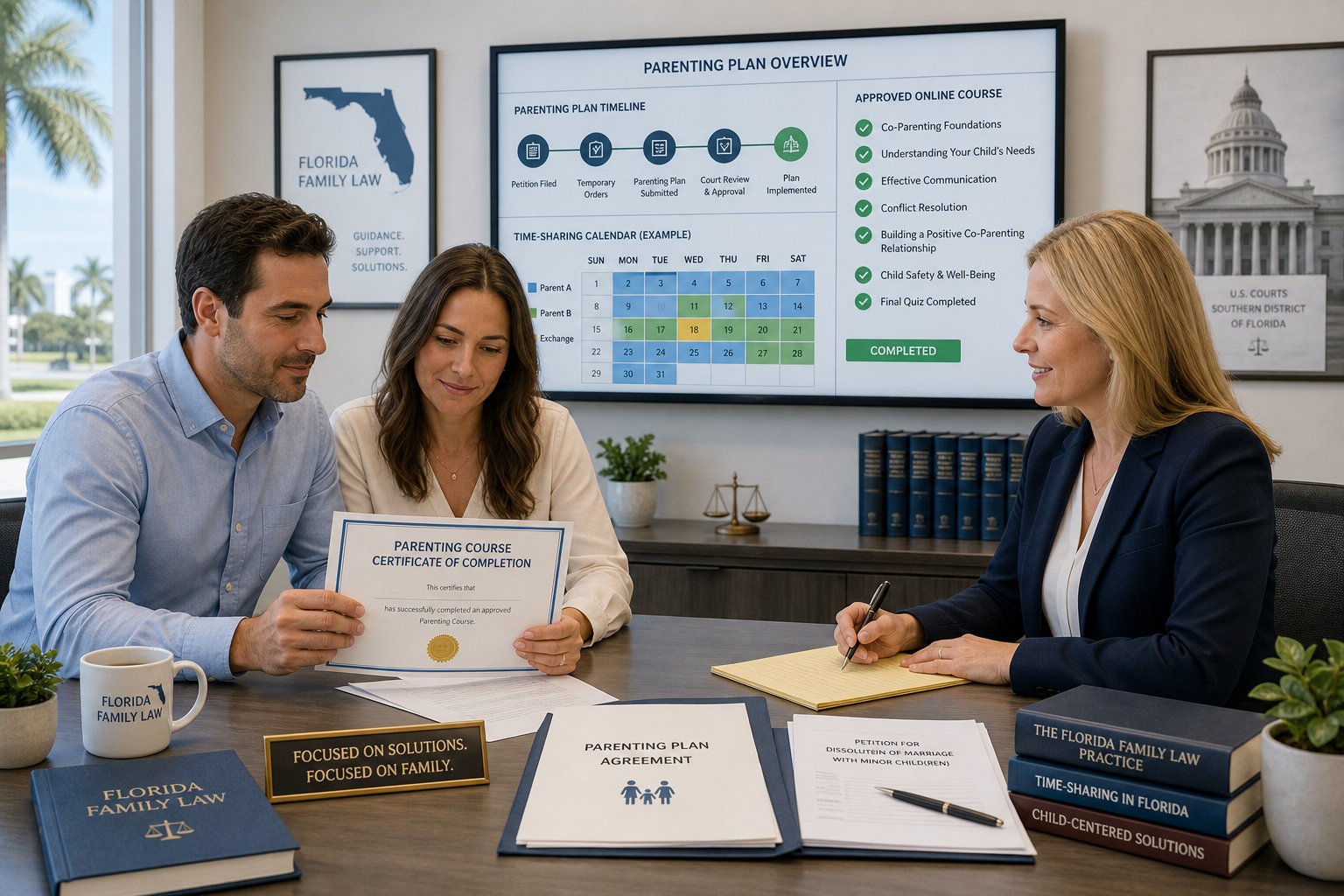
Florida generally requires parents with minor children in certain family law cases to take a parenting course. The formal name is the Parent Education and Family Stabilization Course. Under section 61.21, Florida Statutes, the course must be approved by the Florida Department of Children and Families.
This is not just a suggestion. In many divorce and paternity cases, the court expects both parents to complete a class of at least 4 hours. The purpose is practical: help parents reduce conflict, understand the effect of separation on children, and support safer, healthier co-parenting.
For Florida parents, the requirement often connects directly to issues like:
- Parenting plan terms
- Parental responsibility
- Time-sharing
- Child support or paternity-related child issues
The class does not decide who is the better parent. It also does not replace the court process. Instead, it gives both parents a common base of information about communication, child needs, and family change.
Still, the exact way the rule works can vary. Some courts apply local procedures about when to file the certificate of completion, whether online courses are accepted, and where proof must be submitted. That is why Florida parents should check both statewide rules and local court instructions.
A good starting point is the Florida Courts family law resources and the Florida DCF approved course information.
Who Must Take The Parent Education And Family Stabilization Course
In Florida, both parties usually must take the course when a divorce involves minor children. That means the filing parent and the other parent are each generally responsible for completing it.
The requirement also often applies in paternity cases when the court is dealing with:
- Parental responsibility
- Time-sharing
- Child support involving a child
In some cases, the court may also require the course later in a case involving changes to a parenting plan or time-sharing schedule. That is one reason parents should not assume the class only matters at the start of a divorce.
Florida law also allows a court to excuse a parent for good cause in some situations. But that is up to the court. You should not assume you are excused unless the judge has clearly said so in your case.
This matters for parents who are separated but not yet divorced, parents in a paternity action, and parents returning to court over child-related issues. If your case involves decisions about where a child lives, who makes major decisions, or how parenting time will work, this course may be part of the process.
If you are unsure whether the requirement applies, check your court papers, review your local family court instructions, or contact the Clerk of Court for filing information. You can also review county information through your local clerk or court website.
When You Need To Complete The Course And What Happens If You Do Not
In many Florida cases, you should complete the course as early as possible. State rules commonly require the petitioner in a divorce case to finish within 45 days of filing, and the other parent within 45 days of service. Similar timing can apply in paternity matters, depending on how the case begins.
Just as important, proof of completion usually must be filed before the court enters a final judgment. If you do not complete the course on time, several things can happen:
- Your final hearing may be delayed
- The judge may refuse to finalize parts of the case
- The court may impose sanctions
- In some cases, the court may consider noncompliance when handling issues tied to time-sharing or shared parental responsibility
- A judge may address the failure as a court-order problem, including possible contempt concerns
So, what happens if I miss the court deadline? In plain terms, your case can stall until you fix the problem, and the court may take the missed deadline seriously.
The next step is usually simple, even if it feels urgent: enroll in a DCF-approved provider, complete the course, get your certificate of completion, and follow your local court’s filing instructions through the Clerk of Court. If you already missed the deadline, act quickly and review any court notices or orders in your case.
For statewide legal background, Florida Statutes section 61.21 and your local court or clerk website.
What To Look For In A Florida-Approved Online Parenting Class
The first thing to check is approval status. A Florida online class should be offered by a DCF-approved provider. If the provider is not approved by the Florida Department of Children and Families, the certificate may not meet the court requirement.
Next, confirm that the class meets the state minimum length. Florida generally requires at least a 4-hour course. That sounds basic, but it matters.
You should also verify whether your local court accepts an online format. Many parents prefer online learning because it is flexible, but some counties or judges may have specific rules. A provider can be approved, yet your local court may still have instructions about format or filing.
Look for these features:
- Clear statement of Florida DCF approval
- A course built for Florida family law cases
- A certificate of completion you can download or print
- Simple access on phone, tablet, or computer
- Help or support if you have filing questions
If you want an online option, DivorceParentingClass.net offers a Florida course designed around the Parent Education and Family Stabilization Course requirement. Even so, you should still confirm local acceptance rules with your county court if you have any doubt.
That one check can save time, money, and stress.
What The Course Covers And How Online Completion Usually Works
Florida’s required parenting course covers practical topics tied to family change and child well-being. The point is to help parents make better decisions during and after separation.
Course topics often include:
- The effect of divorce or separation on children and parents
- Communication between co-parents
- Parenting plan basics
- Child needs at different ages
- Financial responsibilities for children
- Conflict reduction
- Safety issues, including abuse or neglect concerns
- Co-parenting concerns involving special needs children when relevant
Most online courses are self-paced. That means you can log in, complete the lessons, and move through the material in sections. The provider usually tracks your progress electronically.
Some online courses include short quizzes or a final test. Others require you to confirm that you completed each unit before moving on. You normally must finish all required content before the system issues your certificate of completion.
For many parents, online completion is easier than trying to fit an in-person class into work, child care, and court deadlines. If your court allows online learning, that flexibility can help you comply faster.
If you need a Florida option, you can take the course online through DivorceParentingClass.net, then follow your county’s filing steps for the certificate.
How Certificates, Court Acceptance, And County Questions Are Handled
After you finish the course, you should receive a certificate of completion. This is the proof the court wants. Depending on the provider, the certificate may be available as a digital file, a printable copy, or both.
But finishing the class is only part of compliance. You also need to make sure the certificate is handled the right way. In many cases, each parent must file proof with the court before the judge enters a final judgment.
That process may depend on your county. Some courts want the certificate filed with the Clerk of Court. Others may give case-specific instructions in a court order, case management order, or family law packet.
A few key points matter here:
- DCF approval supports statewide recognition
- Local court procedures can still differ
- Online acceptance may depend on county or judge instructions
- Each parent usually files their own proof
This is why parents should check official local sources, such as their county clerk or family court page. You can also review statewide court information through Florida Courts and DCF information through Florida DCF.
If you are close to a deadline, confirm the filing method before you assume the court has what it needs.
Special Situations In Divorce, Paternity, And Time-Sharing Cases
The Florida divorce parenting class requirement most often comes up in divorce cases with minor children, but it is not limited to divorce. It can also apply in paternity cases and some other child-related family matters.
In a divorce case, both parents usually must complete the course unless the court excuses one parent for good cause. In a paternity case, the same issue can arise when the court is deciding time-sharing, parental responsibility, or child support.
Modification cases can be different. A court may require the course when parents are changing an existing parenting plan or asking for a new time-sharing arrangement. That does not happen in every case, but it can happen.
Some parents also face special practical issues, such as:
- Living outside Florida while the case is in Florida
- Needing an online option because of work or distance
- Having a child with special needs
- Uncertainty about county rules for online certificates
In those situations, local instructions matter even more. A course that fits one county’s process may not fit another county’s filing practice.
If you need to complete the Florida Parent Education and Family Stabilization Course online, DivorceParentingClass.net is one option to review. Always match the provider’s approval status with your local court’s instructions before filing.
FAQ
What happens if I don’t complete the Florida parenting class?
The court may delay your case and generally won’t enter a final judgment until you finish the required course and file the certificate. The exact consequences depend on your judge, county, and case.
Can my divorce be finalized without it?
Generally not, in a case involving minor children. Courts typically require proof of completion before finalizing, so the missing certificate can hold up the final judgment.
What if I genuinely can’t complete it?
A judge may excuse a parent for good cause, but that’s up to the court and isn’t automatic. If you have a hardship, raise it with the court rather than simply not completing the course.
How do I fix a missed requirement?
Complete a DCF-approved course as soon as possible and file the certificate the way your court directs. That usually clears the holdup so the case can move forward.
Conclusion
Skipping the course mostly creates delay: the court can hold up hearings and won’t typically finalize a case with minor children until the certificate is filed. The good news is that it’s a fixable problem — complete a DCF-approved course and file the proof. If a genuine hardship makes completion impossible, raise it with the court rather than letting the requirement quietly stall your case.
If you still need to finish, you can complete the DCF-approved Parent Education and Family Stabilization Course online and file your certificate promptly.
Related Articles
- Florida Divorce Parenting Class Requirement: Who Has to Take It and When
- When Should You Take the Florida Parenting Class During Divorce?
- Can the Florida Parent Education Course Requirement Be Waived?
- Florida Divorce With Minor Children: Parent Education Course Checklist
Sources
Billy Forte is the founder of Divorce Parenting Class, which offers a Florida DCF-approved online Parent Education and Family Stabilization Course. The brand focuses on clear, supportive, plain-English guidance to help Florida parents complete the court-required class and file their certificate.
This article is general information, not legal advice. Florida family-law requirements and certificate acceptance can vary by court, county, judge, and case type, so review your court papers and official Florida sources, or consult a family-law attorney, before acting.