
Updated June 2026 · Reviewed by Billy Forte
Yes, in most Florida family cases with minor children you can satisfy the parenting-class requirement online through a Florida DCF-approved provider, as long as your court accepts that format. The class is the Parent Education and Family Stabilization Course, it must be at least four hours, and it’s required under Florida law before many final judgments. This guide walks through who must take it, how the online course works from registration to certificate, and how to make sure the provider you choose is one your court will accept.
Applies to the Florida Parent Education and Family Stabilization Course (Fla. Stat. 61.21). Requirements and acceptance can vary by court, county, judge, and case type, so review your court papers and official Florida sources.
Key Facts
- Official name: The Parent Education and Family Stabilization Course, required under Florida Statute 61.21.
- Length: At least four hours; each parent generally completes it separately.
- Who must take it: Parents in most Florida divorce, paternity, and custody cases involving minor children.
- DCF-approved: The course must come from a provider approved by the Florida Department of Children and Families.
- Online is common: Many courts accept a DCF-approved online course, but acceptance can vary by court and county.
- Certificate: You file the certificate of completion with the Clerk of Court (or give it to your attorney to file).
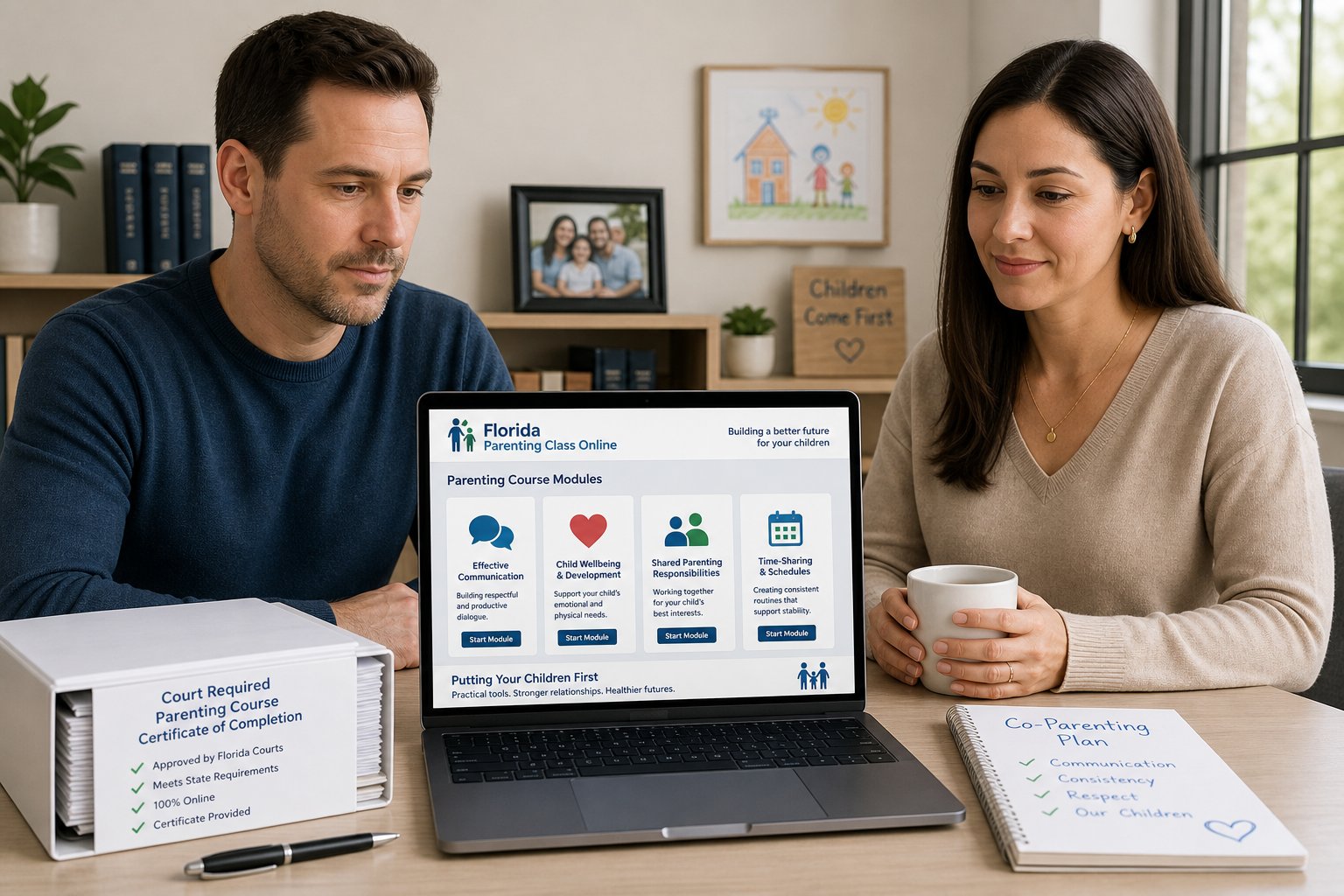
What The Florida Parenting Class Is And Why Courts Require It
The Florida parenting class is the Parent Education and Family Stabilization Course. It is a state-required course for many family law cases with minor children. Under Florida Statute 61.21, courts generally require parents to complete it before the court enters a final judgment.
The course must be at least 4 hours long. Its goal is simple: help parents understand how divorce, separation, and case conflict can affect children. The class also teaches ways to lower stress, improve communication, and support a more stable home life.
Florida courts do not require this class just to create another task. They require it because family cases often affect children in lasting ways. When parents learn more about child needs, time-sharing, communication, and shared decision-making, children often face less conflict.
You may also see the course tied to issues like:
- Parental responsibility
- Parenting plans
- Child adjustment after separation
- Basic conflict reduction
- Safe co-parenting practices
The state approves providers through the Florida Department of Children and Families. That approval matters because not every online class meets Florida’s rules. Even so, court practice can still vary by county, court, judge, and case type.
If you are unsure whether your case requires the course, check your court papers, ask your lawyer, or review your county family court instructions.
Who Must Take The Parent Education And Family Stabilization Course
In Florida, both parents usually must take the course in cases involving minor children. That often includes divorce cases, paternity cases, and some actions involving custody or time-sharing. Each parent must complete the class on their own and receive their own certificate of completion.
The exact requirement depends on the type of case. In general, courts look at whether the case involves parenting issues for a child under 18. If it does, the course is often part of the case requirements.
Common examples include:
- Dissolution of marriage with minor children
- Paternity actions
- Cases involving a parenting plan
- Cases involving parental responsibility
- Some post-judgment family matters, if ordered
This does not mean every family case works the same way. A judge may issue special instructions. A county may also have local forms or filing rules. So while the state rule is broad, your next step should always match your court’s directions.
Also, one parent finishing the class does not cover the other parent. The court generally expects separate completion by each person. That means separate registration, separate coursework, and separate filing or submission of the certificate.
You should read any order from the court closely. If you have questions, the Florida Courts self-help resources and your local clerk’s office can help you find the right procedure.
How An Online Florida Parenting Class Works From Registration To Certificate
A Florida parenting class online usually follows a simple path. You register with a DCF-approved provider, create your account, complete the lessons, and then get your certificate. Most online courses are self-paced, so you can stop and restart as needed.
The process often looks like this:
- Choose a Florida-approved course provider.
- Create your own account with your legal name.
- Pay the course fee.
- Complete the 4-hour class content.
- Finish any required quiz or final exam.
- Download or print your certificate.
- File it with the Clerk of Court or give it to your attorney.
Many providers let you use a phone, tablet, or computer. That makes the class easier to fit into work and parenting schedules. Still, you should check whether your local court has any special format rules before you enroll.
At DivorceParentingClass.net, the Florida course is offered online and is designed for self-paced access. The site states that it is a DCF-approved provider and provides a certificate after completion, but you should still follow your local court’s filing instructions.
Keep a copy of your certificate for your records. If your court uses e-filing, your lawyer may upload it for you. If not, you may need to bring or send it to the clerk based on county procedure.
What The Course Covers For Co-Parenting, Communication, And Child Well-Being
The course focuses on how separation affects children and how parents can reduce harm. It is not only about court rules. It is about daily choices that shape a child’s routine, stress level, and sense of safety.
Most Florida-approved courses cover topics such as:
- The effects of divorce or separation on children
- Child development and age-based needs
- Co-parenting skills
- Communication between parents
- Conflict reduction
- Parenting plans and time-sharing
- Parental responsibility
- Safety issues, including family violence awareness
- Community resources for parents and children
A useful course explains these topics in plain language. For example, it may show why children do better when parents keep adult conflict away from them. It may also explain how clear routines, consistent rules, and respectful messages between homes can lower stress.
Some courses also review how parents can support school routines, health care decisions, and transitions between homes. These lessons matter because court orders often deal with the legal side, while the class focuses on the human side.
The Florida Department of Children and Families explains provider standards, and local courts may give more detail about what they expect. A strong course should help you understand both the legal context and the parenting habits that support child well-being.
How To Choose A Florida DCF-Approved Online Course Your Court Will Accept
Start with one key check: confirm the provider is a Florida DCF-approved provider for the Parent Education and Family Stabilization Course. If the provider is not approved, your certificate may not meet the state requirement. That is the first filter.
Next, check your local court instructions. This step matters because DCF approval does not replace local court rules. A county, judge, or case type may have its own instructions about accepted formats, filing steps, or deadlines.
When you compare providers, look for:
- Clear proof of DCF approval
- A 4-hour Florida course
- Easy access on phone, tablet, or computer
- Plain pricing and refund terms
- Fast certificate access after completion
- Contact information for support
You can also review family court or clerk pages for your county. The Florida Courts website can help you find court resources, and your local Clerk of Court may list filing steps.
If you want an online option, DivorceParentingClass.net offers a Florida course built for this requirement. Before you enroll, match the provider details to your court order or local instructions. If anything is unclear, ask your lawyer, the clerk, or the court’s family law help desk before you pay.
Common Questions About Timing, Length, Exams, And Filing Your Certificate
Most parents want the same answers first: how long it takes, when it is due, whether there is a test, and where the certificate goes. In Florida, the course is generally 4 hours long. Many courts expect quick completion after filing or service, and some sources state a 45-day deadline is common, but you should follow your own court order first.
Here are the basics:
- Length: At least 4 hours
- Format: Often self-paced online
- Accounts: Each parent needs a separate account
- Exams: Some providers include quizzes or a final exam
- Certificate: Usually available as a PDF after completion
- Filing: Often filed with the clerk or through your lawyer
Do not assume every provider uses the same test rules. Some require only lesson checks. Others may include a final exam. Also, do not assume every county handles certificates the same way. Some courts may want formal filing, while others may accept submission through counsel.
If you need a next step, review your court order and then take the online Florida Parent Education and Family Stabilization Course at DivorceParentingClass.net. After you finish, file your certificate the way your county requires.
What Happens If You Do Not Complete The Required Parenting Course
Failing to complete the course can delay your case. Under Florida law, the court generally cannot enter a final judgment until the parenting course requirement is met in cases where it applies. That means one missed step can hold up the rest of the process.
Courts may also treat noncompliance seriously. Depending on the facts, the court may issue orders to enforce compliance. In some cases, a judge may consider the lack of completion when reviewing parenting issues tied to cooperation, parental responsibility, or time-sharing.
Possible results may include:
- Delay of final judgment
- Extra hearings or compliance orders
- Possible contempt findings or sanctions
- Negative effect on unresolved parenting issues
That does not mean the same outcome happens in every case. Florida family cases depend on the court, county, judge, and facts. Still, ignoring the requirement is risky.
If your deadline is close, act now. Confirm your court’s instructions, complete the required course, and save your certificate of completion. That one step can help keep your case moving.
FAQ
Can I take the Florida parenting class online?
Usually yes. Most Florida courts accept a DCF-approved online Parent Education and Family Stabilization Course, though acceptance can vary by court and county, so check your court’s instructions.
What is the course officially called?
The Parent Education and Family Stabilization Course, required under Florida Statute 61.21 in many family cases involving minor children.
How long is the course?
At least four hours. Each parent generally completes the course separately and receives their own certificate of completion.
Who has to take it?
Parents in most Florida divorce, paternity, and custody cases with minor children. Your court order or local rules confirm whether it applies to your case.
How do I file the certificate?
After finishing, you file your certificate of completion with the Clerk of Court, or give it to your attorney to file. Keep a copy for your records.
Conclusion
For most Florida parents, the requirement comes down to a few clear steps: complete a DCF-approved four-hour Parent Education and Family Stabilization Course, get your certificate, and file it with the court. Doing it online is usually an option, but the safest move is to confirm your specific court’s instructions before you start. Handle those pieces in order and the requirement becomes a straightforward step in your case.
When you’re ready, you can complete the Florida DCF-approved Parent Education and Family Stabilization Course online and receive your certificate of completion.
Related Articles
- Court-Approved Parenting Classes in Florida: How to Choose One
- What Is the Parent Education and Family Stabilization Course in Florida?
- 4-Hour Parenting Class Florida: What the Course Includes
- Will a Florida Court Accept an Online Parenting Class Certificate?
Sources
Billy Forte is the founder of Divorce Parenting Class, which offers a Florida DCF-approved online Parent Education and Family Stabilization Course. The brand focuses on clear, supportive, plain-English guidance to help Florida parents complete the court-required class and file their certificate.
This article is general information, not legal advice. Florida family-law requirements and certificate acceptance can vary by court, county, judge, and case type, so review your court papers and official Florida sources, or consult a family-law attorney, before acting.