
Updated June 2026 · Reviewed by Billy Forte
Florida’s required parenting class is a four-hour course called the Parent Education and Family Stabilization Course, and its curriculum focuses on helping parents support their children through divorce or separation. Expect lessons on how family change affects children, co-parenting and communication, reducing conflict, and the legal and emotional steps of the process. The four hours are set as a minimum by Florida law, and each parent generally completes the course separately.
Applies to the Florida Parent Education and Family Stabilization Course (Fla. Stat. 61.21). Requirements and acceptance can vary by court, county, judge, and case type, so review your court papers and official Florida sources.
Key Facts
- Four-hour minimum: Florida law sets the course at a minimum of four hours.
- Core topics: How divorce affects children, co-parenting, communication, and reducing conflict.
- Goal: Help parents stabilize the family and support children’s well-being during the case.
- Each parent separately: Both parents generally take the course on their own and get their own certificate.
- DCF-approved curriculum: Approved providers cover the topics Florida requires.
Who Must Take The Florida Parent Education And Family Stabilization Course
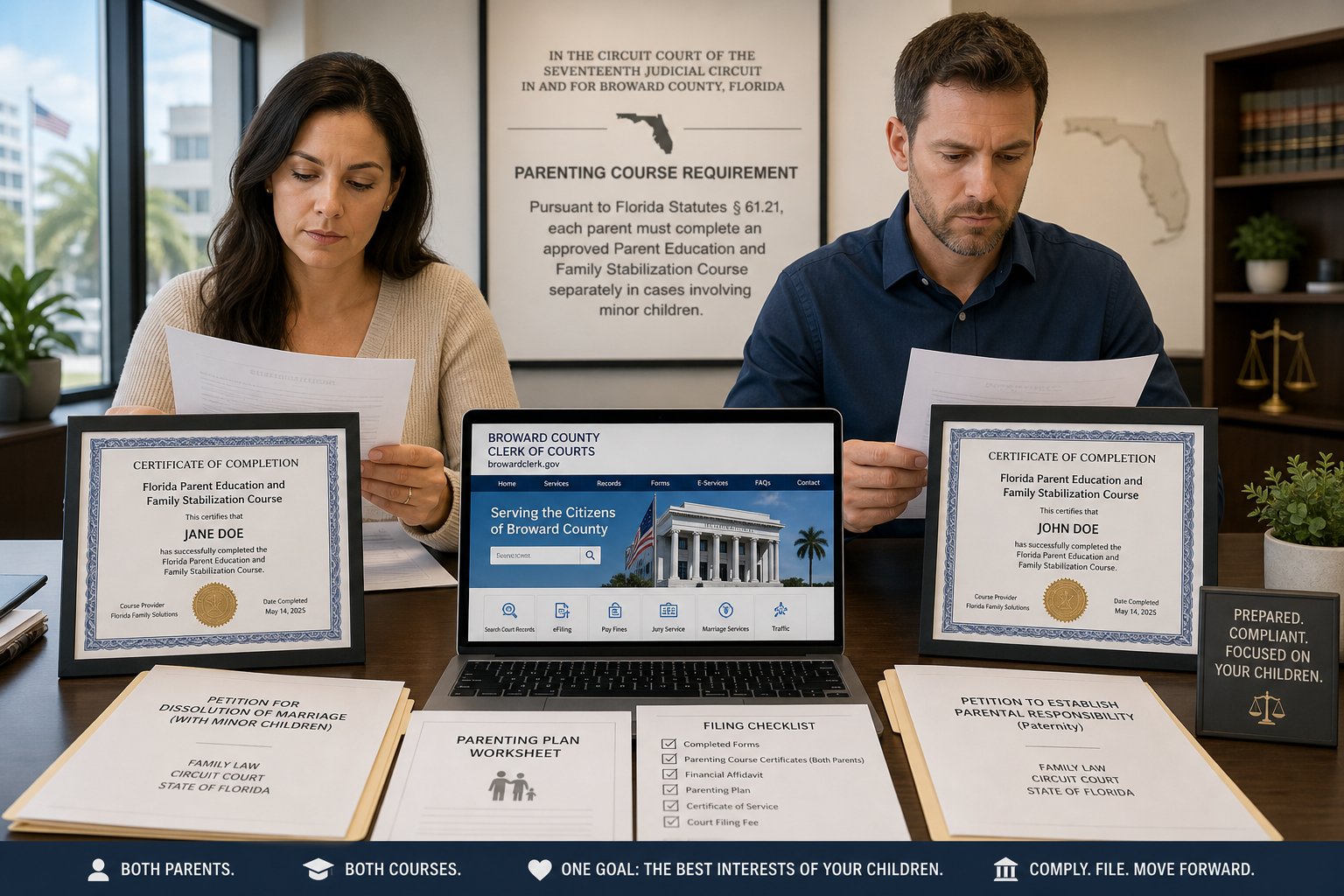
Florida law generally requires this course when parents with minor children are involved in certain family law cases. Under Florida Statutes section 61.21, the rule commonly applies in dissolution of marriage, paternity, and other cases that involve parental issues.
In plain terms, if your case involves children under 18, the court may require both parents to complete the Parent Education and Family Stabilization Course. That usually means the petitioner and the respondent must each enroll on their own and receive their own certificate of completion.
This matters because the class is not a shared task. One parent cannot take it for both people, and one certificate does not cover both parents.
Requirements can still vary by:
- Court
- County
- Judge
- Case type
So even though Florida has a statewide framework, your local court instructions still control the details in your case. You may see directions in your summons, standing order, family law packet, or on the local court or clerk website.
Many courts will not move a case to final judgment until the required parenting class certificates are filed. Because of that, it helps to check your court papers early and confirm what your county expects. If you are unsure, review your case documents and the local Clerk of Court guidance before you enroll.
What The 4-Hour Florida Parenting Class Covers
The 4-hour parenting class Florida courts require is meant to teach basic skills and reduce harm to children during separation or divorce. A DCF-approved course must meet state content standards, so the topics are broader than simple custody rules.
Most approved courses cover:
- How divorce or separation affects children
- How children react at different ages
- Communication with the other parent
- Communication with your child
- Parental responsibility and time-sharing
- Conflict reduction and co-parenting skills
- Stress, coping, and support resources
- Domestic violence and child safety issues
You may also see lessons about building a workable parenting plan, helping children feel secure, and avoiding behavior that puts them in the middle of adult conflict. That includes not using children to carry messages, not asking them to take sides, and not speaking badly about the other parent in front of them.
A good course also explains that children often need stable routines, calm communication, and clear expectations. Those ideas can help when parents are working through school schedules, exchanges, holidays, or changing homes.
For Florida parents, the goal is not just to check a box. The course is designed to support safer, more informed decisions while the family structure changes.
Online Vs Local Options: How To Choose A Florida Court-Accepted Course
You can often choose between an online course and a local in-person class, but the key issue is approval. In Florida, start by making sure the provider is a DCF-approved provider for the Parent Education and Family Stabilization Course.
You can review approved providers through the Florida Department of Children and Families. That is the safest first check.
An online parenting class for divorce is often easier for busy parents because it may let you:
- Log in from a phone, tablet, or computer
- Work at your own pace
- Stop and return later
- Finish outside normal business hours
That flexibility can help if you work shifts, share child care, or live far from a class site. DivorceParentingClass.net offers a Florida DCF parenting course online, which can be useful if your court allows distance learning and you want a simpler path.
Still, online is not always the right choice in every case. Some judges or local procedures may give specific directions, and some parents prefer an in-person setting.
Before you enroll, confirm four things:
- The provider is DCF approved.
- The course is the exact Florida parent education course required.
- Your local court accepts that format.
- The certificate process is clear.
That quick check can prevent delays and extra cost later.
How Approval, Court Acceptance, And Certificates Work In Florida
In Florida, DCF approval and court acceptance are related, but they are not the same thing. The Florida Department of Children and Families approves providers to offer the course, while your local court decides how certificates are handled in your case.
That is why you should not assume that any parenting class will work. The safer choice is a course from a DCF-approved provider that clearly states it is the Florida Parent Education and Family Stabilization Course.
After you complete the course requirements, you receive a certificate of completion. Depending on the provider, that may be a downloadable PDF, an emailed record, or another format the court accepts.
Course completion often includes:
- Finishing all lesson modules
- Reviewing videos, text, or examples
- Completing short quizzes or checks
- Passing a final test, if required by that provider
Once you have the certificate, follow the instructions from your court, lawyer, or Clerk of Court. Some parents file it with case papers. Others give it to counsel for filing.
For court information, check the Florida Courts website and your county court or clerk page. Local instructions matter because filing methods and case steps can differ.
The practical rule is simple: use an approved provider, keep your certificate, and follow your court’s filing directions exactly.
When To Take The Class And What Happens If You Miss The Deadline
You should take the class as early as you can after your case starts. In many Florida cases, the common deadline is 45 days from filing for the petitioner and 45 days from service for the respondent, but your court order or county procedure may set the timeline you must follow.
Early completion lowers the risk of case delays. It also gives you time to fix problems if you entered the wrong name, chose the wrong course, or need help with the certificate.
If you miss the deadline, the court may respond in several ways depending on the case and judge. Possible results can include:
- Delay of hearings or final judgment
- Orders to complete the class by a new date
- Contempt issues for noncompliance
- Problems with requests tied to time-sharing or parental responsibility
That does not mean every missed deadline brings the same result. Still, it is a court requirement in many cases, so it should not be pushed aside.
Check your summons, standing order, or family law papers for the exact date that applies to you. Then choose a DCF-approved course and complete it with enough time to receive and file your certificate.
What To Expect During The Course, From Access To Final Completion
Most Florida courses are built to meet the minimum 4-hour standard, but that does not always mean four straight hours in one sitting. Many online providers let you sign in, complete part of the course, log out, and return later.
The format is usually simple. You read short lessons, review examples, and answer questions along the way.
Common course features include:
- Short reading sections
- Videos or slides
- Real-life parenting scenarios
- Knowledge checks or quizzes
- A final review or exam
The subject matter focuses on co-parenting behavior, child needs, conflict control, and ways to make a parenting plan work better in daily life. You may also see examples about school events, holiday schedules, child exchanges, and how to speak with children in age-appropriate ways.
If you choose an online provider like DivorceParentingClass.net, review the access rules before you start. Check device compatibility, login steps, support options, and how the certificate of completion is delivered after you finish.
That way, you can complete the course with fewer surprises and keep your case moving.
How The Class Supports Co-Parenting And Helps Children Adjust
The course is meant to do more than satisfy a court rule. It teaches habits that can reduce stress for children when parents live apart.
Children often struggle most with conflict, uncertainty, and being placed in the middle. A good class shows you how to lower those risks through steady routines, calm exchanges, and clear parent-child communication.
Key ideas often include:
- Keep adult conflict away from children
- Do not use children as messengers
- Support the child’s relationship with both parents when safe
- Build routines children can count on
- Focus on the child’s needs, not old arguments
These lessons connect directly to Florida family law terms like time-sharing, parental responsibility, and the parenting plan. Those legal labels matter, but daily behavior matters too. A clear pickup routine, respectful messages, and consistent school expectations can make a real difference.
If you still need to complete the required Florida course, you can review the online Florida Parent Education and Family Stabilization Course at DivorceParentingClass.net. Use your court papers and local instructions to confirm the right next step for your case.
FAQ
What does the 4-hour Florida parenting class include?
It covers how divorce and separation affect children, co-parenting and communication skills, reducing conflict, and the steps of the family-law process, over a minimum of four hours.
Is the course really four hours?
Yes. Florida law sets a four-hour minimum for the Parent Education and Family Stabilization Course. DCF-approved providers build their curriculum around that requirement.
Do both parents take it?
Generally yes. Each parent usually completes the course separately and receives their own certificate of completion to file with the court.
Is there a test?
Many providers include short quizzes or knowledge checks to confirm you completed the material, but the focus is education, not passing a difficult exam.
Conclusion
The four-hour class is designed to be practical rather than punitive: its real subject is your children and how to help them through a hard transition. Knowing the topics ahead of time — co-parenting, communication, reducing conflict — makes the four hours feel purposeful. Complete it, collect your certificate, and you’ve handled one of the clearer requirements in your case.
You can complete the four-hour, DCF-approved Parent Education and Family Stabilization Course online at your own pace.
Related Articles
- Florida Parenting Class Online: Court-Approved 4-Hour Course Guide
- What Is the Parent Education and Family Stabilization Course in Florida?
- Can You Finish the Florida Parenting Class in One Day?
- Court-Approved Parenting Classes in Florida: How to Choose One
Sources
Billy Forte is the founder of Divorce Parenting Class, which offers a Florida DCF-approved online Parent Education and Family Stabilization Course. The brand focuses on clear, supportive, plain-English guidance to help Florida parents complete the court-required class and file their certificate.
This article is general information, not legal advice. Florida family-law requirements and certificate acceptance can vary by court, county, judge, and case type, so review your court papers and official Florida sources, or consult a family-law attorney, before acting.