
Updated June 2026 · Reviewed by Billy Forte
For a Florida divorce, “accredited” does not automatically mean court-approved — what matters is whether the course is the DCF-approved Parent Education and Family Stabilization Course. “Accredited” is a loose marketing term that can sound official without meaning your court will accept the certificate. This guide explains what “accredited” really signals, why DCF approval is the standard that counts in Florida, and how to tell whether a course will satisfy your case.
Applies to the Florida Parent Education and Family Stabilization Course (Fla. Stat. 61.21). Requirements and acceptance can vary by court, county, judge, and case type, so review your court papers and official Florida sources.
Key Facts
- “Accredited” is vague: It often means “professional-sounding,” not court-recognized.
- DCF approval is the standard: For Florida cases, DCF approval is what makes a course count.
- Approved ≠ just accredited: A course can be accredited yet not approved for Florida’s requirement.
- Verify the provider: Check the Florida DCF approved-provider list before enrolling.
- Confirm acceptance: Approval plus your court’s instructions determine whether the certificate is accepted.
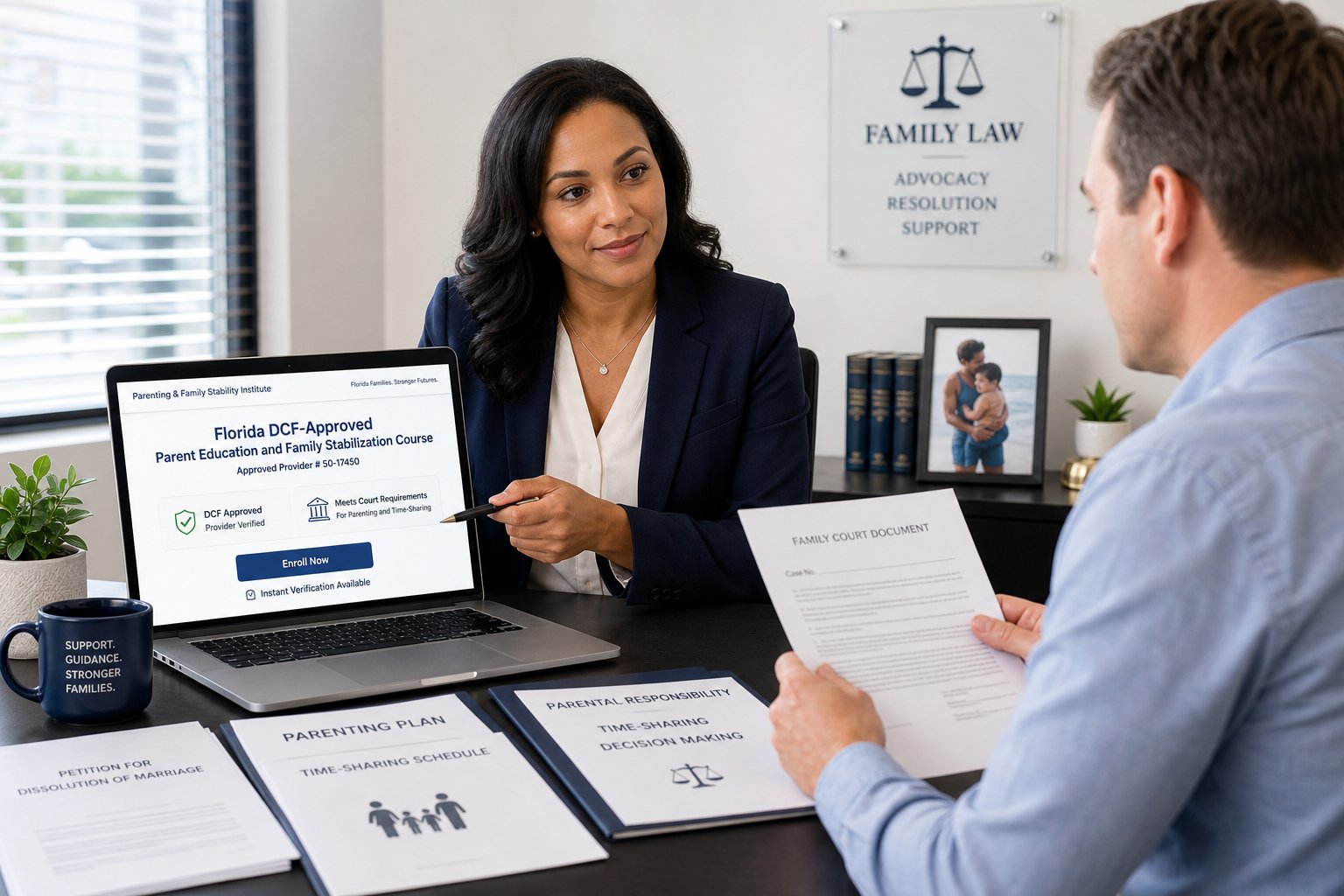
What Accredited Parenting Courses Are And When Florida Parents Need One
In Florida, people often use the word accredited to mean a course that sounds official. But for your case, that word is not the main legal test. What matters most is whether the provider is a DCF-approved provider for the Parent Education and Family Stabilization Course.
Florida law points parents to this course in family cases with minor children. That usually includes divorce cases and can also include some paternity or parenting cases. The rule comes from Florida Statutes section 61.21.
The course is meant to help parents during family change. It focuses on how separation affects children, how parents can reduce conflict, and how to support a healthy parenting plan, parental responsibility, and time-sharing setup.
In plain terms, an accredited parenting course may be real, professional, and useful. Still, if it is not approved for Florida’s required parent education program, it may not satisfy your court requirement. That is why Florida parents should look for the exact course name, not just broad labels.
You will usually need the Florida course if:
- You are divorcing and have minor children
- You are in a paternity case involving parenting issues
- The court orders the class in a case about time-sharing or related issues
- A judge directs another party or caregiver to complete it
Some courts may excuse a person, but you should never assume that on your own. Read your court papers closely and follow any deadline in your order.
How To Tell Whether A Course Is Approved, Accepted, And Legitimate
The fastest way to check a Florida parenting course is simple: confirm that the provider appears on the official Florida Department of Children and Families list for the Parent Education and Family Stabilization Course. If the provider is not on that list, the course may not meet the Florida requirement for your case.
Start with the source. Florida DCF publishes approved providers through its family services information page and related provider materials at Florida DCF. Then compare that information with the provider’s website.
A legitimate Florida course should clearly tell you:
- The exact course name
- Its DCF-approved provider status
- Whether the course is online or in person
- How you receive your certificate of completion
- What steps you may need to take with your court
Court acceptance is a second question. Even if a provider is DCF-approved, your local court may have extra instructions about online learning, filing, or deadlines. That is why approved and accepted by your court process are related, but not always identical.
You can also check local court pages through Florida Courts or your county Clerk of Court website. Look for family law self-help pages, administrative orders, or filing instructions. If your order says to complete a parent course, use that wording as your checklist.
Who Usually Needs The Florida Parent Education And Family Stabilization Course
Florida parents most often need this course in divorce cases with minor children. Courts may also require it in paternity cases, custody-related matters, or other actions involving a parenting plan, parental responsibility, or time-sharing.
In some cases, both parents must complete the course. In others, the court may order another adult involved in the case to do it too. Because case type matters, your next step is to compare your court papers with the county’s family law instructions.
Online Vs Local Parenting Courses: Which Format Fits Your Situation
Florida allows both online and local in-person parenting courses, but each must meet state rules. In general, the course must be at least 4 hours long if it is the standard Florida Parent Education and Family Stabilization Course.
Online courses work well for many parents. You can usually sign in from a phone, tablet, or computer. That can help if you work odd hours, share a car, or need to study after the children are asleep.
Local classroom courses may fit better if your county prefers in-person attendance or if you learn better in a live setting. Some parents also like being able to ask questions face to face.
Still, not every format fits every case. Some counties or judges may set rules about distance learning. So before you enroll, check your order and your local court information.
Here is a simple way to compare formats:
- Online: flexible, self-paced, easy access across Florida
- In person: fixed schedule, live instruction, sometimes preferred locally
- Both: should match DCF standards for the required course
For many families, an online option from a DCF-approved provider is the easiest path. DivorceParentingClass.net offers the Florida course online, with access from common devices and a certificate after completion. But you should still confirm that the format matches any county or judge-specific rule before you enroll.
What An Accredited Parenting Course Typically Covers
A Florida parent course usually covers the effect of divorce or separation on children first. That is the heart of the program. The goal is to help parents make choices that lower stress for children during a family case.
Most approved courses also explain child development. This helps parents understand what behavior is normal at different ages. A toddler, a grade-school child, and a teen may react very differently to the same family change.
Common topics include:
- The impact of divorce and separation on children and parents
- Child development and age-based needs
- Co-parenting skills
- Communication tools for hard talks
- Conflict control and problem solving
- Non-aggressive discipline
- Stress management
- Community and family resources
These lessons connect directly to court issues like a parenting plan, parental responsibility, and time-sharing. A course is not there to decide your case. It is there to give you practical tools so you can support your children and work with the court process in a safer, calmer way.
If a provider says very little about course topics, that is a warning sign. A clear provider should explain what the class teaches, how long it takes, and what proof of completion you receive. That makes it easier to see whether the course is a true Florida parent education class or just a general parenting program.
How Enrollment, Completion, And Certificates Usually Work
Most Florida parenting courses follow a simple path: register, complete the required hours, and get your certificate of completion. The exact steps vary by provider, but the basic flow is usually the same.
If you choose an online provider, you normally create an account, pay the fee, and start the course modules. If you choose a local class, you may register by phone, online, or through a set class schedule. Either way, make sure the course is the Florida Parent Education and Family Stabilization Course.
Completion often means finishing all lessons and, in some programs, passing a short quiz or exam. Do not assume every provider works the same way. Read the rules before you pay.
After you finish, the provider issues a certificate of completion. Some online courses offer instant download. Others may email the certificate or provide mailing options.
You may need to file that certificate with the court, keep it for your records, or provide it as directed in your case. Your local process may involve the Clerk of Court, your lawyer, or electronic filing rules listed on county court pages.
Before you start, check these points:
- The course name matches the Florida requirement
- The provider states DCF approval
- You understand all fees
- You know how to get your certificate
- You know where the court wants proof filed
If you need a Florida online option, you can review the course details and enrollment steps at DivorceParentingClass.net.
What To Compare Before You Enroll In A Florida Parenting Course
The best course is not just the cheapest one. It is the one that fits your Florida case, meets state standards, and gives you the right paperwork. A few quick checks can save you time and stress.
Start with DCF approval status. If the provider is not approved for Florida’s parent education course, stop there. Then look at your local court rules. Some counties are fine with online learning, while others may give special instructions.
Next, compare the basics side by side:
- Provider status: listed by the Florida Department of Children and Families
- Format: online or in person
- Length: meets the 4-hour minimum for the Florida course
- Price: includes all required fees or shows extra costs clearly
- Certificate access: download, email, or mail options
- Support: help if you have login or certificate questions
- Court instructions: county, judge, and case type details
This is also where broad terms like accredited parenting courses can confuse people. A course may be accredited by some private standard, or it may simply market itself that way. For Florida family court purposes, that label matters less than approved provider status and local court acceptance procedures.
If you want a clear online option, review the Florida course at DivorceParentingClass.net and then compare it with your order and county instructions. That helps you move forward with fewer surprises.
FAQ
Does accredited mean court-approved in Florida?
Not necessarily. “Accredited” is a general term that can sound official without meaning your court will accept the course. For a Florida case, DCF approval is the standard that makes a course count.
What’s the difference between accredited and DCF-approved?
“Accredited” is a loose, often marketing, label. DCF approval is the specific Florida recognition that makes the Parent Education and Family Stabilization Course valid for your case.
Can an accredited course still satisfy my case?
Only if it’s also the DCF-approved course your case requires. An accredited-but-unapproved course generally won’t satisfy a Florida court requirement.
How do I confirm a course will count?
Verify the provider on the Florida DCF approved-provider list and confirm your court accepts it. Don’t rely on the word “accredited” alone.
Conclusion
When you see “accredited,” treat it as a prompt to dig deeper rather than a guarantee: in Florida, the question that matters is whether the course is DCF-approved for the required Parent Education and Family Stabilization Course. Verify that approval and confirm your court accepts it, and the marketing language stops mattering. Approval, not accreditation, is what makes your certificate count.
To be certain it counts, choose the DCF-approved Parent Education and Family Stabilization Course for your Florida case.
Related Articles
- Divorce Parenting Class Near Me vs. Online Class in Florida
- Court-Ordered Parenting Class Online: Why State Approval Matters
- Parenting Classes Approved by Court: Questions to Ask Before You Enroll
- Parenting Classes for Court vs. Voluntary Parenting Classes
Sources
Billy Forte is the founder of Divorce Parenting Class, which offers a Florida DCF-approved online Parent Education and Family Stabilization Course. The brand focuses on clear, supportive, plain-English guidance to help Florida parents complete the court-required class and file their certificate.
This article is general information, not legal advice. Florida family-law requirements and certificate acceptance can vary by court, county, judge, and case type, so review your court papers and official Florida sources, or consult a family-law attorney, before acting.