
Updated October 2026 · Reviewed by Billy Forte
Parenting classes are available online throughout Florida, or in person near you. Read your case order before choosing a format. In Duval, Clay and Nassau, get any required court permission before using an online alternative.
Key Facts
- Your court decides: the format that counts is set by your court’s instructions. See do you need a local class.
- Online is in the law: DCF must approve at least one statewide internet course. See what the law requires.
- In-person rule: Online courses are available statewide. Duval, Clay and Nassau generally require in-person attendance unless the court approves another format; obtain any required permission before taking an online course. See where in-person is required.
- Finding a class: DCF’s list shows each course’s city and delivery method. See finding a class.
- Same core rules: every format needs at least 4 hours and a 70 percent test score. See formats compared.
Do You Need Parenting Classes Near You?
It depends on your court. Florida’s statute allows online and correspondence courses, but it does not make every court accept them.
Online courses are available statewide. Duval, Clay and Nassau generally require in-person attendance unless the court approves another format; obtain any required permission before taking an online course.
Who Needs the Class at All
The format question only matters if your case requires the course. Section 61.21(4)(a) covers all parties to a divorce with minor children. It also covers parties to a paternity case involving parental responsibility.
In a case to change a parenting plan or time-sharing schedule, the court may require it. A divorce with no minor children is outside this rule.
What Florida Law Requires
Section 61.21(3) sets the statewide system. DCF must give each judicial circuit a list of approved course providers and sites. Each circuit list must include at least one site with a sliding fee scale, if one is available.
The same subsection requires distance options. DCF must approve “a minimum of one statewide approved course to be provided through the Internet” and one by correspondence. DCF rule 65C-32.001 calls these “distance learning.”
So the law makes sure an online course exists. It does not make your court accept one.
Local Format Rules and Online Permission
Online courses are available to parents in all Florida counties. The Duval standing order and Clay standing order generally call for in-person attendance, with court approval for another course. Nassau’s dissolution order calls for an in-person program; its Division A procedures describe limited online exceptions with advance court permission. Check the order for your case before enrolling.
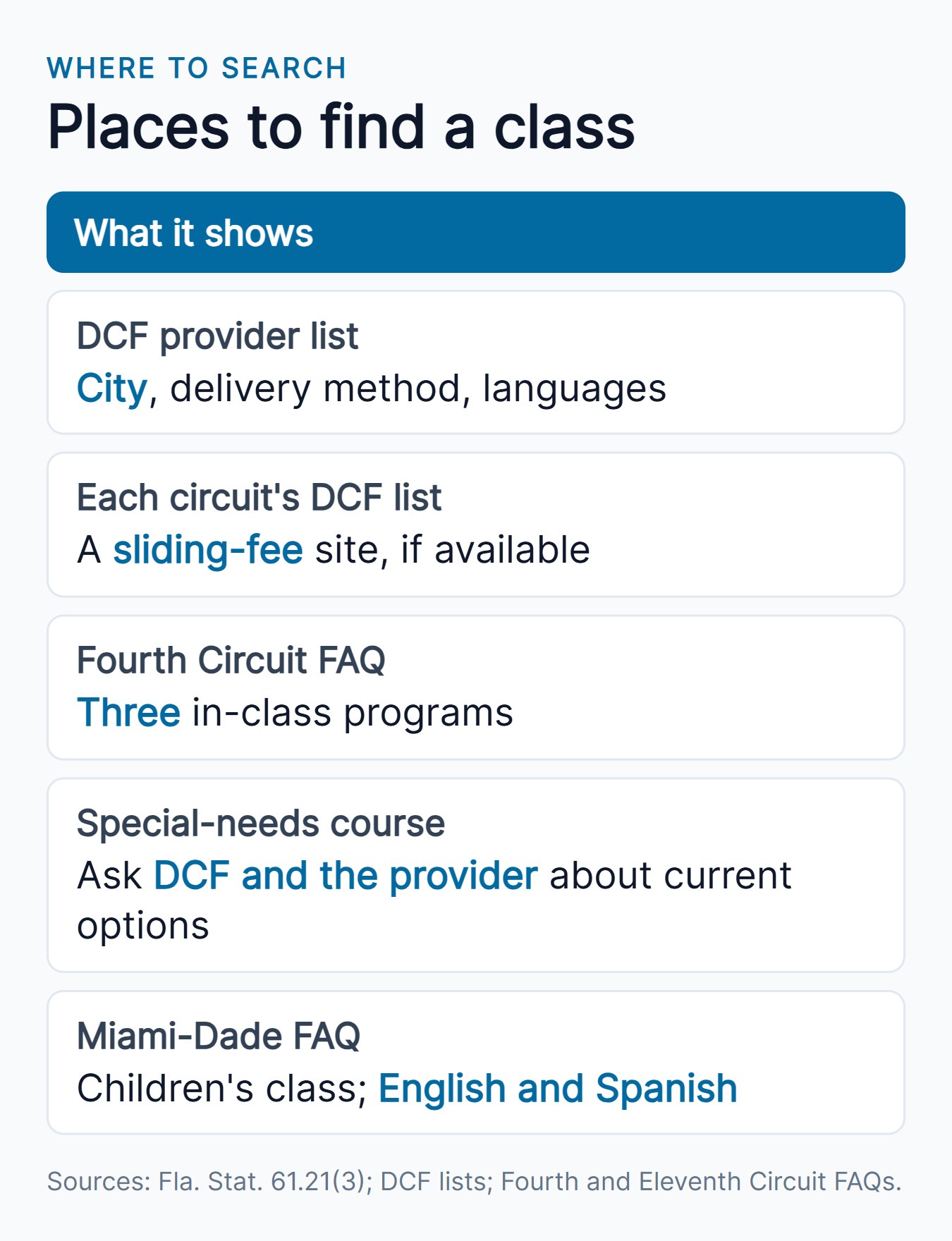
The circuit’s Family Court Services FAQ goes further. It says the courses “mandated by Administrative Order” are three named local programs. It adds, “YOU MUST REGISTER FOR ONE OF THE FOLLOWING IN-CLASS PARENTING CLASSES.”
The same FAQ answer also points parents to DCF’s list of local and online providers. So ask the circuit’s Family Court Services which class applies to your case.
Online courses are available statewide. Duval, Clay and Nassau generally require in-person attendance unless the court approves another format; obtain any required permission before taking an online course.
An Older DCF Warning
A 2014 DCF provider list carried a note: “Some Florida counties have Administrative Orders requiring parents to take the Course in a live-classroom setting.” It advised calling the local Family Court Office before taking a distance course. The list is old, but the advice still applies.
Finding Parenting Classes Near You
DCF’s provider list is the place to search. The page says its providers “are approved by the Florida Department of Children and Families.” Its columns help you sort local and online options:
- City. Where a local course meets.
- Delivery Method. How the course is given.
- Languages. Which languages it is offered in.
- Indigent Status. Options for parents who cannot pay full price.
- Exp. Date. When DCF’s approval ends.
Online courses are available statewide. Duval, Clay and Nassau generally require in-person attendance unless the court approves another format; obtain any required permission before taking an online course.
In-Person, Online and Correspondence Compared
The core rules are the same in every format. A few rules apply only to distance courses.
| Rule | In person | Online | Correspondence |
|---|---|---|---|
| At least 4 hours, test included | Yes | Yes | Yes |
| Lock against finishing in under 4 hours | Not addressed | Required | Not addressed |
| Instructor answers content questions in 1 business day | Not addressed | Required | Required |
| Identity of participants verified | Required | Required | Required |
| 70 percent to pass, unlimited attempts | Yes | Yes | Yes |
| Accepted by every court | No official source says so | No; Fourth Circuit requiresIn-person default; online needs court permission | No official source says so |
The length and identity rules come from DCF rule 65C-32.002. The test rules come from rule 65C-32.004. For online rules in depth, see court-ordered classes online.
Cost: Local vs Online
Florida sets no price for either format. Section 61.21(7) allows “a reasonable fee” for each parent. The fee rules are the same wherever you take the course:
- Sliding-fee sites. DCF must list at least one in each circuit, if available.
- Indigent options. DCF’s list shows each course’s indigent status.
- No retake charge. Providers may not charge more for the extra time needed to pass.
Some courts post their own fees. The Miami-Dade FAQ lists class fees and a fee waiver for incomes below federal poverty guidelines. The page is undated, so confirm current fees with the court.
Proof Works the Same in Any Format
The provider gives a certificate to each parent who completes the course and scores at least 70 percent. It must show the course name, the provider’s name and contact information, the curriculum name if any, and your start and finish dates.
Then each parent files proof with the court before the final judgment. The Ninth Circuit’s order has each party give the certificate to the Clerk of the Circuit Court. It also says out-of-state certificates “may be accepted by the Court.”
Taking the Class Apart From the Other Parent
Local or online, parents do not have to take the course together. Section 61.21(11) lets the court bar a joint class if there is a history of domestic violence. The Miami-Dade FAQ says parents may attend separately.
What either parent says in a session stays out of the case unless the parties agree in writing.
Deadlines Do Not Change With Format
The 45-day rule is the same for a local class and an online one. The petitioner finishes within 45 days after filing, and the other party within 45 days after service. Section 61.21(5) also says to begin “as expeditiously as possible.”
If your court requires a local class, contact the program early.
A circuit can also set an earlier step. The Seventh Circuit’s order asks parties to enroll within 20 days and finish before court-ordered mediation or trial. The Seventh Circuit’s order asks parties to enroll within 20 days and finish before court-ordered mediation or trial.
Online Courses Still Have an Instructor
An online course is not a course with no teacher. DCF rule 65C-32.002 says online and correspondence providers must let parents contact the instructor. Content questions must be answered within one business day.
Special-Needs Courses by Format
For children with special needs or emotional concerns, section 61.21 requires a course designed for those needs. Check DCF parent education information and ask the provider and court about a suitable course before enrolling.
Provider lists can change. Ask DCF and the provider to confirm which current course addresses your child’s needs, then check any court-permission requirement before enrolling.
Local Programs Beyond the Main Class
Some courts add their own programs, and those are local by nature. The Eleventh Circuit’s Miami-Dade FAQ says a child aged 6 to 17 must attend a 3½-hour class for children of divorcing parents. It also says classes are offered in English and Spanish.
How to Decide Between Local and Online
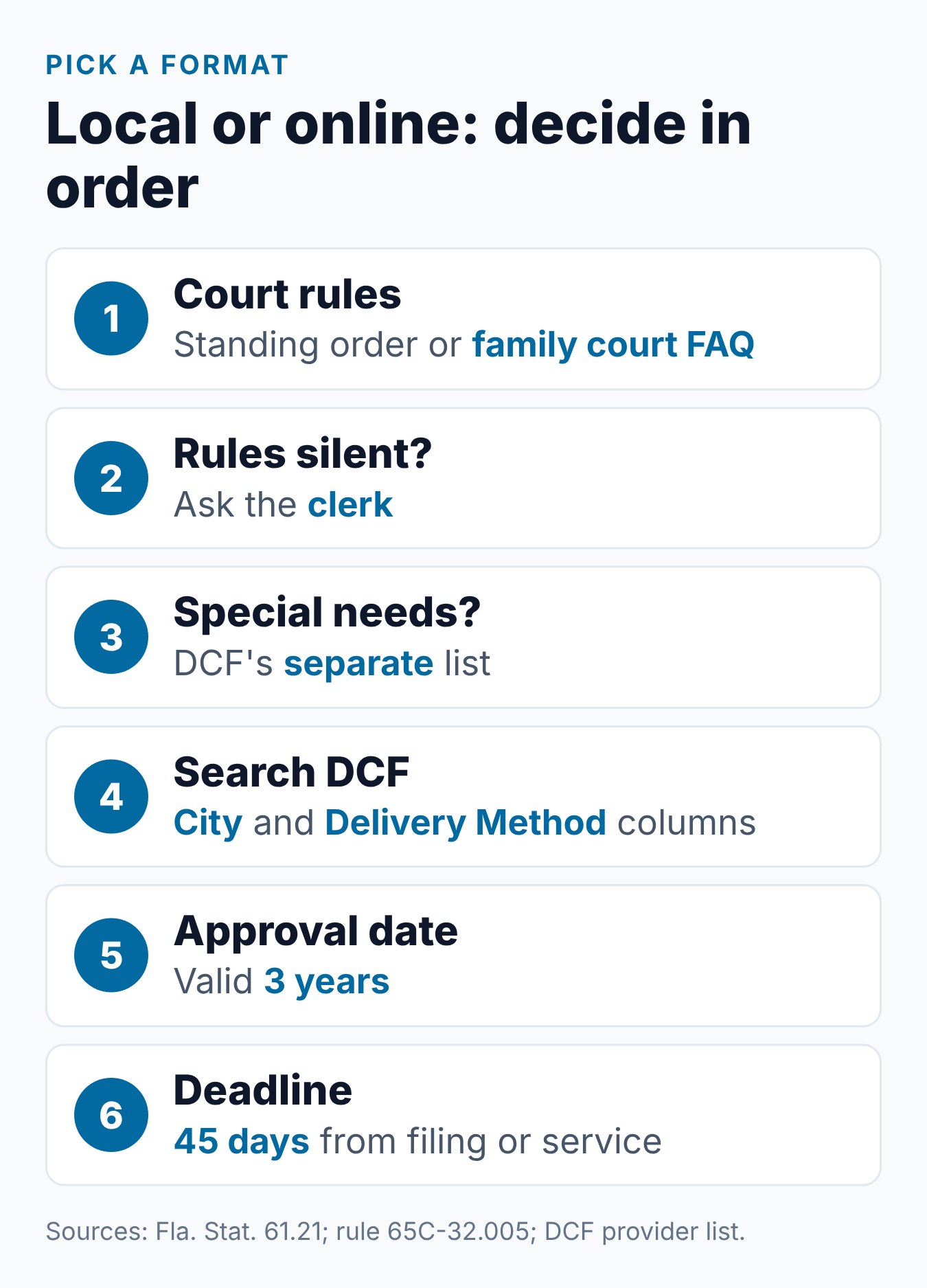
Work through these steps in order:
1. Read your court’s rules. Look for a standing order or a family court FAQ. 2. Ask the clerk if the rules are silent. Silence is not approval of online classes. For children with special needs or emotional concerns, section 61.21 requires a course designed for those needs. Check DCF parent education information and ask the provider and court about a suitable course before enrolling. 4. Search DCF’s list. Use the City and Delivery Method columns. 5. Check the expiration date. DCF approval lasts three years. 6. Plan for the deadline. Finish within 45 days of filing or service.
Questions for the Clerk About Format
If your court’s rules do not mention format, ask the clerk’s office:
- Does this court accept a DCF-approved online course?
- Does it accept a correspondence course?
- Is there a local order on parenting classes?
- Does this court keep its own list of local classes?
Write down who you spoke with and the date.
Guides in This Series
Each guide covers one question about choosing a class:
- Court-ordered vs voluntary classes: which class meets section 61.21.
- Questions to ask before you enroll: what to check with the provider and your court.
- Court-ordered classes online: why DCF approval matters for online courses.
- Labels vs DCF approval: why DCF’s list, not a badge, is the test.
Common Mistakes
Each one is based on section 61.21, a DCF rule or a court page:
- Buying online first and asking later. Online courses are available statewide. Duval, Clay and Nassau generally require in-person attendance unless the court approves another format; obtain any required permission before taking an online course.
- Reading silence as a yes. No other court page we read promised online acceptance.
- Skipping DCF’s list. Only DCF-approved courses meet section 61.21.
- Missing the children’s class. Miami-Dade requires one for ages 6 to 17.
- Waiting to register. The 45-day clock runs whatever format you choose.
What We Found on the Official Pages
Online courses are available statewide. Duval, Clay and Nassau generally require in-person attendance unless the court approves another format; obtain any required permission before taking an online course.
The Ninth Circuit’s order for Orange and Osceola did not address online versus in-person classes. It did say out-of-state certificates “may be accepted by the Court.”
How Requirements Can Vary
DivorceParentingClass.net is available online to parents in every Florida county. Section 61.21 sets the statewide parenting course requirement, and DCF approves courses. Availability online does not replace the instructions in your own case.
Duval, Clay and Nassau orders generally call for an in-person course. Court approval may allow another format; obtain any required permission before taking an online course.
Read the order for your county, case type and assigned judge. A Nassau order is not the standing order for every county in the Fourth Circuit.
Local instructions can also set registration, filing and completion steps. Keep any permission with your case records, finish by your applicable deadline, and file your own certificate as directed. An enrollment receipt is not proof that the court has accepted a certificate.
Laws, court orders and local rules can change. Check your court’s instructions, your county clerk’s website and DCF’s provider list before you enroll or file.
Frequently Asked Questions
Do I need an in-person class near me?
Only if your court requires it. The Fourth Circuit (Duval, Clay and Nassau) does, so check your court’s rules first.
Is an online class the same course as a local one?
Both must be DCF-approved and meet the same core rules, including at least 4 hours and a 70 percent test score.
How do I find local classes?
Use DCF’s provider list and read the City and Delivery Method columns. In the Fourth Circuit, use the court’s own list.
Does every county accept online classes?
Online courses are available statewide. Duval, Clay and Nassau generally require in-person attendance unless the court approves another format; obtain any required permission before taking an online course.
Is there a low-cost local option?
DCF must list at least one sliding-fee site in each circuit, if available. The list also shows each course’s indigent status.
Can I take the class in Spanish?
Check the Languages column on DCF’s list. The Miami-Dade court says its classes are offered in English and Spanish.
Is a local class longer than an online one?
Both must be at least 4 hours, including the test. Online courses must also stop anyone from finishing in less.
Can my ex and I take a local class together?
You may, but you do not have to. The court can bar a joint class if there is a history of domestic violence.
Conclusion
The choice between local and online parenting classes starts with your court, not with the class. Read your court’s rules, then search DCF’s list for a course in the format your court accepts. If online is allowed, you can consider DivorceParentingClass.net’s online Florida parent education course, after you confirm that your court accepts an online course.
Related Articles
- Parenting Classes Ordered by Court vs. Voluntary Classes
- Parenting Classes Approved by Court: Questions to Ask Before You Enroll
- Court Ordered Parenting Classes Online: Florida Rules
- Accredited Parenting Courses: What Does Accredited Mean for Florida Divorce?
- DCF Approved Parenting Classes and the Florida Divorce Class
Sources
- Florida Statutes § 61.21 — Parenting course
- Fla. Admin. Code R. 65C-32.001 — Definitions
- Fla. Admin. Code R. 65C-32.002 — Course length and delivery
- Fla. Admin. Code R. 65C-32.004 — Test and certificate
- Florida DCF — Parent education information
- Florida DCF — Approved course provider list
- Florida DCF — Courses for children with special needs or emotional concerns
- Nassau County — Standing Family Law Order (dissolution, PDF)
- Fourth Judicial Circuit — Family Court Services FAQ
- Ninth Judicial Circuit — Administrative Order 07-98-37-01 (PDF)
- Eleventh Judicial Circuit — Divorce Education Program FAQ
- Seventh Judicial Circuit — Order FM-2024-016-SC
Billy Forte is the owner of DivorceParentingClass.net.
This article is general information, not legal advice. Court rules, local practice, and case facts can differ by county, judge, and case type in Florida. Use official court and state sources, and consult a qualified Florida family law attorney for legal guidance specific to your case.