
Updated June 2026 · Reviewed by Billy Forte
A “DCF-approved parenting class” and a “Florida divorce parenting class” generally describe the same thing: the Parent Education and Family Stabilization Course from a provider approved by the Florida Department of Children and Families. “DCF-approved” points to who approves the course, while “divorce parenting class” describes when it’s required — but for a divorce with minor children, you need both qualities in one course. This guide untangles the terms so you choose a class that actually meets your court’s requirement.
Applies to the Florida Parent Education and Family Stabilization Course (Fla. Stat. 61.21). Requirements and acceptance can vary by court, county, judge, and case type, so review your court papers and official Florida sources.
Key Facts
- DCF-approved = the approval: It means the Florida Department of Children and Families approved the provider.
- Divorce parenting class = the context: It describes the course’s role in a divorce or family case.
- Same course: For a Florida divorce with minor children, you need a DCF-approved Parent Education and Family Stabilization Course.
- Approval drives acceptance: DCF approval is what makes the certificate valid for Florida family cases.
- Still check your court: Local filing rules can vary even when the course is DCF-approved.
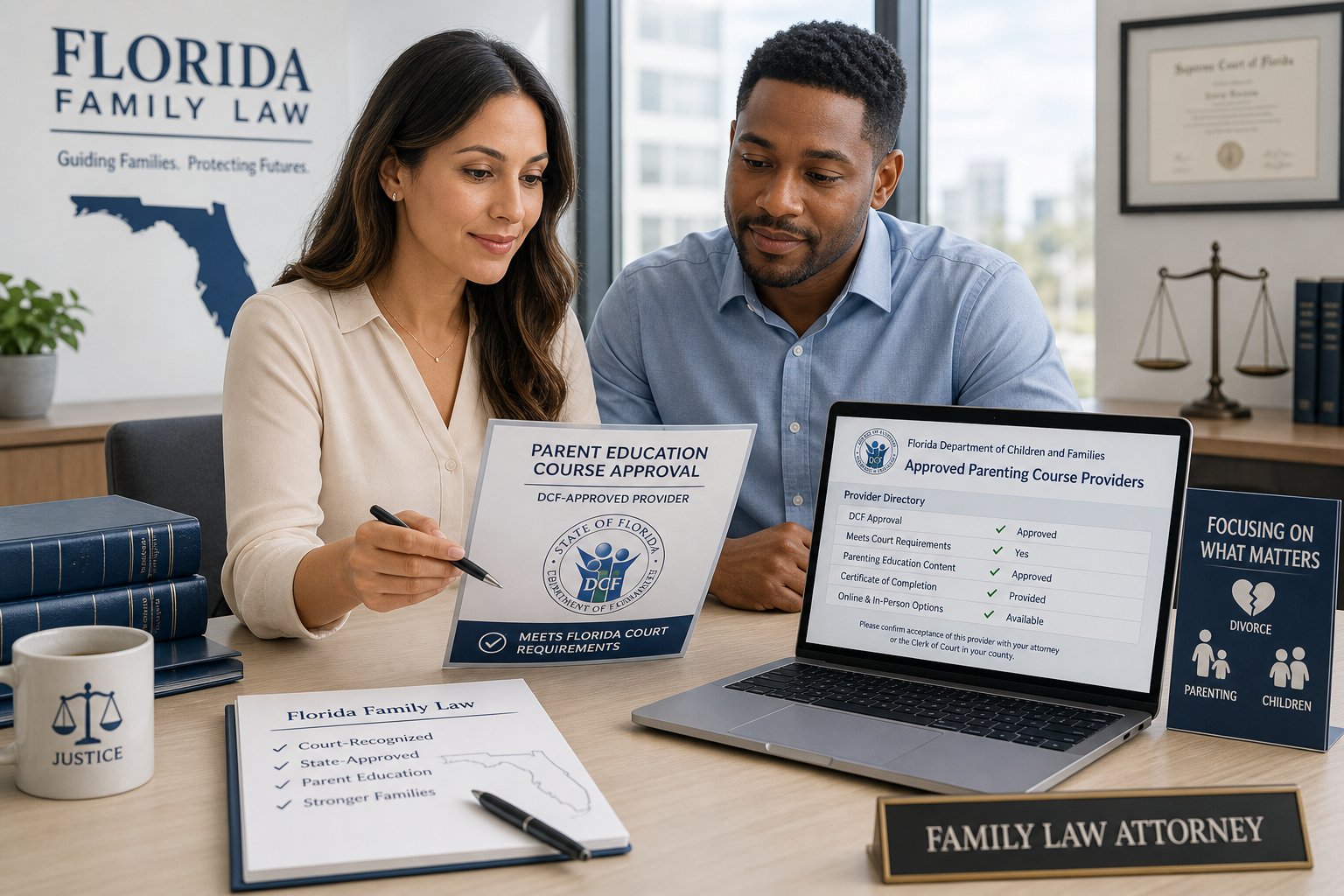
What A DCF-Approved Parenting Class Means In Florida
A DCF-approved parenting class in Florida usually refers to the state-recognized Parent Education and Family Stabilization Course. It is not a random parenting course. It is a course approved by the Florida Department of Children and Families for use in cases where Florida law requires parent education.
Under Florida Statutes section 61.21, courts generally require this course in certain family law cases involving minor children. The law is tied to divorce and related parenting issues, not to general child welfare training. So when people ask whether a DCF-approved parenting class is the same as the divorce parenting class, the practical answer is often yes in this setting: the approved course for many Florida divorce and parenting cases is the Parent Education and Family Stabilization Course.
Still, names can confuse people. Some providers call it a Florida divorce parenting class, others call it a Florida DCF parenting course, and courts may use the formal legal name. Those labels often point to the same required course, but you should confirm the provider is on the official DCF list. You can check that through the Florida Department of Children and Families.
The key point is simple:
- DCF-approved means the provider has state approval
- Parent Education and Family Stabilization Course is the formal Florida course name
- Divorce parenting class is a common plain-language name for the same requirement in many cases
That state approval matters. But state approval does not erase local court rules.
Who Usually Needs To Take The Course In Divorce, Custody, And Paternity Cases
In Florida, parents with minor children usually need the course when they are in a dissolution of marriage case. That is the most common setting. If you and the other parent are divorcing and share minor children, each parent is often required to complete the course.
The requirement also often appears in cases about time-sharing, parental responsibility, or paternity. Courts use the course to give parents basic education about how separation affects children and how co-parenting works under Florida law. The goal is not to punish either parent. The goal is to support better decisions for children while the case moves forward.
Common case types where the course may be required include:
- Divorce with minor children
- Paternity cases involving minor children
- Some actions involving parenting plans
- Some cases addressing time-sharing or parental responsibility
Florida Courts provide family law resources through the Florida Courts family page. Local circuits may also post their own instructions. Because practice can vary, always read your court papers closely.
If you are not sure whether your case requires the class, check:
- Your summons or court order
- The family law packet for your county
- Your judicial circuit website
- The Clerk of Court instructions for filing
If the court says you must complete it, do not wait. Deadlines can arrive faster than people expect.
How Online Florida Parenting Classes Work From Registration To Certificate
Most online Florida parenting classes follow a simple path. You register, pay, complete the course, and get a certificate of completion. The course must still meet Florida rules, so ease of use does not replace the need for state approval.
A typical online process looks like this:
- Choose a DCF-approved provider
- Create an account online
- Enter your contact details and case details if requested
- Complete the required course material
- Finish any quizzes or final step required by the provider
- Download, print, or email your certificate
Florida’s course is generally at least 4 hours long. Many providers offer the class in self-paced modules. That means you can often log in from a phone, tablet, or computer and complete sections over time.
For example, DivorceParentingClass.net offers the Florida Parent Education and Family Stabilization Course online through a DCF-approved provider. For many parents, that format is easier than finding an in-person class, especially when work, child care, and court stress all hit at once.
Before you register, make sure the certificate includes the right course name and provider details. After you finish, save the PDF right away and keep a copy in more than one place. You may need it for filing, emailing, or later court review.
What To Check Before Choosing A Provider
The first thing to check is whether the provider is truly DCF-approved. If the provider is not on the state list, the class may not meet Florida’s parent education requirement. That can cost you more time and more money.
You should also check whether the course is clearly labeled Parent Education and Family Stabilization Course. Some sites offer general parenting education, co-parenting support, or anger management. Those may be useful in other settings, but they are not the same as Florida’s required course.
Use this checklist before you enroll:
- Confirm the provider appears on the Florida Department of Children and Families list
- Confirm the course is the Florida Parent Education and Family Stabilization Course
- Check whether your county or circuit gives extra filing instructions
- Make sure the provider gives a certificate of completion you can download
- Review the provider’s support options in case you need help
- Check whether the provider mentions local court practices without promising guaranteed acceptance
You can also review county court or clerk pages for local guidance. For example, many circuits post family law forms and instructions through their own court websites or clerk sites.
A good provider helps you complete the course clearly and gives you the documents you need. But no provider should promise results that depend on your judge or local court.
Court Approval, County Acceptance, And Certificate Filing
Finishing the class is only part of the job. The court usually needs proof that you completed it. That proof is your certificate of completion.
In many Florida family cases, the certificate must be filed in the case record. A final judgment may be delayed until required certificates are filed. That is one reason people get confused about “DCF-approved” versus “court-approved.” A provider may be approved by DCF, but you still must follow local court steps for filing and acceptance.
Here is the practical rule: state approval and court filing are related, but not identical.
You may need to do one or more of these steps:
- Download your certificate
- File it with the Clerk of Court
- Upload it through an e-filing system if allowed
- Provide your case number if the provider offers filing help
- Bring a copy to a hearing if instructed
Local practice can vary by county, court, judge, and case type. Some courts accept online course certificates with no issue when the provider is on the DCF list and the course matches the legal requirement. Others may have specific instructions about where or how to file.
So always read your court order and local instructions. If you are ready to enroll, you can take the online Florida Parent Education and Family Stabilization Course at DivorceParentingClass.net and then follow your county’s filing rules carefully.
What The Parent Education And Family Stabilization Course Covers
The course teaches basic facts about how separation affects children and parents. It also explains core Florida parenting issues in simple terms. The purpose is to reduce conflict and help parents make safer, steadier choices.
While each approved provider may present the material in its own format, Florida-approved courses generally cover topics such as:
- The effects of divorce or separation on children
- The effects of divorce or separation on parents
- Parental responsibility and co-parenting basics
- Time-sharing and parenting plan concepts
- Ways to communicate with the other parent
- How to reduce conflict around children
- Awareness of domestic violence and child abuse issues
- Resources for families who need more support
Many courses also explain why children do better when parents avoid putting them in the middle of adult conflict. That can mean not using children as messengers, not speaking badly about the other parent in front of them, and keeping routines more stable.
You should not expect the course to give legal advice about your exact case. Instead, it gives broad education that supports better parenting decisions during a family case. For official court forms and statewide family law resources, Florida Courts.
Deadlines, Course Length, And What Happens If You Do Not Complete It
Florida deadlines matter. In many cases, the petitioner must complete the course within 45 days after filing, and the respondent must complete it within 45 days after service. Similar timing may apply in paternity cases, depending on the case and court instructions.
The course is generally at least 4 hours long under Florida rules. Some providers may offer longer versions if a court order requires more. But for many standard cases, the approved Parent Education and Family Stabilization Course is the required starting point.
If you do not complete the course on time, the court may take the delay seriously. Depending on the case, that may include:
- Delay of hearings or final judgment
- Orders to complete the course by a set date
- A finding of contempt
- Limits affecting shared parental responsibility or time-sharing until you comply
That does not mean every late case ends the same way. Courts look at facts, orders, and local practice. But missing the deadline can create avoidable problems.
The safest next step is simple. Check your order, confirm the provider is DCF-approved, complete the class, and file your certificate as instructed. If you need an online option, DivorceParentingClass.net offers the Florida course for parents who need to meet this requirement.
FAQ
Is a DCF-approved parenting class the same as the Florida divorce parenting class?
Generally yes. For a Florida divorce with minor children, the required class is a DCF-approved Parent Education and Family Stabilization Course — “DCF-approved” and “divorce parenting class” describe the same course from different angles.
What does DCF approval mean?
It means the Florida Department of Children and Families approved the provider to offer the required parenting course. That approval is what makes the certificate valid statewide.
Does the name on the website matter?
Less than the approval. Whatever a provider calls it, confirm it’s DCF-approved and is the four-hour Parent Education and Family Stabilization Course.
Will any DCF-approved class be accepted by my court?
Usually, but local filing rules vary. Confirm your court’s instructions, since acceptance can differ by court and county even for approved courses.
Conclusion
These terms trip people up, but they point to one course: a DCF-approved Parent Education and Family Stabilization Course for your Florida family case. Focus on the approval and the course content rather than the label a provider uses, and confirm your court’s filing rules. That keeps you from paying for a class that doesn’t meet the requirement.
You can complete a DCF-approved Parent Education and Family Stabilization Course online for your Florida case.
Related Articles
- Florida Parenting Class Online: Court-Approved 4-Hour Course Guide
- Court-Approved Parenting Classes in Florida: How to Choose One
- Florida Parenting Class vs. Parent Education Course: Different Names Explained
- What Is the Parent Education and Family Stabilization Course in Florida?
Sources
Billy Forte is the founder of Divorce Parenting Class, which offers a Florida DCF-approved online Parent Education and Family Stabilization Course. The brand focuses on clear, supportive, plain-English guidance to help Florida parents complete the court-required class and file their certificate.
This article is general information, not legal advice. Florida family-law requirements and certificate acceptance can vary by court, county, judge, and case type, so review your court papers and official Florida sources, or consult a family-law attorney, before acting.