
Updated June 2026 · Reviewed by Billy Forte
For a court-ordered parenting class, taking it online is usually fine — but state approval is what makes it count, because not every online class is recognized for a Florida case. The course must be the DCF-approved Parent Education and Family Stabilization Course, or the certificate may not satisfy your court. This guide explains why state approval matters so much for court-ordered classes and how to confirm an online course qualifies.
Applies to the Florida Parent Education and Family Stabilization Course (Fla. Stat. 61.21). Requirements and acceptance can vary by court, county, judge, and case type, so review your court papers and official Florida sources.
Key Facts
- Approval is the point: A court-ordered class must be DCF-approved to satisfy a Florida case.
- Not every online class counts: Some online courses aren’t approved for Florida’s requirement.
- Same course online: A DCF-approved online course is the same Parent Education and Family Stabilization Course.
- Verify the provider: Check the Florida DCF approved-provider list before enrolling.
- Confirm court acceptance: Approval plus your court’s instructions determine whether it’s accepted.
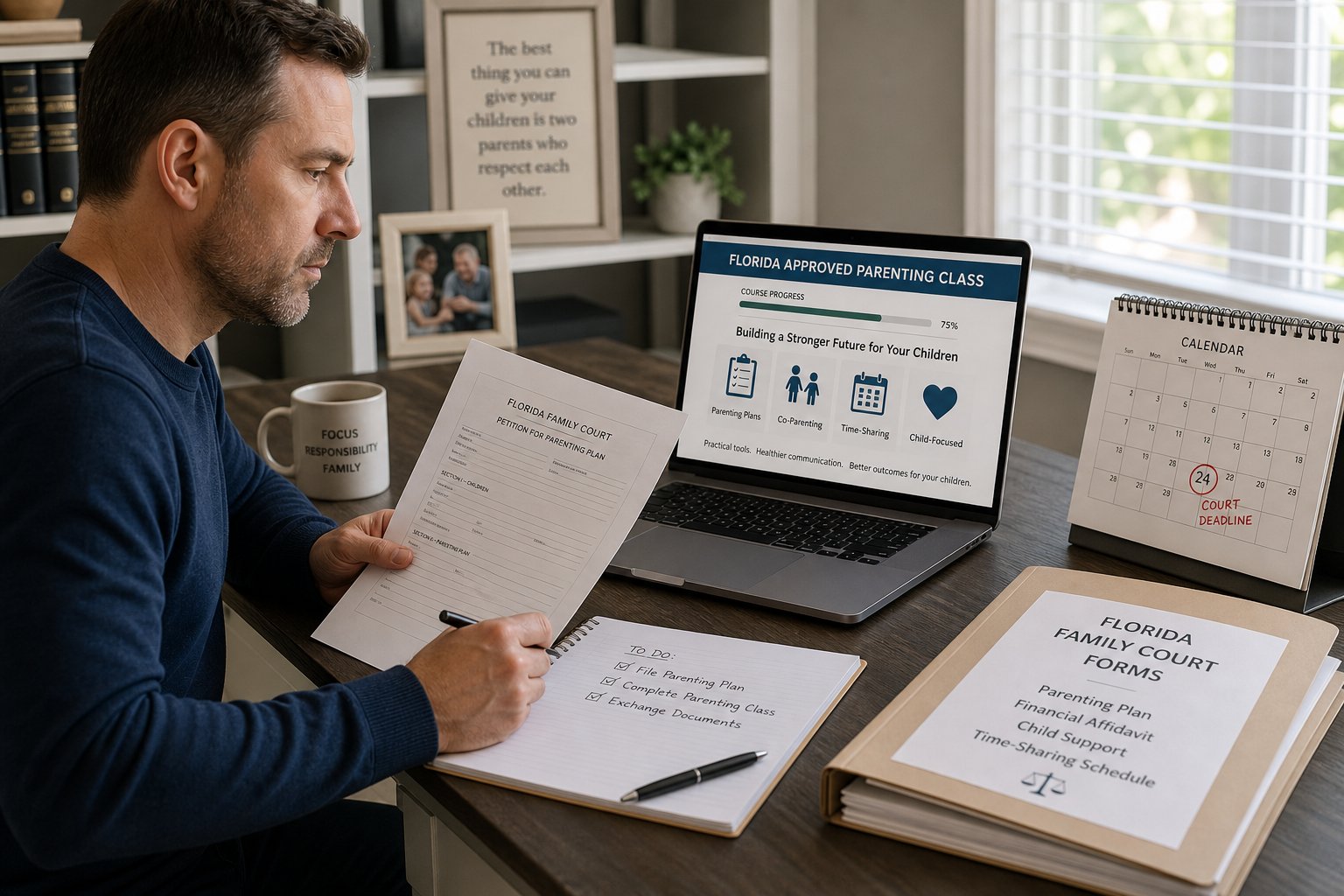
Who Needs A Court-Ordered Parenting Class In Florida
Florida generally requires this class when parents with minor children are involved in a divorce. The formal course name is the Parent Education and Family Stabilization Course. You may also hear people call it a court-ordered parenting class online, but in Florida the official name matters.
The main rule comes from Florida Statutes section 61.21. That law says parents in many dissolution of marriage cases with minor children must complete an approved course. Courts often use the class to help parents reduce conflict and focus on the child’s needs during and after the case.
This requirement can also show up in other family law cases. For example, some courts require it in:
- Paternity cases
- Time-sharing disputes
- Cases involving a parenting plan
- Cases dealing with parental responsibility
Still, requirements are not identical in every case. Your court, county, judge, and case type can affect what you must do and when you must do it.
That is why the safest answer is simple: do not assume any class will work. Check your court papers. Then review your county court or clerk instructions. You can also look at Florida Courts family law resources for general court information.
If your order or filing packet says you must complete the course, act early. Deadlines can matter, and a late certificate can create problems in your case.
What The Florida Parent Education And Family Stabilization Course Covers
The Florida course is not just a box to check. It covers basic topics the state wants parents to understand when a family case affects children. Under Florida rules, the course must meet state standards and run for at least 4 hours.
A DCF-approved provider should cover topics such as:
- The effect of divorce or separation on children
- The effect of family conflict on parents
- Child development and emotional needs
- Co-parenting skills and respectful communication
- Ways to reduce a child’s exposure to conflict
- Problem solving around time-sharing and daily routines
The goal is practical. Florida wants parents to better understand how conflict can affect children and how to support stability during a case. That matters when families are making or updating a parenting plan.
A good course will explain how children of different ages may react to change. It should also teach parents how to avoid putting children in the middle of adult disputes. Even small shifts, like not using a child to carry messages, can lower stress.
You can review state agency information through the Florida Department of Children and Families and confirm whether a provider is approved before you register. That extra check can save time and money.
How Online Parenting Classes Work From Registration To Certificate
Most Florida online classes follow a simple path. You register, complete the lessons, finish any quiz or test the provider requires, and then receive your certificate of completion.
Here is how the process often works:
- Register online. You create an account and pay the course fee.
- Complete the lessons. Most approved programs are self-paced and available 24/7.
- Take quizzes or a final test if required. Policies vary by provider.
- Get your certificate. Many providers offer a PDF download after completion.
Many online courses work on a phone, tablet, or computer. That helps if you need flexibility around work, school pickup, or other family duties. You can usually log out and return later, as long as you finish within the provider’s access period.
But details differ. Some programs give instant certificates. Others may take longer. Some have multiple test attempts. Others may limit retries. Some courts or attorneys may want the certificate in a certain form.
After you finish, follow your local instructions. In many cases, you may need to file the certificate with the Clerk of Court, give it to your lawyer, or bring it to a hearing. Check your county’s website or your court order before you submit anything.
If you want a Florida-specific option, DivorceParentingClass.net offers a Florida Parent Education and Family Stabilization Course online through a DCF-approved provider.
What To Look For In A Court-Accepted Online Class
The most important point is this: a class can be online and still be wrong for your case. You need a course that matches Florida’s rules and your local court’s directions.
Start with the basics. The course should clearly say it is a DCF-approved Parent Education and Family Stabilization Course for Florida. It should also explain how you get proof after completion and whether the course meets the state’s 4-hour minimum.
A useful provider should make key facts easy to find. Look for:
- Florida approval status
- The full course name
- Length of the class
- Certificate details
- Contact information for support
- Clear pricing and access terms
Then check the local side. Even if a provider is approved, your county court may have its own instructions. That is why approval and acceptance are related, but not always identical.
DCF Approval, County Acceptance, And Proof Of Completion
DCF approval is the first filter. Florida uses approved providers for this course type, and that status matters. You can verify provider information through the Florida Department of Children and Families.
But local court instructions matter too. Some providers say they are accepted widely, and that may be true in many places. Still, your own county, judge, and case type control what your court expects. If your paperwork is unclear, check your county court or clerk website. For example, many counties post family case instructions through the clerk or court administration pages.
Proof also matters. The provider should explain exactly what your certificate of completion includes. Your court may need your name, the course name, and the completion date. Keep a copy for your records.
Course Access, Cost, And Retake Policies
Convenience matters, but it should come after approval. Once the course fits your case, compare the user details.
Check these items before you sign up:
- Access window: How long can you use the course?
- Device support: Can you use your phone or tablet?
- Total cost: Are there extra fees for the certificate?
- Retake rules: Can you retry quizzes or a final exam?
- Support: Can you reach someone if you have a problem?
Florida course prices often vary. Some providers are low cost, while others charge more for faster certificate handling or added support. Also, some programs offer multiple test attempts, while others do not. Read the policy page before you pay.
If speed matters, look at certificate delivery details closely. A provider that gives a clear PDF right after completion can help you avoid last-minute stress.
How To Choose The Right Online Parenting Class For Your Case
Choose the course that fits both Florida approval rules and your local court’s instructions. That is the safest way to meet the requirement fast and correctly.
A simple checklist helps:
- Confirm the course is a Florida Parent Education and Family Stabilization Course
- Verify the provider is a DCF-approved provider
- Review your court order, filing packet, or county instructions
- Check whether your case involves divorce, paternity, time-sharing, or parental responsibility
- Make sure the certificate format works for your court
- Compare cost, access time, and support
If you want a Florida-only option, DivorceParentingClass.net offers an online course built for this requirement. The site states that its program is DCF-approved, online, and designed for parents who need to complete the Florida course on their own schedule.
Before you enroll, match the provider to your case papers. Then, if needed, confirm instructions with your county court, attorney, or the Clerk of Court. That small step can prevent delays.
If you are ready to move forward, you can take the Florida Parent.
FAQ
Can any online class satisfy a court-ordered parenting requirement?
No. For a Florida case, the online class must be the DCF-approved Parent Education and Family Stabilization Course. An unapproved online class generally won’t satisfy a court-ordered requirement.
Why does state approval matter so much?
Because approval is what makes the certificate count. A class can look professional yet not be approved for Florida’s requirement, in which case the court may not accept it.
How do I confirm an online class is approved?
Check the provider against the Florida DCF approved-provider list, and confirm your court accepts the online format for your case.
Is an approved online class the same as an in-person one?
Yes. A DCF-approved online course covers the same required material and produces the same certificate. The difference is format, not whether it counts.
Conclusion
With a court-ordered class, the format matters less than the approval: an online course is fine as long as it’s the DCF-approved Parent Education and Family Stabilization Course. That single check — verifying approval before you enroll — is what ensures the certificate satisfies your case. Confirm the provider’s approval and your court’s acceptance, and an online class works just as well as a local one.
To be sure it counts, complete the DCF-approved Parent Education and Family Stabilization Course online for your court-ordered requirement.
Related Articles
- Divorce Parenting Class Near Me vs. Online Class in Florida
- Accredited Parenting Courses: What Does Accredited Mean for Florida Divorce?
- Parenting Classes Approved by Court: Questions to Ask Before You Enroll
- Parenting Classes for Court vs. Voluntary Parenting Classes
Sources
Billy Forte is the founder of Divorce Parenting Class, which offers a Florida DCF-approved online Parent Education and Family Stabilization Course. The brand focuses on clear, supportive, plain-English guidance to help Florida parents complete the court-required class and file their certificate.
This article is general information, not legal advice. Florida family-law requirements and certificate acceptance can vary by court, county, judge, and case type, so review your court papers and official Florida sources, or consult a family-law attorney, before acting.