
Updated June 2026 · Reviewed by Billy Forte
The “Florida parenting class” and the “Parent Education and Family Stabilization Course” are the same court requirement — one is the everyday nickname, the other is the official name in Florida law. People also call it the divorce parenting class, the family stabilization class, or the four-hour parenting course, which causes a lot of confusion. This guide clears up the names so you can be confident you’re signing up for the right course.
Applies to the Florida Parent Education and Family Stabilization Course (Fla. Stat. 61.21). Requirements and acceptance can vary by court, county, judge, and case type, so review your court papers and official Florida sources.
Key Facts
- Same requirement: “Florida parenting class” is the common name for the official Parent Education and Family Stabilization Course.
- Official name: Florida law (Statute 61.21) calls it the Parent Education and Family Stabilization Course.
- Other nicknames: Divorce parenting class, family stabilization class, and four-hour parenting course all refer to it.
- One DCF-approved course: Whatever the name, you need the DCF-approved four-hour course.
- Not a different class: The varied names don’t mean different requirements for the same case.
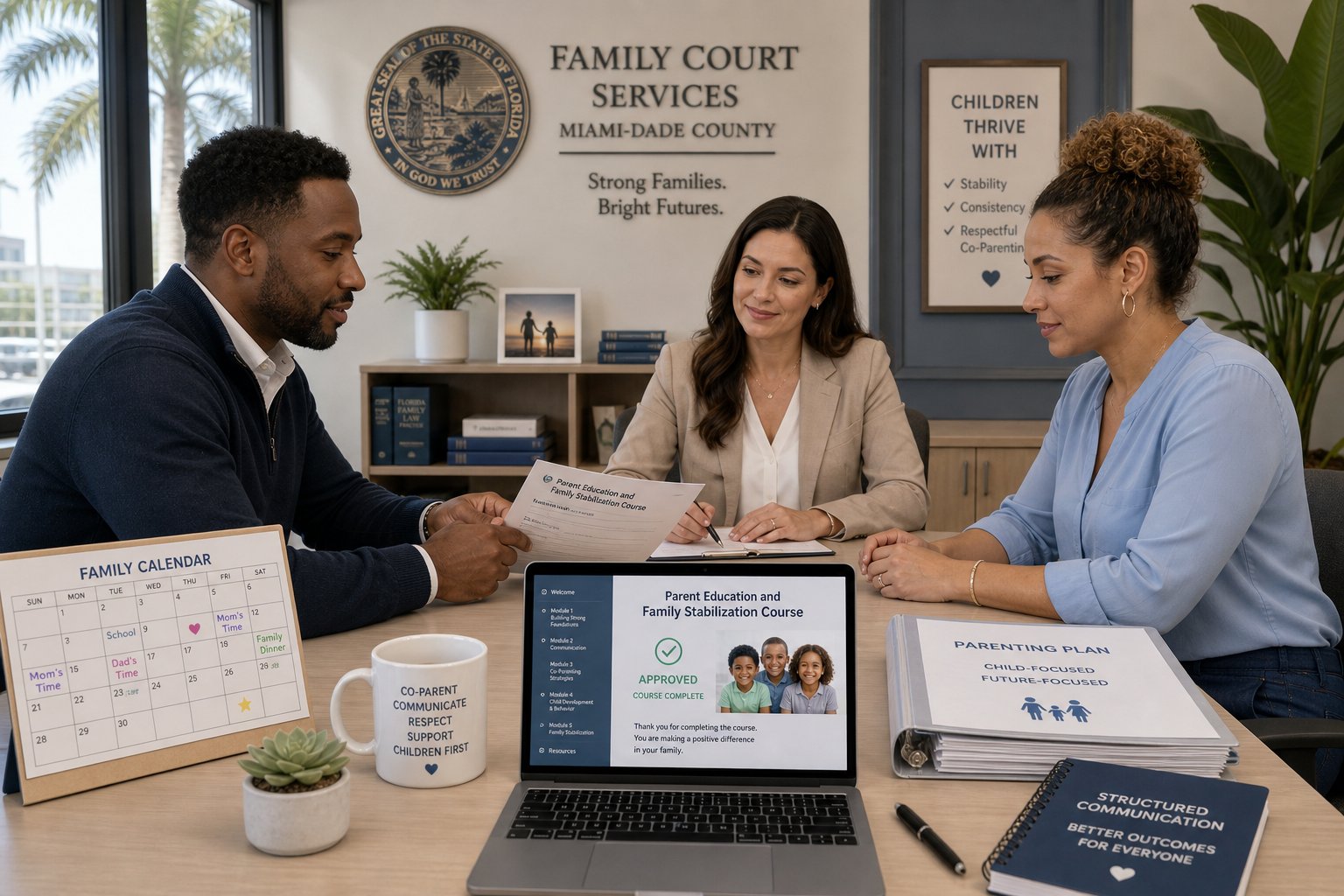
What The Florida Parenting Class Is And Why The Court Requires It
The Florida parenting class is the state’s Parent Education and Family Stabilization Course. In most Florida divorce cases with minor children, this is not an extra option. It is a court requirement.
Under Florida Statutes section 61.21, the court generally requires parents to complete an approved course before a final judgment when minor children are involved. The goal is simple. The state wants parents to understand how family change can affect children and how to reduce harm.
This course is not about picking a winner between parents. It is about helping both parents support their children during divorce, separation, or other family law cases. The court uses it to encourage better co-parenting, safer communication, and more stable routines for children.
You may also hear different names for the same basic requirement, such as:
- Florida parenting class
- Parent Education and Family Stabilization Course
- divorce parenting class
- parent education course
In Florida, those names often point to the same 4-hour course requirement. But local practice still matters. Some courts post their own instructions, approved lists, or filing steps through the circuit court or Clerk of Court.
That is why the safest view is this: the names are often different, but the required course is usually the same. Still, you should read your court papers and local family court instructions closely.
Who Must Take The Parent Education And Family Stabilization Course In Florida
In Florida, both parents usually must take the course when they are part of a divorce with minor children. That includes the petitioner and the respondent.
The requirement also often applies in paternity actions when the case involves:
- parental responsibility
- time-sharing
- child support involving minor children
This matters because many parents think only the filing party has to do it. That is usually not true. Florida courts generally expect each party to complete the course before the case can move to final judgment.
The rule comes up most often in cases about:
- dissolution of marriage with minor children
- paternity
- parenting plans
- custody-related issues tied to time-sharing
Still, not every family case works the same way. Your exact duty can depend on the court, county, judge, and case type. Some local courts post family law packets and instructions through Florida Courts or county clerk websites. Those pages often explain when the course is required and how to show proof.
If your case involves minor children and court orders about parenting, assume the course may be required unless your court says otherwise. Then confirm the rule in your case file, local court forms, or with the Clerk of Court.
How The Online Florida Parenting Class Works From Registration To Certificate
Most online Florida parenting classes follow the same basic steps. You choose a provider, register, complete the lessons, and get a certificate of completion.
First, make sure the provider is a DCF-approved provider. Florida approves these courses through the Florida Department of Children and Families. Some circuits also publish local provider information or acceptance notes. A provider may be DCF-approved, but you should still follow any local court instructions.
Next, you register online. Many providers let you take the course on a phone, tablet, or computer. The course is usually self-paced, which helps if you are working, caring for children, or handling court deadlines.
Florida’s course is generally a minimum 4-hour class. Depending on the provider, you may complete:
- lesson modules
- short quizzes
- knowledge checks
- a final test or review step
After you finish, the provider issues your certificate. Some courses let you download it right away. Others may mail it or offer faster delivery options.
Then you must follow your court’s filing process. In some counties, you may file the certificate with the court. In others, local instructions may tell you where and how to submit it. Keep a copy for your records.
If you want an online option, you can review the Florida Parent Education and Family Stabilization Course offered by DivorceParentingClass.net, then compare it with your local court instructions before you enroll.
What The Course Covers About Children, Co-Parenting, And Family Change
The course focuses on how divorce and separation affect children and what parents can do to lower stress and conflict. It is practical, not just legal.
Most Florida-approved courses cover the effect of family change on children at different ages. A toddler may react one way. A teen may react another way. The class explains common signs of stress, changes in behavior, and healthy ways to support children through change.
You can also expect lessons on:
- children’s emotional and social needs
- how conflict between parents affects children
- co-parenting skills
- building and following a parenting plan
- shared parental responsibility and time-sharing concepts
- respectful communication
- problem solving after separation
Many courses also address serious issues that can affect family safety and child well-being, such as domestic violence, substance abuse, and the need for community support. Some include local or general resource information for counseling and family services.
The course is not meant to solve every dispute. But it can help you see how daily choices affect your child. Small changes matter. Clear handoffs, calm messages, and steady routines can reduce stress for children.
That is one reason Florida courts require the class. The court wants parents to make decisions with the child’s needs in mind, not just the conflict between adults.
Florida Court Approval, DCF Acceptance, And County Certificate Questions
A key point is this: DCF approval matters, but local court instructions still matter too. These are connected, not identical.
The Florida Department of Children and Families approves providers for the Parent Education and Family Stabilization Course. If a course is not from a DCF-approved provider, that is a major warning sign. In most cases, you should not use it.
But DCF-approved does not erase local procedure. Your county or judicial circuit may have its own:
- filing instructions
- accepted provider lists or references
- family law forms
- certificate submission rules
Some parents ask whether court-approved and DCF-approved mean the same thing. Often, people use those terms loosely. In practice, DCF-approved provider is the official Florida approval concept. Still, your judge or local court may expect you to follow county-specific instructions about how the certificate reaches the file.
This is why you should check three things:
- The provider is DCF-approved.
- Your local court does not give different filing instructions.
- Your certificate matches the name used in your case record.
You can review local court resources through Florida Courts and your county Clerk of Court website. If the court posts a family law page, read that page before you submit your certificate.
Deadlines, Completion Rules, And What Happens If You Do Not Finish On Time
Florida courts often set strict deadlines for this course. If you miss them, your case can slow down or get more complicated.
In many Florida family cases, the petitioner must complete the course within 45 days of filing. The respondent often must complete it within 45 days of service. In paternity matters, the timing may depend on the court order or local rule tied to the case. Always check your own papers.
The court generally wants both parents to finish before final judgment. That means waiting too long can create avoidable problems. A missing certificate may delay hearings or final orders.
Possible consequences can include:
- delay of the final judgment
- court orders to complete the course
- contempt issues
- negative effects tied to requests about time-sharing or parental responsibility
That does not mean the same outcome happens in every county or every case. But it does mean the requirement is serious.
Completion rules also matter. You usually must finish the full course, not just part of it. If a provider requires quizzes or a final step, you must complete those too before the certificate is issued.
If you have a deadline in your case, enroll as soon as you confirm the right provider and filing steps. Waiting can create problems that are hard to fix.
How To Choose The Right Florida Parenting Class For Your Situation
The right class is one that meets Florida requirements and fits your court process. Start with approval, then look at convenience.
First, confirm the provider is approved by the Florida Department of Children and Families. That is the basic screen. After that, check whether your circuit court or county clerk posts local guidance.
Then compare practical details, such as:
- online or live format
- phone, tablet, or computer access
- English or Spanish options
- cost
- how the certificate of completion is delivered
- customer support if you have filing questions
If you want a fully online option, DivorceParentingClass.net offers a Florida course built for parents who need flexible access from home or on the go. It is still smart to compare that option with your local court instructions, especially if your county has special filing steps.
A good rule is simple. Do not pick based on price alone. Pick a course that is clearly Florida-focused, from a DCF-approved provider, and easy for you to complete on time.
The names may vary, but the next step is usually the same: confirm your court’s instructions, choose an approved Florida course, complete the 4-hour requirement, and file your certificate the way your court expects.
FAQ
Is the Florida parenting class the same as the Parent Education and Family Stabilization Course?
Yes. “Florida parenting class” is the everyday name; the Parent Education and Family Stabilization Course is the official name under Florida Statute 61.21. They’re the same requirement.
Why are there so many names?
People use nicknames like divorce parenting class, family stabilization class, or four-hour parenting course. They all point to the same DCF-approved Florida requirement.
Do I need to take more than one course?
No. Despite the different names, it’s a single requirement. You need one DCF-approved four-hour course and one certificate per parent.
How do I make sure I pick the right one?
Confirm the provider is DCF-approved and the course is the four-hour Parent Education and Family Stabilization Course. That’s the course Florida courts require.
Conclusion
The takeaway is simple: the many names all describe one course. Whether your paperwork says “parenting class,” “family stabilization course,” or the full official title, you’re looking for the same DCF-approved four-hour requirement. Confirm the approval and the length, and the naming confusion stops mattering.
Whatever it’s called on your paperwork, you can complete the DCF-approved Parent Education and Family Stabilization Course online.
Related Articles
- Florida Parenting Class Online: Court-Approved 4-Hour Course Guide
- What Is the Parent Education and Family Stabilization Course in Florida?
- DCF Approved Parenting Classes vs. Florida Divorce Parenting Class
- 4-Hour Parenting Class Florida: What the Course Includes
Sources
Billy Forte is the founder of Divorce Parenting Class, which offers a Florida DCF-approved online Parent Education and Family Stabilization Course. The brand focuses on clear, supportive, plain-English guidance to help Florida parents complete the court-required class and file their certificate.
This article is general information, not legal advice. Florida family-law requirements and certificate acceptance can vary by court, county, judge, and case type, so review your court papers and official Florida sources, or consult a family-law attorney, before acting.