
Updated June 2026 · Reviewed by Billy Forte
Yes, parents generally still need the Florida parenting class even if they agree on everything, because mutual agreement doesn’t remove the Parent Education and Family Stabilization Course requirement in a case with minor children. The court still typically needs each parent’s certificate before the final judgment, though a judge may excuse a parent for good cause. This guide explains why agreement doesn’t end the requirement and what to do instead.
Applies to the Florida Parent Education and Family Stabilization Course (Fla. Stat. 61.21). Requirements and acceptance can vary by court, county, judge, and case type, so review your court papers and official Florida sources.
Key Facts
- Agreement isn’t a waiver: Agreeing on terms doesn’t remove the course requirement.
- Still both parents: Each parent generally completes the course and files a certificate.
- Court decides exceptions: Only a judge can excuse a parent, for good cause.
- Before final judgment: Certificates are typically needed before the case is finalized.
- Plan for it: Treat the course as a required step even in a fully agreed case.
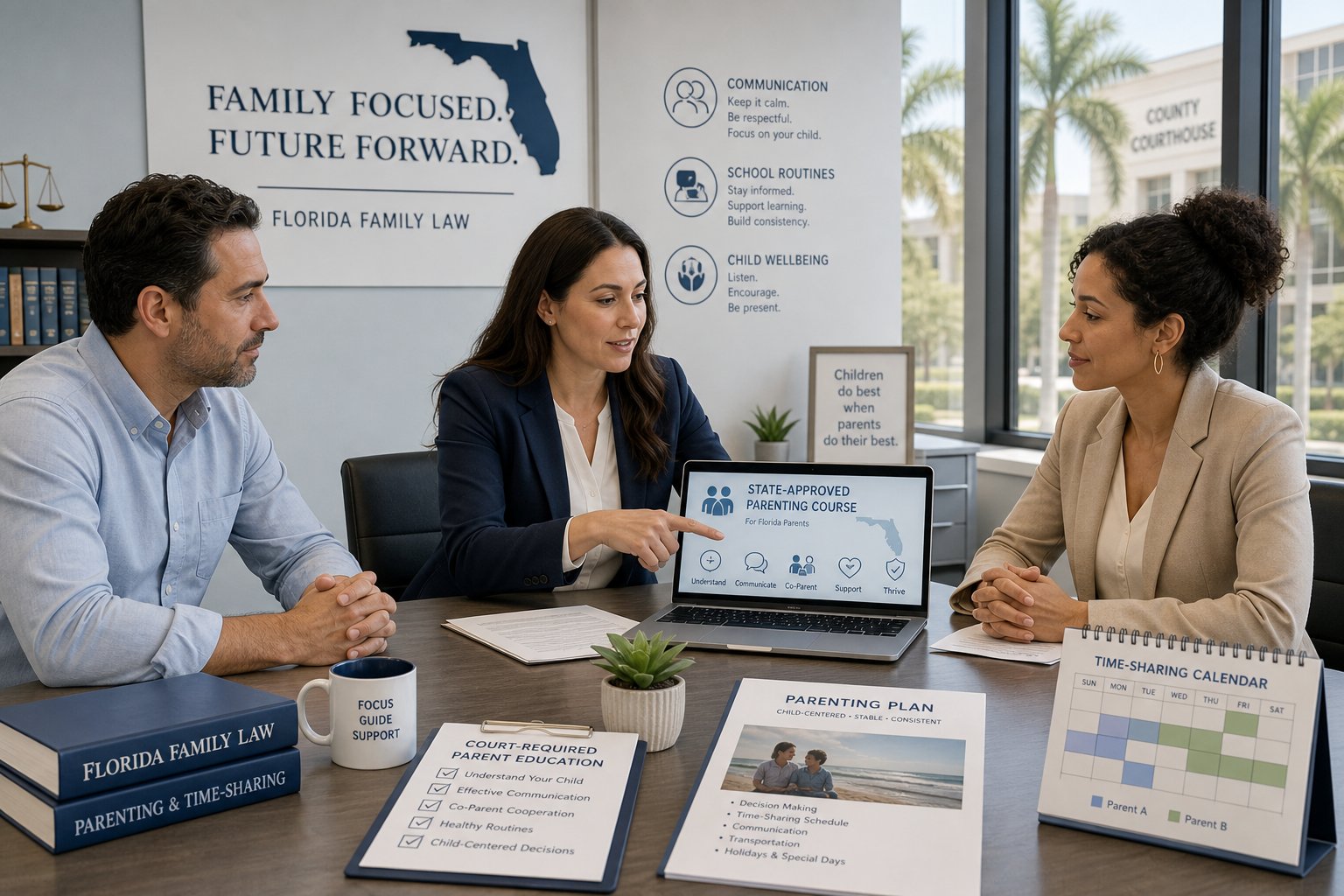
What The Florida Parenting Class Is And Why Courts Require It
The Florida parenting class is the Parent Education and Family Stabilization Course. It is a state-approved course for parents in certain family law cases involving minor children.
Florida law says the course must be at least 4 hours long. The legal basis is Florida Statute 61.21, and the provider must be approved by the Florida Department of Children and Families.
Courts require it because agreement between parents does not remove the need for parent education. The point is not to settle disputes. The point is to help parents understand how separation affects children and how to reduce harm.
In simple terms, the class focuses on:
- how children may react to divorce or separation
- how conflict affects children
- how to support a healthy parenting plan
- how to handle time-sharing and daily communication better
- how to keep children out of adult conflict
That matters even in low-conflict cases. Parents can agree on paper and still struggle with handoffs, schedules, school issues, or new partners. The course gives a shared base of rules and skills.
Because Florida courts care about the child’s best interests, they often treat this class as a standard step before final judgment. If you are in a case with minor children, assume the requirement applies unless the court says otherwise.
Who Must Take The Parent Education And Family Stabilization Course
In Florida, both parties usually must take the course in a divorce case with minor children. That is true even if you already agree on the parenting plan, parental responsibility, support, or time-sharing.
The requirement also often applies in paternity cases involving parental responsibility. Some local courts may apply related rules in other family cases, but the exact requirement can depend on the court, county, judge, and case type.
The key question is not whether you are fighting. The key question is whether your case involves minor children and falls under the Florida rule.
Here is the general pattern:
- Dissolution of marriage with minor children: both parents usually must complete it
- Paternity with parental responsibility issues: both parents may need it
- Cases without minor children: the class usually is not required
A judge may excuse a parent for good cause, but that is not automatic. Parents should not assume that full agreement, an uncontested case, or private settlement removes the course requirement.
If you are unsure, check three places:
- your court order or case paperwork
- your circuit family court website
- the local Clerk of Court instructions
If the court requires the course, use a DCF-approved provider. That is the safest path for a valid Florida parenting class certificate.
When To Take The Class And What Happens If You Miss The Deadline
You should take the class as early as possible after your case starts. Many Florida courts use a 45-day rule: the petitioner completes it within 45 days of filing, and the respondent completes it within 45 days of service.
That timeline is common, but not universal. Your judge or circuit may use a different deadline. Always follow your court papers first.
If you miss the deadline, the court can still require completion before moving your case forward. In many cases, the court may:
- delay the final judgment
- order you to finish the class before another hearing
- impose sanctions or other case-related consequences
The exact result depends on the judge and local practice. Still, missing the deadline rarely helps. It can slow down an otherwise simple case.
This is why agreement between parents does not solve the timing issue. Even when there is no dispute, the court may still wait for proof that each parent finished the course.
A practical next step is to review your summons, standing order, or family court packet for the deadline. Then compare it with your county court website.
If you still need a course, you can take the Florida Parent Education and Family Stabilization Course online at DivorceParentingClass.net through a DCF-approved provider and keep your case moving.
What The Course Covers And How It Helps With Co-Parenting
The course covers the effect of divorce or separation on children and parents. It also teaches basic co-parenting skills that support a better parenting plan.
Florida’s approved course topics commonly include:
- children’s emotional and behavioral responses to family change
- the harm caused by parental conflict
- communication skills for co-parents
- stress and anger control
- time-sharing transitions and routines
- keeping children out of adult disputes
- local and community support resources
This is one reason courts still require the class even when parents agree. A written agreement does not teach day-to-day co-parenting. The course helps with real problems that show up after the case starts.
For example, parents may agree on equal time-sharing but still argue about pickups, late notices, school forms, or medical updates. A good course explains how to share information, lower conflict, and focus on the child.
The class can also help parents understand terms they see in court forms, such as parental responsibility and parenting plans. It is not a legal strategy class. It is a parent education class built to reduce harm to children.
That is why courts treat it as more than a box to check. The goal is practical: better choices, clearer communication, and less stress for children.
Online Vs. In-Person Options And How To Choose A DCF-Approved Course
Florida parents often can choose online, classroom, virtual, or other approved formats. The best option is the one your court allows and that appears on the DCF-approved provider list.
Before you register, confirm two things:
- The provider is approved by the Florida Department of Children and Families.
- Your local court accepts that format under its current rules.
Many parents choose online classes because they are easier to fit around work, school, and child care. A self-paced online course may let you log in from a phone, tablet, or computer and stop and start as needed.
When comparing providers, look for clear details about:
- DCF approval status
- course length of at least 4 hours
- how you get your certificate of completion
- whether the class works on mobile devices
- support if you have a filing or access question
For Florida parents who want a simple online option, DivorceParentingClass.net offers a DCF-approved Florida Parent Education and Family Stabilization Course designed for flexible access.
Do not assume any parenting class will work. A general parenting course, out-of-state class, or non-approved provider may not meet Florida court rules. Check the approval list and your local court instructions before you enroll.
Certificates, Court Acceptance, And How To Submit Proof Of Completion
After you finish the course, you should receive a certificate of completion. In many online programs, that certificate is available as a PDF right away.
A DCF-approved certificate is generally the right kind of proof for Florida cases. Still, local filing steps can vary by county and court. Some courts want you to file it with the Clerk of Court. Others may have provider delivery options or e-filing rules.
A safe process looks like this:
- save your certificate right away
- print a copy for your records
- review your county clerk or family court page
- file the certificate as your court requires
- keep proof of filing or submission
Helpful official sources include Florida Courts, your local circuit family court website, and your county Clerk of Court page.
Court acceptance usually depends on three things:
- the provider is DCF-approved
- the format meets local court rules
- you submit the certificate correctly in your case
If you are unsure where to file proof, check your circuit website before your deadline. That small step can prevent delays.
And if you still need the course, start with a Florida-specific provider that clearly explains certificate access and filing support.
Common Questions About Length, Access, Cost, And Final Exams
The Florida parenting class is usually at least 4 hours long. That minimum comes from Florida’s course rules.
Many approved providers offer self-paced access. That means you can often sign in any time, use a phone or computer, and complete the class in parts instead of one sitting. This is helpful for parents with work shifts, child care needs, or shared schedules.
Cost varies by provider. Many online options are in the rough range of about $19.95 to $25, based on common Florida listings, but prices can change. Always confirm the full price before you pay.
Final exam rules also vary. Many online courses use a simple end-of-course test and may allow multiple tries. Do not assume every course has the same format, score rule, or certificate process.
Here are the most common practical questions:
- Can both parents take the same class? Yes, but each parent usually needs a separate enrollment and certificate.
- Can I take it online? Often yes, if the provider is DCF-approved and your court accepts the format.
- Does agreement between parents remove the class? Usually no.
- What should I do next? Check your court deadline, choose a DCF-approved provider, complete the course, and file your proof.
FAQ
If we agree on everything, do we still need the parenting class?
Generally yes. Mutual agreement doesn’t remove the Parent Education and Family Stabilization Course requirement when minor children are involved. Each parent typically still completes it and files a certificate.
Can we waive it by agreement?
No. Parents can’t waive the requirement by agreeing. Only a judge can excuse a parent, for good cause, and that decision rests with the court.
Why does the court require it even when we agree?
The requirement is focused on supporting the children through the transition, not on whether the parents disagree. That’s why it generally applies regardless of agreement.
Do we each take it, or just one of us?
Each parent generally completes the course separately and files an individual certificate, even when the divorce is fully agreed.
Conclusion
Agreeing on every term is great for your case, but it doesn’t remove the parenting-course requirement when children are involved — that piece is about the kids, not the level of conflict. Plan for both parents to complete the DCF-approved course and file certificates before the final judgment. If you think an exception applies, raise it with the judge, since agreement alone won’t create a waiver.
You can complete the DCF-approved Parent Education and Family Stabilization Course online so a fully agreed case stays on track.
Related Articles
- Is the Florida Parenting Class Required for an Uncontested Divorce?
- Florida Divorce Parenting Class Requirement: Who Has to Take It and When
- Can the Florida Parent Education Course Requirement Be Waived?
- Why Are Parenting Classes Required for Divorce in Florida?
Sources
Billy Forte is the founder of Divorce Parenting Class, which offers a Florida DCF-approved online Parent Education and Family Stabilization Course. The brand focuses on clear, supportive, plain-English guidance to help Florida parents complete the court-required class and file their certificate.
This article is general information, not legal advice. Florida family-law requirements and certificate acceptance can vary by court, county, judge, and case type, so review your court papers and official Florida sources, or consult a family-law attorney, before acting.