
Updated June 2026 · Reviewed by Billy Forte
A Florida parenting class certificate doesn’t have a fixed statewide expiration date, but the real question is whether your court, county, or judge wants the course completed recently enough for your case. A certificate is generally valid for the family law case you completed it for, though a very old certificate from a prior matter may not satisfy a new case. This guide explains how certificate “expiration” really works in Florida and how to avoid a timing problem.
Applies to the Florida Parent Education and Family Stabilization Course (Fla. Stat. 61.21). Requirements and acceptance can vary by court, county, judge, and case type, so review your court papers and official Florida sources.
Key Facts
- No fixed statewide expiry: Florida doesn’t set a single expiration date for the certificate.
- Tied to your case: A certificate is generally valid for the case you completed the course for.
- Recency can matter: Courts may expect the course completed reasonably close to your case.
- Old certificates: One from a much earlier or different case may not satisfy a new matter.
- When unsure, ask: Check your court papers or the Clerk of Court about timing for your case.
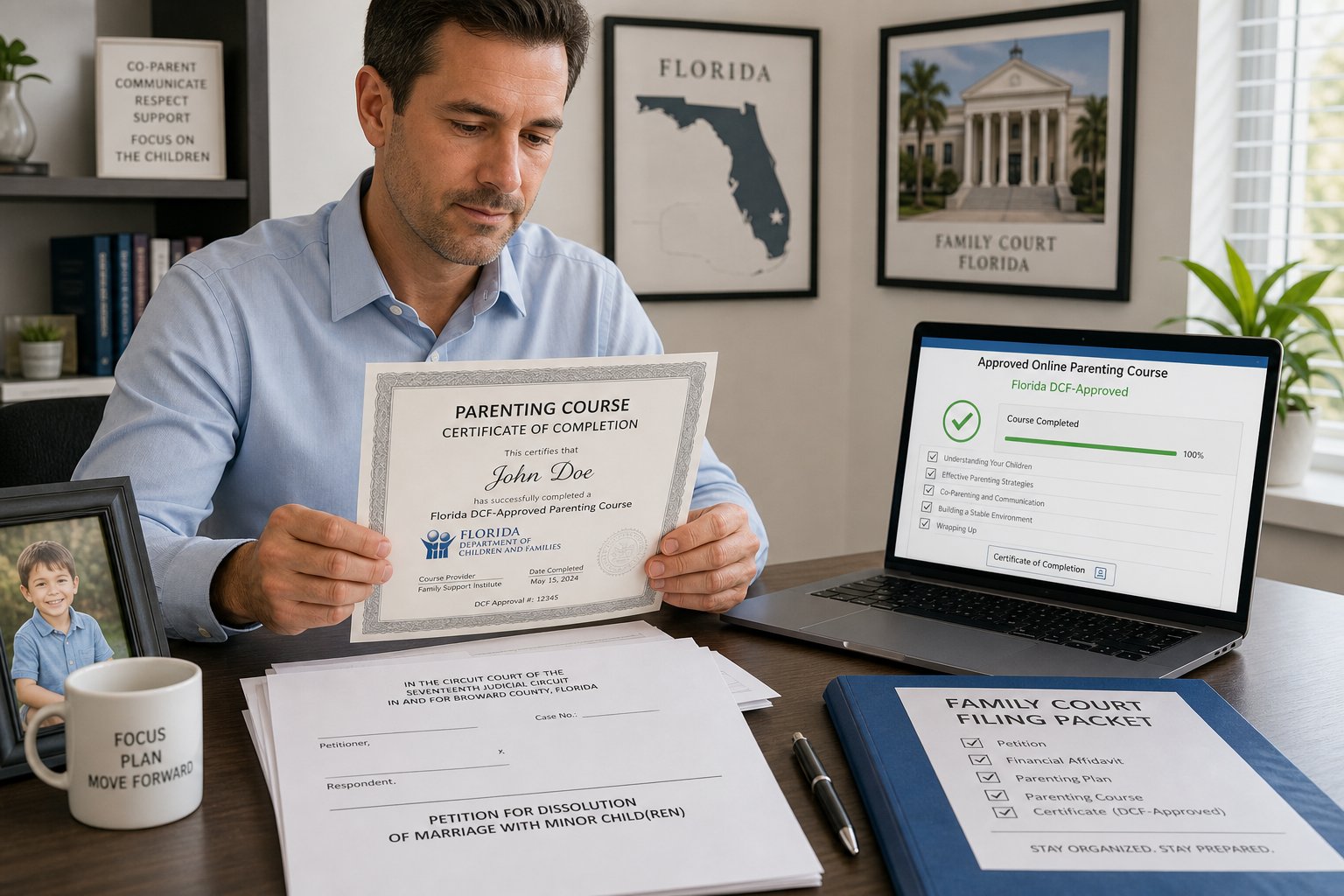
What A Florida Parenting Class Certificate Is And Why The Court Requires It
A Florida parenting class certificate is proof that you completed the state-required Parent Education and Family Stabilization Course. In most cases, Florida courts require this when parents with minor children are involved in divorce or other family law matters.
The rule comes from Florida Statutes section 61.21. That law requires an approved parenting course before the court enters a final judgment in certain cases. The course must be at least 4 hours long.
The certificate matters because it shows the court that you completed the required education. The course is meant to help parents understand:
- how separation or divorce affects children
- how to reduce conflict
- how to support healthy co-parenting
- how parental responsibility and time-sharing issues affect family life
The certificate is not the same as your final court approval. It is only proof that you took the course. You still need to follow your case deadlines, court orders, and filing steps.
Florida uses the term Parent Education and Family Stabilization Course. The provider must be approved by the Florida Department of Children and Families. If the course is not from a DCF-approved provider, your court may reject it.
That is why the right course matters. It is not just about finishing fast. It is about making sure your certificate fits your case requirements.
Who Needs The Certificate In Florida Family Law Cases
In Florida, parents with minor children usually need this certificate in divorce cases. The same can also apply in paternity and other cases that involve time-sharing, support, or a parenting plan.
In general, both parents must take the class. Each parent must complete the course separately. Each parent also gets a separate certificate of completion.
Common case types where the court may require the course include:
- dissolution of marriage with minor children
- paternity actions
- cases involving time-sharing or parental responsibility
- some support cases tied to parenting issues
Still, the exact rule can depend on the court. Requirements may vary by county, judge, and case type. Some courts give very clear written instructions in the summons or family law packet. Others list the requirement on the circuit court or Clerk of Court website.
If you are the petitioner, the deadline often starts when you file. If you are the respondent, the deadline often starts when you are served. But you should always read your own papers carefully.
A common mistake is thinking one parent can file one certificate for both people. That is not how it works. The court usually expects two separate completions and two separate filings.
If you are not sure whether your case requires the course, check your county court instructions, ask your lawyer if you have one, or review Florida Courts family law forms and resources.
How To Choose An Online DCF-Approved Course Your Court Will Accept
Choose a DCF-approved provider first. Then confirm that your court accepts an online class for your case.
This is the safest way to avoid delays. A course can look fine on a website but still create problems if it is not approved or if your local court has its own instructions.
Start with the Florida Department of Children and Families and look for the approved parent education provider list. A valid provider should clearly state that it offers the Florida Parent Education and Family Stabilization Course and meets the 4-hour minimum.
Before you register, check for these basics:
- DCF approval for the Florida course
- clear certificate delivery details
- online access by phone, tablet, or computer
- course length that meets Florida rules
- local court acceptance information or guidance
It also helps to check your county court or clerk website. Some courts post filing directions, approved provider notes, or family case checklists. For example, your local Clerk of Court may explain whether you should e-file the certificate or bring it in person.
If you want a simple online option, DivorceParentingClass.net offers a Florida course designed for parents who need to meet this requirement online. Still, you should match any provider to your local court instructions before you enroll.
That extra check can save time and avoid having to retake the class.
What The Parent Education And Family Stabilization Course Covers
The course teaches parents how family changes affect children and how to reduce conflict. It focuses on practical parenting skills, not just legal rules.
Florida approved courses usually cover the emotional and developmental impact of divorce or separation on children. They also explain how parents can support children through change without putting them in the middle of adult conflict.
Most courses include topics like these:
- the effect of divorce on children at different ages
- co-parenting communication skills
- conflict reduction between parents
- stress and adjustment for families
- basic information about parenting plans
- the meaning of time-sharing and parental responsibility
Some courses also explain how court conflict can affect children. Others add tools for better routines, calmer exchanges, and more respectful communication.
Many online providers break the material into short units. That can make it easier to finish on your schedule. If the course allows you to stop and restart, you can complete it in blocks instead of one sitting.
Because the state requires a minimum of 4 hours, be careful with any provider that seems too short or too vague about the content. The course should clearly match Florida requirements.
How Long The Course Takes, When To Finish It, And What Happens If You Miss The Deadline
The Florida course must last at least 4 hours. In many cases, you must finish it within 45 days.
That 45-day timeline often applies from the date of filing for the petitioner or the date of service for the respondent. Paternity cases may follow similar timing. But local rules can differ, so always read your court papers.
Here is the key point about validity: the course itself does not usually have a simple statewide expiration date like a driver license. Instead, the real issue is whether the certificate was completed for the right case and filed by the deadline set by your court.
If you wait too long, the court may respond in several ways:
- delay your final hearing or final judgment
- order you to complete the class before moving forward
- hold you in contempt in some cases
- consider your noncompliance when dealing with case progress
Some sources also note that missed compliance can affect issues tied to time-sharing or parental responsibility. That does not mean the court will always do so, but it shows why deadlines matter.
So, if you have not started yet, do not wait. Pick a DCF-approved provider, complete the course, and then make sure you follow your court’s filing instructions.
How You Receive Your Certificate And File It With The Court
After you finish the course, the provider gives you a certificate of completion. That certificate proves you completed the required class, but it does not always mean the court already has it.
This is a very important difference. Completing the course and filing proof with the court are two separate steps.
Certificate delivery depends on the provider. Some online courses offer an instant PDF download. Others may email the certificate or make it available through your account. Some providers may take longer unless you choose a faster delivery option.
Once you receive the certificate, you may need to file it with the Clerk of Court. Depending on your county and case setup, that may happen by:
- e-filing through the court system
- filing in person with the clerk
- giving it to your attorney to file
- bringing it to a hearing if the court directs that method
Always check your county instructions first. Filing rules can vary. The court may require your case number, a certain document title, or a specific filing portal.
If you need a Florida online option with clear certificate access, you can take the Florida Parent Education and Family Stabilization Course at DivorceParentingClass.net. After that, follow your local court filing steps right away.
Common Questions About Acceptance, Devices, Exams, And Both Parents Taking The Class
Will my court accept the certificate? Usually, acceptance starts with two checks: the provider must be on the Florida Department of Children and Families approved list, and your local court must allow that format for your case. Review your county court or clerk website for local directions.
Can I take the class on a phone? Many online Florida courses work on a smartphone, tablet, or computer. Some also let you log out and come back later, which helps if you need to split up the 4 hours.
Is there a test? Many courses include a final exam. Some providers use a short multiple-choice test and allow more than one attempt. The rules are set by the provider, so check before you enroll.
Do both parents have to take it? Yes, in most Florida cases, both parents must complete the course separately. One parent cannot take it for the other. And one certificate does not cover both people.
Does the certificate expire? Usually, courts care most about whether the certificate fits your current case and whether you filed it on time. If your case changes, is reopened later, or the court asks for updated proof, check with the court or your lawyer.
For official information, review Florida Statute 61.21, the Florida DCF website, and your local county clerk or court page.
FAQ
Does a Florida parenting class certificate expire?
There’s no fixed statewide expiration date. A certificate is generally valid for the case you completed it for, but courts may want the course completed recently, so timing can still matter.
Can I use an old certificate for a new case?
Maybe not. A certificate from a much earlier or different matter may not satisfy a new case. If your situation has changed, confirm with your court whether you need to complete the course again.
How recent does completion need to be?
It depends on your court and case. There’s no universal rule, so if you completed the course a while ago, check with the Clerk of Court or your attorney before relying on the old certificate.
Is the certificate valid in every Florida county?
A DCF-approved course is recognized statewide, but acceptance and timing expectations can vary by court and county. Confirm your specific court’s instructions.
Conclusion
The practical answer is that the certificate doesn’t expire on a set date, but its usefulness is tied to your case and how recently you completed the course. For your current matter, a certificate from your DCF-approved course is generally fine. If you’re reaching back to an old one, check with your court first so timing doesn’t become a problem.
If you need a current certificate, you can complete the DCF-approved Parent Education and Family Stabilization Course online and download fresh proof of completion.
Related Articles
- How to Get Your Florida Parenting Class Certificate
- What Information Goes on a Florida Parenting Class Certificate?
- How to Submit Your Parenting Class Certificate to a Florida Court
- What If the Court Rejects My Parenting Class Certificate?
Sources
Billy Forte is the founder of Divorce Parenting Class, which offers a Florida DCF-approved online Parent Education and Family Stabilization Course. The brand focuses on clear, supportive, plain-English guidance to help Florida parents complete the court-required class and file their certificate.
This article is general information, not legal advice. Florida family-law requirements and certificate acceptance can vary by court, county, judge, and case type, so review your court papers and official Florida sources, or consult a family-law attorney, before acting.