
Updated June 2026 · Reviewed by Billy Forte
In most Florida cases, a court will accept an online parenting class certificate as long as the course is DCF-approved and your court allows the online format. DCF approval is what makes a certificate valid statewide, but individual courts, counties, and judges can still have their own filing instructions, so acceptance is usually — not automatically — guaranteed. This guide explains what makes a certificate acceptable and how to confirm it before you file.
Applies to the Florida Parent Education and Family Stabilization Course (Fla. Stat. 61.21). Requirements and acceptance can vary by court, county, judge, and case type, so review your court papers and official Florida sources.
Key Facts
- Usually accepted: Most Florida courts accept a certificate from a DCF-approved online course.
- DCF approval is key: It’s what makes the course and certificate valid for Florida family cases.
- Acceptance can vary: Individual courts, counties, and judges may have specific filing rules.
- Confirm before filing: Check your court papers or ask the Clerk of Court if you’re unsure.
- Keep proof: Save your certificate and a copy in case the court or clerk requests it again.
Who Must Take The Florida Parent Education And Family Stabilization Course
Florida usually requires this course when your case involves minor children. Under Florida Statute 61.21, parents in many divorce and family law cases must complete a Parent Education and Family Stabilization Course before final judgment.
In most cases, both parents must take it. That means each parent completes the course alone and gets a separate certificate of completion.
This requirement often applies in cases such as:
- Dissolution of marriage with minor children
- Paternity cases with parenting issues
- Cases about a parenting plan
- Cases involving parental responsibility or time-sharing
Some courts may also order the course in other family cases. For example, a judge may require it in a modification case or another matter involving children.
That said, the rule is not exactly the same in every situation. Your next step depends on your county, your judge, and your case type. Some local courts post instructions on their circuit or clerk website. You can also review general family court resources on Florida Courts.
The key point is simple: if your case in Florida involves children, assume you should check the course rule right away. Do not wait until the end of the case to find out you still need it.
What The Florida Parenting Class Covers And Why Courts Require It
The class teaches basic skills for co-parenting during and after separation. Florida courts require it to help reduce conflict and protect children during a hard family change.
A Florida parenting class online usually covers:
- How separation affects children at different ages
- How children may show stress, fear, or anger
- Better ways to talk with the other parent
- Ways to support a child in two homes
- Basic ideas behind parental responsibility and time-sharing
- Safety issues, including abuse and domestic violence awareness
The course is not just about rules. It is meant to help parents make calmer choices. Courts want parents to focus on the child, not the conflict.
Many approved programs also explain how parenting choices affect school, routines, and emotional health. That matters because a child often needs steady structure during a divorce or paternity case.
The required Florida course is at least 4 hours long. The state sets standards for providers through the Florida Department of Children and Families.
If you are asking whether the class is worth taking seriously, the answer is yes. The court sees it as part of the process for cases involving children, not as a side task.
How An Online Florida Parenting Class Works From Registration To Certificate
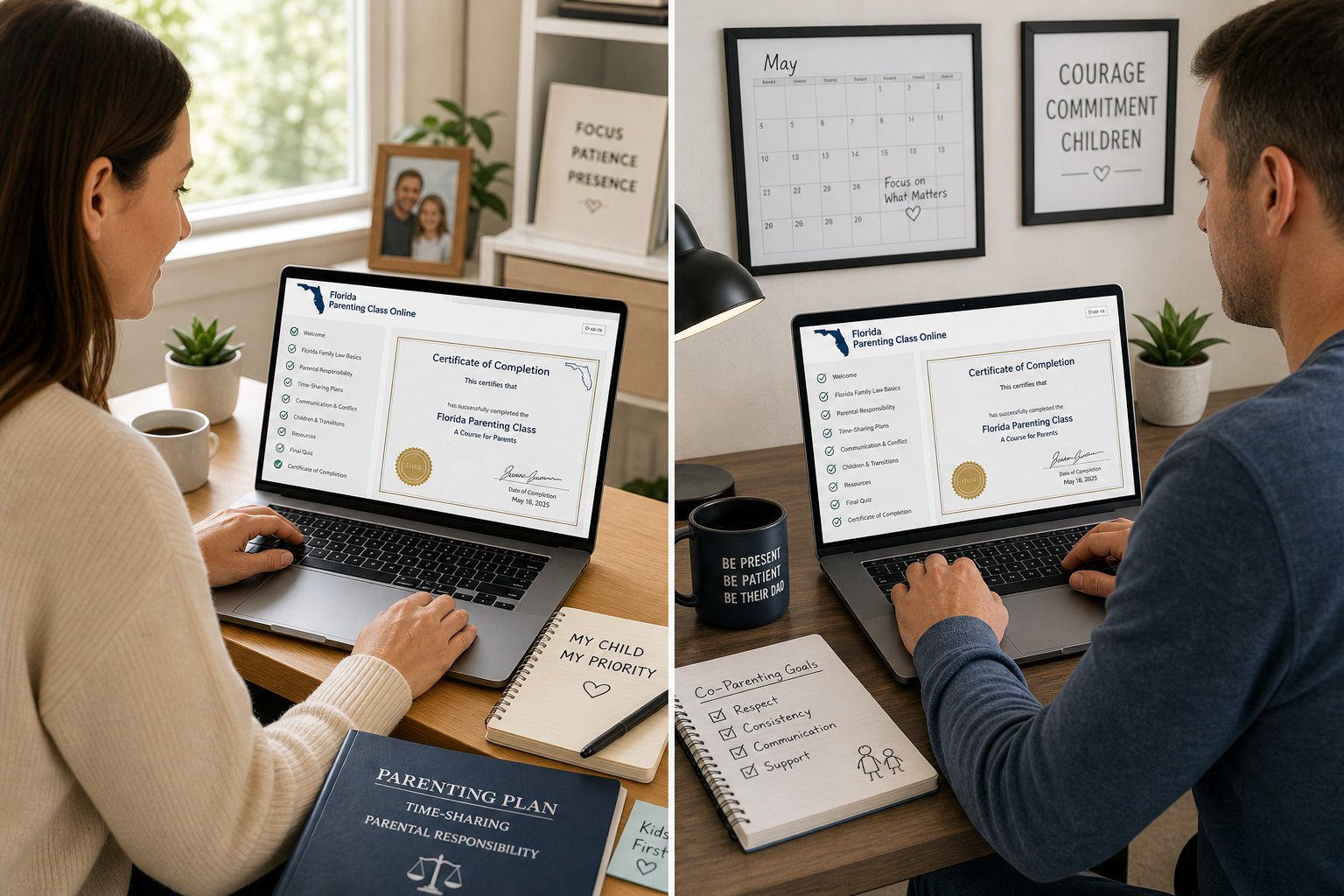
The process is usually simple. You pick a DCF-approved provider, register, complete the lessons, and receive your certificate.
Most online courses follow these steps:
- Create an account.
- Pay the course fee.
- Work through the lessons at your own pace.
- Complete any quizzes or final test.
- Download or receive your certificate of completion.
Many Florida parents prefer the online format because they can use a phone, tablet, or computer. You can often stop and start as needed, as long as you finish the full required time.
A common point of confusion is this: completing the course is not the same as filing proof with the court. The provider gives you the certificate. After that, you may need to file it with the Clerk of Court, upload it through your county system, give it to your lawyer, or follow a judge’s order.
That is why an online class can be accepted while a case still gets delayed. The problem may not be the course. The problem may be that the certificate was never filed the right way.
If you need a Florida parenting class online, DivorceParentingClass.net offers a Florida DCF-approved course built for this state requirement, with online access and a certificate after completion.
How To Choose A Florida DCF-Approved Course Your Court Will Accept
Start with approval status. If the provider is not a DCF-approved provider, your court may reject the class.
You should verify three things before you pay:
- The provider appears on the Florida DCF list for parent education providers
- The course is the actual Parent Education and Family Stabilization Course for Florida
- Your local court instructions do not add extra steps
Use the state source first. The Florida DCF parent education page is the best place to confirm provider status. Then check your circuit court and county clerk pages for local filing rules. Some counties explain where to submit a certificate, whether e-filing is allowed, and whether a copy must be filed before a hearing.
You should also read the provider’s own terms. Look for clear details about:
- Course length
- Certificate access
- Customer support
- Refund or acceptance policies
Be careful with broad promises. A provider can be state approved, and that matters a lot. But no provider can control every local practice or every judge. So the safest answer to “Will my judge or clerk accept an online class?” is this: they usually will accept an online class from a DCF-approved provider when it meets Florida’s course requirement and you follow local court instructions for proof.
When To Take The Class And What Happens If You Miss The Requirement
Take the course early. In many Florida cases, timing matters.
Florida sources commonly state that the petitioner must complete the course within 45 days of filing, and the respondent must complete it within 45 days of service. Courts may not enter a final judgment until the requirement is met.
If you wait too long, several problems can follow:
- Your case may be delayed
- A hearing may move forward without all needed documents filed
- The court may order compliance by a set date
- In some cases, the court may impose sanctions or contempt remedies
Missing the requirement can also affect issues tied to the child. In serious situations, a court may consider compliance when addressing time-sharing or shared parental responsibility, especially if a parent ignores court orders.
Do not assume the court will remind you more than once. And do not assume the other parent filing their certificate covers you. Each parent must complete the course and handle their own proof.
If you already filed your case and have not taken the class, check your court papers and local county instructions now. Then complete the approved course and file your certificate the way your court requires.
Common Questions About Time, Cost, Exams, And Certificate Delivery
Most Florida parents want the same four answers first: how long it takes, what it costs, whether there is a test, and how fast the certificate arrives.
Time: The course is usually 4 hours minimum. Many online providers let you split that time across more than one session.
Cost: Online prices often fall in a broad range, commonly from about $14.95 to $60, depending on the provider and included services. Lower cost does not always mean lower quality, but approval status matters more than price.
Exams: Some courses include short quizzes and a final exam. A common format is a multiple-choice test with a passing score such as 80%, though course design can vary by provider.
Certificate delivery: Some providers offer a downloadable PDF right after completion. Others may send access later. Always check whether the certificate is instant, emailed, mailed, or placed in your account.
Also, ask one more question: does the provider explain what you must do after you get the certificate? That step matters. The court needs proof, but the provider usually does not file it for you unless that service is clearly stated.
If speed matters in your case, review certificate details before you register.
How The Course Can Support Better Co-Parenting During Divorce Or Separation
The course can do more than satisfy a court rule. It can help you make a better plan for life after the case.
A good program teaches small skills that matter a lot in daily parenting. For example, it may show how to keep adult conflict away from the child, how to make handoffs less tense, and how to use clear messages about school, health care, and schedules.
That can support a stronger parenting plan because both parents better understand:
- The child’s need for routine
- Age-based reactions to divorce or separation
- How conflict harms children over time
- How respectful communication helps decision-making
Florida courts require this course because children usually do better when parents lower conflict and stay child-focused. Even when parents disagree, they still need a workable system for school events, doctor visits, holidays, and changes in time-sharing.
If you still need to complete the requirement, you can take the Florida Parent Education and Family Stabilization Course online through DivorceParentingClass.net. After you finish, make sure you use your certificate of completion exactly as your county court or Clerk of Court directs.
FAQ
Will a Florida court accept my online parenting class certificate?
Usually yes, if the course is DCF-approved and your court accepts the online format. Acceptance can vary by court and county, so confirm your court’s instructions before filing.
What makes a certificate acceptable?
The course must be the DCF-approved Parent Education and Family Stabilization Course. DCF approval is what makes the certificate valid for Florida family cases.
Could a court reject an online certificate?
It’s uncommon for a DCF-approved course, but local rules differ. Checking your court papers or the Clerk of Court first avoids a rejected or questioned filing.
How do I file the certificate?
File it with the Clerk of Court or give it to your attorney to file, and keep a copy for your records in case it’s requested again.
Conclusion
The honest answer is “usually, but confirm”: a DCF-approved online certificate is accepted in most Florida courts, yet local filing rules vary enough that a quick check is worth it. Verify your court’s instructions, keep a copy of your certificate, and file it the way your paperwork directs. That small step is the best way to make sure your completed course actually counts.
You can complete a DCF-approved Parent Education and Family Stabilization Course online and receive a certificate of completion to file with your court.
Related Articles
- Florida Parenting Class Online: Court-Approved 4-Hour Course Guide
- Court-Approved Parenting Classes in Florida: How to Choose One
- What Is the Parent Education and Family Stabilization Course in Florida?
- DCF Approved Parenting Classes vs. Florida Divorce Parenting Class
Sources
Billy Forte is the founder of Divorce Parenting Class, which offers a Florida DCF-approved online Parent Education and Family Stabilization Course. The brand focuses on clear, supportive, plain-English guidance to help Florida parents complete the court-required class and file their certificate.
This article is general information, not legal advice. Florida family-law requirements and certificate acceptance can vary by court, county, judge, and case type, so review your court papers and official Florida sources, or consult a family-law attorney, before acting.