
Updated June 2026 · Reviewed by Billy Forte
In Florida, “time-sharing” is the legal term for how parents share time with their children, and courts often require the Parent Education and Family Stabilization Course in cases where time-sharing is decided. The course doesn’t set your time-sharing schedule — that’s part of your parenting plan — but completing it is generally required before the court finalizes a case involving minor children. This guide explains how the course relates to time-sharing and custody, who must take it, and when to complete it.
Applies to the Florida Parent Education and Family Stabilization Course (Fla. Stat. 61.21). Requirements and acceptance can vary by court, county, judge, and case type, so review your court papers and official Florida sources.
Key Facts
- Time-sharing: Florida’s term for how parents share time with their children, set in the parenting plan.
- Course is separate: The class educates parents; it doesn’t decide your time-sharing schedule.
- Often required together: Courts commonly require the course in cases where time-sharing is decided.
- Who takes it: Both parents in most divorce, paternity, and custody cases with minor children.
- Timing varies: Course deadlines depend on the court, county, judge, and case type — check your court papers.
Who Must Take The Course In Florida Family Law Cases
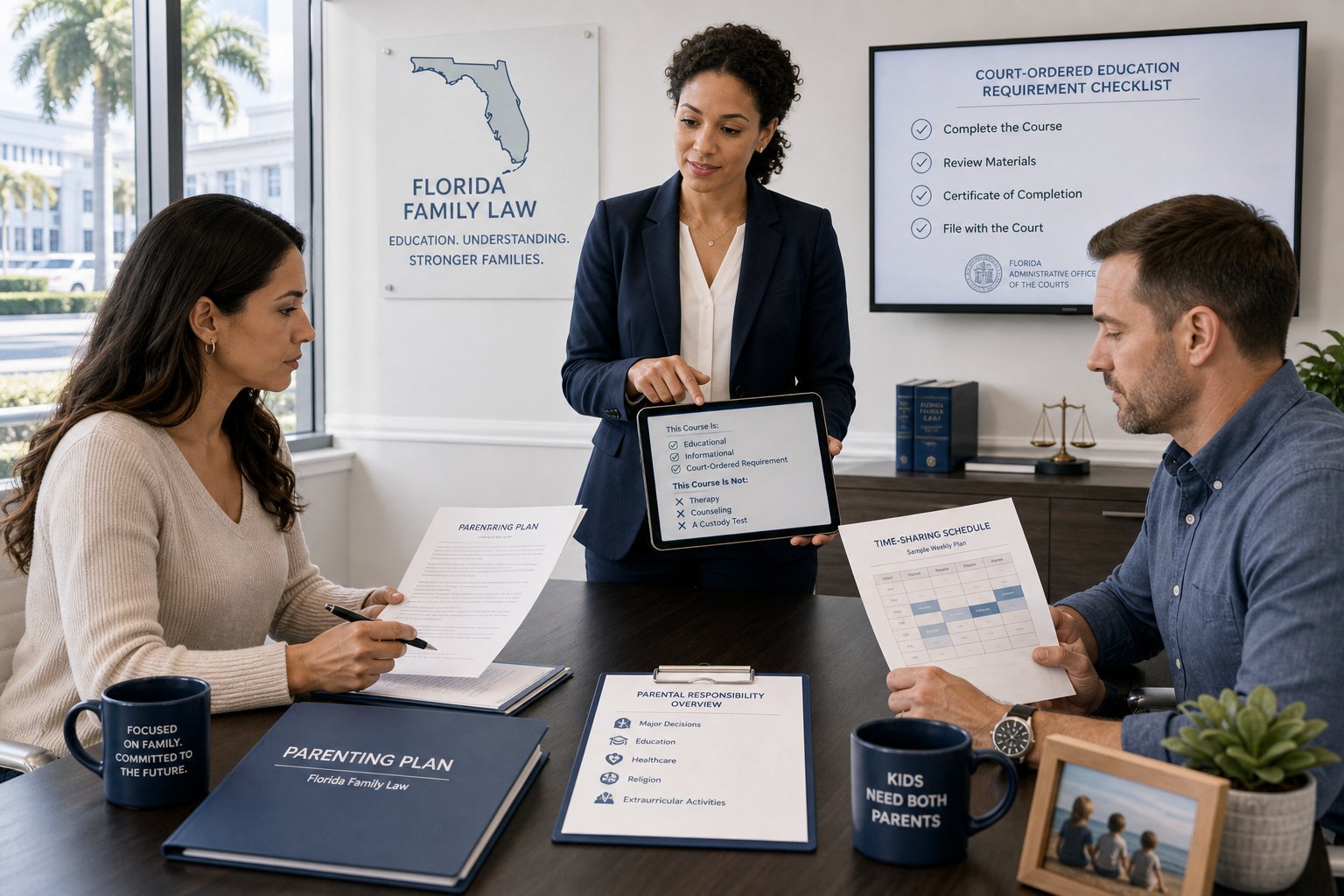
Florida generally requires the course when parents with minor children are involved in certain family law cases. The main rule comes from Florida Statutes section 61.21, which says parties to a dissolution of marriage action with minor children must complete a Parent Education and Family Stabilization Course approved by the Florida Department of Children and Families.
That means the course is often part of a divorce case where the court must decide or review:
- Time-sharing
- Parental responsibility
- A parenting plan
- Other issues involving the care of children
In many places, parents in paternity or similar family cases may also be ordered to take it. But that part can depend on the court, the county, the judge, and the type of case filed. So, one of the safest steps is to read your court order, petition, summons, or case checklist line by line.
The course is not therapy. It is not a custody test either. Instead, it is an education class meant to help parents understand how separation and court conflict can affect children.
If you are unsure whether your case requires it, check your local court materials through Florida Courts and your county Clerk of Court website. You can also review the approved provider information from the Florida Department of Children and Families.
When To Complete It And What Happens If You Miss The Deadline
In many Florida cases, timing matters almost as much as completion. A common deadline is 45 days after filing for the petitioner and 45 days after service for the other parent, but your actual deadline can depend on your court order, local practice, and case type.
That is why you should never guess about timing. Look for the exact due date in your case papers. If the judge set a deadline, that date controls your next step.
Missing the deadline can create real problems. Depending on the case, the court may respond in ways that affect progress in your matter, including possible contempt of court issues. Some sources also note that delays can affect decisions tied to shared parental responsibility or time-sharing if a parent does not follow court requirements.
This does not mean every missed deadline leads to the same result. Florida family courts handle cases one at a time, and judges have discretion within the rules and facts before them.
So act early if you can. If you have not enrolled yet, review your court papers, confirm the due date, and choose a DCF-approved provider that fits your schedule. That simple step can reduce stress and help you avoid avoidable delays.
What The Florida Parenting Course Covers
The Florida parenting course covers the effect of divorce, separation, and family conflict on both parents and children. Its goal is educational: to give you practical information that supports healthier co-parenting during a hard period.
Under state requirements, the class must be at least 4 hours long. Approved courses commonly include topics such as:
- The impact of separation on children
- Age-based child needs and reactions
- Co-parent communication
- Conflict reduction
- Problem solving between parents
- The basics of a parenting plan
- How parental behavior affects children
Many courses also explain the difference between helping a child adjust and putting a child in the middle of adult conflict. That matters in Florida cases because courts focus strongly on the child’s best interests when reviewing time-sharing and parental responsibility arrangements.
The class does not decide your case. It does not replace legal advice, counseling, or mediation. Still, it can help you understand why the court wants parents to learn skills that reduce conflict and support stable routines for children.
If you want the official state framework, the Florida Department of Children and Families publishes information about approved parent education providers and standards.
How The Online Course Works From Registration To Certificate
Most online providers follow a simple path: register, complete the lessons, finish any required quizzes or exam steps, and then get your certificate of completion. The exact screens vary by provider, but the basic process is usually easy to follow.
A typical online course works like this:
- You create an account.
- You enter your name and case-related details.
- You take the required lessons.
- You complete quizzes or a final test, if required.
- You download, print, or receive your certificate.
This format helps many parents because they can use a phone, tablet, or computer and work around jobs, school pickups, and court dates. That flexibility is one reason online options are popular.
Still, convenience is only part of the issue. You also need to confirm that the provider is DCF-approved and that your court accepts the format in your case. State approval matters, but local court instructions still matter too.
At DivorceParentingClass.net, the Florida course is offered fully online through a DCF-approved provider. If the format works for your case, you can move from registration to completion in one place and then follow your local filing or submission instructions for the certificate.
DCF Approval And Court Acceptance Across Florida
DCF approval is the first thing to check. In Florida, the Florida Department of Children and Families approves providers for the Parent Education and Family Stabilization Course, and that approval is the baseline many courts expect.
You can review provider information through the Florida Department of Children and Families. If a course is not from a DCF-approved provider, that is a major warning sign.
But approval does not answer every question. Court acceptance can still vary based on:
- The county
n- The judge
- The case type
- Whether the court allows an online format in that case
- Any special language in your order or local instructions
This is why parents should not assume that every online course works for every case. Some courts accept online completion broadly. Others may want a specific process for proof, filing, or timing.
A good check is to compare three sources:
- Your court order or case packet
- Your county court or Clerk of Court website
- The provider’s approval status
If those line up, you are in a much better spot. If they do not, pause and verify before you spend time or money on the wrong class.
How To Choose A Florida Parenting Class That Fits Your Situation
The best class for you is one that meets court rules and is easy for you to finish on time. A low price does not help if the course is not approved or does not fit your court’s instructions.
Start with the basics. Make sure the class is:
- A Florida Parent Education and Family Stabilization Course
- From a DCF-approved provider
- At least 4 hours long
- Available in a format your court accepts
Then look at practical details. These may matter just as much:
- Whether you can take it on your phone or tablet
- Language options
- Customer support hours
- How you receive the certificate of completion
- Whether the site explains filing steps clearly
- Total cost, including any extra fees
For many parents, ease of use matters a lot. If the site is confusing, the chance of delay goes up. And if your deadline is close, that can become a real issue fast.
If you want an online option built for Florida cases, you can review the course at DivorceParentingClass.net. Check the provider status, compare it with your court instructions, and choose the course format that best fits your case.
Common Questions About Length, Cost, Exams, And Certificates
Most Florida parent education courses are 4 hours long because that is the common minimum tied to state requirements. If you see a class that looks much shorter, treat that as a reason to verify approval before enrolling.
Cost varies by provider. Some sources show free local options in limited situations, while many online courses charge a modest fee, often around $25 or more. Prices can change, so always check the provider’s current page.
Exams or quizzes also vary. Some providers use short quizzes after sections. Others use a final exam. A few providers may allow more than one attempt, but that is not the same everywhere.
Certificates are the document courts care about. After you pass or finish the required steps, you may be able to download the certificate right away, or the provider may issue it through another process. Then you may need to file it, upload it, or keep it for proof, depending on local court directions.
Before you enroll, confirm these points:
- Is the provider DCF-approved?
- Is the class accepted by your court?
- How long is the course?
- What is the total cost?
- Is there an exam?
- How do you get the certificate?
- Does your Clerk of Court require a specific filing method?
FAQ
How does the parent education course relate to time-sharing?
Courts often require the course in cases where time-sharing is decided, but the course doesn’t set your schedule. Time-sharing is part of your parenting plan, while the course is a separate educational requirement.
Does taking the course affect my custody outcome?
No. The course is educational and doesn’t determine time-sharing or custody. Those are decided through your parenting plan and the court, based on the child’s best interests.
Who has to take the course in a custody case?
Generally both parents in Florida cases with minor children, including many paternity and custody matters. Whether it applies can depend on your court and case type.
When do I need to complete it?
Usually before the final judgment, and many courts set an earlier deadline. Timing varies by court and county, so confirm your specific deadline.
Conclusion
Time-sharing and the parent education course are connected but distinct: the course is a requirement that often accompanies time-sharing decisions, not a factor that decides them. Completing it won’t change your schedule, but skipping it can hold up a case. Take it early, keep your certificate, and let your parenting plan handle the actual time-sharing terms.
You can complete the required course with a DCF-approved Parent Education and Family Stabilization Course online while your time-sharing details are worked out separately.
Related Articles
- Florida Parenting Plan vs. Parent Education Course: What Is the Difference?
- How to File for Divorce in Florida With Minor Children: The Parent Course Step
- Divorce in Florida With Kids: Deadlines, Course, and Certificate
- Florida Divorce Checklist for Parents With Minor Children
Sources
Billy Forte is the founder of Divorce Parenting Class, which offers a Florida DCF-approved online Parent Education and Family Stabilization Course. The brand focuses on clear, supportive, plain-English guidance to help Florida parents complete the court-required class and file their certificate.
This article is general information, not legal advice. Florida family-law requirements and certificate acceptance can vary by court, county, judge, and case type, so review your court papers and official Florida sources, or consult a family-law attorney, before acting.