
Updated June 2026 · Reviewed by Billy Forte
In practice, the Florida parenting class final exam is something you can usually pass using what you learned in the course, and many providers effectively let you reference the material, though exact exam rules are set by each provider rather than by the state. The test is generally a short, straightforward multiple-choice check on the course’s main ideas, not a difficult exam. This guide explains what to expect on the final and why the specifics depend on your provider.
Applies to the Florida Parent Education and Family Stabilization Course (Fla. Stat. 61.21). Requirements and acceptance can vary by court, county, judge, and case type, so review your court papers and official Florida sources.
Key Facts
- Set by the provider: Florida doesn’t fix a single statewide exam format; each provider sets its own.
- Usually straightforward: The final is typically a short multiple-choice check on key ideas.
- Often reference-friendly: Many providers let you use what you learned in the material.
- Retakes common: Many providers allow retakes if you don’t pass the first time.
- Focus on learning: The exam confirms you engaged with the material, not that you memorized it.
What The Florida Parenting Class Is And Who Has To Take It
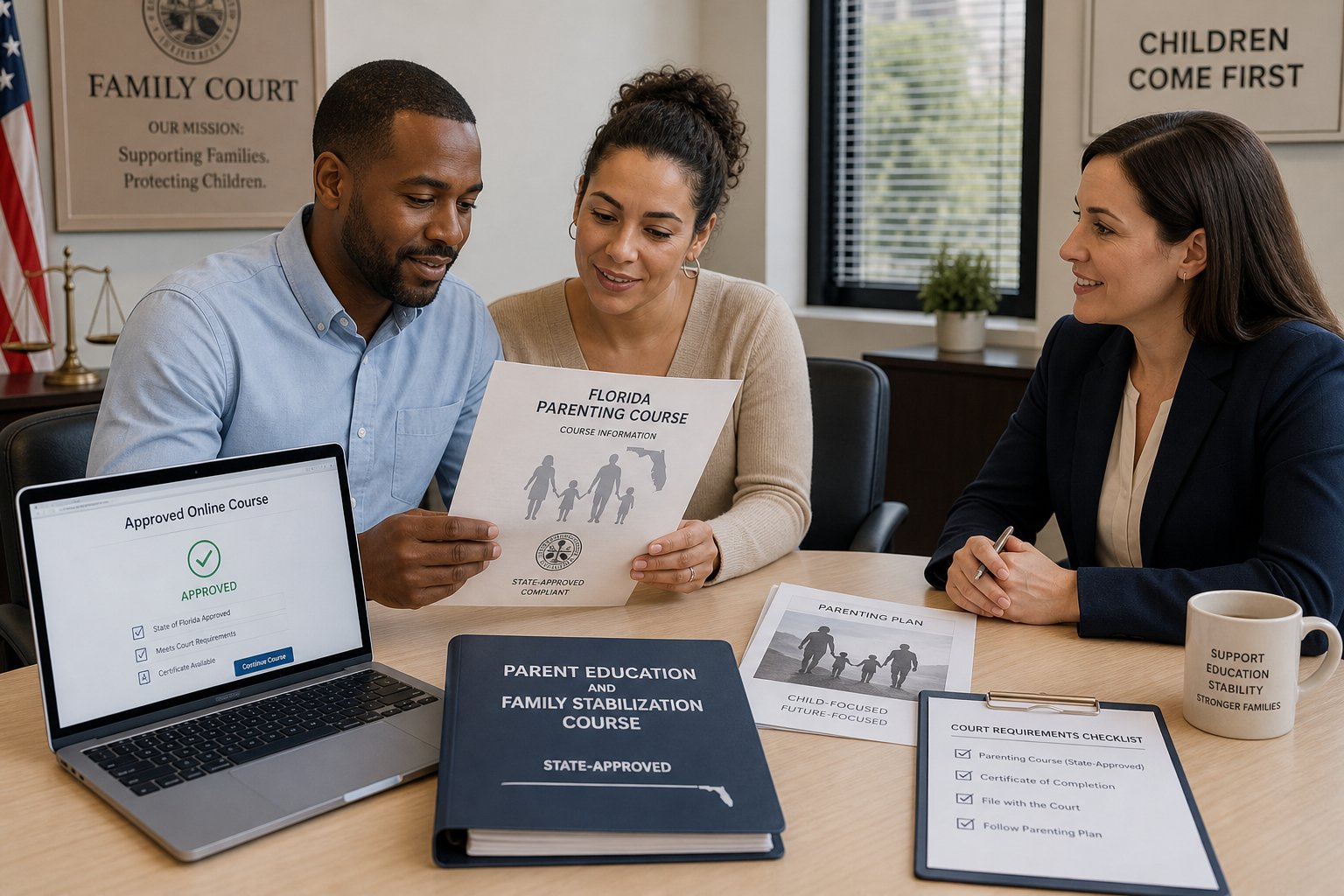
The Florida parenting class is the Parent Education and Family Stabilization Course. In Florida, this course is often required when parents with minor children are involved in a divorce or certain family law cases.
The course must be from a DCF-approved provider. Florida says approved providers must meet state standards, and the course is generally at least 4 hours long. You can review state information through the Florida Department of Children and Families and legal requirements in Florida Statutes section 61.21.
Courts often require the course in cases that affect a child’s home life and care. That may include:
- Dissolution of marriage with minor children
- Some paternity cases
- Some time-sharing or parental responsibility matters
- Other family cases where a judge orders it
Still, the exact requirement can vary. Your court, county, judge, and case type matter. That is why you should check your court papers and your local Clerk of Court or family court website.
The point of the class is not to trick you with a hard test. It is to teach basic skills that support children during family change. Topics often include child adjustment, co-parent communication, conflict, and how a parenting plan works. If your case requires the course, make sure you choose a Florida-approved provider and complete it before any deadline in your order or notice.
Why People Search For Florida Parenting Class Test Answers
Most people search for Florida parenting class test answers because they feel pressure. Court deadlines are stressful. So are separation, paperwork, and trying to finish one more required step.
A lot of parents worry about two things:
- Is the test hard?
- Can I use the course material?
In most approved programs, the real answer is reassuring. The final exam is usually based on the course itself, not on hidden facts or legal trivia. That means if you read the lessons and pay attention, you should be in good shape.
People also look for answer sheets because they think one wrong move will stop their case. Usually, that is not how these courses work. Many online providers use a simple multiple-choice test, a passing score around 70%, and retakes if needed. In other words, the course is often built to help you succeed, not fail.
There is another problem with answer sheets: they may be wrong, old, or from another provider. Florida-approved courses can present the same core topics in different words or in a different order. So a random list online may not match your course at all.
A better plan is to use a provider with clear lessons, easy navigation, and fair retake rules. That approach is usually faster than hunting for outside answers that may not even fit your exam.
What The Final Test Usually Covers
The final test usually covers the same key ideas taught in the course. It is often a multiple-choice exam, and many providers use about 25 questions with a passing score of 70%.
That means the test is not meant to feel like a school entrance exam. It is more like a basic check that you understood the main points. Questions often focus on child well-being, co-parenting behavior, and ways to reduce conflict.
You may also see questions about what Florida courts expect parents to understand. For example, the course may explain how conflict can affect children, why parents should not place children in the middle, and how a parenting plan, time-sharing, and parental responsibility fit into family cases.
Some providers unlock the final only after you complete the required time in the course. That is common because Florida-approved programs must meet a time minimum.
Topics Commonly Included In The Course
Most DCF-approved courses cover a similar group of topics. These often include:
- How divorce or separation can affect children
- How ongoing parental conflict affects child development
- How to move from spouses to co-parents
- Communication and conflict-resolution skills
- Anger management and emotional control
- Ways to keep children out of adult disputes
- Basic court-related parenting issues in Florida
If you want to prepare, focus on those themes. Look for the plain-language takeaways in each lesson. The final exam usually reflects those core points, not obscure details from outside sources.
How Scoring, Retakes, And Certificates Usually Work
Most Florida online parenting courses use a simple scoring system. Many require a 70% passing score on the final exam. Just as important, many also allow unlimited retakes with no extra exam fee.
That matters because it answers the biggest fear. If you do not pass on the first try, you can often review the material and try again. In many programs, the test is also not timed, which gives you room to read carefully.
The process often works like this:
- You register with a DCF-approved provider.
- You complete the course time requirement.
- You take the final exam.
- If needed, you retake it.
- After passing, you receive a certificate of completion.
Your certificate of completion is the document you may need to file with the court. Depending on the provider, you may get it by email right away, download it from your account, or request a mailed copy. Always follow your local court’s filing instructions and any order from the judge.
Because filing rules vary, check your county court or Clerk of Court website. You can also review general court information through Florida Courts.
Before you enroll, confirm three details: the course is Florida approved, the retake policy is clear, and the certificate method fits your court deadline.
How To Pass The Florida Parenting Class Without Relying On Answer Sheets
The easiest way to pass is to use the course itself. For most parents, that is enough.
Start by reading each lesson with one goal in mind: find the main rule or idea. Most questions come from the course content, so you do not need outside answer keys if you understand the basics.
A few simple habits help:
- Read section summaries and review questions
- Take short notes on child-focused points
- Pause on topics about conflict and co-parenting
- Watch for examples of helpful and harmful parent behavior
- Review any missed questions before retaking the exam
Pay special attention to ideas that come up more than once. For example, many courses stress that children do better when parents reduce conflict, keep routines stable, and avoid making children carry messages between homes.
It also helps to remember what the course is trying to do. It is not only about passing a test. It is about helping parents make better choices during a hard time. That is why the same ideas often appear in lessons, reviews, and final questions.
If you are choosing an online option, a course like the one offered by DivorceParentingClass.net can make the process easier because it is built for Florida requirements and self-paced learning. Read the lessons, use the built-in structure, and then take the exam with confidence.
How To Choose A Florida-Approved Online Course That Makes Passing Easier
The best course for most parents is one that is Florida approved, easy to use, and clear about the test. Approval comes first. If the provider is not approved for the Parent Education and Family Stabilization Course, the certificate may not meet your court’s requirement.
Look for these features before you sign up:
- Approval by the Florida Department of Children and Families
- A full 4-hour course that meets Florida rules
- Self-paced access on phone, tablet, or computer
- Clear exam policy, including passing score and retakes
- Clear certificate delivery details
- Upfront pricing without surprise fees
- Support if you have account or certificate questions
You should also check local court instructions. A provider can be approved, but your county or judge may still have filing rules you must follow. For court forms and local pages, start with Florida Courts and your county Clerk of Court website.
If you want a simple next step, you can take the Florida Parent Education and Family Stabilization Course online through DivorceParentingClass.net. The site states that its course is DCF-approved, fully online, and includes unlimited exam attempts, which can lower stress for parents who are worried about passing.
FAQ
Is the Florida parenting class final exam open book?
Exam rules are set by each provider, not the state, but in practice the test is usually a straightforward check you can pass using what you learned. Many providers effectively let you reference the course material.
Is the final exam hard?
Usually not. It’s typically a short multiple-choice test on the course’s main ideas, designed to confirm you engaged with the material rather than to trip you up.
What if I don’t pass?
Many providers allow retakes, sometimes unlimited, so a missed attempt usually isn’t a problem. Check your provider’s retake policy before you start.
Are the exam rules the same everywhere?
No. The format, question count, and passing score are set by each provider, so they can differ. There’s no single statewide exam standard for the course.
Conclusion
The reassuring reality is that the final is usually a manageable check on what the course taught, not a high-stakes test — though the exact rules come from your provider, not a statewide standard. Pay attention during the course, check your provider’s retake policy, and the exam tends to take care of itself. What matters for your case is completing a DCF-approved course and getting the certificate.
You can complete the DCF-approved Parent Education and Family Stabilization Course online and review your provider’s exam and retake details before you begin.
Related Articles
- How Many Questions Are on the Florida Parenting Course Final Exam?
- Can You Fail the Florida Parenting Class? Retakes and Passing Score
- Are There Quizzes in the Florida Parent Education Course?
- How Long Is the Florida Parenting Class for Divorce?
Sources
Billy Forte is the founder of Divorce Parenting Class, which offers a Florida DCF-approved online Parent Education and Family Stabilization Course. The brand focuses on clear, supportive, plain-English guidance to help Florida parents complete the court-required class and file their certificate.
This article is general information, not legal advice. Florida family-law requirements and certificate acceptance can vary by court, county, judge, and case type, so review your court papers and official Florida sources, or consult a family-law attorney, before acting.