
Updated June 2026 · Reviewed by Billy Forte
In Pinellas County, the parenting class is the statewide DCF-approved Parent Education and Family Stabilization Course required across Florida, while filing the certificate follows the Pinellas Clerk of Court’s instructions. The course doesn’t change by county; the local filing process can. This guide explains the statewide requirement and how to confirm Pinellas County’s filing steps.
Applies to the Florida Parent Education and Family Stabilization Course (Fla. Stat. 61.21). Requirements and acceptance can vary by court, county, judge, and case type, so review your court papers and official Florida sources.
Key Facts
- Statewide course: The DCF-approved, four-hour course applies in Pinellas just as across Florida.
- Local filing: Certificate filing follows the Pinellas Clerk of Court’s instructions and your case.
- Both parents: Each parent generally completes the course separately and files a certificate.
- Confirm steps: Check your court papers or the Pinellas Clerk’s official site for the current process.
- DCF approval matters: Confirm your provider is DCF-approved so the certificate counts.
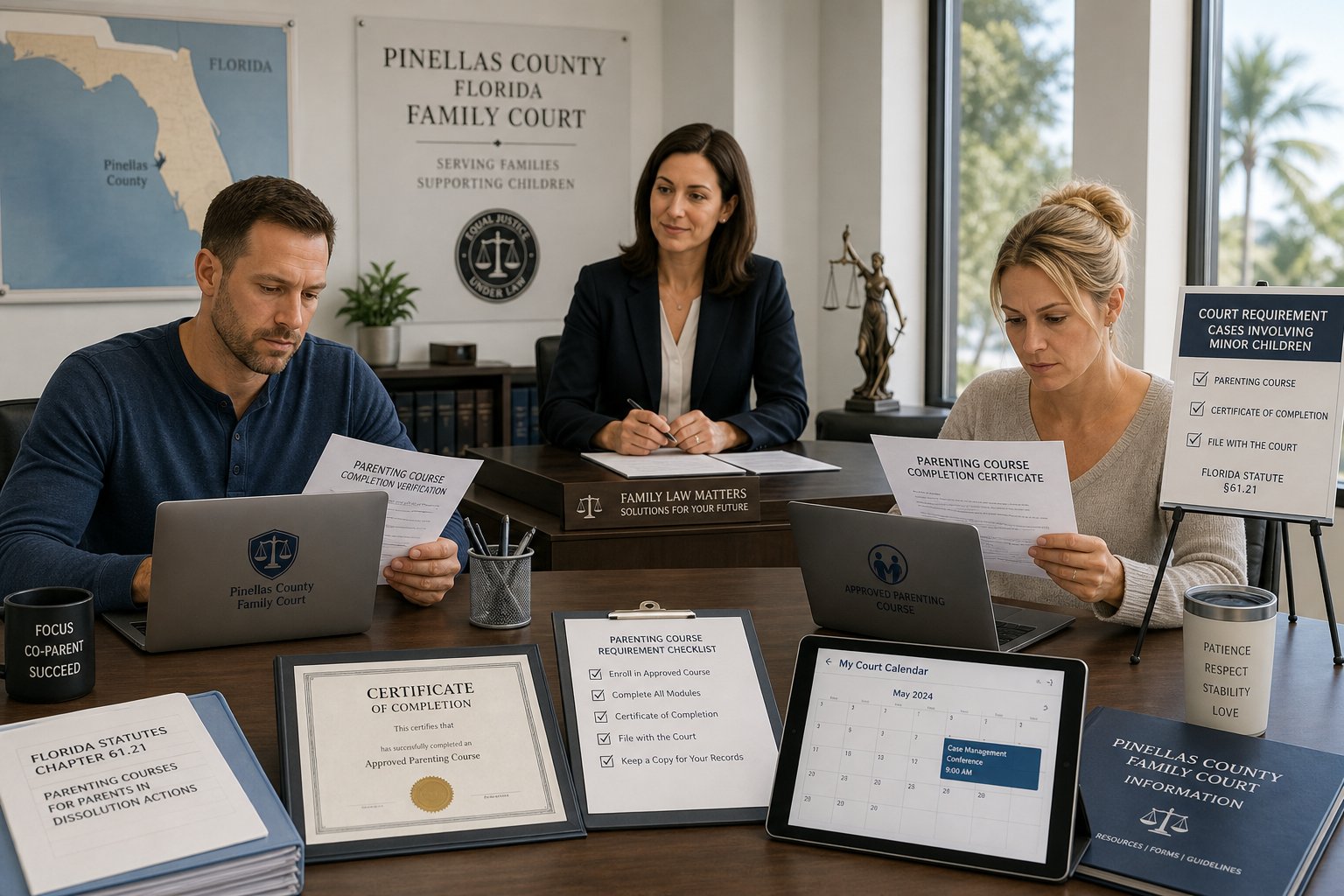
Who Needs A Parenting Class In Pinellas County
Florida law is the main reason many parents need a class. Under Florida Statutes section 61.21, parents with minor children in a dissolution of marriage case generally must complete a Parent Education and Family Stabilization Course. The course must be at least four hours and must come from a DCF-approved provider.
That same issue can come up in other family law matters, too. In Florida, courts may require the course in paternity, time-sharing, parenting plan, and some post-judgment cases involving parental responsibility or child-related disputes. Even so, you should not assume every case works the same way, because local practice and judicial orders can differ.
For Pinellas County parents, the safest answer is simple: if your case involves minor children, ask early whether the course is required. That includes both parents, not just the one who filed the case. In many situations, each parent must complete the class separately.
A few practical points matter here:
- The class is for the parents, not the children.
- You usually cannot take just any general parenting course.
- The provider should be listed by the Florida Department of Children and Families.
- The court may also care about the format of the class, not only the provider.
If you are unsure whether your case counts, review your court papers, ask your lawyer if you have one, or contact the Pinellas Clerk for general process information. That small check can save time and help you avoid filing the wrong certificate.
What The Parent Education And Family Stabilization Course Covers
The course is not just a box to check. Florida uses this class to help parents understand how separation and conflict affect children, and how to support children through family change. The Florida Department of Children and Families describes the program as education for parents dealing with divorce or related family issues involving children.
Most approved courses cover a core group of topics, such as:
- The effects of divorce and conflict on children
- Co-parenting skills
- Better communication between parents
- Parenting plans and time-sharing
- Shared parental responsibility
- Ways to reduce stress for children
In plain terms, the class teaches parents how to shift from couple conflict to child-focused decision-making. That can include how children react at different ages, why routine matters, and how parental conflict can harm adjustment. Many courses also explain how to avoid putting children in the middle of adult disputes.
This matters because Florida family courts often expect parents to support the best interests of the child. A course like this can help you understand the language used in a parenting plan and why courts look closely at cooperation, stability, and communication.
If you are comparing providers, look for a course that clearly states it is the Florida Parent Education and Family Stabilization Course, not a generic parenting seminar. The course name, provider approval status, and completion certificate all need to match what your case requires.
Online Vs In-Person Parenting Classes In Pinellas County
This is where many parents get confused. Florida approves both online and live-format providers at the state level, but state approval does not always answer local acceptance questions by itself. In Pinellas County, some providers say courts may prefer a live class, such as in-person instruction or a live Zoom session, for some cases.
At the same time, other providers say their online parenting classes are accepted in Pinellas County. That conflict is exactly why parents should verify the format before paying. A self-paced online course may be convenient, but convenience is not the only issue if your court expects a live option.
Here is the practical way to think about it:
So, if you want the fastest path, do not guess. Check the provider against the DCF list, then confirm whether that format works for your Pinellas case. You can also review local court information through the Sixth Judicial Circuit and the Pinellas County Clerk of the Circuit Court & Comptroller.
That extra check matters more than any ad claim. A cheap class that does not fit your case can cost you more time in the end.
How To Choose A Court-Accepted Provider
A good provider should make three things clear right away: DCF approval, course format, and certificate of completion. If any of those points are vague, pause before you enroll.
Start with the official source. Florida keeps information about approved Parent Education and Family Stabilization Course providers through the Florida Department of Children and Families. If a provider is not approved, that is a major warning sign.
Next, check whether the provider speaks clearly about Pinellas County or the Sixth Judicial Circuit. That does not mean you should rely on marketing language alone. It means you should use that statement as a starting point and verify it when needed.
Use this checklist:
- Confirm the provider is a DCF-approved provider.
- Confirm the class is the correct Florida Parent Education and Family Stabilization Course.
- Ask whether the course is self-paced online, live online, or in-person.
- Make sure you receive a certificate of completion with the details needed for court filing.
- If your instructions are unclear, check with the Clerk, your lawyer, or your court paperwork.
If you want an online option, DivorceParentingClass.net offers a Florida DCF-approved course that parents can take by phone, tablet, or computer. Still, you should match any online option to your court instructions and local requirements before enrolling. That step helps you avoid a course that is approved generally but not suitable for your specific case.
When To Take The Class And How Filing The Certificate Works
The best time to take the class is as early as you can after you learn it is required. In many Florida cases, providers note that parents often have about 45 days from filing or service to complete the course. But deadlines can depend on the judge, the county, and the case type, so your actual deadline comes from your court papers or orders.
Waiting can create avoidable stress. If your final hearing approaches and your certificate is not filed, that can cause delays. It is much easier to finish the class early and keep your paperwork ready.
After you complete the class, the provider should give you a certificate of completion. Then, you or your attorney usually file that certificate with the Pinellas County Clerk of the Circuit Court under your case number. Make sure the names and case details match your court records.
A few basics can help:
- Save a digital copy of your certificate.
- Print a paper copy for your records.
- Check your case number before filing.
- Follow any court order that gives filing instructions.
If you need a Florida online option, you can review the course at DivorceParentingClass.net and confirm whether that format fits your case. Then file the certificate promptly so your case record stays complete.
Pinellas County Family Law And Community Support Resources
Court compliance is only one part of the process. Many families also need practical support while they work through divorce, paternity, or time-sharing issues. Pinellas County has resources that may help with parenting support, public information, and referrals.
A useful starting point is the Healthy Start Coalition of Pinellas. The group connects families to programs related to pregnancy, child development, home visiting, and parenting support. If your family needs added guidance outside the court process, that kind of community help can make a real difference.
You can also use statewide sources for accurate family law information. The Florida Courts website offers forms, self-help materials, and court system information. For course approval questions, the Florida Department of Children and Families remains the key source.
Clerk, Legal Aid, And Family Support Contacts To Know
For Pinellas County court records and filing information, contact the Pinellas County Clerk of the Circuit Court & Comptroller. Use the clerk’s official website for the current address, phone number, and filing instructions, since those details can change.
If you need legal help but cannot afford full representation, ask about local legal aid or family law self-help options through court and community resource pages. And if you still need to complete the required Florida course, review DivorceParentingClass.net for a DCF-approved online option that you can take on your own schedule.
FAQ
Is the Pinellas County parenting class different from other counties?
No. It’s the same statewide DCF-approved Parent Education and Family Stabilization Course. What’s specific to Pinellas is how you file the certificate with the local Clerk of Court.
How do I file my certificate in Pinellas County?
Generally with the Pinellas Clerk of Court, or through your attorney, following the county’s process. Confirm the current address, contact details, and steps on the clerk’s official website.
Can I take the course online in Clearwater or St. Petersburg?
Usually yes, if the provider is DCF-approved and your court accepts the online format. Confirm acceptance with your court, since local practice can vary.
Where do I find current clerk contact information?
Use the Pinellas County Clerk of the Circuit Court’s official website, which lists the current address, phone, and filing instructions — these can change, so rely on the official source.
Conclusion
Pinellas parents take the same statewide DCF-approved course, with filing handled through the local Clerk of Court. Complete an approved course, confirm Pinellas County’s current filing steps and contact details from the clerk’s official site, and submit your certificate. The course is consistent statewide; the local filing is what you verify.
You can complete the DCF-approved Parent Education and Family Stabilization Course online and file your certificate with the Pinellas clerk.
Related Articles
- Florida Parenting Class by County: Court Certificate Guide
- Hillsborough County Parenting Class for Divorce
- Palm Beach County Parenting Class Guide
- Lee County / Fort Myers Parenting Class Guide
Sources
Billy Forte is the founder of Divorce Parenting Class, which offers a Florida DCF-approved online Parent Education and Family Stabilization Course. The brand focuses on clear, supportive, plain-English guidance to help Florida parents complete the court-required class and file their certificate.
This article is general information, not legal advice. Florida family-law requirements and certificate acceptance can vary by court, county, judge, and case type, so review your court papers and official Florida sources, or consult a family-law attorney, before acting.