
Updated June 2026 · Reviewed by Billy Forte
In Hillsborough County, the parenting class for divorce is the statewide DCF-approved Parent Education and Family Stabilization Course required across Florida, while filing the certificate follows the Hillsborough Clerk of Court’s instructions. The course doesn’t change by county; the local filing process can. This guide explains the statewide requirement and how to confirm Hillsborough’s filing steps.
Applies to the Florida Parent Education and Family Stabilization Course (Fla. Stat. 61.21). Requirements and acceptance can vary by court, county, judge, and case type, so review your court papers and official Florida sources.
Key Facts
- Statewide course: The DCF-approved, four-hour course applies in Hillsborough just as across Florida.
- Local filing: Certificate filing follows the Hillsborough Clerk of Court’s instructions and your case.
- Both parents: Each parent generally completes the course separately and files a certificate.
- Confirm steps: Check your court papers or the Hillsborough Clerk for the current filing process.
- DCF approval matters: Confirm your provider is DCF-approved so the certificate counts.
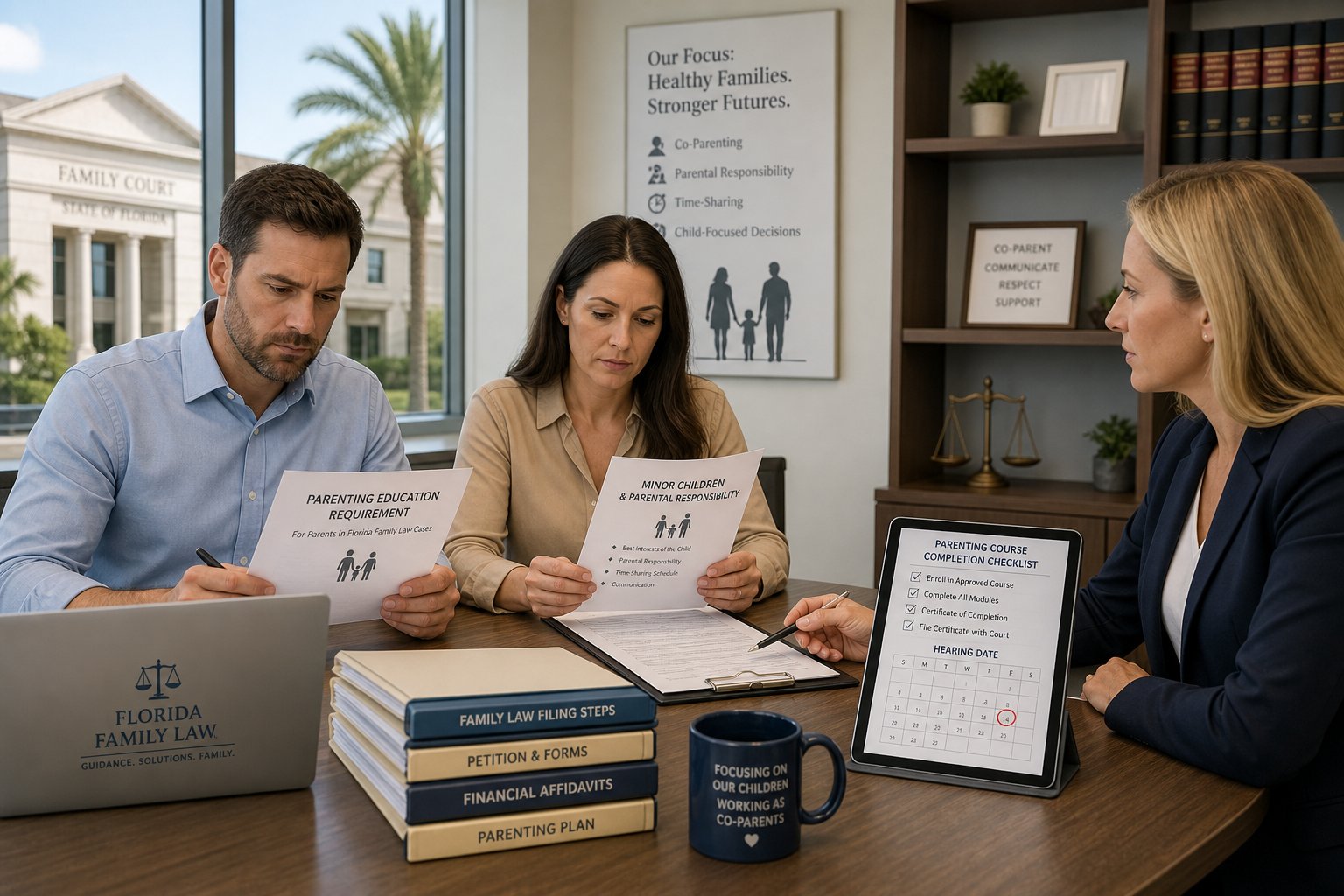
Who Needs A Hillsborough County Parenting Class
A Hillsborough County parenting class usually means Florida’s required Parent Education and Family Stabilization Course. If you are a parent with minor children in a Florida divorce case, you may need it.
Florida law generally requires both parties in a dissolution of marriage case with minor children to complete this class before final judgment. The rule also may apply in certain family cases involving children, such as some paternity matters when the court must address parental responsibility or time-sharing. You can review the state rule in Florida Statutes section 61.21.
A few points matter here:
- Both parents may be required to take the course
- The course is for cases involving minor children
- The exact requirement can vary by court, county, judge, and case type
- A judge may excuse a party for good cause in limited situations
If you are in Hillsborough County, do not assume every family case works the same way. Some parents need the class early in the case. Others may be told to complete it before a final hearing or final judgment. The safest step is to read your court papers closely and check instructions from the Florida Courts family law resources and the local court or clerk website.
If your case involves children, check whether the course is required before you pick a provider.
What The Florida Parent Education And Family Stabilization Course Covers
The course teaches how family change affects both parents and children. Its main goal is to help parents lower conflict and make better choices for their children.
Under Florida Department of Children and Families standards, the course is at least 4 hours long. It is built to educate, train, and assist parents during separation, divorce, and related family cases. You can learn more from the Florida DCF.
Most approved classes cover topics like these:
- How divorce or separation can affect children at different ages
- Ways to support a child’s adjustment and daily routine
- Co-parenting skills and problem-solving
- Better parent-to-parent communication
- The meaning of shared parental responsibility
- How time-sharing decisions can affect children
- How to reduce stress and family conflict
- How to focus on the child’s best interests
A good class does not tell you who should win your case. Instead, it explains how children often react to change and what parents can do to make the transition less harmful. That matters because courts in Florida expect parents to put children first, even when the adults disagree.
If you are trying to meet a court requirement, pick a course that clearly states it is a Florida Parent Education and Family Stabilization Course from a DCF-approved provider.
Online Vs Local In-Person Options In Hillsborough County
Many Florida parents now choose an online class because it is easier to fit into work and family schedules. But you still need to make sure the class format is allowed in your case.
In Hillsborough County, you may see both online and in-person options. Online courses can be helpful if you need flexibility, use a phone or laptop, or want to work in small blocks of time. In-person classes may appeal to parents who prefer a classroom setting.
Online classes often offer these benefits:
- Start from home
- Work at your own pace
- Use a phone, tablet, or computer
- Stop and restart as needed
- Get your certificate of completion after you finish
Still, not every court handles remote learning the same way. Some provider pages say their online class is accepted in Hillsborough County. That can be useful information, but it should not replace checking local instructions. Court acceptance can depend on the specific court, the judge, and the case type.
If you want a fully online option, DivorceParentingClass.net offers a Florida DCF parenting course that is designed for parents who need a simple path to compliance. Before you enroll, confirm that an online format works for your case and that the provider is approved.
How To Know If A Parenting Class Is Accepted By The Court
The first thing to check is DCF approval. If a provider is not approved by the Florida Department of Children and Families, the course may not meet Florida’s basic requirement.
That said, DCF approval is not the only issue. You also need to make sure the course is accepted by the court handling your case. Requirements can depend on local practice, your judge, and whether your matter is a divorce, paternity, or another family law case involving children.
Use this checklist before you register:
- Confirm the provider says it is DCF-approved
- Check that the course is the Parent Education and Family Stabilization Course
- Read any orders or notices in your case
- Review the local court or Clerk of Court website
- Ask your lawyer, if you have one, how your court handles online classes
Helpful sources include the Florida DCF, Florida Courts, and the Hillsborough County Clerk of Court & Comptroller.
Be careful with broad promises. A provider can say it is approved and commonly used, but no website should promise acceptance in every case without reference to local court instructions. The smart move is to verify both pieces: state approval and local court acceptance.
How The Online Class Works From Registration To Certificate
Most online courses follow a simple step-by-step process. You register, complete the lessons, finish any required quizzes or test, and then receive your certificate of completion.
The exact setup depends on the provider. Some courses use short modules. Some include quizzes after each section. Others have a final exam. Provider features can vary, so read the course details before you pay.
A typical online process looks like this:
- Create an account
- Enter your name and case-related details if requested
- Pay the course fee
- Complete all required lessons
- Finish quizzes or the final test, if required
- Download or receive your certificate
With DivorceParentingClass.net, the course is built for easy access on a phone, tablet, or computer. That can help if you have work, school pickups, or other family demands. It also means you can move at your own pace instead of sitting in a set classroom block.
Before you begin, make sure your name is entered correctly. Your certificate should match the name you use for court records. Small errors can create extra work later when you need to provide proof of completion.
What To Expect After Completion And When To File Your Certificate
After you complete the class, the key document is your certificate of completion. You may need to give that certificate to the court, file it with the Clerk of Court, or keep it ready for your lawyer to submit, depending on the instructions in your case.
Do not assume every county or judge uses the same process. Some courts want filing by a certain stage of the case. Others may mention the certificate in an order, checklist, or hearing notice. Because of that, the best source is always your own case paperwork and the local court’s directions.
A few practical tips can help:
- Save a digital copy of the certificate
- Print a paper copy for your records
- Check that your name is correct
- Review your court papers for filing instructions
- Ask your lawyer or the clerk what form of submission is expected, if unclear
Timing matters. Florida law often ties course completion to the progress of the case, and waiting too long can create problems. If you finish early, keep your proof in a safe place and follow the filing steps listed in your case materials.
Once you finish the course, review your court notice and submit the certificate the way your case instructions require.
How The Course Helps With Co-Parenting, Communication, And Family Stability
The class is not only a court requirement. It also gives many parents a better way to work together after a split.
Florida’s parent education course focuses on the effect of conflict on children. It teaches parents how to speak with less blame, keep children out of adult disputes, and support a more stable home life. Those skills matter when you are building a parenting plan or adjusting to a new time-sharing routine.
Strong course content often helps you:
- Keep talks with the other parent brief and clear
- Avoid using children as messengers
- Stay focused on school, health, and routines
- Understand how stress shows up in children
- Make choices that support family stability
Even simple changes can help. For example, using a calm written message instead of a late-night phone call may reduce conflict. Keeping exchange details clear may also lower stress for children.
If you need a flexible online option, you can take the Florida Parent Education and Family Stabilization Course at DivorceParentingClass.net. It offers a DCF-approved online course for Florida parents who need to meet court requirements and get their certificate.
FAQ
Is the Hillsborough County parenting class different from other counties?
No. It’s the same statewide DCF-approved Parent Education and Family Stabilization Course. What’s specific to Hillsborough is how you file the certificate with the local Clerk of Court.
How do I file my certificate in Hillsborough County?
Generally with the Hillsborough Clerk of Court, or through your attorney, following the county’s process. Confirm the current steps on the clerk’s official site or your court papers.
Can I take the course online in Tampa?
Usually yes, if the provider is DCF-approved and your court accepts the online format. Confirm acceptance with your court, since local practice can vary.
When should I complete it?
Early in your case is safest, generally before the final judgment. Deadlines can vary by court, so check your court papers for your specific timeframe.
Conclusion
Hillsborough parents take the same statewide DCF-approved course, with filing handled through the local Clerk of Court. Complete an approved course, confirm Hillsborough’s filing steps from the clerk or your court papers, and file your certificate. The course is consistent statewide; the filing is what you verify for Tampa.
You can complete the DCF-approved Parent Education and Family Stabilization Course online and file your certificate with the Hillsborough clerk.
Related Articles
- Florida Parenting Class by County: Court Certificate Guide
- Pinellas County Parenting Class Guide
- Orange County / Orlando Parenting Class for Divorce
- Miami-Dade Divorce Parenting Class Guide
Sources
Billy Forte is the founder of Divorce Parenting Class, which offers a Florida DCF-approved online Parent Education and Family Stabilization Course. The brand focuses on clear, supportive, plain-English guidance to help Florida parents complete the court-required class and file their certificate.
This article is general information, not legal advice. Florida family-law requirements and certificate acceptance can vary by court, county, judge, and case type, so review your court papers and official Florida sources, or consult a family-law attorney, before acting.