
Updated June 2026 · Reviewed by Billy Forte
A free online parenting class with a certificate will satisfy a Florida court only if the course is DCF-approved and your court accepts it — otherwise the certificate is for personal learning, not court credit. Many free classes offer useful general parenting education but aren’t the required Parent Education and Family Stabilization Course. This guide explains how to tell an informational free class from a court-accepted one so you don’t rely on the wrong certificate.
Applies to the Florida Parent Education and Family Stabilization Course (Fla. Stat. 61.21). Requirements and acceptance can vary by court, county, judge, and case type, so review your court papers and official Florida sources.
Key Facts
- Free ≠ automatically accepted: A court accepts a free class only if it’s DCF-approved and your court allows it.
- Many free classes are informational: They teach general parenting, not the required Florida course.
- Check for DCF approval: That’s what separates a court-accepted course from a learning-only one.
- A certificate alone isn’t proof: A completion certificate doesn’t mean the course counts for court.
- Verify before relying on it: Confirm approval and your court’s acceptance before using a free class for your case.
What Free Online Parenting Classes Usually Offer
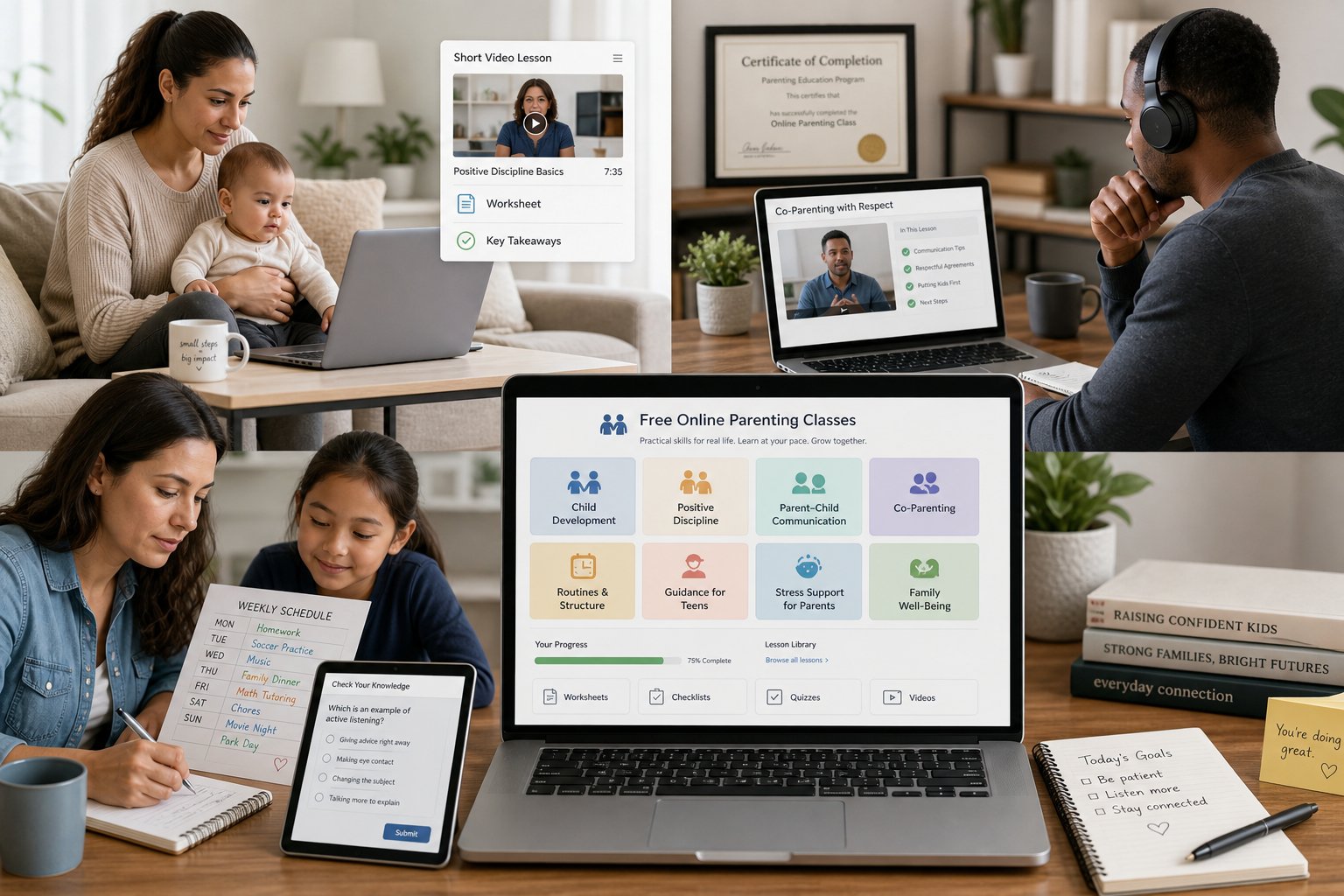
Free online parenting classes usually give basic education, not always court credit. Most include short videos, simple reading lessons, worksheets, and sometimes quizzes. Some also offer a certificate of completion, but that certificate may be for personal learning only.
Who These Classes Are Best For
Free classes often work well for parents who want help with daily parenting problems. That includes new parents, parents of teens, and separated parents who want better co-parenting skills.
They can be useful if you want to learn about:
- child development
- routines and limits
- calm discipline
- talking with teens
- reducing conflict between homes
- helping children handle stress
For Florida parents in a divorce or paternity case, free classes can still add value. They may help you build better habits before your parenting plan is final. But if the court ordered a Parent Education and Family Stabilization Course, a general free class is usually not enough by itself.
Topics You Can Expect To Learn
Most free parenting classes cover common family topics in plain language. The exact lessons depend on the provider, but many focus on practical skills you can use right away.
Common topics include:
- child growth and behavior
- positive discipline without hitting
- family routines and rules
- parent-child communication
- conflict control and problem solving
- co-parenting after separation
- emotional health and stress
- teen safety issues
Some divorce-focused classes also discuss how conflict affects children. That matters in Florida cases that involve parental responsibility, time-sharing, and a parenting plan. Even so, a helpful topic list is not the same as state approval. If your goal is court compliance, content alone does not decide acceptance.
Where To Find Free Online Parenting Classes
You can find free online parenting classes from nonprofits, public programs, education platforms, and private companies. Some are fully free. Others offer only a free workshop or sample lesson, so read the details closely.
Good places to check include:
- research-based parenting programs such as Triple P
- nonprofit family groups such as The Family Tree
- online learning sites such as Alison
- co-parenting education tools such as UpToParents
- hospital, school, or community parent resource pages
When you compare options, look for clear course details. A trustworthy site should say what the class covers, how long it takes, whether it is self-paced, and whether it gives a certificate of completion.
If you need a Florida court class, start with official sources first. Review the Florida Department of Children and Families and your local court or Clerk of Court website. You can also check the Florida Courts family law resources for family case information.
And be careful with search results for “free parenting classes online.” A course may be real and helpful but still not count for your case. Before you spend hours on a class, confirm whether it is only educational or whether it is tied to a Florida-approved requirement.
How To Tell Whether A Free Class Is Informational Or Court Approved
The fastest way to tell is this: court-approved courses say so clearly and show Florida-specific approval details. If a site only says the class helps parents, treat it as informational unless you confirm more.
Look for these signs:
- the course names Florida directly
- the provider says it is a DCF-approved provider
- the class is described as a Parent Education and Family Stabilization Course
- the site explains who must take it
- the provider offers a Florida-ready certificate
- the course matches local court instructions
Then take one more step. Check your county court or Clerk of Court page to see whether it lists approved providers, filing instructions, or family case rules. Some counties post detailed guidance. Others direct you to state-approved providers or tell you to ask the judicial assistant, clerk, or your lawyer.
Also separate course completion from proof filing. Finishing a class means you completed the lessons. Filing proof means you submit the certificate of completion to the right place if your court requires that step. A valid certificate does not help if it never reaches the court in the proper way.
For the legal rule behind parenting plans and related family matters, Florida Statutes Chapter 61. If a site cannot explain its approval status in plain terms, move on.
What Florida Parents In Divorce Or Custody Cases Need To Know
Florida parents need to know that free classes and court-required classes are often not the same thing. In many Florida family cases with minor children, the court generally requires parents to complete a Parent Education and Family Stabilization Course from a Florida Department of Children and Families approved provider.
This issue often comes up in divorce cases. It can also matter in some paternity or other family law matters. Your county, judge, and case type can affect what the court expects, so check your own case papers and local instructions.
Here is the key point: a free parenting class may teach useful co-parenting skills, but it may not meet the Florida requirement. Generic courses from national platforms often do not say they are Florida approved. That means the court may not accept the certificate for your case.
You should also know that the court process has two parts:
- complete the required course
- file or present the certificate of completion if your court requires it
Those are different tasks. Do both exactly as your court directs.
If you are looking for a Florida online option, DivorceParentingClass.net offers a Florida Parent Education and Family Stabilization Course from a DCF-approved provider. Before you enroll, compare that information with your county court page and any order in your case. That extra check can save time and avoid problems with your filing deadline.
How To Choose The Right Online Parenting Course For Your Situation
Choose the course based on your real goal first. If you want better parenting skills, a free class may be enough. If you need to satisfy a Florida court requirement, choose a course that is built for that exact purpose.
Use this simple checklist:
- Know why you need the class
- check whether Florida approval is required
- match the course to your child’s age and family issue
- confirm the full cost before you start
- make sure you can access it on your phone, tablet, or computer
- review how the certificate works
Price matters, but do not assume free is better for a court case. Some free or low-cost searches lead to general parenting lessons, not a Florida-compliant course. Also, do not assume a paid class is accepted just because it costs money. Approval status matters more than price.
Look for plain, direct wording on the website. A reliable provider should explain the course name, provider approval, certificate process, and support options without vague claims.
If your case involves divorce, time-sharing, or parental responsibility, a Florida-specific course is usually the safer path. If you are ready to complete the required Florida course online, you can review the details at DivorceParentingClass.net.
FAQ
Will a court accept a free online parenting class certificate?
Only if the course is DCF-approved and your Florida court accepts it. Many free classes provide general education and a certificate, but that certificate doesn’t satisfy a court requirement unless the course is approved.
How do I tell if a free class counts for court?
Check whether the provider is on the Florida DCF approved-provider list. If it isn’t, the class is likely informational and won’t satisfy your case, even with a certificate.
Are free parenting classes still useful?
Yes, for building skills and confidence. They just may not meet a court requirement. If your case requires the course, use a DCF-approved provider so it counts.
What’s the risk of using a free class for court?
If it isn’t DCF-approved, the court may reject the certificate, costing you time near a deadline. Confirming approval first avoids having to retake an approved course later.
Conclusion
Free classes can be genuinely helpful, but for a Florida case the deciding factor is DCF approval, not the price or the presence of a certificate. Treat a free class as personal education unless you’ve confirmed it’s approved and your court accepts it. When the requirement is on the line, an approved course is the only reliable way to be sure the certificate counts.
If you need a certificate that’s built to meet the requirement, complete the DCF-approved Parent Education and Family Stabilization Course online.
Related Articles
- How Much Does a Florida Parenting Class Cost?
- Free DCF Approved Parenting Classes vs. Court-Ordered Divorce Classes
- Low-Cost Florida Parenting Class Options: What to Check Before Enrolling
- Cheapest Court-Approved Parenting Class in Florida: What Matters Besides Price
Sources
Billy Forte is the founder of Divorce Parenting Class, which offers a Florida DCF-approved online Parent Education and Family Stabilization Course. The brand focuses on clear, supportive, plain-English guidance to help Florida parents complete the court-required class and file their certificate.
This article is general information, not legal advice. Florida family-law requirements and certificate acceptance can vary by court, county, judge, and case type, so review your court papers and official Florida sources, or consult a family-law attorney, before acting.