
Updated June 2026 · Reviewed by Billy Forte
The cheapest court-approved parenting class in Florida is only a bargain if it’s actually DCF-approved and accepted by your court — otherwise the low price costs you a do-over. Beyond price, what matters is approval, your court’s acceptance, the certificate details, and reliable completion. This guide explains what to weigh besides cost so the class you pick is both affordable and valid for your case.
Applies to the Florida Parent Education and Family Stabilization Course (Fla. Stat. 61.21). Requirements and acceptance can vary by court, county, judge, and case type, so review your court papers and official Florida sources.
Key Facts
- Cheapest only counts if approved: A low price means nothing if the course isn’t DCF-approved.
- Court acceptance matters: Confirm your court accepts the course, since acceptance can vary.
- Certificate quality: Make sure it shows your name and any required case details.
- Reliable completion: A working platform and support matter when a deadline is near.
- Value over price: The right measure is total value — approval, certificate, and support — not just cost.
What A Court-Approved Parenting Class In Florida Actually Means
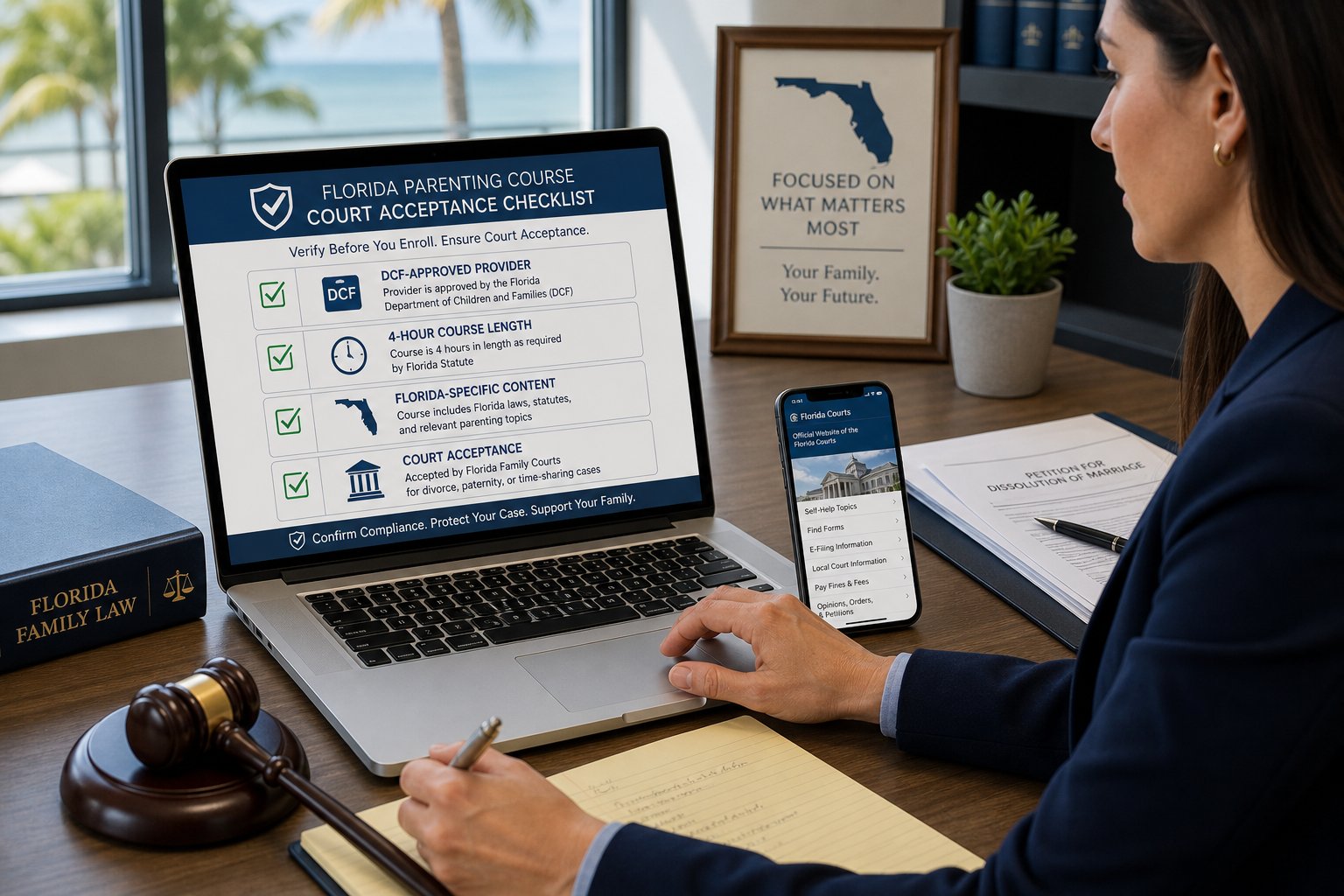
A court-approved parenting class in Florida usually means a 4-hour Parent Education and Family Stabilization Course that meets state standards and is offered by a Florida Department of Children and Families approved provider. That is the starting point. It does not mean every judge in every case will accept any course without question.
Under Florida Statutes section 61.21, the course is tied to family cases involving parents and children. The provider must be approved by DCF. The course must also cover required topics and meet the minimum time requirement.
Here is what court-approved should make you check:
- DCF-approved provider status
- A 4-hour course length
- Florida-specific course content
- Whether your local court accepts online, in-person, or both
- Any instructions in your court order
This is where many parents get tripped up. A website may say it is accepted by Florida courts, but your own case still follows the order from your court. Counties, judges, and case types can matter.
If you are comparing low-cost options, do not focus on price alone. A cheap class that is not approved can waste your time and money. A better first step is to verify the provider on the official DCF source and then read any local family court instructions on Florida Courts or your county clerk site.
Who Must Take The Parent Education And Family Stabilization Course
Florida generally requires this course when parents with minor children are in a divorce case. It may also apply in some paternity or family law cases that involve parental responsibility, time-sharing, or support issues.
The basic rule is simple. If your case involves children and the court says the class is required, each parent usually must complete it. In many cases, both parties must finish the course before final judgment.
This often applies to:
- Dissolution of marriage cases with minor children
- Paternity actions involving parenting issues
- Cases involving a parenting plan
- Cases where the court addresses time-sharing or parental responsibility
You should not assume the rule works the same way in every case. Your deadline and filing steps can depend on the court, county, judge, and case type. Some local courts post family law instructions online. Others state the requirement in the summons, standing order, or case paperwork.
If you are not sure whether you must take the class, read your court papers closely. You can also review official family resources from Florida Courts and your county court or clerk website. If your order says to complete the course, do not wait until the last minute. Missing the deadline can create avoidable problems later in the case.
Online Vs In-Person Florida Parenting Classes: What Courts Accept
Florida allows both online and in-person parenting classes through approved providers. But local acceptance is the key issue. Some courts accept DCF-approved online courses with no problem, while some counties or judges may give more specific instructions.
That means the real question is not just, “Is online allowed in Florida?” The better question is, “Will my court accept this format for my case?”
A safe way to check is to confirm three things:
- The provider is a DCF-approved provider
- The course is the Florida Parent Education and Family Stabilization Course
- Your local court does not restrict the format
Online classes can be easier for many parents. You can usually work from your phone, tablet, or computer. That matters if you have work hours, child care limits, or travel problems.
Still, convenience should not replace verification. A DCF-approved online course may be a strong option, but your judge controls your case. If your order, county page, or family law packet gives directions, follow those directions.
For example, DivorceParentingClass.net offers a Florida course online and states that it is DCF-approved. Even so, you should still compare that information with your local court instructions before you enroll. That extra check can help you avoid filing a certificate of completion that the court asks you to replace later.
How To Choose A Florida DCF-Approved Provider
The best provider is not always the cheapest one. The best provider is the one that is approved, clear, and fits your court’s rules. Price matters, of course, but only after you confirm the basics.
Start with the official source. Use the Florida Department of Children and Families provider information to confirm that the course provider is approved for the Florida Parent Education and Family Stabilization Course.
Then check the provider itself. A reliable provider should clearly show:
- DCF-approved status
- The course name for Florida
- That the course meets the 4-hour minimum
- How you receive the certificate of completion
- Support contact information
- Any limits based on county or court format rules
After that, review your local court website. County family court pages and clerk pages may list approved formats, filing notes, or other directions. You can find clerk resources through the Florida Court Clerks & Comptrollers.
Be careful with searches for free or very low-cost classes. A low price can be valid, but free offers may not meet Florida rules, may be for another state, or may not be approved at all. If a site does not clearly identify Florida approval, course length, and certificate details, move on.
Before you pay, check the provider name, the course name, and your local instructions one more time. That small step is often what protects you from paying twice.
What The Course Covers And How Long It Takes
Florida’s course is at least 4 hours long. It is not just a formality. The class is meant to help parents understand how family changes affect children and how to reduce harm during the case and after it.
The course content usually includes:
- The effect of divorce or separation on children
- The effect on parents and family life
- Co-parenting skills
- Better communication
- Conflict reduction
- Family stabilization
- The needs of children during change
In many courses, you will also see topics tied to a parenting plan, healthy decision-making, and ways to support children without pulling them into adult conflict. The goal is practical. Courts want parents to have basic tools for handling change in a safer way.
Course delivery can vary by provider. Some online programs let you log in and out as needed. Some may have quizzes or checkpoints. Some classroom options follow a fixed schedule. You should read the provider’s details before signing up.
If you need flexibility, an online course may be easier to fit into your week. If you prefer a set class setting, an in-person option may feel simpler. In either case, make sure the course is the Florida-required version, not a general parenting class from another state.
When To Take The Class, Get Your Certificate, And Meet Court Deadlines
You should take the class as early as your case instructions allow. In many Florida family cases, a common rule is 45 days after filing for the petitioner and 45 days after service for the respondent, with completion required before final judgment. But your own deadline can differ.
Always check:
- Your court order
- Your family law packet
- Your county court website
- Your Clerk of Court filing instructions
After you finish the course, you should receive a certificate of completion. How that certificate is handled depends on the provider and local practice. Some providers give an instant download. Some send it by email. Some may explain whether you must file it yourself or keep it for court use.
Do not assume the court received it unless your provider or court instructions clearly say so. A certificate only helps if it gets where it needs to go in the way your court requires.
If you want a simple next step, review your case paperwork and choose a provider that explains certificate delivery clearly. If you need an online Florida option, you can take the Florida Parent Education and Family Stabilization Course at DivorceParentingClass.net after you confirm it matches your local court instructions.
What Happens If You Do Not Complete The Required Class
Failing to complete the required class can hurt your case. Florida courts may treat noncompliance as a serious problem, especially when the order clearly requires the course.
Possible results can include:
- Delay in moving the case forward
- Problems before final judgment
- A finding of contempt of court
- Limits tied to time-sharing or shared parental responsibility until you comply
The exact result depends on your judge, county, case type, and the orders already entered in your case. That is why waiting is risky. Even if the class seems simple, the deadline still matters.
If you missed a deadline, do not ignore the issue. Read your court order again, gather your case papers, and complete the course as soon as allowed under your court’s instructions. Then check with the proper court or clerk process for your certificate of completion.
A low-cost class only helps if it meets Florida rules and your court accepts it. Approval, format, and timing matter more than the lowest number on a checkout page.
FAQ
Is the cheapest court-approved parenting class a safe choice?
Only if it’s genuinely DCF-approved and your court accepts it. A low price is fine when the course is approved; the risk is a cheap class that turns out not to count.
What matters besides price?
DCF approval, your court’s acceptance, the certificate details, the format, and reliable support. These determine whether the class actually satisfies your case.
How do I confirm a cheap class is court-approved?
Check the provider against the Florida DCF approved-provider list and confirm your court accepts it. Don’t rely on a ‘court-approved’ label without verifying.
Could the cheapest option cost more later?
Yes — if the court rejects an unapproved class, you’d retake an approved one and pay again. Verifying approval first protects both your money and your deadline.
Conclusion
Chasing the lowest price is fine as long as you measure the right thing: an unapproved class isn’t cheap if it doesn’t count. Weigh approval, court acceptance, certificate quality, and reliability alongside cost. A DCF-approved course at a fair price gives you the savings without gambling on whether your certificate will be accepted.
For a course built to meet the requirement, complete the DCF-approved Parent Education and Family Stabilization Course online.
Related Articles
- How Much Does a Florida Parenting Class Cost?
- Low-Cost Florida Parenting Class Options: What to Check Before Enrolling
- Free Parenting Classes Online With Certificate: Will a Court Accept Them?
- Free DCF Approved Parenting Classes vs. Court-Ordered Divorce Classes
Sources
Billy Forte is the founder of Divorce Parenting Class, which offers a Florida DCF-approved online Parent Education and Family Stabilization Course. The brand focuses on clear, supportive, plain-English guidance to help Florida parents complete the court-required class and file their certificate.
This article is general information, not legal advice. Florida family-law requirements and certificate acceptance can vary by court, county, judge, and case type, so review your court papers and official Florida sources, or consult a family-law attorney, before acting.