
Updated June 2026 · Reviewed by Billy Forte
Low-cost Florida parenting class options can be perfectly fine, as long as the provider is DCF-approved so the course still satisfies your court. A low price only saves you money if the certificate actually counts, so the checks before enrolling matter more than the headline cost. This guide covers what to verify — approval, court acceptance, certificate, and format — so an affordable class doesn’t turn into a costly do-over.
Applies to the Florida Parent Education and Family Stabilization Course (Fla. Stat. 61.21). Requirements and acceptance can vary by court, county, judge, and case type, so review your court papers and official Florida sources.
Key Facts
- Low cost is fine if approved: An affordable class works as long as it’s DCF-approved.
- Confirm approval first: Verify the provider on the Florida DCF approved list before paying.
- Check court acceptance: Approval plus your court’s instructions determine whether it’s accepted.
- Look at the certificate: Make sure it includes your name and any case details your court needs.
- Mind the format and support: Confirm online/in-person and that help is available if you need it.
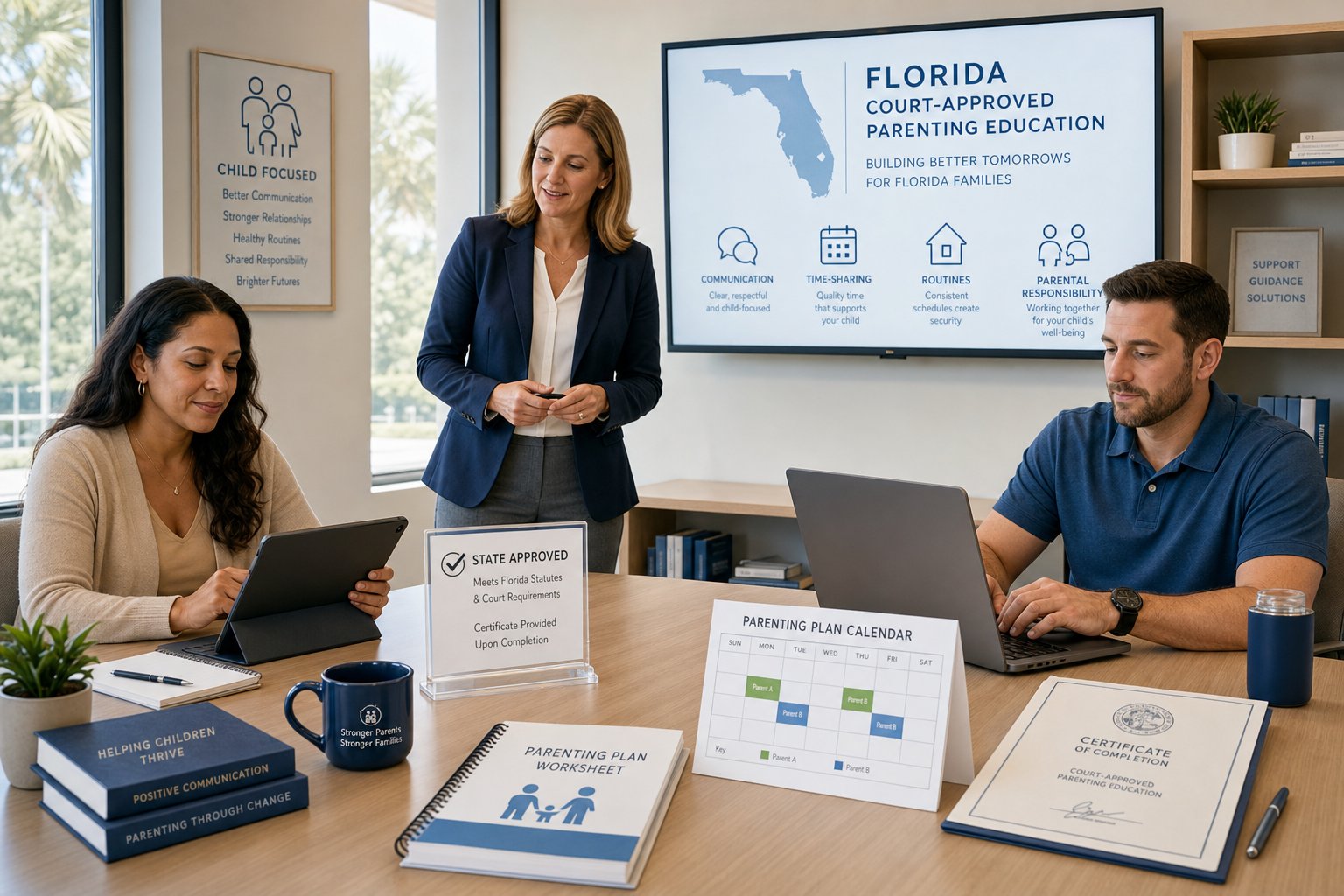
What The Florida Parenting Class Is And Why It Is Required
The Florida parenting class is the state’s Parent Education and Family Stabilization Course. In most qualifying cases, it is a 4-hour course approved by the Florida Department of Children and Families. The goal is simple: help parents understand how family conflict, divorce, and separation can affect children.
Florida requires this course because the law aims to protect children during family change. Under Florida Statute 61.21, the course may cover the effects of divorce on parents and children, plus issues tied to care, time-sharing, and support. That matters because court orders do more than end a marriage. They also shape a child’s daily life.
The class is not just a formality. It supports better decisions around parental responsibility, communication, and a workable parenting plan. A good course explains how to reduce conflict, keep children out of adult disputes, and build steady routines across two homes.
You should also know that Florida allows approved online options. The Florida DCF approved provider list is the best place to confirm that a provider is authorized. Cost matters, of course. But when you search for free or low-cost options, approval status should come first, not price alone.
Who Must Take The Parent Education And Family Stabilization Course
In Florida, this course generally applies when parents with minor children are involved in certain family law cases. The clearest example is a dissolution of marriage case with minor children. It can also apply in paternity cases that involve parental responsibility and time-sharing.
The main rule comes from state law, but your exact requirement can still depend on the court, the county, the judge, and the kind of case you filed. That is why two people in different counties may see slightly different instructions, even under the same Florida statute.
In general, the people who may need the course include:
- A parent who files for divorce with minor children
- The other parent who responds to that case
- A parent in a paternity case involving parenting issues
- In some cases, parties in other family matters if the court orders it
Florida courts can excuse completion for good cause in limited situations, but that is a court decision. You should not assume you are excused just because your case feels unusual.
To verify your own requirement, check the family case packet from your county court, review Florida Courts family law forms, or contact the Clerk of Court for filing guidance. If you already have a lawyer, ask how the rule applies in your case.
How The Florida Parenting Class Works Online
A Florida online parenting class can be valid if the provider is DCF-approved. Florida law requires at least one statewide internet option, and approved providers may offer the course for remote completion. That means you can often take the class from home on a phone, tablet, or computer.
Most online courses follow a simple process. You register, pay the course fee, complete the lessons, and receive a certificate of completion if you finish all required parts. Each provider may structure the material a bit differently, so read the instructions before you start.
When you compare online options, look for these basics:
- DCF-approved provider status
- Clear course length and format
- Device access on phone, tablet, or computer
- Language or support options if needed
- How the certificate is delivered after completion
If you are trying to choose an affordable class safely, this is where people often make mistakes. A low price does not help if the provider is not approved or if your court has extra local instructions. Some sites also make broad claims about acceptance. It is smarter to verify the provider on the DCF list and then confirm local court expectations.
If you want an online option, DivorceParentingClass.net offers a Florida Parent Education and Family Stabilization Course online through a DCF-approved provider.
What The Course Covers For Co-Parenting, Communication, And Child Well-Being
The course is meant to help you make better choices for your child during and after separation. Florida law says the program may address issues tied to custody, care, and support. In practice, approved providers usually teach a mix of legal basics, parenting skills, and child-focused communication.
Most Florida parenting class programs cover topics such as:
- How divorce or separation can affect children by age
- How to reduce conflict in front of children
- How to support healthy co-parenting
- How to communicate about schedules and school needs
- How to keep children out of adult disputes
- How a parenting plan and time-sharing affect daily life
A useful class also explains that children often do better when parents keep routines stable. Simple things matter. Bedtimes, school work, exchange plans, and calm handoffs can lower stress for kids.
Communication is another big part of the course. You may learn to keep messages short, clear, and focused on the child. That helps when you need to discuss medical care, school events, or holiday schedules without starting a new fight.
The best courses do not promise to fix every conflict. They do give you tools to protect your child’s well-being while the case moves forward.
Certificates, Court Acceptance, And Florida County Requirements
Your certificate of completion is the proof that you finished the course. After you complete a class through a DCF-approved provider, the provider should issue a certificate. That certificate is often needed for your case file or final hearing process, depending on local practice.
Still, court acceptance is not only about the certificate itself. It can also depend on whether the provider is on the DCF approved list and whether your county has its own filing steps. Some courts want you to file the certificate with the clerk. Others may have specific instructions in the case packet.
That is why you should check both sources:
- The Florida DCF provider list
- Your county court or Clerk of Court website
You can also review Florida Courts for statewide court information. If your county posts family law instructions, read them closely before you upload, mail, or bring in your certificate.
Be careful with broad claims like “accepted everywhere” if they are not tied to approval status and local court rules. A safer approach is to confirm the provider first, then confirm your county process. Keep a copy of your certificate for your records, and follow your court’s instructions for the next step.
Deadlines, Completion Rules, And What Happens If You Do Not Finish On Time
You should complete the course as early as you can after your case starts. Florida courts may set deadlines, and some provider and court materials state that petitioners must complete the class within 45 days of filing and respondents within 45 days of service. But deadlines can vary by court order, county practice, case type, or judge.
That is the key point: do not guess. Read your court papers. Then confirm any timing rules through your county court, your attorney, or the Clerk of Court.
If you do not finish on time, the court can impose sanctions under Florida Statute 61.21. Depending on the case, that may include contempt or other limits related to parental responsibility or time-sharing. Courts may excuse late completion for good cause in some situations, but that is not automatic.
A few simple steps can help you avoid problems:
- Enroll early after filing or service
- Save your login details
- Finish the full course, not part of it
- Keep your certificate of completion
- Follow local filing or hearing instructions
If you already have a deadline, act on it now so you have time to fix any issue with registration or proof of completion.
How To Choose A Florida Parenting Class Provider
Choose a provider by checking approval first, cost second, and local court fit third. That is the safest way to find an affordable option without risking a useless certificate. When people search for a free or cheap class, they sometimes miss the part that matters most: DCF approval.
Start with the official provider list from the Florida Department of Children and Families. Then compare providers on practical points, not just headline price.
Check these items before you enroll:
- Is the provider DCF-approved?
- Is the course online, classroom, or correspondence?
- Does your county court give any special instructions?
- How do you receive the certificate of completion?
- Is support available if you have login or certificate issues?
- Are there language options that fit your needs?
Also, be careful with “lowest cost” claims if the site does not clearly show provider approval and course details. Cheap is only useful if the class meets the rule in your case.
If you want a simple online option, you can take the Florida Parent Education and Family Stabilization Course at DivorceParentingClass.net. Before you enroll, compare it with your county instructions so your next step is clear.
FAQ
Are low-cost Florida parenting classes legitimate?
They can be, as long as the provider is DCF-approved. A low price is fine when the course still satisfies your court; the key is confirming approval before you enroll.
What should I check before enrolling in a cheap class?
Confirm DCF approval, check that your court accepts it, review what the certificate includes, and verify the format and available support. These ensure the affordable class actually counts.
Could a cheap class cost me more later?
Yes, if it isn’t approved and the court rejects the certificate, you’d have to retake an approved course. Verifying approval up front prevents paying twice.
Where do I confirm a provider is approved?
Check the Florida DCF approved-provider list. If a low-cost class isn’t on it, treat it as informational rather than court-accepted.
Conclusion
Saving money on a parenting class is reasonable, but only an approved course actually saves you anything — a cheap class that the court rejects costs more in the end. Run the quick checks first: approval, acceptance, certificate, and format. With those confirmed, a low-cost DCF-approved course gives you both the savings and the certainty that it counts.
You can enroll directly in the DCF-approved Parent Education and Family Stabilization Course online and know it’s built to meet Florida’s requirement.
Related Articles
- How Much Does a Florida Parenting Class Cost?
- Cheapest Court-Approved Parenting Class in Florida: What Matters Besides Price
- Free Parenting Classes Online With Certificate: Will a Court Accept Them?
- Free DCF Approved Parenting Classes vs. Court-Ordered Divorce Classes
Sources
Billy Forte is the founder of Divorce Parenting Class, which offers a Florida DCF-approved online Parent Education and Family Stabilization Course. The brand focuses on clear, supportive, plain-English guidance to help Florida parents complete the court-required class and file their certificate.
This article is general information, not legal advice. Florida family-law requirements and certificate acceptance can vary by court, county, judge, and case type, so review your court papers and official Florida sources, or consult a family-law attorney, before acting.