
Updated June 2026 · Reviewed by Billy Forte
Yes, you can usually finish the Florida parenting class in one day, since the requirement is a four-hour course and most DCF-approved online providers let you work at your own pace. Many parents complete the four hours in a single sitting and download the certificate the same day. What matters for your case isn’t how fast you finish, but that the course is DCF-approved and that you file the certificate the way your court directs.
Applies to the Florida Parent Education and Family Stabilization Course (Fla. Stat. 61.21). Requirements and acceptance can vary by court, county, judge, and case type, so review your court papers and official Florida sources.
Key Facts
- Four hours, often one sitting: The course is a four-hour minimum, and self-paced formats let many finish in a day.
- Same-day certificate: Many providers issue the certificate immediately after completion.
- Self-paced: You can usually pause and resume if you can’t finish all at once.
- Approval matters more than speed: Make sure the course is DCF-approved so the certificate counts.
- File it correctly: Filing the certificate with the court is what completes the requirement.
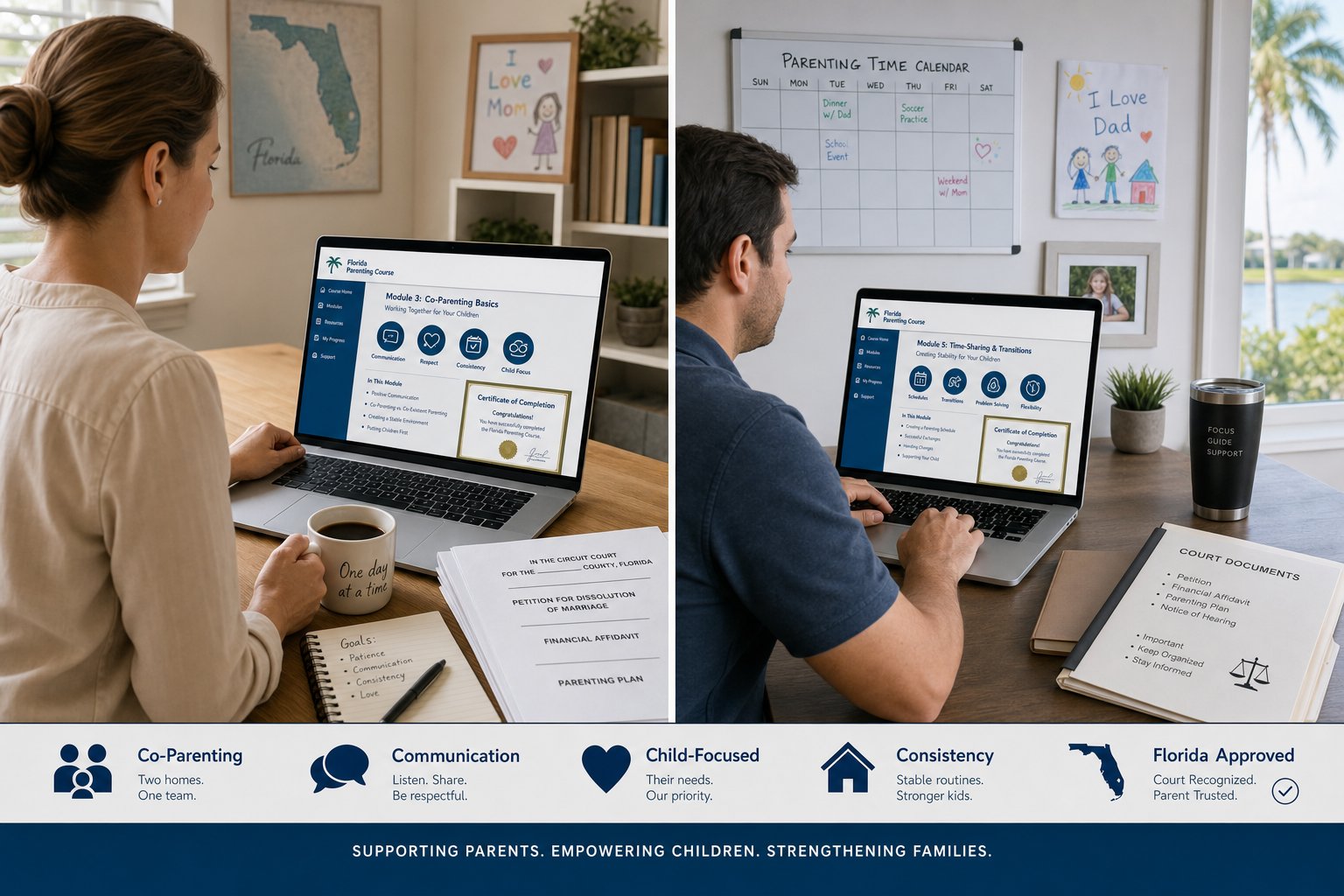
What The Florida 4-Hour Parenting Class Is And Who Must Take It
The Florida 4-hour parenting class is the state-required Parent Education and Family Stabilization Course for many family law cases involving minor children. Under Florida Statutes section 61.21, courts generally require this course in a dissolution of marriage case with minor children, and it may also apply in paternity or other cases involving parental responsibility or time-sharing.
In plain terms, the class teaches parents how family changes can affect children. It also covers co-parenting, communication, and ways to reduce conflict. The goal is not to punish parents. The goal is to support children during a hard transition.
In many Florida cases, both parents must take the course separately. One parent cannot take it for the other, and sharing a certificate does not meet the rule. Courts often expect each person to complete the class on their own and submit their own certificate of completion.
Requirements can still vary. Your county, judge, and case type may affect whether the class is required, when you must finish it, and how you must show proof. That matters in cases involving:
- Divorce with minor children
- Paternity actions
- Time-sharing disputes
- Parenting plan issues
- Other matters ordered by the court
If you are unsure whether your case requires the course, check your court papers, your local family court page, or the Florida Courts website. You can also review your circuit’s family law instructions before you register.
Whether The Online Course Is Approved And Accepted In Florida Courts
An online class can count in Florida, but the key point is provider approval. The course should be offered by a DCF-approved provider for the Florida Parent Education and Family Stabilization Course. DCF stands for the Florida Department of Children and Families.
Florida courts generally look for a course that meets state standards. DCF keeps information about approved course providers, and that approval is a strong sign that the class is designed to satisfy the state requirement. You can review DCF information through the Florida Department of Children and Families.
Still, approval does not mean every court handles paperwork the same way. A DCF-approved provider may meet the course requirement, but local court instructions still matter. Your judge or clerk may have specific filing rules about when and how to submit your certificate.
That is why it helps to separate two steps:
- Completing the online course
- Filing your certificate with the court
These are not the same thing. You might finish a 100% online class in one sitting. But if you do not file the certificate the right way, the court record may still show the requirement as incomplete.
If you want a Florida-focused option, DivorceParentingClass.net states that its course is a Florida DCF-approved provider course and is built for parents who need a fully online format. Even so, you should still follow your county court’s instructions and confirm any local filing step with the Clerk of Court if needed.
What The Parent Education And Family Stabilization Course Covers
The course covers the core issues Florida wants parents to understand when a family law case affects children. It is not just about legal terms. It is about how children react, what parents can do better, and how conflict affects daily life.
A typical Florida course includes topics such as:
- The impact of divorce or separation on children and parents
- How children at different ages may respond
- Co-parenting communication skills
- Parenting plan basics
- Parental responsibility and time-sharing concepts
- Ways to lower conflict between parents
- How to talk with children about family changes
- Domestic violence, abuse, and safety concerns
- Community resources and basic court-related information
These topics come from the course standards used in Florida family cases. For example, many approved providers explain how children may show stress through sleep problems, behavior changes, school trouble, or withdrawal. The course may also explain why children do better when parents keep adult conflict away from them.
You should also expect content on decision-making and schedules. In Florida, issues like shared parental responsibility, communication, and time-sharing are common in family court orders. The class helps you understand the parenting side of those terms.
Some providers use readings, short lessons, quizzes, videos, or a final check for understanding. The exact format can differ, but the main subject areas should line up with Florida’s approved standards. If you want details from the court side, the Florida Courts family law self-help resources can help you connect the course topics to common case steps.
How The 100% Online Class Works From Registration To Certificate
Most Florida online parenting classes follow a simple path. You register, complete the course materials, finish any required checks, and then receive a certificate of completion.
In many cases, the process looks like this:
- Create an account with a Florida provider.
- Choose the Parent Education and Family Stabilization Course.
- Pay the course fee.
- Work through the lessons online.
- Complete any quizzes or final exam if required.
- Download or print your certificate.
A big reason parents choose an online class is flexibility. Many providers let you log in from a phone, tablet, or computer. Your progress is often saved, so you can stop and come back later. But the course still must meet the 4-hour minimum, so it is not something you can legally skip through in a few minutes.
Some providers issue certificates right after completion. Others may have a short processing step. Before you sign up, check:
- Whether the provider is DCF-approved
- Whether progress is saved between sessions
- Whether the certificate is instant or delayed
- Whether there are extra certificate fees
- Whether support is available if you have trouble logging in
If you want a direct next step, you can take the Florida Parent Education and Family Stabilization Course online at DivorceParentingClass.net. After that, make sure you follow your county’s filing instructions so the court gets proper proof of completion.
When To Take The Class And What Happens If You Miss The Deadline
In many Florida cases, you should take the class early. Under section 61.21, courts often require the petitioner to complete it within 45 days of filing and the respondent within 45 days of service, unless the court orders otherwise.
That timeline matters because courts often will not enter a final judgment until both parents complete the requirement and file their certificates. So even if the rest of your case is moving, this one item can still hold things up.
Missing the deadline can create real problems. Depending on your court and your case, the judge may:
- Delay case progress
- Refuse to finalize the case
- Order you to complete the class by a new date
- Treat noncompliance as a serious court issue
- Consider the failure when addressing parenting matters
Florida courts may also look at whether parents are following orders tied to time-sharing and parental responsibility. That does not mean every missed deadline leads to the same result. It means the risk is not worth ignoring.
The safest approach is to read your court order and local instructions as soon as possible. You can also check your county clerk or circuit court website for family law forms and filing details. For example, many counties post family case instructions through the local Clerk of Court or circuit family division pages. If your deadline is close, choose a provider that clearly states how fast the certificate is available and then file it as your court requires.
How To Choose A Florida Online Parenting Class That Fits Your Situation
The best Florida online parenting class is one that meets the state rule and also fits your court process, budget, and schedule. Start with approval first, then look at practical details.
Here is what to check before you register:
- DCF-approved provider status for the Florida course
- A full 4-hour Parent Education and Family Stabilization Course
- Clear wording that the course is for Florida family law cases
- Mobile-friendly access if you plan to use a phone or tablet
- Saved progress if you cannot finish in one sitting
- Clear certificate delivery details
- Simple customer support options
- Language options if needed
It also helps to check your local court’s website. Some circuits or clerks provide filing notes, family law packets, or extra instructions for parents with minor children. You can search your county’s clerk page or start with the Florida Courts directory.
If you want a simple online option, DivorceParentingClass.net offers a Florida-focused course built around the state requirement. That can be useful if you want a course designed for divorce, parenting plans, and co-parenting issues in Florida.
Before you choose, remember one last point: course completion and court filing are separate steps. Pick a provider that helps you finish the class clearly, then follow your judge’s and Clerk of Court instructions for submitting your certificate.
FAQ
Can I finish the Florida parenting class in one day?
Usually yes. It’s a four-hour course, and most DCF-approved online providers are self-paced, so many parents complete it in a single day and get the certificate the same day.
Will I get my certificate the same day?
Often, yes. Many providers issue the certificate of completion immediately after you finish the four hours. Then you file it with the court.
Do I have to finish in one sitting?
No. Most online courses let you pause and resume, so you can complete the four hours across the day or over a few sessions if you prefer.
Does finishing fast affect court acceptance?
No. What matters is that the course is DCF-approved and the certificate is filed correctly — not how quickly you complete the four hours.
Conclusion
Finishing in a day is realistic for most parents: the course is four hours, and a self-paced online format makes a single sitting possible, often with a same-day certificate. The speed isn’t what counts, though — DCF approval and filing the certificate correctly are. Complete an approved course, file the proof, and the requirement is done.
You can complete the four-hour, DCF-approved Parent Education and Family Stabilization Course online at your own pace and download your certificate when you finish.
Related Articles
- Florida Parenting Class Online: Court-Approved 4-Hour Course Guide
- 4-Hour Parenting Class Florida: What the Course Includes
- Can You Take the Florida Parenting Class on Your Phone?
- Court-Approved Parenting Classes in Florida: How to Choose One
Sources
Billy Forte is the founder of Divorce Parenting Class, which offers a Florida DCF-approved online Parent Education and Family Stabilization Course. The brand focuses on clear, supportive, plain-English guidance to help Florida parents complete the court-required class and file their certificate.
This article is general information, not legal advice. Florida family-law requirements and certificate acceptance can vary by court, county, judge, and case type, so review your court papers and official Florida sources, or consult a family-law attorney, before acting.