
Updated June 2026 · Reviewed by Billy Forte
Yes, you can usually take the Florida parenting class before filing for divorce, and completing it early is often a smart way to stay ahead of the requirement. The course is the same DCF-approved Parent Education and Family Stabilization Course whether you take it before or after filing, and your certificate is generally valid for your case. This guide explains the timing, the one caveat about very early completion, and how to make sure the certificate still counts when you file.
Applies to the Florida Parent Education and Family Stabilization Course (Fla. Stat. 61.21). Requirements and acceptance can vary by court, county, judge, and case type, so review your court papers and official Florida sources.
Key Facts
- Early is usually fine: You can typically complete the course before filing for divorce.
- Same course either way: It’s the DCF-approved Parent Education and Family Stabilization Course regardless of timing.
- Stay ahead: Completing early can keep the requirement from delaying your case later.
- Watch very early timing: A certificate from long before your case may raise recency questions — confirm with your court.
- Keep your certificate: Save it so it’s ready to file once your case is open.
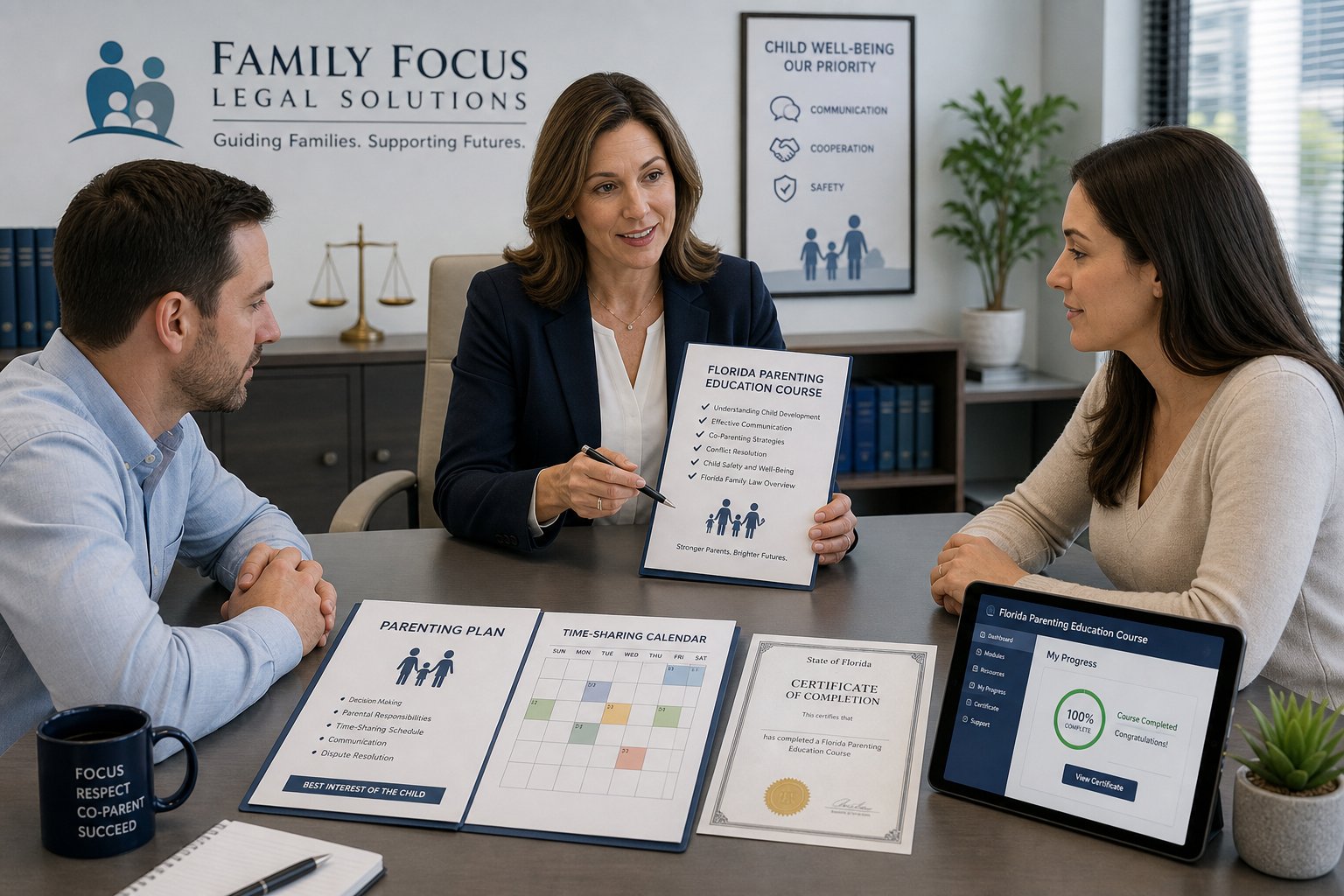
What The Florida Parenting Class Is And Why Courts Require It
The Florida parenting class for divorce is the state’s Parent Education and Family Stabilization Course. It is not general parenting advice. It is a specific course tied to family law cases.
Florida law generally requires this course when parents with minor children are involved in a divorce, separation, or certain other family cases. The legal basis appears in Florida Statutes section 61.21. The course must be approved by the Florida Department of Children and Families.
Courts require it for a simple reason. Family breakup can raise conflict, stress, and confusion for children. The course is meant to lower that harm and help parents make better choices while the case moves forward.
Most approved courses cover core topics such as:
- How divorce affects children at different ages
- How conflict between parents can harm children
- Better ways to communicate
- Parental responsibility and decision-making
- Time-sharing and parenting plans
- Safety issues, including abuse and domestic violence awareness
The goal is not to decide your case. The goal is to give you a shared base of information. That matters when the court expects both parents to support a workable parenting plan.
Because the course is a legal requirement in many Florida cases, choosing a DCF-approved provider matters more than choosing the cheapest or fastest class alone. If the provider is not approved, the certificate may not satisfy the court requirement.
Who Needs To Take The Parent Education And Family Stabilization Course
In Florida, both parents usually must take the course when a divorce involves minor children. This includes the parent who files the case and the parent who responds.
The requirement can also apply in some other family law matters. For example, courts may require it in certain paternity or time-sharing cases. That is why the exact rule can depend on the court, county, judge, and case type.
A common timing rule appears in local court materials:
- The filing parent often must complete the course within 45 days of filing
- The other parent often must complete it within 45 days of service
- Proof usually must be filed before the case is finished
Still, those deadlines are not the same thing as when you may take the class. In many situations, you can take it before filing if you know a case is coming. That can help you avoid a deadline rush later.
What matters most is that:
- The course is the correct Florida course
- The provider is DCF-approved
- Your certificate of completion is kept and filed as required by the court
If you are not sure whether your case requires the class, check your county court or clerk website. You can also review general family court information from Florida Courts.
How The Online Florida Parenting Class Works From Registration To Certificate
Most online courses follow a simple path. You register, complete the lessons, finish any required test, and then get your certificate of completion.
Start by confirming the provider is on the official Florida Department of Children and Families approved list. You can check the state’s information through the DCF website. That step matters because statewide approval starts there.
After that, the process usually looks like this:
- Create an account
- Pay the course fee
- Work through the course modules
- Complete at least the required 4 hours of content
- Take any final quiz or exam the provider requires
- Download or print your certificate
Many online providers let you stop and start. That means you can take the class on your phone, tablet, or computer over more than one session. For many parents, that flexibility is the main benefit of an online format.
At DivorceParentingClass.net, the course is built for Florida parents who need a Parent Education and Family Stabilization Course online. The site states that it is DCF-approved and offers access across common devices.
Keep one point clear: finishing the course does not file your certificate for you unless the provider and your court specifically say that happens. In many cases, you still need to submit proof to the court yourself through the Clerk of Court or the court’s e-filing system.
What The Course Covers For Co-Parenting, Communication, And Child Well-Being
The course focuses on how separation affects children and how parents can reduce harm. That is the heart of the program.
You can expect lessons on children’s stress, behavior changes, and age-based needs. A young child may react very differently than a teenager. The course helps parents spot those differences and respond in healthier ways.
Most Florida-approved courses also cover:
- Co-parenting after separation
- Better parent-to-parent communication
- How to lower conflict in front of children
- The meaning of shared parental responsibility
- How time-sharing affects routines, school, and care
- How to support children during transitions between homes
Some courses also include safety topics. These may cover abuse awareness, family violence concerns, and when normal co-parenting advice may not fit a family’s situation.
Another common topic is the legal structure around a Florida family case. That can include basic information about child support, parenting plans, court expectations, and why judges want parents to put children first.
The course is educational, not case-specific. It does not tell you what order the judge will enter. But it can help you understand the terms you may see in your case and why the court expects a child-focused approach.
That is one reason many parents choose to complete the class early. It can make later paperwork and parenting plan talks easier to understand.
Court Approval, County Acceptance, And When To File Your Certificate
A DCF-approved provider is the starting point, but you still need to follow local court rules about filing your proof. That is where many parents get mixed up.
The class itself is one step. Filing the certificate of completion with the court is a separate step. You may finish the course before filing your case, but the court usually still needs the certificate placed in the case record at the right time.
In many Florida counties, parents file the certificate with the Clerk of Court. Some courts may allow or expect e-filing. Some counties post local family law instructions on the clerk or court website.
You should verify three things:
- The provider is DCF-approved statewide
- Your county accepts that provider for your case type
- You know how and when your court wants the certificate filed
Most Florida courts accept approved providers, but local practice can differ. Also, judges may issue case-specific orders that control deadlines. If proof is missing, the court may delay final action in the case. In some situations, missed course requirements can also affect issues tied to time-sharing or other family orders.
For official local instructions, check your county court or clerk page. You can start with Florida Courts and then find your county. Once you complete the class, make sure you keep a copy of the certificate and follow your court’s filing steps.
Common Questions About Timing, Length, Exams, And Missed Deadlines
Yes, you can often complete the course before you file. But you should not assume that early completion changes any later court deadline for filing proof.
Here are the main points parents ask about most.
How long is the class?
Florida’s Parent Education and Family Stabilization Course must be at least 4 hours. Some providers break that into smaller units so you can complete it over time.
Is there an exam?
Many online providers include a final exam or quiz. The exact format depends on the provider. Some providers allow more than one attempt.
When is the deadline?
A common rule is 45 days from filing for the petitioner and 45 days from service for the other parent. But local orders and county practice can matter.
What if I miss the deadline?
Missing the deadline can create problems. The court may delay parts of the case, and in some situations the judge may take other action allowed by law or court order.
Does taking it early help?
Often, yes. Taking it early can reduce stress and give you one less deadline to track. But it does not replace the need to file the certificate properly in the case.
If your case is active, review your court papers and any orders right away so you know the date that applies to you.
How To Choose A Florida Parenting Class That Is Simple, Flexible, And Legitimate
The best course is one that is approved, clear, and easy to complete correctly. Approval comes first.
Before you sign up, check for these basics:
- It is a DCF-approved provider
- It is the Florida Parent Education and Family Stabilization Course
- It meets the 4-hour minimum
- It gives a clear certificate of completion
- It explains how the course works before you pay
- It works on phone, tablet, and computer if you need flexibility
Then look at practical details. Can you pause and return later? Is pricing easy to understand? Are support options listed if you have account or certificate questions?
DivorceParentingClass.net offers an online Florida course built around those needs. If you want a flexible option, you can take the Florida Parent.
Still, keep your court in the loop. A provider can be state-approved, while your local court may still have filing rules you must follow closely.
One last tip: save your certificate in more than one place. Keep a digital copy and a printed copy if possible. That small step can help if the court, your lawyer, or the clerk asks for proof later.
FAQ
Can I take the Florida parenting class before filing for divorce?
Usually yes. You can complete the DCF-approved course before filing, and the certificate is generally valid for your case. Completing it early can help you stay ahead of the requirement.
Is it the same course before and after filing?
Yes. It’s the same DCF-approved Parent Education and Family Stabilization Course either way. Timing doesn’t change the course or the requirement, only when you complete it.
Could taking it too early be a problem?
Occasionally. A certificate from long before your case may raise recency questions with some courts. If there’s a long gap, confirm with your court that the earlier certificate will count.
What should I do with the certificate if I file later?
Keep it saved so it’s ready to file with the Clerk of Court once your case is open. Confirm your name and case details match when you file.
Conclusion
Taking the class before you file is generally allowed and can be a practical head start, since the course and certificate are the same regardless of timing. The main thing to watch is a very long gap between completion and your case, which a court might question. Complete a DCF-approved course, keep your certificate, and file it once your case is underway.
You can get ahead of the requirement now with the DCF-approved Parent Education and Family Stabilization Course online and keep your certificate ready to file.
Related Articles
- How to Get Your Florida Parenting Class Certificate
- Does a Florida Parenting Class Certificate Expire?
- How to Submit Your Parenting Class Certificate to a Florida Court
- What If the Court Rejects My Parenting Class Certificate?
Sources
Billy Forte is the founder of Divorce Parenting Class, which offers a Florida DCF-approved online Parent Education and Family Stabilization Course. The brand focuses on clear, supportive, plain-English guidance to help Florida parents complete the court-required class and file their certificate.
This article is general information, not legal advice. Florida family-law requirements and certificate acceptance can vary by court, county, judge, and case type, so review your court papers and official Florida sources, or consult a family-law attorney, before acting.