
Updated June 2026 · Reviewed by Billy Forte
Parents facing a Florida family court case usually have the same handful of questions about the Parent Education and Family Stabilization Course: who must take it, when it’s due, what it covers, how much it costs, and how the certificate is filed. The short answers are that most parents in cases with minor children must complete the DCF-approved four-hour course, usually before the final judgment, and file a certificate with the court. This FAQ covers those common questions, while noting that exact rules vary by court and county.
Applies to the Florida Parent Education and Family Stabilization Course (Fla. Stat. 61.21). Requirements and acceptance can vary by court, county, judge, and case type, so review your court papers and official Florida sources.
Key Facts
- Who must take it: Most parents in Florida cases with minor children (divorce, paternity, custody).
- Length: At least four hours, from a DCF-approved provider.
- When it’s due: Usually before the final judgment; many courts set an earlier deadline.
- Format: Available online from DCF-approved providers; commonly mobile-friendly.
- Certificate: File it with the Clerk of Court or through your attorney.
- Rules vary: Requirements can depend on the court, county, judge, and case type.
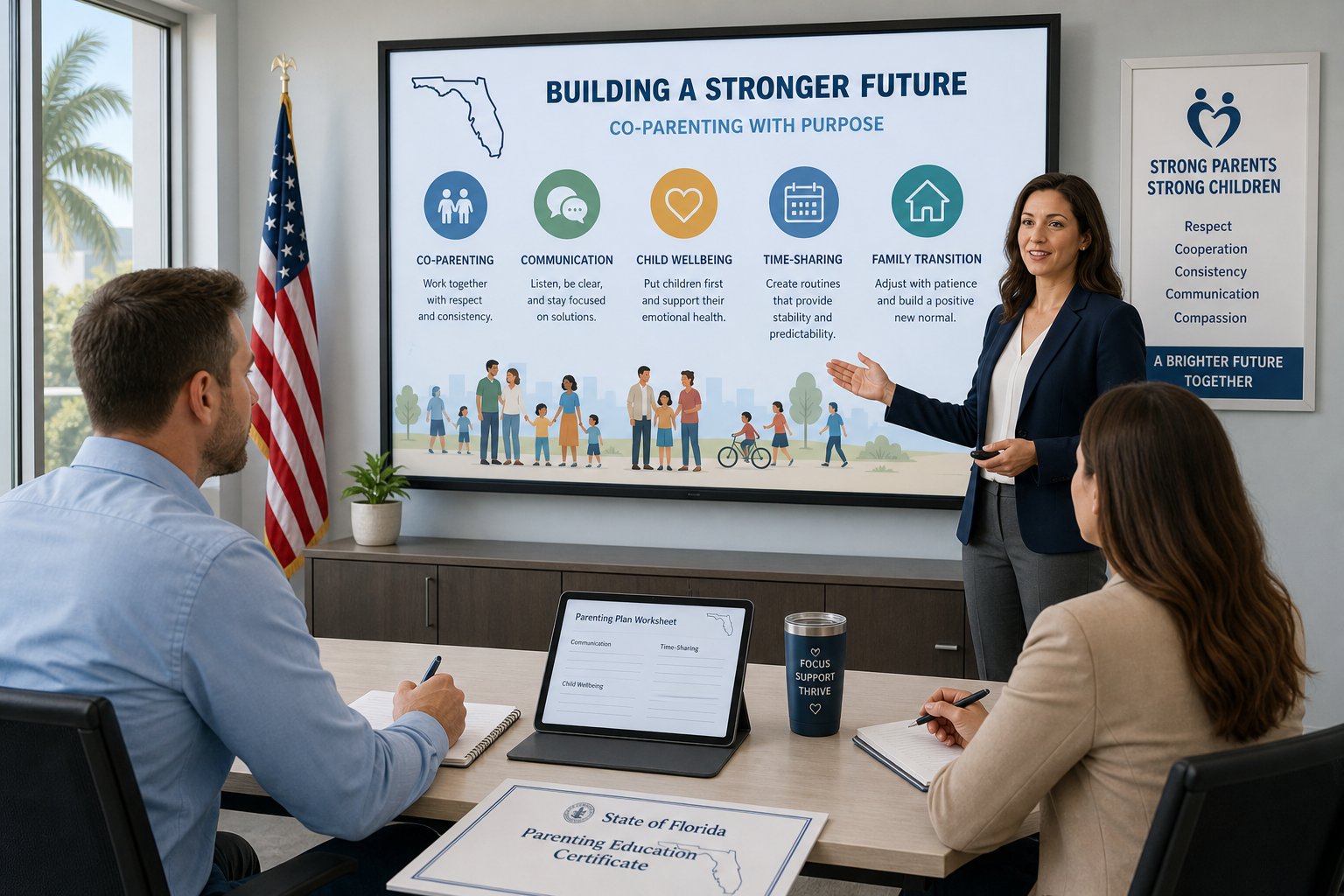
What The Florida Parent Education And Family Stabilization Course Is
The Parent Education and Family Stabilization Course is a Florida court-related class for parents with minor children. It is meant to teach how family change can affect children and how parents can reduce harm during a divorce or other family case.
Under Florida Statute 61.21, the course is generally required in cases involving dissolution of marriage, parenting issues, or paternity matters with minor children. The class must be at least 4 hours long and must follow standards approved by the Florida Department of Children and Families.
This is not a therapy program. It is also not a legal strategy class. Instead, it gives basic education on topics that often matter in Florida family court, such as:
- How conflict affects children
- How to support a child during separation
- Parental responsibility and co-parenting basics
- Communication skills
- Time-sharing issues and family change
A key point is that the course is about parenting after separation, not about proving who is right or wrong in court. Florida wants parents to understand how their choices can shape a child’s stress, behavior, and adjustment.
You can review general court information through Florida Courts and provider information through the Florida Department of Children and Families.
Who Needs To Take The Course And When To Complete It
In Florida, both parents usually need to take the course when a case involves minor children and issues like divorce, custody, paternity, or time-sharing. The requirement often applies before the court enters a final judgment.
In many counties, the usual timeline is:
- Petitioner: within 45 days after filing
- Respondent: within 45 days after service
Still, you should not assume the same rule applies in every case. Requirements can depend on the court, county, judge, and case type. Some local courts publish family law instructions on their clerk or court websites. That is why it is smart to check your county’s family court or Clerk of Court page along with any papers filed in your case.
Common case types where the course may be required include:
- Divorce with minor children
- Paternity actions involving parenting issues
- Some cases involving a parenting plan
- Some cases involving time-sharing or parental responsibility
If you have a lawyer, ask where your certificate should go. If you do not, review your court papers carefully and check local filing instructions. A missed deadline can slow your case, so confirm your due date as early as possible.
What The Course Covers For Parents And Children
The course covers how separation affects both parents and children, and how to make better choices during the case. Florida-approved providers follow state standards, so the main topics are similar even if course format differs.
Most classes include lessons on:
- The effect of divorce or separation on children at different ages
- Ways to lower a child’s exposure to adult conflict
- Co-parenting skills and respectful communication
- Problem solving and conflict resolution
- Family court terms tied to parenting, such as time-sharing and parental responsibility
- The role of a parenting plan
Many parents want to know whether the class is hard. Usually, it is not designed to trick you. The goal is practical learning. For example, a section may explain why children do better when parents avoid using them as messengers, keep routines steady, and speak calmly about the other parent.
The class may also explain how court conflict can affect sleep, school, behavior, and stress in children. That matters because judges expect parents to put children first. In simple terms, the course teaches what helps children feel safer and what tends to make things worse.
If you are choosing a provider, look for clear lessons, simple progress tracking, and support if you have questions during the course.
How Online Florida Parenting Classes Work
Many Florida parents complete the course online through a DCF-approved provider. Online classes are often self-paced, which means you can start, stop, and return later from a phone, tablet, or computer.
A typical online process looks like this:
- Register with your name and case-related details if requested.
- Pay the course fee.
- Complete the required lessons or modules.
- Answer quizzes or short checks during the course.
- Finish any final step needed for your certificate of completion.
The online format helps when you have work, child care, or a tight court deadline. But online access does not mean every provider is acceptable in every court. The provider should be listed by the Florida Department of Children and Families, and you should still follow local court directions.
For parents who want a flexible option, DivorceParentingClass.net offers a Florida Parent Education and Family Stabilization Course online through a DCF-approved provider. Before you enroll, compare the provider details with your local court instructions so you know the class fits your case requirements.
Approval, Court Acceptance, And Certificate Requirements
The most important approval rule is simple: the class provider should be approved by the Florida Department of Children and Families. You can verify approved providers on the DCF website.
That said, DCF-approved does not remove the need to follow local court rules. Some courts or judges may have specific instructions about online providers, filing methods, or proof of completion. So court acceptance can depend on your county and case.
Your certificate of completion is the document that shows you finished the course. Depending on the provider, you may receive it right away as a PDF or after processing. Courts often require the certificate to be filed with the Clerk of Court or submitted through your attorney.
Before you choose a class, confirm:
- The provider is on the DCF-approved list
- The course is for Florida cases
- Your court accepts that format
- How you will receive the certificate
- Where the certificate must be filed
You can also check your county court or clerk website for family law instructions. Helpful starting points include Florida Courts and your local clerk page. Save a copy of your certificate once you get it, and follow the filing steps listed for your case.
What Happens If You Do Not Complete The Required Course
If you do not complete the required course, your case may be delayed. In many Florida family cases, the court generally cannot enter a final judgment until both parents complete the course and file proof as required.
Other possible outcomes can include court enforcement steps. Depending on the facts and the judge’s order, a parent may face contempt issues or problems related to requests involving time-sharing or shared parental responsibility.
This does not mean the same result happens in every case. Courts look at case details, local rules, and whether a parent followed deadlines and orders. But the main point is clear: ignoring the course requirement can create avoidable problems.
Parents often ask if they can wait until the end of the case. That is risky. If your paperwork or local rules give a deadline, treat it as important. The course is usually one of the easier parts of a family case to finish, so it makes sense to complete it early enough to avoid last-minute filing issues.
If you are unsure whether the requirement applies to you, check your court papers and local family court instructions right away.
How To Choose The Right Florida Parenting Class Provider
The right provider is one that meets Florida rules and fits your court’s instructions. Start with approval first, then compare convenience and support.
Here is what to check:
- DCF-approved provider status
- Florida-specific course, not a general parenting class
- Online or other format accepted by your court
- Clear certificate process
- Mobile access and easy login
- Support hours and help options
- Price and refund policy
It also helps to look at how simple the course is to use. A clean dashboard, saved progress, and plain-language lessons can reduce stress. If English is not your first language, check whether the provider offers language support or easy-to-read material.
For a flexible option, you can take the online Florida Parent Education and Family Stabilization Course at DivorceParentingClass.net. Before enrolling, match the provider’s details with your county’s court or clerk instructions so you can complete the course and handle your certificate the right way.
FAQ
Who has to take the Florida parent education course?
Most parents in Florida cases with minor children — including divorce, paternity, and custody matters. Whether it applies can depend on your case type and court.
When is the course due?
Usually before the final judgment, and many courts set a deadline tied to filing or service. The exact timing varies by court and county, so check your court papers.
How much does it cost and how long is it?
It’s a minimum four-hour course. Costs vary by provider, so compare DCF-approved options. The focus is completing the approved course and filing the certificate.
What happens if I don’t complete it?
It can delay your case or affect how the court proceeds toward a final judgment. Completing a DCF-approved course and filing the certificate keeps the case moving.
Where do I file the certificate?
With the Clerk of Court, or give it to your attorney to file. Keep a copy for your records in case it’s requested again.
Conclusion
Most questions about the course come down to the same reassuring answer: complete the DCF-approved four-hour class, file your certificate, and confirm your court’s specific deadline. The details vary by court and county, but the core requirement is consistent statewide. Handle it early and it becomes one of the most predictable parts of a family court case.
When you’re ready, you can complete the DCF-approved Parent Education and Family Stabilization Course online and file your certificate with the court.
Related Articles
- Divorce in Florida With Kids: Deadlines, Course, and Certificate
- Florida Divorce Checklist for Parents With Minor Children
- How to File for Divorce in Florida With Minor Children: The Parent Course Step
- Florida Parenting Plan vs. Parent Education Course: What Is the Difference?
Sources
Billy Forte is the founder of Divorce Parenting Class, which offers a Florida DCF-approved online Parent Education and Family Stabilization Course. The brand focuses on clear, supportive, plain-English guidance to help Florida parents complete the court-required class and file their certificate.
This article is general information, not legal advice. Florida family-law requirements and certificate acceptance can vary by court, county, judge, and case type, so review your court papers and official Florida sources, or consult a family-law attorney, before acting.