
Updated June 2026 · Reviewed by Billy Forte
The Florida parenting class for divorce is a minimum of four hours, since state law sets four hours as the floor for the DCF-approved Parent Education and Family Stabilization Course. Most parents finish in about that time, though the exact pace depends on the provider’s format and how you work through the material. This guide explains what the four-hour minimum really means, what can affect your actual time, and how to plan completion around your court deadline.
Applies to the Florida Parent Education and Family Stabilization Course (Fla. Stat. 61.21). Requirements and acceptance can vary by court, county, judge, and case type, so review your court papers and official Florida sources.
Key Facts
- Four-hour minimum: Florida law sets the course at a minimum of four hours.
- Actual time varies: Your pace depends on the provider’s format and how you move through lessons.
- Self-paced is common: Many online courses let you pause and resume, so it needn’t be one sitting.
- Each parent separately: Both parents generally complete the four hours on their own.
- Plan for the deadline: Finish well before your court’s deadline to allow for filing the certificate.
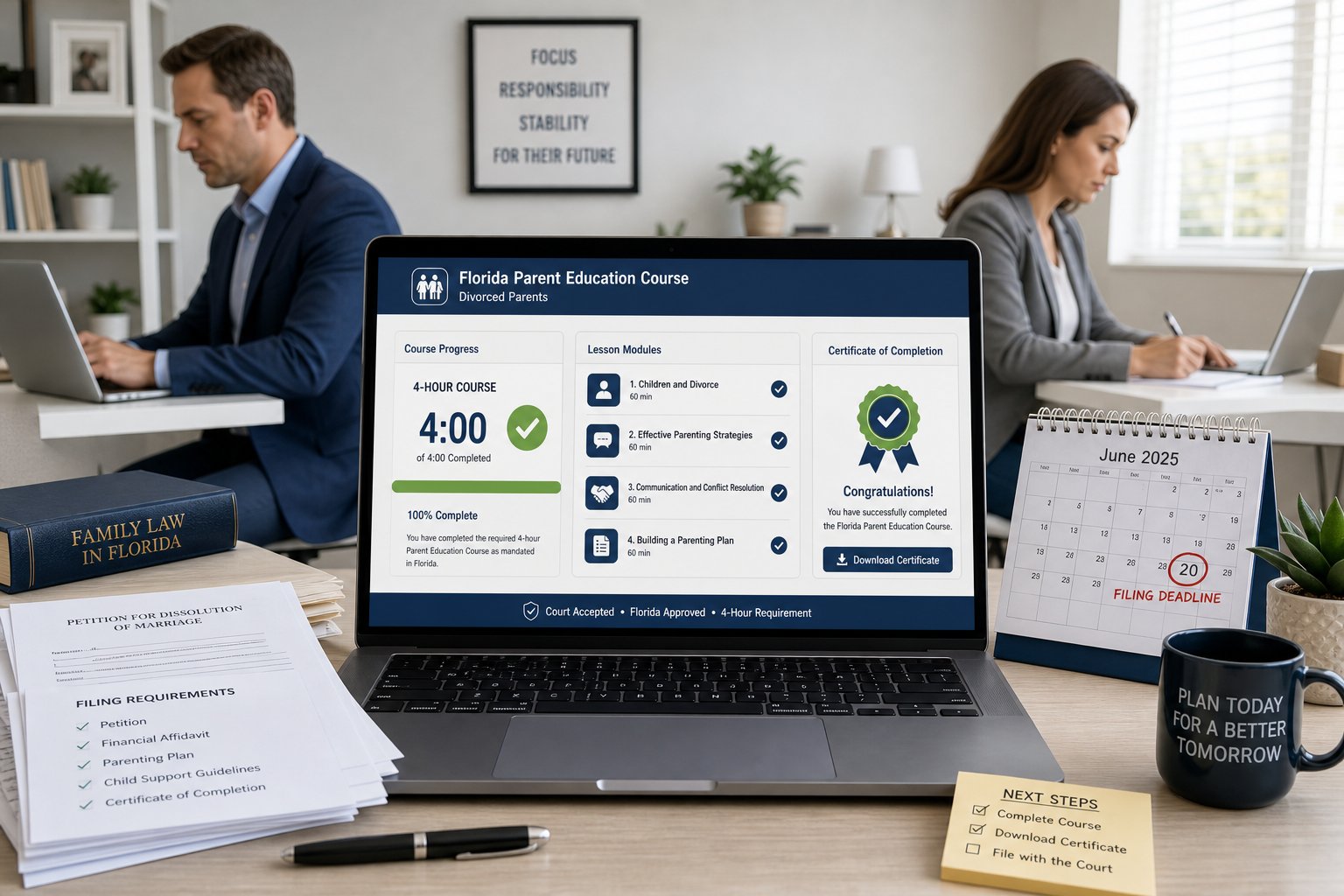
How Long the Florida Parenting Class Usually Takes
The short answer is simple: the Florida parenting class usually takes 4 hours. That is the standard length for the Parent Education and Family Stabilization Course offered by a DCF-approved provider.
Florida does not treat this as a quick checklist item. The course has a set minimum because courts want parents to spend real time on the material. Even if a provider breaks the class into smaller lessons, the total instructional time still needs to add up to at least 4 hours.
If you take the course online, you may be able to stop and start based on your schedule. That can make it feel easier to manage, but it does not change the total time requirement. A self-paced course still has to meet the same state standard as an in-person class.
A few practical points help set expectations:
- Plan for at least 4 hours total
- Some online courses divide the class into short modules
- Breaks may be allowed, depending on the provider’s format
- Reading speed and quiz time can affect how long it feels
So if you are asking, how long is the parenting class for divorce in Florida, the safest answer is about 4 hours, and not less. If your court papers give a deadline, give yourself extra time before the hearing or final judgment date. That leaves room to complete the class, download your certificate of completion, and follow your county’s filing instructions with the Clerk of Court.
Who Has To Take the Class and When It Must Be Completed
In Florida, the course is generally required when parents with minor children are involved in a divorce, and it can also apply in certain cases about paternity, custody, or support where parenting issues are before the court. The rule comes from Florida Statutes section 61.21, which requires a Parent Education and Family Stabilization Course in covered family law cases.
Usually, both parents must take the class. That includes the parent who filed the case and the parent who responded. The goal is not to punish either side. It is to help both parents understand the effect of separation on children and to support better co-parenting.
Timing matters. In many cases, the course must be completed before the court enters a final judgment on parenting matters. Some courts may expect completion earlier in the case. Also, local practice can vary based on the court, county, judge, and case type.
Because Florida procedures are local in many ways, check these sources:
- Your court order or case packet
- Your county court or Clerk of Court website
- The Florida Courts website
- The provider list or program details from the Florida Department of Children and Families
If your case involves a parenting plan, parental responsibility, or time-sharing, do not wait until the last minute. Finish the class early enough to avoid delays in your case.
What the Course Covers and Why Courts Require It
Most Florida-approved courses cover topics like these:
- How separation affects children at different ages
- How stress affects parents and parenting
- Ways to improve co-parent communication
- How to reduce conflict in front of children
- Basic ideas behind a parenting plan
- How time-sharing and parental responsibility affect daily life
- Steps that help children adjust to change
Florida courts require this course for a practical reason: they want to reduce harm to children during and after a family law case. Parents often need clear, structured guidance at a hard time. A good course gives that in simple terms.
This matters because children often react to conflict more than to the divorce itself. When parents communicate better, follow routines, and keep children out of adult disputes, children usually do better. That is why the state puts the course requirement in place.
If you are choosing a provider, make sure the course is offered by a DCF-approved provider. Approval matters because the court may look for a valid certificate of completion from a provider that meets Florida requirements. If you need a flexible option, you can review the online Florida Parent Education and Family Stabilization Course at DivorceParentingClass.net.
Online vs In-Person Parenting Classes: Does the Time Differ?
No. In Florida, online and in-person parenting classes must meet the same 4-hour minimum when they are approved for the Parent Education and Family Stabilization requirement.
The real difference is usually format, not length. An in-person class often happens in one scheduled block. You show up at a set time, stay for the full session, and complete it there. An online class is often more flexible. You may be able to log in from your phone, tablet, or computer and work through the lessons in parts.
That flexibility helps many parents, especially when they are balancing work, child care, and court deadlines. But the online version still needs to deliver the same amount of educational content.
Here is the usual comparison:
- In-person: fixed schedule, one location, one session in many cases
- Online: self-paced, remote access, may allow breaks between modules
- Both: must meet Florida approval standards and time requirements
For many parents, online is easier because it removes travel time. That does not make the legal requirement shorter. It just makes it easier to fit into a busy week.
Before you enroll, confirm two things:
- The provider is approved for Florida.
- Your county or judge allows that format in your case.
That quick check can save you from taking a class that does not match local court instructions.
What It Costs, How Completion Works, and When You Get Your Certificate
The cost of the class depends on the provider. In many cases, Florida parents will see pricing in the $30 to $60 or more range, but there is no single statewide fee listed for every provider.
Because cost and process vary, compare a few basics before you sign up:
- Total price
- Whether the course is fully online
- Whether the provider is DCF-approved
- How the certificate of completion is issued
- What support is available if you have trouble logging in or downloading proof
Completion is usually straightforward. You register, work through the class material, and finish any required checks built into the course. Once you complete the program, you receive your certificate. Some providers issue it right away online, while others may have their own processing steps.
After that, you may need to file the certificate with the court or provide it as directed in your case. Local instructions matter here. Some counties want filing through the Clerk of Court. Others may have case-specific directions from the judge.
If you want a flexible online option, DivorceParentingClass.net offers a Florida course designed for parents who need to meet the state requirement from home. Before you enroll, compare the provider details with your local court instructions so your next step is clear.
Special Situations That Can Affect the Requirement
Most parents in covered Florida cases still need to complete the course, but some situations can change how the requirement works. The key point is that exceptions are court-based, not automatic.
Requirements can depend on the court, county, judge, and case type. That means one parent may need standard completion, while another may need a different arrangement approved by the court. If a problem affects your ability to take the class, raise it through the proper court process rather than guessing.
Examples of issues that can affect the requirement include:
- Serious medical limits
- Incarceration
- Safety concerns
- Access problems that make standard attendance hard
- Other facts the court sees as good cause
The safest path is to read your court papers closely and check your county court website for local instructions. If your case has unusual facts, act early so there is time for the court to respond before any deadline.
Domestic Violence, Waivers, and Other Court-Approved Exceptions
In some cases, a judge may waive or modify the class requirement. This can happen only by court action, and it usually depends on the facts of your case.
For example, domestic violence concerns may affect whether standard participation is appropriate. In other cases, a waiver or change may be requested because of a serious disability, incarceration, or another major barrier. Some courts may also address fee issues by order when a parent cannot afford the class, but that is not automatic.
What matters most is this: do not assume you are excused. Check the local court or Clerk of Court website, review any order in your case, and follow the court’s process if you need a waiver or other exception.
For official background, review Florida Courts family law resources and the Florida Department of Children and Families. If you are ready to complete the standard requirement, you can take the Florida Parent Education and Family Stabilization Course online at DivorceParentingClass.net.
FAQ
How long is the Florida parenting class for divorce?
It’s a minimum of four hours, set by Florida law for the DCF-approved Parent Education and Family Stabilization Course. Most parents finish around that time, though pace varies by provider and how you work through it.
Can I finish in one sitting?
Often yes. Many online providers are self-paced, so you can complete the four hours in a single session or split it across a few. The four-hour minimum still applies either way.
Does it ever take longer than four hours?
It can, depending on the provider’s format and how thoroughly you work through the material. Four hours is the minimum, not a guaranteed total for everyone.
Do both parents take the full four hours?
Generally yes. Each parent completes the four-hour course separately and receives their own certificate of completion.
Conclusion
The short answer is four hours minimum, with your real time depending on the provider and your own pace. Because the requirement is a floor rather than a fixed total, the practical move is to start early and not count on finishing at the last minute. Complete the four-hour DCF-approved course with time to spare, and filing the certificate before your deadline becomes easy.
You can complete the four-hour, DCF-approved Parent Education and Family Stabilization Course online at your own pace.
Related Articles
- What Does the Florida Parent Education and Family Stabilization Course Cover?
- How to Finish a Florida Parenting Class Quickly Without Missing Requirements
- Are There Quizzes in the Florida Parent Education Course?
- Can You Fail the Florida Parenting Class? Retakes and Passing Score
Sources
Billy Forte is the founder of Divorce Parenting Class, which offers a Florida DCF-approved online Parent Education and Family Stabilization Course. The brand focuses on clear, supportive, plain-English guidance to help Florida parents complete the court-required class and file their certificate.
This article is general information, not legal advice. Florida family-law requirements and certificate acceptance can vary by court, county, judge, and case type, so review your court papers and official Florida sources, or consult a family-law attorney, before acting.