
Updated June 2026 · Reviewed by Billy Forte
There’s no single statewide number of questions on the Florida parenting course final exam, because each DCF-approved provider sets its own exam format; many use around 25 questions with a passing score often near 70%, but those are provider conventions, not a Florida rule. The test is generally a short multiple-choice check on the course’s main ideas. This guide explains the typical format, why it varies, and how to find your provider’s exact rules.
Applies to the Florida Parent Education and Family Stabilization Course (Fla. Stat. 61.21). Requirements and acceptance can vary by court, county, judge, and case type, so review your court papers and official Florida sources.
Key Facts
- No statewide number: Florida doesn’t fix a question count; each provider sets its own exam.
- Often around 25: Many providers use roughly 25 multiple-choice questions, but it’s not universal.
- Passing score varies: A passing score near 70% is common but set by the provider, not the state.
- Retakes common: Many providers allow retakes if you don’t pass on the first try.
- Check your provider: Your provider’s course details are the only reliable source for exact rules.
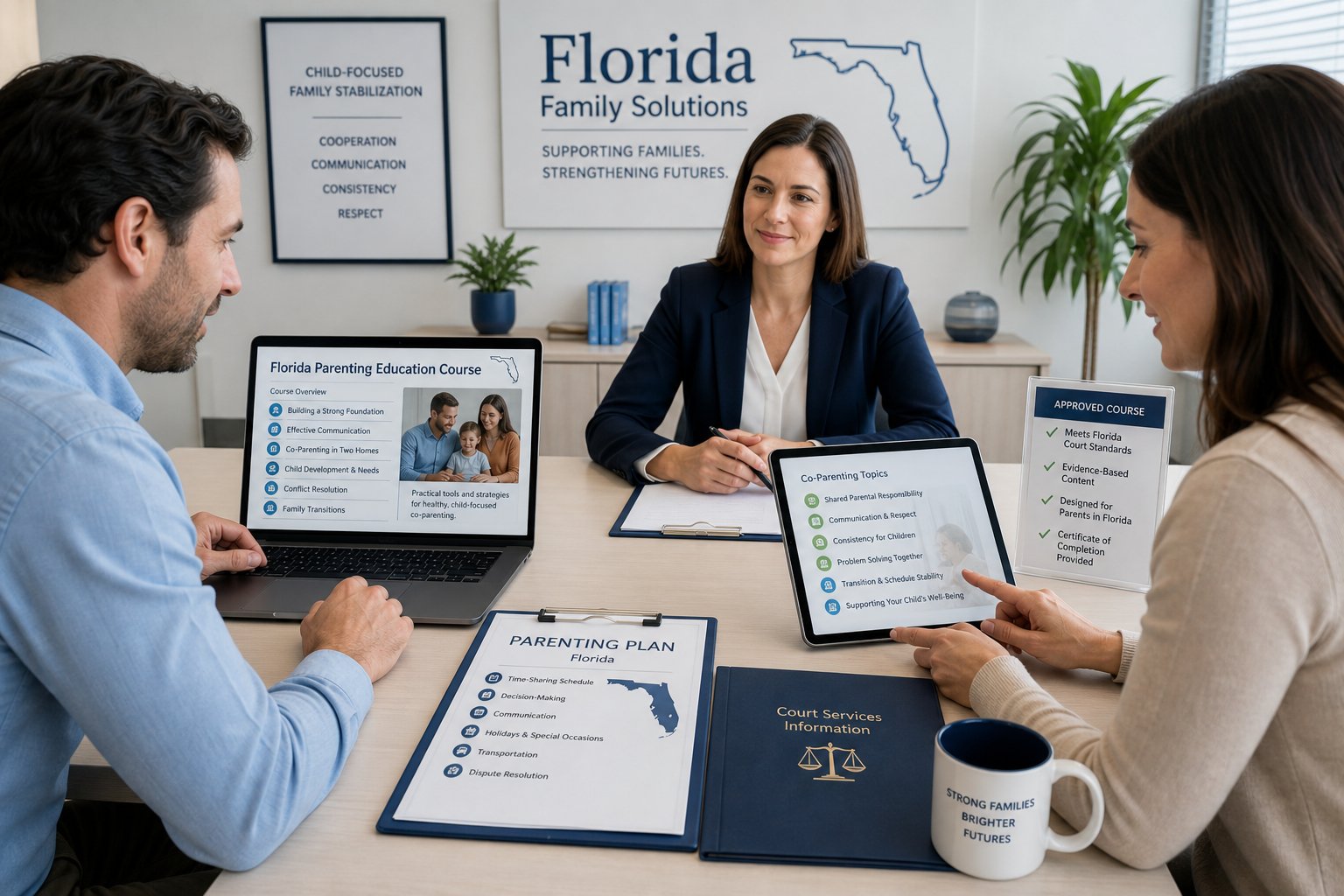
What The Florida Parenting Class Is And Who Must Take It
Florida calls this program the Parent Education and Family Stabilization Course. It is generally required for parents with minor children in certain family law cases, including many divorce, paternity, and time-sharing matters.
The goal is simple. The course teaches how family change can affect children and how parents can support them better. It often covers co-parenting, conflict, communication, emotional stress, and ways to build a workable parenting plan.
In many Florida cases, both parents must complete the course. That often includes the petitioner and the other party. Still, requirements can depend on the court, county, judge, and case type, so you should always follow your court papers and local instructions.
Florida courts and approved providers often explain that the course must meet state standards. The Florida Department of Children and Families keeps information on approved providers, which matters because courts usually expect a course from a DCF-approved provider. You can review the state page for approved providers through the Florida Department of Children and Families.
Florida law and court rules connect the course to cases involving children because the court wants parents to understand how separation affects them. That does not mean the course gives legal advice. It is an education step tied to family cases involving parental responsibility and time-sharing.
If your court order or case instructions say you must take the class, use a DCF-approved provider and keep a copy of your records.
How The Test Usually Works In An Online Florida Parenting Course
In most online courses, the test comes after you complete the required class time. Florida providers commonly use a multiple-choice final exam. Many courses also include short lesson checks or chapter quizzes before the final.
A common question is how many questions are on the test. Many providers use 25 questions, but that is not a statewide fixed number. One course may use 25 final questions, while another may split the grading across quizzes and a final exam.
Most providers also require a passing score. In many cases, that score is 70%. If you miss the mark, many online providers let you retake the test.
That setup matters because the course is meant to check that you understood the material, not to trap you. Questions usually focus on the main topics from the class, such as:
- how divorce or separation can affect children
- ways to reduce conflict
- healthy co-parenting habits
- communication between parents
- the role of a parenting plan
Many providers unlock the final only after you finish the required 4-hour course time. That means you usually cannot skip right to the exam. You need to complete the lessons first, then take the test, then earn your certificate of completion after passing.
Can You Get Florida Parenting Class Test Answers Online?
You may find posts, videos, or forum comments that claim to share Florida parenting class test answers. But those answer lists are not a reliable way to pass.
The main reason is that Florida does not use one single statewide exam with one public answer key. Approved providers create their own course systems within state rules. So even if someone posts answers from one class, those answers may not match the version you take.
There is also a practical issue. If your course uses random questions, lesson-based quizzes, or updated wording, shared answers can be wrong or incomplete. That can waste time and create more stress.
A better approach is to treat the course as open learning. Read the lesson content, pay attention to the key ideas, and use the retake option if your provider offers one. Many do.
The official point of the class is to help parents understand the impact of conflict on children and support better co-parenting. So the test usually reflects basic course content, not trick questions.
Why Exact Answers Vary By Provider And Course Version
Exact answers vary because question banks, course layouts, and test versions are different. One DCF-approved provider may use a 25-question final. Another may use unit quizzes plus a final. Another may update wording in 2026 without changing the main topic.
That is why there is no dependable universal answer sheet for every Florida course. The safest source is the course material inside your own provider account. If a point seems unclear, review that section before you retest.
The Best Way To Pass Without Looking For Shared Answer Keys
The best way to pass is to complete the full course and review the lesson material before the exam. That sounds basic, but it works because the final usually tests the same points the course repeats.
Start by taking notes on the major themes. Focus on how children respond to family change, how parents can lower conflict, and why communication matters. Those points show up often in parent education courses.
It also helps to slow down on sections about:
- child adjustment after separation
- co-parenting communication
- problem solving between parents
- conflict and stress
- the purpose of court orders and parenting plans
If your provider allows retakes, use that feature as a study tool. Many approved online courses do. After a missed question set, go back to the lesson and review the topic again.
You should also choose a provider with a clear format. At DivorceParentingClass.net, the Florida course is built for online use and is offered by a DCF-approved provider. A clear course layout, device access, and support can make the process easier when you are trying to finish on time.
If you have not enrolled yet, review the provider details and take the Florida Parent Education and Family Stabilization Course through a DCF-approved option that fits your court instructions.
What Happens After You Pass: Certificate, Court Filing, And Deadlines
After you pass, you receive a certificate of completion. That certificate is your proof that you finished the Florida Parent Education and Family Stabilization Course.
Providers often make the certificate available as a download, by email, or both. Keep a copy for your records. You may need to give it to your lawyer, file it with the court, or present it based on local rules.
In many Florida cases, course completion must happen before a final judgment can be entered. Some provider summaries and court guidance also note common deadlines such as 45 days after filing for the petitioner and 45 days after service for the other party, unless the court orders something different. Still, deadlines can vary by county, judge, and case type.
That is why you should check your own court documents and local court or Clerk of Court instructions. Helpful official sources include the Florida Courts self-help page and county clerk websites.
Also remember that passing the test does not finish your whole case. It only completes the course step. You still need to follow any filing rules, hearing dates, and court orders tied to your case.
Once you pass, save your certificate and check how your court wants proof filed before your deadline.
Common Questions About Approval, Acceptance, Timing, And Retakes
Does the provider need state approval? Yes, in most cases you should use a DCF-approved provider. Florida courts often rely on that approval when deciding whether the class meets the requirement. You can confirm provider status through the Florida Department of Children and Families.
Will every Florida court accept every online course? Courts often accept approved courses, but local practice still matters. Your county, judge, court division, and case type can affect what proof is needed and how it must be filed.
How long is the class? Florida’s parent education course is generally at least 4 hours. Online providers usually track your progress, and the final exam often stays locked until you complete the required time.
Can you retake the test? Many online providers allow retakes, sometimes unlimited retakes. The certificate is usually issued only after you pass.
Is there one official statewide test? No. The state approves providers, but providers may use different question sets and formats. That is why searching for one universal answer key usually does not help.
What should you do next? If you still need the course, use a provider that clearly states Florida approval and explains how the certificate works. You can take the online Florida course through DivorceParentingClass.net if it fits your court’s requirements.
For legal questions about your case, deadlines, parental responsibility, or time-sharing, check official court sources or speak with a qualified Florida lawyer.
FAQ
How many questions are on the Florida parenting course final exam?
There’s no statewide fixed number — each provider sets its own. Many use around 25 multiple-choice questions, but that’s a common convention rather than a Florida rule, so check your provider.
What’s the passing score?
It varies by provider; a score near 70% is common but not a statewide standard. Your provider’s course details list the actual passing score for its exam.
Is there one official Florida exam?
No. Florida sets the four-hour course requirement and DCF approval, but it doesn’t mandate a single exam format, so question counts and passing scores differ between providers.
Can I retake the exam?
Many providers allow retakes, sometimes unlimited, so not passing on the first attempt usually isn’t a problem. Confirm the retake policy with your provider.
Conclusion
The accurate answer is that there’s no universal number — many providers land around 25 questions with a roughly 70% passing score, but those are conventions, not Florida law. The only dependable source is your own provider’s course details. Focus on engaging with the material and using any retake option, and the exam becomes a formality on the way to your certificate.
You can complete the DCF-approved Parent Education and Family Stabilization Course online and review your provider’s exam format before you start.
Related Articles
- Is the Florida Parenting Class Final Exam Open Book?
- Can You Fail the Florida Parenting Class? Retakes and Passing Score
- Are There Quizzes in the Florida Parent Education Course?
- How Long Is the Florida Parenting Class for Divorce?
Sources
Billy Forte is the founder of Divorce Parenting Class, which offers a Florida DCF-approved online Parent Education and Family Stabilization Course. The brand focuses on clear, supportive, plain-English guidance to help Florida parents complete the court-required class and file their certificate.
This article is general information, not legal advice. Florida family-law requirements and certificate acceptance can vary by court, county, judge, and case type, so review your court papers and official Florida sources, or consult a family-law attorney, before acting.