
Updated June 2026 · Reviewed by Billy Forte
To file for divorce in Florida with minor children, you confirm residency, file a petition for dissolution of marriage in your county, serve your spouse, and work through disclosures, a parenting plan, and often mediation before a final judgment. Somewhere in that process, both parents must also complete the required Parent Education and Family Stabilization Course and file the certificate with the court. This guide walks the steps in order and shows exactly where the parenting course fits, so nothing stalls your case.
Applies to the Florida Parent Education and Family Stabilization Course (Fla. Stat. 61.21). Requirements and acceptance can vary by court, county, judge, and case type, so review your court papers and official Florida sources.
Key Facts
- Residency first: Florida generally requires at least one spouse to have lived in the state for six months before filing.
- File and serve: You file a petition for dissolution in your county and have your spouse formally served.
- Response window: Once served, the other spouse generally has 20 days to file an answer.
- Parenting course required: Both parents complete the DCF-approved Parent Education and Family Stabilization Course and file the certificate.
- Parenting plan and mediation: Cases with minor children involve a parenting plan, and many courts order mediation.
- Timing varies: Course deadlines and procedures can depend on your court, county, and judge — check your court papers.
Make Sure You Qualify To File In Florida
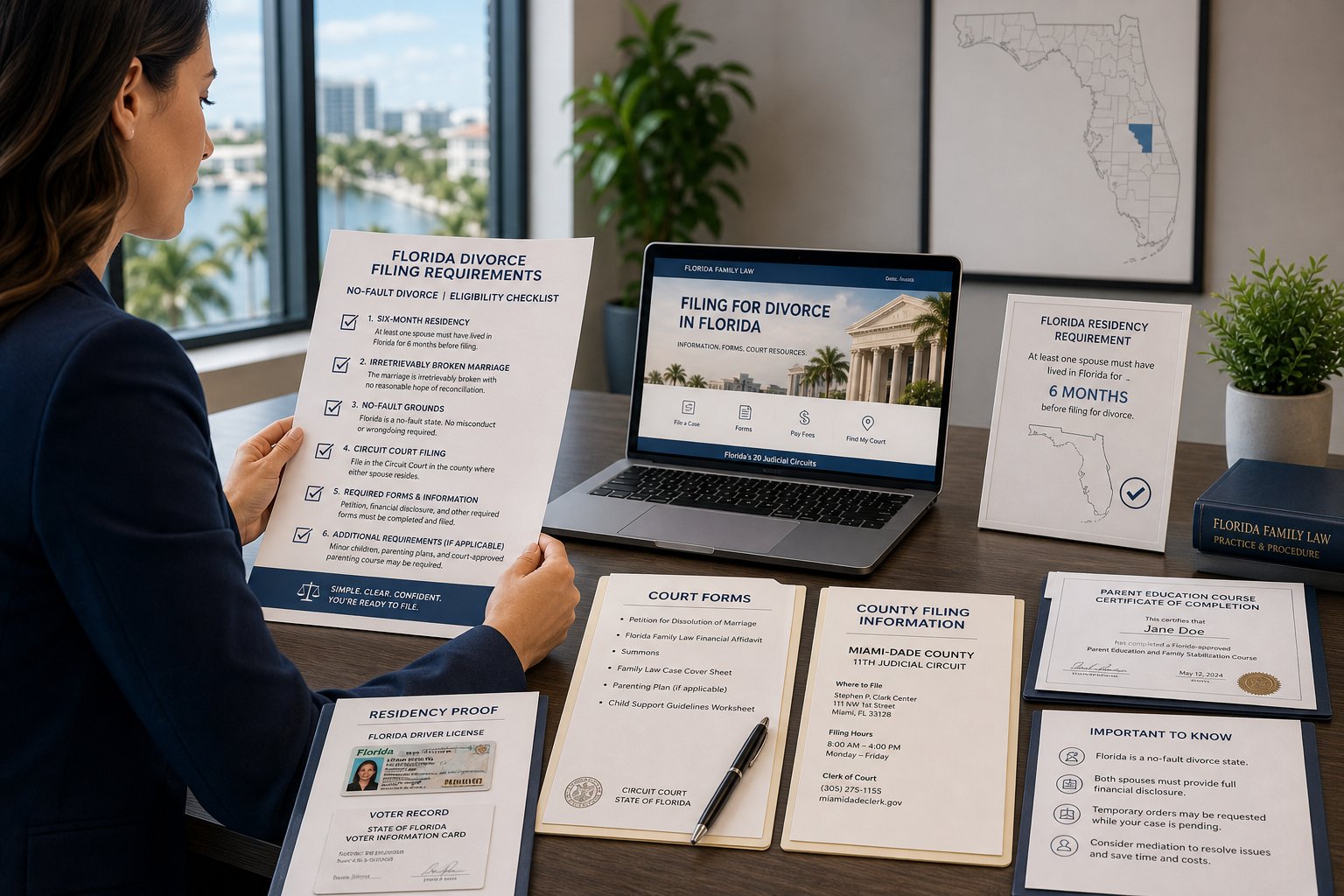
You can file for divorce in Florida only if your case meets the state’s basic rules. Florida calls divorce dissolution of marriage. Before you prepare forms, confirm that you meet the residency rule, have a valid legal ground, and know the right county for filing.
Residency Requirements, No-Fault Grounds, And Which County To Use
At least one spouse must have lived in Florida for 6 months before the case is filed. That rule comes from Florida Statutes section 61.021. You usually prove residency with a Florida driver license, Florida ID, voter record, or a witness who can confirm residence.
Florida is a no-fault divorce state. In most cases, you only state that the marriage is irretrievably broken. You do not need to prove adultery, abuse, or another fault ground to open the case.
You usually file in the circuit court for the county where either spouse lives. Local court sites and clerk pages explain filing options, fees, and local procedures. You can also review the Florida Courts family law forms before you file.
If you have minor children, start checking your county’s family court page early. Some courts give specific instructions on when to complete the parent course and how to file the certificate of completion. That matters because taking the course is not the same as proving to the court that you took it.
Choose The Right Type Of Florida Divorce Case
The right case type depends on whether you have children and whether you agree on all issues. This choice affects the forms you use, the steps that follow, and whether the parenting course applies.
Simplified Dissolution Vs. Regular Uncontested Vs. Contested Divorce
Simplified dissolution is the shortest route, but it is not for parents with minor children. It is only available when there are no minor or dependent children, no current pregnancy, no request for alimony, and full agreement on property and debts. Both spouses must also agree to appear together.
If you have minor children, you will usually file a regular dissolution case. That case may be uncontested or contested.
A regular uncontested divorce means you and the other parent agree on the main terms, such as:
- Property and debts
- Child support
- Parenting plan
- Parental responsibility
- Time-sharing
A contested divorce means there is a dispute about one or more issues. That can lead to more filings, disclosure, mediation, and hearings.
For parents, this case choice matters because the course requirement usually applies in cases involving minor children, not simplified cases. Florida courts generally require the Parent Education and Family Stabilization Course in these family cases, but details can vary by county, judge, and case type. Check both the local court instructions and the Florida Department of Children and Families information on approved providers.
Prepare, File, And Serve The Divorce Papers
To start the case, you prepare the correct forms, file them with the court, and make sure the other spouse is served. This is the formal start of the divorce process.
Use the Florida Supreme Court Approved Family Law Forms that match your case type. Parents with minor children may need forms such as the petition for dissolution with dependent or minor children, a UCCJEA affidavit, and a notice related to social security information. Your county clerk may also require a local cover sheet or packet.
You can find official forms through Florida Courts. Read the instructions for each form before signing. Many forms must be signed before a notary or the Clerk of Court.
You then file the case with the circuit court clerk in the proper county. Some counties allow filing in person and through the Florida Courts E-Filing Portal. Filing fees often apply, and fee waivers may be available for people who qualify.
After filing, the other spouse must be served unless they file a waiver. Service is often done by the sheriff or a certified private process server. Keep proof of service in the court file.
If your case involves minor children, this is a good point to confirm the parent course rule for your court. Many parents ask, where does the parenting class fit in the divorce process? In Florida, it usually comes after the case begins and before the final hearing or final judgment, but your court may set a deadline or mention it in local instructions.
What Happens After Filing: Response, Disclosures, And Temporary Issues
After filing and service, the case moves into the response and information-sharing stage. This part sets the timeline for what happens next.
The spouse who was served usually has 20 days to file an answer. They may also file a counterpetition. If no response is filed on time, the filing spouse may ask for a default, but local court procedure still controls the next step.
Florida also uses mandatory financial disclosure in many divorce cases. In general, each party must exchange financial information within 45 days of service. This may include a financial affidavit, tax returns, pay stubs, and account statements. Official family law forms explain the disclosure list.
If you share minor children, the court may also focus early on temporary parenting issues. A parent may ask for temporary orders on:
- Child support
- Time-sharing
- Use of the home
- Other urgent family needs
The court may set hearings or a case management conference.
This stage is also when many parents should make a practical checklist. The checklist should include two separate items:
- Complete the Parent Education and Family Stabilization Course with a DCF-approved provider
- File the certificate of completion with the court or clerk as your county requires
That separation matters. Completing the course does not always place proof in the court file by itself. Review your county clerk or family court page and follow the exact filing method your court uses.
Mediation, Parenting Requirements, And The Final Judgment
Most Florida divorce cases with children move toward settlement, mediation, and final court approval. If you do not resolve every issue early, the court may require mediation before trial.
In mediation, a neutral mediator helps both sides try to reach agreement. If you settle, the terms are often written into a marital settlement agreement and a parenting plan. The parenting plan covers parental responsibility, time-sharing, communication, transportation, and other child-related rules. Florida courts also use child support guidelines based on income and time-sharing.
For parents with minor children, the Parent Education and Family Stabilization Course is usually part of this stage of the case. Florida generally requires parents in divorce and some related family law cases to complete an approved course before final judgment. The course provider should be a DCF-approved provider listed through the Florida Department of Children and Families.
The key point is simple: take the course, then make sure proof reaches the court. Your proof is usually a certificate of completion. Some courts may want it filed with the Clerk of Court. Others may have local instructions for e-filing or for giving it to the judge’s office as part of a hearing packet. Check your county court and clerk websites, such as the Florida Courts court locations directory.
If you need a flexible online option, you can take the Florida Parent Education and Family Stabilization Course at DivorceParentingClass.net. The site offers a Florida-focused online course from a DCF-approved provider and gives you a certificate after completion, which you can then file as your court directs.
In an uncontested case, the court may set a short final hearing after the required waiting period and after needed documents are filed. In a contested case, unresolved issues may go to trial. The judge then signs the Final Judgment of Dissolution of Marriage once the case is ready and all required steps are complete.
FAQ
Where does the parenting class fit in a Florida divorce?
Both parents must complete the DCF-approved Parent Education and Family Stabilization Course during the case and file the certificate before the final judgment. Many courts set a deadline early in the case.
What are the basic steps to file for divorce in Florida with kids?
Confirm residency, file a petition for dissolution in your county, serve your spouse, exchange required disclosures, complete the parenting course and a parenting plan, attend any ordered mediation, and proceed to final judgment.
How long does the other spouse have to respond?
After being served, the responding spouse generally has 20 days to file an answer. Deadlines can vary, so check your court’s instructions.
Do both parents have to take the course?
Yes. In Florida cases with minor children, both parents generally must complete the course separately, each filing their own certificate of completion.
Conclusion
Filing for divorce in Florida with children is a sequence of defined steps, and the parenting course is one of them — not an afterthought. Knowing where it fits lets you complete it early and avoid a last-minute scramble before the final judgment. Because details vary by court and county, confirm your specific deadlines with your court papers or the Clerk of Court as you go.
You can complete the required step early with a DCF-approved Parent Education and Family Stabilization Course online and file your certificate before the final judgment.
Related Articles
- Divorce in Florida With Kids: Deadlines, Course, and Certificate
- Florida Divorce Checklist for Parents With Minor Children
- Florida Parenting Plan vs. Parent Education Course: What Is the Difference?
- Florida Time-Sharing and the Parent Education Course
Sources
Billy Forte is the founder of Divorce Parenting Class, which offers a Florida DCF-approved online Parent Education and Family Stabilization Course. The brand focuses on clear, supportive, plain-English guidance to help Florida parents complete the court-required class and file their certificate.
This article is general information, not legal advice. Florida family-law requirements and certificate acceptance can vary by court, county, judge, and case type, so review your court papers and official Florida sources, or consult a family-law attorney, before acting.