
Updated June 2026 · Reviewed by Billy Forte
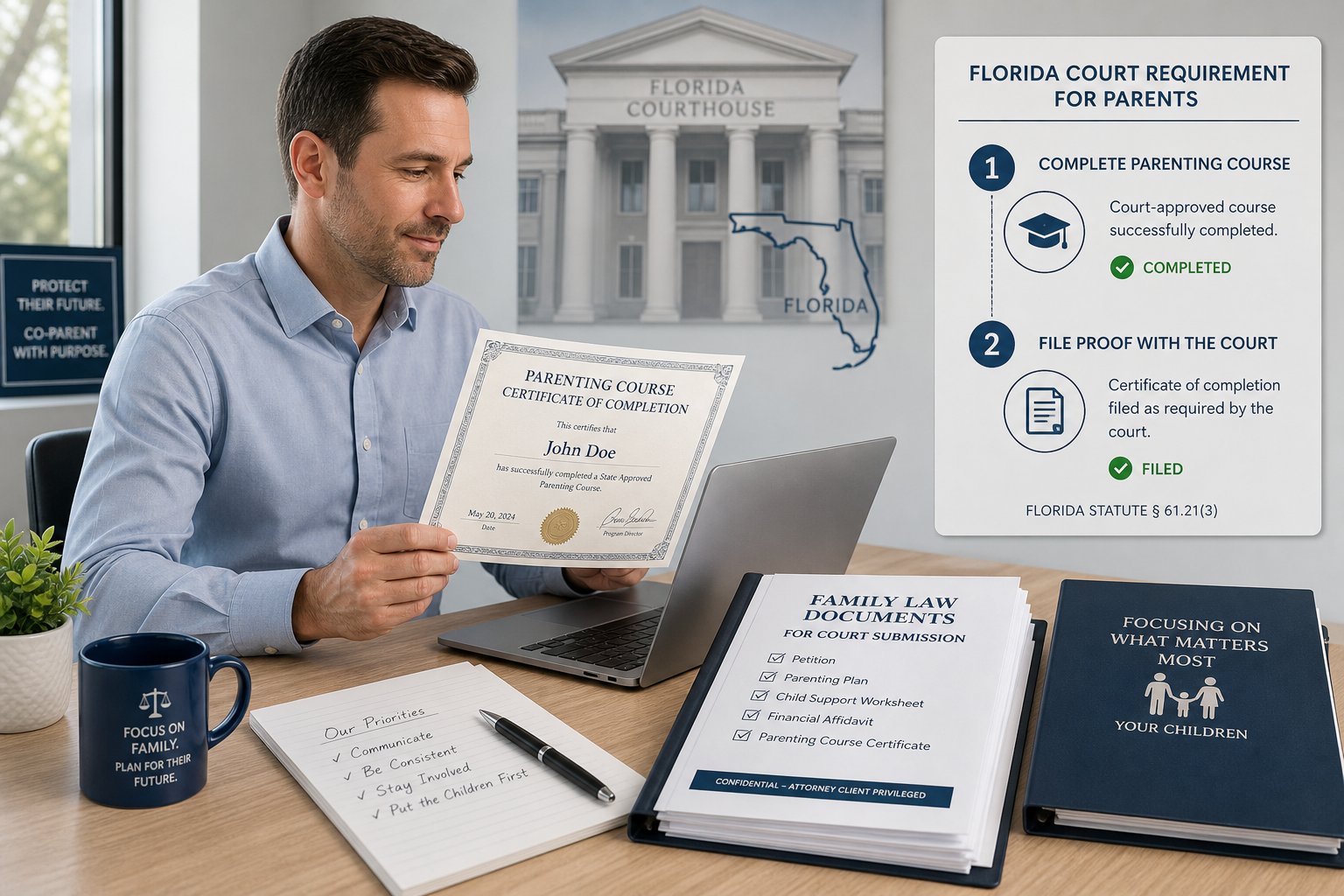
To get your Florida parenting class certificate, you complete the DCF-approved Parent Education and Family Stabilization Course and receive a certificate of completion, which you then file with the court. Most online providers issue the certificate as soon as you finish the four-hour course, so you can download it and file it right away. This guide walks through getting the certificate, what it should include, and how to make sure your court will accept it.
Applies to the Florida Parent Education and Family Stabilization Course (Fla. Stat. 61.21). Requirements and acceptance can vary by court, county, judge, and case type, so review your court papers and official Florida sources.
Key Facts
- Finish the course first: The certificate is issued after you complete the DCF-approved, four-hour course.
- Often immediate: Many online providers deliver the certificate right after completion.
- Each parent separately: Both parents generally complete the course and receive their own certificate.
- Check the details: Confirm your name and case information are correct before filing.
- File with the court: Submit the certificate to the Clerk of Court, or give it to your attorney to file.
- Filing can vary: Exact submission steps differ by county clerk, circuit, and case type — check your court papers.
What A Parenting Class Certificate Is And Why Florida Courts Require It
A parenting class certificate in Florida is the document that shows you finished the required Parent Education and Family Stabilization Course. It is your proof of completion. In many cases, the court will not just take your word for it.
Florida generally requires this course in family law cases that involve minor children. The rule comes from Florida law. The course must be at least 4 hours long, and it must come from a provider approved by the Florida Department of Children and Families.
The purpose is simple. Florida courts want parents to learn how separation, divorce, and conflict can affect children. The course also teaches ways to support a healthy parenting plan, protect the child from adult disputes, and improve co-parenting.
Your certificate matters because it shows the court that you completed that required step. But there are really two separate actions:
- Complete the course with an approved provider
- File or submit proof if your court requires you to do that
That difference causes a lot of confusion. Getting your certificate does not always mean the court already has it. Some providers may offer court delivery options, but many parents still need to submit the certificate themselves based on local instructions.
So, think of the certificate as your receipt for compliance. It proves you finished the class. Then you must make sure the right court office gets that proof in the right way.
Who Needs A Florida Parenting Class Certificate In Divorce, Custody, And Paternity Cases
In Florida, parents often need this certificate when a family case involves minor children and the court must address parenting issues. That usually includes divorce, paternity, and other cases about parental responsibility or time-sharing.
The most common example is a dissolution of marriage case with children. If you are divorcing and you share minor children, the court will often require both parents to complete the course. The same issue can come up in a paternity case when the court needs to decide child-related issues.
You may need the certificate in cases involving:
- Divorce with minor children
- Paternity actions
- Time-sharing disputes
- Parenting plan cases
- Some other family law matters involving child-related decisions
In many Florida courts, both parents must complete the course, not just the person who filed first. That means the petitioner and the respondent may each need their own certificate.
Still, requirements can vary. The exact rule may depend on:
- Your county
- Your court circuit
- Your judge
- Your case type
Because of that, always check your court papers and local court instructions. You can also review information through Florida Courts and your county’s Clerk or family court website. If your case involves children and parenting issues, do not assume the course is optional. Verify the requirement early so you do not miss a deadline.
How To Make Sure Your Certificate Is DCF-Approved And Court Accepted
The safest way to make sure your certificate works is to choose a DCF-approved provider first. In Florida, the Florida Department of Children and Families approves Parent Education and Family Stabilization Course providers. If the provider is not approved, the court may not accept the certificate.
Start by checking the official DCF source for approved courses through the Florida Department of Children and Families. Then compare that information with the provider’s course page.
You should look for clear signs such as:
- The course says it is DCF-approved for Florida
- It is specifically for the Parent Education and Family Stabilization Course
- It states that it meets Florida court requirements, subject to local court rules
- It provides a certificate of completion after you finish
Even then, approval and acceptance are not always identical. A provider can be approved, but your court may still have its own filing steps or preferences. Some courts accept online courses without issue. Others may have local directions on how proof must be submitted.
That is why you should also check:
- Your judge’s order
- Your county court or Clerk website
- Any local family law forms or instructions
If you want an online option, DivorceParentingClass.net offers a Florida course designed for this requirement. But you should still follow your local court’s filing rules after completion.
Action: Before you enroll, confirm both parts: the provider is DCF-approved, and your court accepts that proof format.
What The Parent Education And Family Stabilization Course Covers
The Florida Parent Education and Family Stabilization Course teaches parents how family change can affect children and how to lower conflict. It is not just a paperwork step. The course is meant to help parents make better choices during a hard time.
DCF-approved courses generally cover topics such as:
- The effect of divorce or separation on children
- Children’s emotional and developmental needs
- How conflict between parents can harm children
- Better co-parent communication
- Problem-solving and conflict reduction
- Positive discipline and behavior guidance
- Ways to keep children out of adult disputes
- Community help and support resources
The course supports healthier decisions around time-sharing, parental responsibility, and daily parenting after separation. It can also help parents understand how to build or follow a parenting plan that puts the child first.
This matters because courts want more than a signed form. They want parents to have basic education on how family conflict affects children. The class is one way the court promotes safer, more stable family transitions.
Florida DCF describes these courses as programs that educate and assist parents about the impact of divorce and family change on both parents and children. You can review official agency information through the Florida Department of Children and Families.
So while the certificate is the document you need, the course content is the reason the requirement exists in the first place.
How The Online Process Works From Registration To Instant Certificate
For many parents, the easiest path is an online Florida course. The basic process is usually simple: register, complete the lessons, finish any required final step, and get your certificate.
Here is how it often works:
- Register online
- Choose a Florida Parent Education and Family Stabilization Course
- Create an account
- Pay the course fee
- Complete the course
- Study online at your own pace
- Log in from a phone, tablet, or computer
- Spend the full required time
- Finish the provider’s completion step
- Some courses use a short final exam
- Some do not
- If there is a test, the provider may allow retakes
- Get your certificate of completion
- Many providers offer instant download or immediate access after completion
This is the point many parents ask about most: How do I get proof after completing the course? You get proof by obtaining the certificate of completion from the provider after you finish all required course steps. Then you follow your local court’s rules for filing or submitting that proof.
With DivorceParentingClass.net, the Florida course is online and built for flexible access. That can help if you are working around parenting schedules, job hours, or court deadlines.
Keep a copy of your certificate for your records. If your court requires filing, review the Clerk or court instructions before you submit it.
Common Questions About Timing, Course Length, Cost, And Final Exams
Florida parents usually ask the same few questions first: How long is the course, when is it due, what does it cost, and is there a test? The answer depends in part on the provider and in part on your court.
Course length: Florida law generally requires at least 4 hours for the Parent Education and Family Stabilization Course.
Deadline: Your deadline often comes from a court order, local rule, or case paperwork. Some courts set a time limit after filing. Because that can vary, check your own case documents and local court instructions.
Cost: Fees vary by provider. Some online courses charge a flat fee. Cost can change, so check the provider’s current page before you enroll.
Final exam: Some Florida courses have a short final exam. Others may not. If there is an exam, the provider may explain the passing rules and whether retakes are allowed.
A few practical tips can save time:
- Enroll early if you already know the course is required
- Read the provider’s certificate policy before paying
- Check whether the site gives instant access to proof
- Make sure your name matches your court records
Action: If you need an online Florida option, you can review the course details and start the Florida Parent Education and Family Stabilization Course at DivorceParentingClass.net.
What Happens If You Do Not Complete The Required Parenting Class On Time
If you do not complete the required course on time, your case can slow down. Florida courts may wait for proof before moving forward in a case that involves children.
Depending on your case and court, the judge may:
- Delay hearings or next steps
- Refuse to enter a final judgment yet
- Order you to complete the course before the case continues
- Take other action allowed by the court
That is why the difference between taking the course and filing the certificate matters so much. You can finish the class and still have a problem if the court expected proof by a certain date and did not receive it.
Requirements also differ by county, judge, and case type. So do not guess. Read your court order, review your local Clerk or court website, and follow the filing instructions that apply in your case. You can often find official local information through your county Clerk of Court page and through Florida Courts.
FAQ
How do I get my Florida parenting class certificate?
Complete the DCF-approved Parent Education and Family Stabilization Course. Most online providers issue your certificate of completion immediately after you finish, so you can download it and file it with the court.
How long until I receive the certificate?
With most online providers, right away. Once you finish the four-hour course, the certificate is typically available to download or is emailed to you the same day.
Do both parents get separate certificates?
Generally yes. Each parent completes the course on their own and receives an individual certificate of completion to file with the court.
What do I do with the certificate?
File it with the Clerk of Court, or give it to your attorney to file. Filing steps can vary by county, so check your court papers or county clerk’s instructions.
Conclusion
Getting your certificate comes down to finishing a DCF-approved course and then filing the proof the way your court directs. The course completion is the straightforward part — most providers hand you the certificate immediately. Confirm the details are correct, check your county’s filing steps, and submit it so it counts toward your case.
You can complete the DCF-approved Parent Education and Family Stabilization Course online and download your certificate of completion as soon as you finish.
Related Articles
- How to Submit Your Parenting Class Certificate to a Florida Court
- What Information Goes on a Florida Parenting Class Certificate?
- Does a Florida Parenting Class Certificate Expire?
- What If the Court Rejects My Parenting Class Certificate?
Sources
Billy Forte is the founder of Divorce Parenting Class, which offers a Florida DCF-approved online Parent Education and Family Stabilization Course. The brand focuses on clear, supportive, plain-English guidance to help Florida parents complete the court-required class and file their certificate.
This article is general information, not legal advice. Florida family-law requirements and certificate acceptance can vary by court, county, judge, and case type, so review your court papers and official Florida sources, or consult a family-law attorney, before acting.