
Updated June 2026 · Reviewed by Billy Forte
In Palm Beach County, the parenting class is the statewide DCF-approved Parent Education and Family Stabilization Course required across Florida, while filing the certificate follows the Palm Beach Clerk of Court’s instructions. The course is identical statewide; only the local filing logistics vary. This guide explains the statewide requirement and how to confirm Palm Beach County’s filing steps.
Applies to the Florida Parent Education and Family Stabilization Course (Fla. Stat. 61.21). Requirements and acceptance can vary by court, county, judge, and case type, so review your court papers and official Florida sources.
Key Facts
- Statewide course: The DCF-approved, four-hour course applies in Palm Beach just as across Florida.
- Local filing: Certificate filing follows the Palm Beach Clerk of Court’s instructions and your case.
- Both parents: Each parent generally completes the course separately and files a certificate.
- Confirm steps: Check your court papers or the Palm Beach Clerk for the current filing process.
- DCF approval matters: Confirm your provider is DCF-approved so the certificate counts.
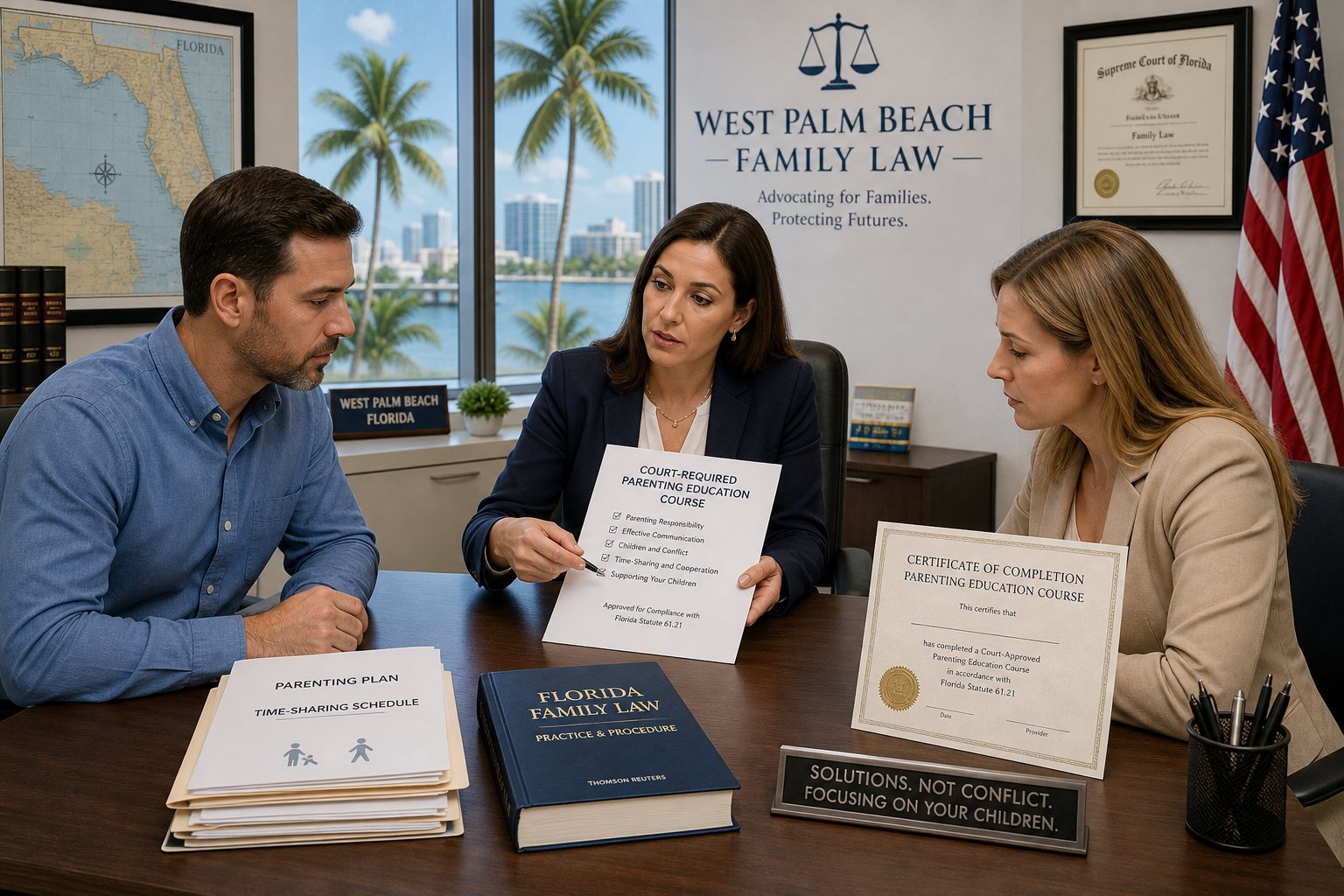
Who Needs A Parenting Class In West Palm Beach
If you are a parent with minor children in a Florida family law case, you may need a parenting class. In many Florida divorce cases, and in some other cases about children, both parents must complete the Parent Education and Family Stabilization Course.
For West Palm Beach families, the key point is this: the rule comes from Florida law, not just from one local office. Under Florida Statutes section 61.21, courts can require education for parents involved in cases that affect children and family structure.
This often matters in cases involving:
- Dissolution of marriage with minor children
- Parental responsibility disputes
- Time-sharing issues
- Some paternity or other family law matters involving children
Still, not every case works the same way. Requirements can depend on the court, county, judge, and case type. That means two parents in Florida may both have children, but their paperwork or court orders may not say the exact same thing.
If your case involves a proposed parenting plan, shared decision-making, or time-sharing with a child, you should read your court papers closely. Look for any direction about a parenting course, the deadline, and how the certificate of completion should be handled.
If you are unsure, your safest next step is to review your filed documents and any notices from the Clerk of Court or judge. Do not assume that one parent can take the class for both people, because Florida generally expects each parent to complete the course separately.
Florida’s Parent Education And Family Stabilization Course Requirement Explained
Florida’s required course is called the Parent Education and Family Stabilization Course. It is meant to help parents reduce harm to children during divorce or separation and improve co-parenting after the case starts.
State law says the course must be at least 4 hours long. It must also be offered by a Florida Department of Children and Families approved provider. You can review the state framework through Florida DCF and the legal basis in section 61.21.
The course usually covers:
- How separation can affect children at different ages
- Ways to lower conflict between parents
- Better communication skills
- Co-parenting tools that support stability
- Family support resources
This is not just a box to check. The class is designed to support better decisions around parental responsibility, child well-being, and day-to-day time-sharing communication.
For many parents, the most important practical point is approval. A course may sound useful, but if it is not from a DCF-approved provider, it may not meet the court requirement. That is why provider approval matters more than marketing language.
Also, each parent usually needs a separate record and separate certificate of completion. A shared login or a combined class does not fit the usual Florida setup. If your papers say you must complete the class, choose an approved provider and keep your certificate in a safe place.
Is An Online Parenting Class Accepted In Palm Beach County
In many Florida cases, an online parenting class can meet the requirement if the provider is DCF-approved and the class fits your court’s instructions. That is why many parents looking for parenting classes west palm beach start with approved online options.
Online acceptance is common, but it is not something to guess about. Courts and providers often note that acceptance can depend on your case type, your judge’s order, and local instructions. Some providers serving Palm Beach County state that their online classes are accepted there, but you should still confirm with your own paperwork before you enroll.
Here is the practical rule:
- Check if the provider is DCF-approved
- Check your court order or notice
- Check whether your case allows online rather than in-person attendance
- Make sure the course is the Florida Parent Education and Family Stabilization Course
You can also review general court information through Florida Courts and local records or service information through the Palm Beach County Clerk of Court.
Online courses can help because they are flexible. You can usually sign in from a phone, tablet, or computer and work at your own pace. But flexibility does not replace compliance. Before you pay, make sure the course matches what your case requires.
How The Class Works From Enrollment To Certificate
Most approved online classes follow a simple path. You enroll, complete the lessons, finish any required checks, and then receive a certificate of completion.
A typical process looks like this:
- Register online with your name and case-related details
- Pay the course fee
- Start the class on your device
- Move through the lessons at your own pace
- Complete the full required time
- Download or receive your certificate
Many Florida courses are built for self-paced use. That means you can often stop and return later rather than sit through one long block. For busy parents with work, school runs, and court stress, that can make the process much easier.
At DivorceParentingClass.net, the Florida course is offered online and is designed for phone, tablet, or computer use. The site states that it is a DCF-approved provider, which is the first detail to verify when you compare options.
After you complete the course, keep your certificate of completion where you can find it fast. You may need it for your records, for your lawyer, or for filing with the Clerk of Court if your case instructions require that step. Read your notice closely so you know what action comes next.
What To Expect From The Course Content
The course content focuses on your child, not on blame between parents. Its goal is to help you support your child through change with less conflict and more stability.
Most Florida-approved classes cover a core set of topics:
- The effect of divorce or separation on children
- The effect of conflict on child well-being
- Communication between parents
- Skills for co-parenting across two homes
- Stress control and problem solving
- Community resources for families
You may also see lessons on how children react at different ages. A preschool child may show stress in one way, while a teen may show it in another. That kind of detail matters when you build or follow a parenting plan.
The class may also discuss practical habits, such as keeping adult conflict away from the child, using clear schedules, and sharing important school or health updates. Those small habits often shape whether time-sharing feels stable for a child.
Good course content should be plain, direct, and easy to use in real life. It should not drown you in legal terms. Instead, it should help you understand what supports children when parents live apart.
West Palm Beach And Palm Beach County Family Support Resources
West Palm Beach parents may need more than a court class. Palm Beach County also has local support programs that can help with parenting, infant care, family stress, and youth support.
One strong option is Triple P – Positive Parenting Program in Palm Beach County. The program offers parenting support for different ages and family needs, including some services in English, Spanish, and Creole. You can learn more through Palm Beach County community resources.
Other useful local resources include:
- Healthy Mothers, Healthy Babies Coalition of Palm Beach County for childbirth, infant care, and family education support: hmhbpbc.org
- School District of Palm Beach County support programs for teen parents and students: palmbeachschools.org
- Court and county resource pages that may point to family services, forms, or referrals
These programs do not replace the Florida court course when your case requires one. Still, they can help you build day-to-day parenting skills and connect with support during a hard season.
If you are under stress, ask whether your local provider offers help in your language or by phone. Small support steps can make co-parenting easier to manage.
How To Choose The Right Parenting Class Provider
The right provider should first meet Florida rules. Start with approval, then look at format, cost, access, and support.
Here is a simple checklist:
- DCF-approved provider status
- Florida-specific Parent Education and Family Stabilization Course
- Clear information about certificate of completion
- Online access by phone, tablet, or computer if your case allows it
- Plain pricing with no surprises
- Helpful support if you have login or certificate questions
Do not choose based on price alone. A very cheap class is not a good deal if it does not meet the court requirement. On the other hand, you also do not need the most expensive option if a lower-cost approved course fits your case.
For parents who want a flexible online option, DivorceParentingClass.net’s Florida Parent Education and Family Stabilization Course is one place to compare. Review the provider details, confirm the course is right for your case, and then enroll if it matches your court instructions.
FAQ
Is the Palm Beach County parenting class different from other counties?
No. It’s the same statewide DCF-approved Parent Education and Family Stabilization Course. What’s specific to Palm Beach is how you file the certificate with the local Clerk of Court.
How do I file my certificate in Palm Beach County?
Generally with the Palm Beach Clerk of Court, or through your attorney, following the county’s process. Confirm the current steps on the clerk’s official site or your court papers.
Can I take the course online in West Palm Beach?
Usually yes, if the provider is DCF-approved and your court accepts the online format. Confirm acceptance with your court, since local practice can vary.
When is it due?
Generally before the final judgment, often earlier in the case. Deadlines vary by court, so check your court papers for your specific timeframe.
Conclusion
Palm Beach parents take the same statewide DCF-approved course, with filing handled through the local Clerk of Court. Complete an approved course, confirm Palm Beach County’s filing steps from the clerk or your court papers, and submit your certificate. The course is the constant; the filing is what you verify locally.
You can complete the DCF-approved Parent Education and Family Stabilization Course online and file your certificate with the Palm Beach clerk.
Related Articles
- Florida Parenting Class by County: Court Certificate Guide
- Miami-Dade Divorce Parenting Class Guide
- Broward County Divorce Parenting Class Guide
- Pinellas County Parenting Class Guide
Sources
Billy Forte is the founder of Divorce Parenting Class, which offers a Florida DCF-approved online Parent Education and Family Stabilization Course. The brand focuses on clear, supportive, plain-English guidance to help Florida parents complete the court-required class and file their certificate.
This article is general information, not legal advice. Florida family-law requirements and certificate acceptance can vary by court, county, judge, and case type, so review your court papers and official Florida sources, or consult a family-law attorney, before acting.