
Updated June 2026 · Reviewed by Billy Forte
Many Florida parent education courses include short quizzes or knowledge checks along the way, but whether and how they appear is set by each DCF-approved provider rather than by the state. These checks are usually brief and meant to confirm you’re engaging with the material, not to make the course difficult. This guide explains what to expect from quizzes and why the details depend on your provider.
Applies to the Florida Parent Education and Family Stabilization Course (Fla. Stat. 61.21). Requirements and acceptance can vary by court, county, judge, and case type, so review your court papers and official Florida sources.
Key Facts
- Common but not universal: Many providers include quizzes or knowledge checks; some don’t.
- Set by the provider: Florida doesn’t mandate a specific quiz format for the course.
- Usually brief: Checks are typically short and tied to the section you just completed.
- Purpose is engagement: They confirm you’re working through the material, not testing hard.
- Retakes common: If a provider uses graded checks, retakes are often available.
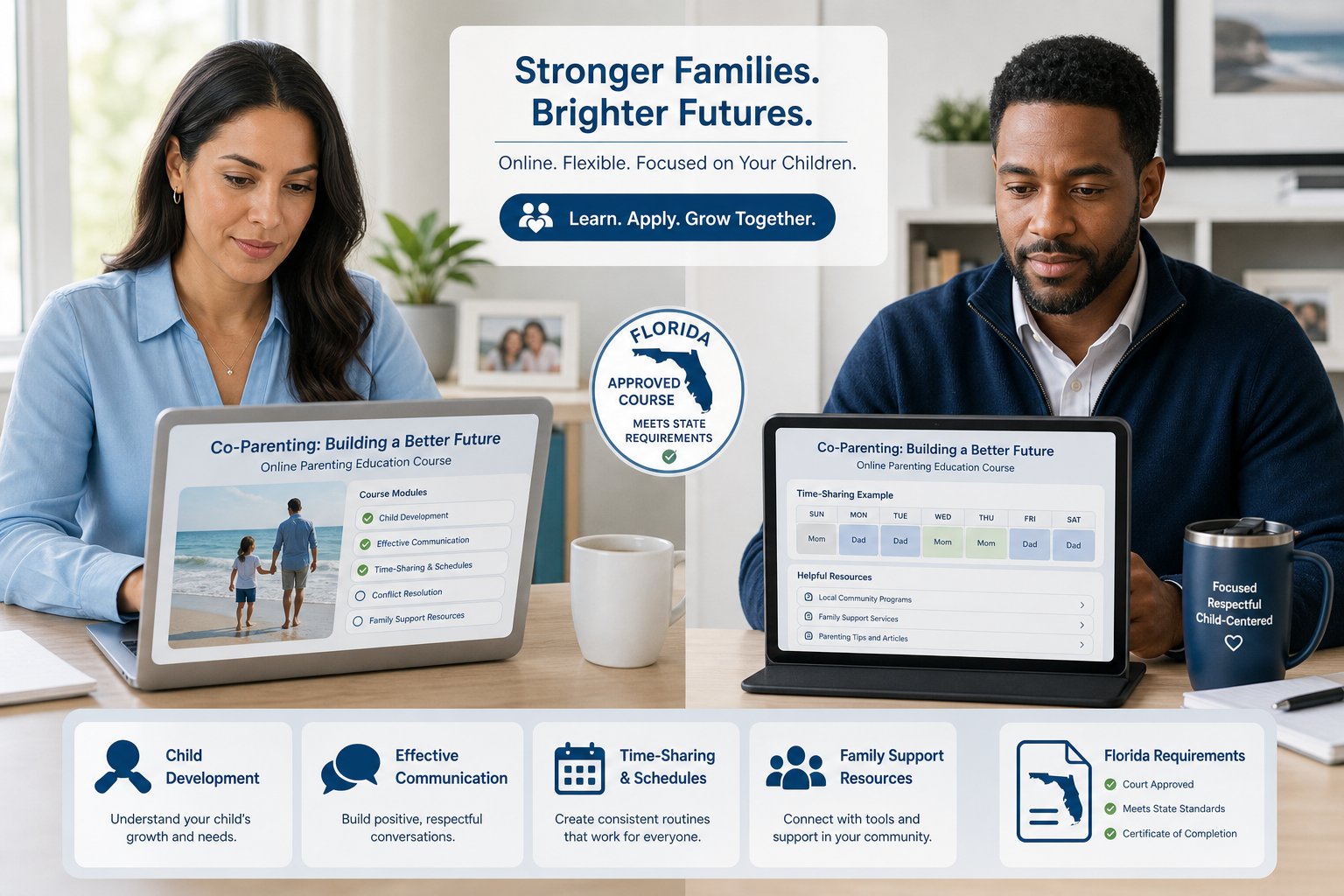
What The Parent Education And Family Stabilization Course Is
The Parent Education and Family Stabilization Course is a Florida-required class for many parents with minor children in family law cases. It is not counseling. It is not therapy. And it does not give legal advice.
Florida created this course under Florida Statute 61.21. The goal is simple: help parents understand how family change affects children and teach better co-parenting skills.
The course must be at least 4 hours long. Approved classes cover topics such as:
- the impact of divorce or separation on children
- child development and age-based reactions
- parental responsibility and time-sharing issues
- communication between parents
- reducing conflict around children
- child abuse, neglect, and domestic violence awareness
- family stress and support resources
Florida approval matters here. A provider should be a DCF-approved provider under the Florida Department of Children and Families program standards. You can review official information through the Florida DCF and the statute itself.
Are there quizzes before the final exam?
Often, yes. Many online providers use short quizzes during the course to check that you understand the material before you reach the final exam. Some providers may use knowledge checks after each unit, while others may save most testing for the end.
That means you should always read the provider’s course details before you enroll. If you want a flexible online option, DivorceParentingClass.net offers a Florida Parent Education and Family Stabilization Course designed for phone, tablet, or computer use, with provider-specific course details available before you begin.
Who Must Take The Course In Florida Family Law Cases
In Florida, all parties in a divorce with minor children generally must take the course before final judgment. The same rule often applies in paternity cases that involve a parenting plan, parental responsibility, or time-sharing.
This rule comes from section 61.21. In plain terms, if your case will decide how parents share responsibility and time with a child, the court may require the class.
Courts may also require the course in some post-judgment cases, such as changes to time-sharing or parenting issues. But not every case works the same way. Requirements can depend on:
- your case type
- your county
- your judge
- your local court procedures
Florida courts can excuse a person for good cause in some cases. That is a court decision, not a provider decision.
For case information and family court resources, you can check the Florida Courts family law page. You can also review your county court or Clerk of Court website for local filing instructions.
If you are unsure whether the class applies in your case, check your court order, your filing papers, or your local clerk instructions right away.
What Parents Learn About Children, Co-Parenting, And Family Change
The course teaches practical facts about how children react to family change. It also shows parents how to lower stress for children during divorce, separation, or paternity cases.
A good Florida-approved class explains that children do not react the same way at every age. A younger child may become clingy or confused. A teen may seem angry or pull away. The point is to help you spot those signs early and respond in a calmer, steadier way.
Most courses cover:
- how divorce or separation can affect children emotionally
- how to talk with children without putting them in the middle
- how to support routines, school, and stability
- how to manage conflict away from the child
- how to build a workable parenting plan mindset
- how time-sharing decisions affect a child’s daily life
Florida standards also include content on child abuse and neglect, domestic violence awareness, and local help resources. That is part of the approved curriculum, not an optional extra.
You may also see lessons on money stress, family roles, and the basic legal terms parents hear in court. These sections are meant to help you understand the process and your child’s needs, not replace legal counsel.
In short, the course focuses on the child’s well-being. That is why courts often require it before entering final orders.
Online Vs Local Options: How To Choose A Florida-Approved Course
You can usually take the class online or through a local in-person option, but the course must be approved for Florida. The safest first step is to confirm that the provider is a DCF-approved provider for the Parent Education and Family Stabilization Course.
Many parents choose online courses because they are self-paced. That can help if work, child care, travel, or court stress makes scheduling hard. But convenience should not be your only test.
Check these points before you register:
- Is the provider approved by the Florida Department of Children and Families?
- Is the class clearly listed for the Florida Parent Education and Family Stabilization Course?
- Does the provider explain whether there are quizzes and a final exam?
- How is the certificate of completion delivered?
- Can you use a phone, tablet, or computer?
- Are support contacts easy to find?
You should also confirm any local court preferences. State approval is key, but some counties may have filing instructions or practical steps on their court or clerk pages. Use the Florida DCF site and your county court resources to verify details.
If you want an online option, DivorceParentingClass.net offers a Florida DCF-approved course you can take on your own schedule. Before enrolling anywhere, read the provider’s course page so you know how the testing, certificate, and access work.
Course Requirements, Timing, And Certificate Acceptance
Florida sets a minimum 4-hour length for the course. The law also says parents should begin as expeditiously as possible, which means you should not wait if your case already started.
The common deadlines under the statute are:
- Dissolution of marriage: petitioner within 45 days after filing
- Dissolution of marriage: respondent within 45 days after service
- Paternity: petitioner within 45 days after filing
- Paternity: other party within 45 days after acknowledgment or adjudication of paternity, or after a support or time-sharing order, depending on the case
You can verify the law in Florida Statute 61.21.
After you finish, you usually receive a certificate of completion. You then need to follow your court’s filing process so proof of compliance reaches the case file before final judgment. In many counties, the Clerk of Court handles filing steps, but local practice can differ.
A certificate from a DCF-approved provider is generally what courts look for. Even so, you should still review your county court or clerk page for local instructions. For example, some counties explain family filing procedures on their clerk websites, and the Florida Courts system provides statewide court information.
Keep a digital copy and a printed copy of your certificate in case the court, clerk, or your lawyer asks for it.
What Happens If You Do Not Complete The Required Class
If the class is required in your case and you do not complete it, the court can treat that as noncompliance. That can slow your case down and create extra problems.
Under Florida law, possible results may include:
- a delay in final judgment
- a contempt finding
- limits or effects on shared parental responsibility or time-sharing
- other sanctions the court finds proper
The exact result depends on the facts, the judge, and the case record. But the main point is clear: skipping the course can affect your case in real ways.
This is one reason the question about quizzes matters less than many parents think. Quizzes can feel annoying, sure, but they are usually a small part of the process. Missing the course deadline is the bigger risk.
If you have a real problem that makes completion hard, do not just let the deadline pass. Review your court papers and speak with your lawyer if you have one. If you do not have a lawyer, check your county court or Clerk of Court website for procedural information and any available self-help resources.
That way, you stay on track with court rules instead of trying to fix a missed requirement later.
How To Make The Process Easier During Divorce Or Separation
The easiest way to handle this requirement is to start early and keep the process simple. Most parents do better when they treat the course like one fixed task on a checklist, not a last-minute scramble.
A few steps can help:
- choose a Florida-approved course first
- confirm whether the course has quizzes, a final exam, and certificate steps
- set aside enough time for the full 4 hours
- save your login details and completion record
- keep your certificate of completion in both digital and paper form
- review your county filing instructions before submitting anything
Online learning can make this easier if your schedule is tight. You can work from home, stop and start as needed, and avoid travel time. For many parents, that is the most practical option during separation.
If you are ready to complete the requirement, you can take the Florida Parent Education and Family Stabilization Course online at DivorceParentingClass.net. Make sure you also follow your court’s instructions for filing the certificate with the proper Clerk of Court.
FAQ
Are there quizzes in the Florida parent education course?
Many providers include short quizzes or knowledge checks, but it’s set by each provider, not the state. They’re usually brief and meant to confirm you’re engaging with the material.
Are the quizzes hard?
Generally no. They’re typically short checks on the section you just covered, designed to reinforce learning rather than to be difficult.
Does every provider use quizzes?
Not necessarily. Quiz format is up to the DCF-approved provider, so some include them throughout and others rely mainly on a final check. Review your provider’s course details.
What if I miss a quiz question?
Many providers let you revisit the material or retake the check. Since the goal is engagement, a missed question usually isn’t a problem.
Conclusion
Quizzes are common in these courses but not guaranteed, and where they appear they’re short, supportive checks rather than hurdles. Because the format is the provider’s choice, your provider’s course details are the place to confirm what to expect. Either way, the quizzes are there to help the material stick, not to stand between you and your certificate.
You can complete the DCF-approved Parent Education and Family Stabilization Course online and see how its quizzes and checks are structured.
Related Articles
- What Does the Florida Parent Education and Family Stabilization Course Cover?
- Is the Florida Parenting Class Final Exam Open Book?
- Can You Fail the Florida Parenting Class? Retakes and Passing Score
- How Long Is the Florida Parenting Class for Divorce?
Sources
Billy Forte is the founder of Divorce Parenting Class, which offers a Florida DCF-approved online Parent Education and Family Stabilization Course. The brand focuses on clear, supportive, plain-English guidance to help Florida parents complete the court-required class and file their certificate.
This article is general information, not legal advice. Florida family-law requirements and certificate acceptance can vary by court, county, judge, and case type, so review your court papers and official Florida sources, or consult a family-law attorney, before acting.