
Updated June 2026 · Reviewed by Billy Forte
A Florida divorce with minor children moves from petition to final judgment through service, responses, financial disclosures, a parenting plan, and often mediation — with the Parent Education and Family Stabilization Course required somewhere along the way. Several deadlines apply, including the responding spouse’s general 20-day window to answer after being served, and a course deadline that varies by court. This guide maps the process and shows where the course and certificate fit, so the requirement never becomes the thing that delays your case.
Applies to the Florida Parent Education and Family Stabilization Course (Fla. Stat. 61.21). Requirements and acceptance can vary by court, county, judge, and case type, so review your court papers and official Florida sources.
Key Facts
- Petition to judgment: The case runs from filing the petition through service, disclosures, parenting plan, mediation, and final judgment.
- Response window: After service, the other spouse generally has 20 days to file an answer.
- Course required: Both parents complete the DCF-approved course and file certificates before the final judgment.
- Course deadline varies: Many courts set an early deadline; it depends on the court, county, and case type.
- Certificate: File your certificate of completion with the Clerk of Court or through your attorney.
Who Can File For Divorce In Florida And Where The Case Is Filed
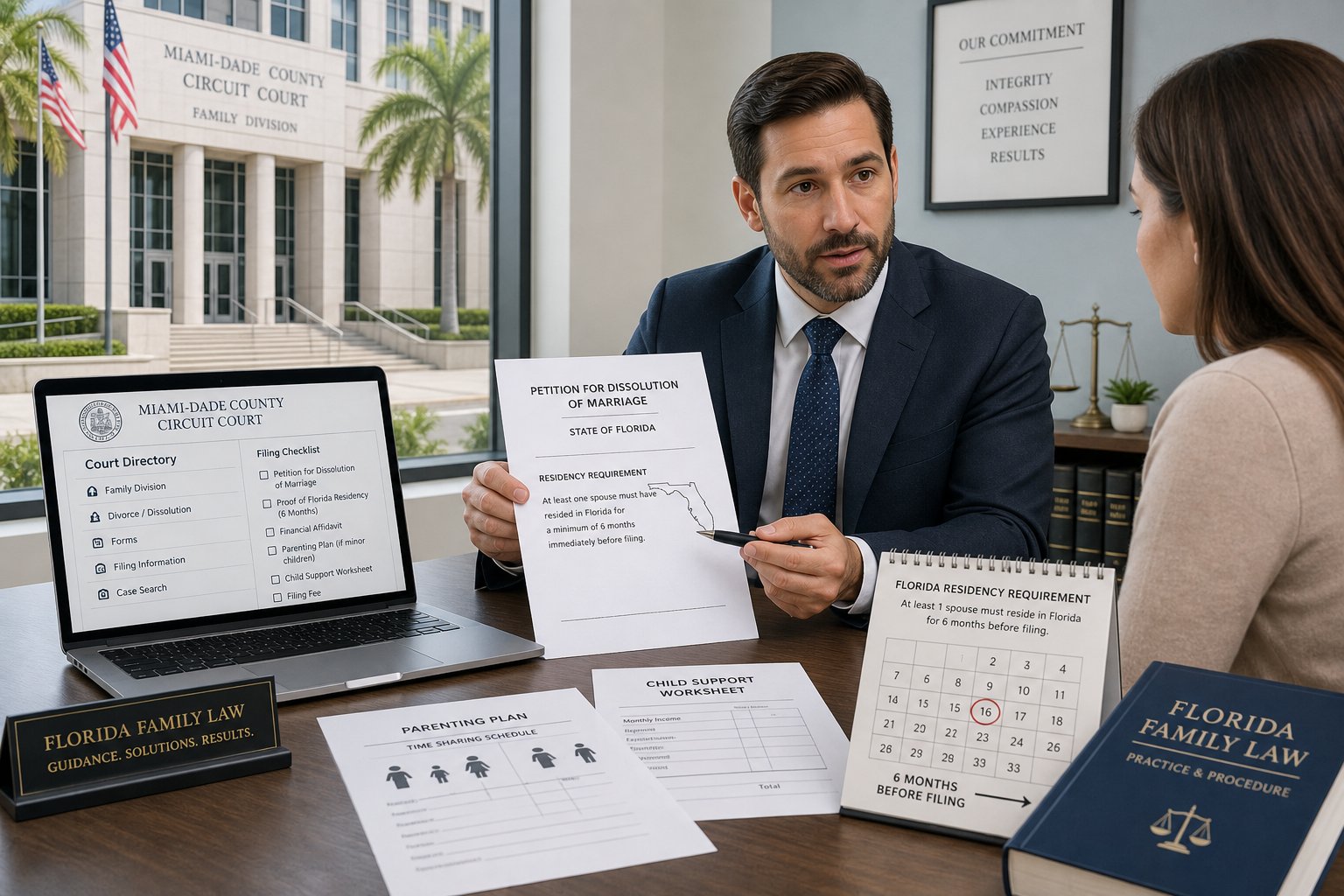
You can file for divorce in Florida if at least one spouse has lived in Florida for 6 months before filing. Florida is a no-fault state, so the usual ground is that the marriage is irretrievably broken. In limited cases, a filing may also involve long-term mental incapacity under state law.
The case is filed in the circuit court. Usually, that means the circuit court in the county where either spouse lives. The Florida Courts system provides county court information through its official directory.
To prove residency, the court may require:
- A Florida driver license issued at least 6 months earlier
- A Florida ID card issued at least 6 months earlier
- Testimony or an affidavit from someone with personal knowledge
If you have minor children, your case brings added court concerns. The court will expect decisions about:
- A parenting plan
- Time-sharing
- Parental responsibility
- Child support
- The required parent course, when applicable
That is why the first step is not only filing. It is also making sure you understand your county’s local process. Some clerks post family case packets and filing guidance on their websites. Check your county’s Clerk of Court or family division page before you submit forms.
How The Divorce Process Works From Petition To Final Judgment
A Florida divorce usually starts when one spouse files a Petition for Dissolution of Marriage with the circuit court. The filing spouse is the petitioner. The other spouse is the respondent.
After filing, the petition must be formally delivered through service of process. Then the respondent has a chance to answer. If the case is contested, the court may set deadlines for disclosures, classes, mediation, and hearings.
Most cases move through these basic stages:
- File the petition.
- Serve the other spouse.
- File an answer or counterpetition.
- Exchange required financial information.
- Address parenting issues, support, and property.
- Attend mediation or case management if ordered.
- Receive a Final Judgment of Dissolution of Marriage.
If you and the other parent agree on all major issues, the process can be shorter. You may sign a settlement agreement and submit a proposed parenting plan for court review. But if you disagree about children, money, or property, the judge may need to decide those issues after hearings or trial.
For parents, timing matters. A final judgment may be delayed if a required course is not completed or if the court has not received proof the requirement was met. That is one reason many parents complete the course early, then check with the clerk or court instructions about how to file the certificate of completion.
Responding To A Divorce Petition, Service Of Process, And Required Disclosures
If you are served with a divorce petition, do not ignore it. In many Florida family cases, the respondent has 20 days to file an answer after service. Missing that deadline can create serious problems, including a possible default.
Service of process usually happens through the sheriff or a certified process server. If a spouse cannot be found after proper efforts, the court may allow another form of service in some cases, such as publication. The rules are strict, and courts look closely at whether service was done the right way.
After service, both sides often must exchange mandatory disclosure. This usually includes:
- Financial affidavits
- Tax returns
- Pay stubs or income proof
- Bank account records
- Retirement account statements
- Debt records
These papers help the court decide support, fees, and property issues. They also help each side understand the full financial picture.
Parents should watch two separate tasks here. Completing the course is one task. Filing proof of completion, often a certificate of completion, is a different task. Some courts want the certificate filed with the Clerk of Court. Others may have a different local step. Read your order and local instructions carefully, then act before your deadline.
What Florida Parents Should Know About Parenting Plans, Time-Sharing, And Relocation
Florida does not focus on “custody” and “visitation” the way some people expect. Florida law uses parenting plan, time-sharing, and parental responsibility. For parents with minor children, these terms matter because they shape daily life after the divorce.
A parenting plan must cover how you will share tasks and communicate about the child. It often includes:
- A regular weekly time-sharing schedule
- Holiday and school break plans
- Decision-making rules
- Transportation and exchange details
- Methods for parent communication
Florida courts decide these issues based on the best interests of the child. You can review family law resources through Florida Courts.
Relocation is a separate issue. If a parent plans to move far enough to trigger Florida’s relocation law, that move usually needs either a written agreement from the other parent or a court order. The court reviews specific facts before allowing relocation with a child.
This is also where the parent course helps. The Parent Education and Family Stabilization Course teaches how conflict affects children, how to build healthier co-parenting habits, and how to reduce stress during transitions. If your case involves minor children, make sure your parenting plan and course requirement both stay on your timeline.
The Parent Education And Family Stabilization Course Requirement
In Florida, parents in a divorce with minor children generally must complete an approved Parent Education and Family Stabilization Course before the court enters a final judgment. This requirement also applies in some other family law cases involving children. The legal basis appears in Florida Statutes section 61.21.
The course must come from a DCF-approved provider. The Florida Department of Children and Families maintains standards for approved providers and course content. You can review agency information through the Florida Department of Children and Families.
The course is about more than a checkbox. It covers topics such as:
- How separation affects children
- Co-parent communication
- Conflict reduction
- Child development needs
- Problem-solving between parents
Here is the key point: taking the course is not the same as filing proof with the court. After you finish, you may receive a certificate of completion. Your court, county, or judge may require that certificate to be filed or submitted in a certain way. If you need a flexible option, you can take the Florida Parent Education and Family Stabilization Course online at DivorceParentingClass.net. Then follow your local court instructions for the next step.
Property Division, Alimony, Attorney’s Fees, And Other Common Financial Issues
Florida uses equitable distribution for marital assets and debts. That means the court divides property in a fair way, which is not always a 50/50 split. The judge looks at what is marital and what is non-marital before dividing what belongs in the marital estate.
Common issues include:
- The home
- Bank accounts
- Credit card debt
- Retirement accounts
- Vehicles
- Business interests
The court may also address alimony in some cases. Whether alimony is awarded can depend on need, ability to pay, and other facts allowed by Florida law. Length of marriage and each spouse’s finances often matter.
If one spouse has far fewer resources, the court may also consider attorney’s fees. The goal is often to help both sides have fair access to legal help.
Parents also need to think about child support. Florida child support decisions usually consider each parent’s income, the time-sharing schedule, health insurance costs, and some child care costs.
Financial issues can affect deadlines because disclosure papers often must be exchanged early. Keep copies of every form, statement, and court notice. That simple step can save time and confusion later.
Mediation, Case Management, And When Couples May Qualify For Simplified Dissolution
Many Florida divorce cases involve mediation. In mediation, a neutral person helps both sides try to reach agreement on parenting, support, property, or other disputes. Courts often require mediation before trial in contested family cases.
The court may also schedule case management. These hearings help the judge track the case, enforce deadlines, and see whether the case is ready for settlement or trial. If you miss a court date or deadline, the case can become harder and more costly.
Some couples hear about simplified dissolution of marriage. That process is usually not available if you have minor or dependent children or if the wife is pregnant. It also requires full agreement on major issues and no request for alimony. So for most parents reading this, simplified dissolution will not fit.
If your case does involve children, the safer approach is to focus on the real requirements in your file:
- Read each court order
- Track response and hearing dates
- Complete the required course
- File or submit the certificate of completion as instructed
- Check your county Clerk of Court page for local forms
For official court forms and family resources, start with Florida Courts Family Law Forms.
FAQ
What deadlines apply in a Florida divorce with kids?
Key ones include the responding spouse’s general 20-day window to answer after service and a court-set deadline for the parent education course. Specific deadlines vary by court and county.
When is the parent education course due?
Usually before the final judgment, and many courts require it earlier in the case. The exact deadline depends on your court, county, and judge, so check your court papers.
What’s the overall process?
Petition, service, the other spouse’s response, financial disclosures, a parenting plan, the parent education course, any ordered mediation, and then the final judgment.
Where does the certificate go?
You file your certificate of completion with the Clerk of Court, or give it to your attorney to file, and keep a copy for your records.
Conclusion
A Florida divorce with children has a clear arc and several moving deadlines, and the parent education course sits inside it as a firm requirement before the final judgment. The reliable strategy is to complete the course early so it’s never the bottleneck, then track your court’s specific deadlines for everything else. When the timing is in your control, the process moves more smoothly.
Get the course off your list early with a DCF-approved Parent Education and Family Stabilization Course online and file your certificate before the final judgment.
Related Articles
- How to File for Divorce in Florida With Minor Children: The Parent Course Step
- Florida Divorce Checklist for Parents With Minor Children
- Florida Parenting Plan vs. Parent Education Course: What Is the Difference?
- Florida Parent Education Course FAQs for Divorce and Family Court
Sources
Billy Forte is the founder of Divorce Parenting Class, which offers a Florida DCF-approved online Parent Education and Family Stabilization Course. The brand focuses on clear, supportive, plain-English guidance to help Florida parents complete the court-required class and file their certificate.
This article is general information, not legal advice. Florida family-law requirements and certificate acceptance can vary by court, county, judge, and case type, so review your court papers and official Florida sources, or consult a family-law attorney, before acting.