
Updated June 2026 · Reviewed by Billy Forte
For most Florida parents, you don’t need an in-person “divorce parenting class near me” if your court accepts a DCF-approved online Parent Education and Family Stabilization Course — and many do. The choice between a local class and an online one usually comes down to your schedule, how you prefer to learn, and what your specific court accepts. This guide compares the two formats and helps you decide which fits your case.
Applies to the Florida Parent Education and Family Stabilization Course (Fla. Stat. 61.21). Requirements and acceptance can vary by court, county, judge, and case type, so review your court papers and official Florida sources.
Key Facts
- Online is widely accepted: Many Florida courts accept a DCF-approved online course, so a local class often isn’t required.
- Same requirement: Whether local or online, it’s the same four-hour Parent Education and Family Stabilization Course.
- Format is about fit: Online suits tight or unpredictable schedules; in-person suits those who prefer a classroom.
- Approval is what counts: Either format must be DCF-approved to satisfy the requirement.
- Acceptance can vary: Confirm your court’s instructions, since acceptance differs by court and county.
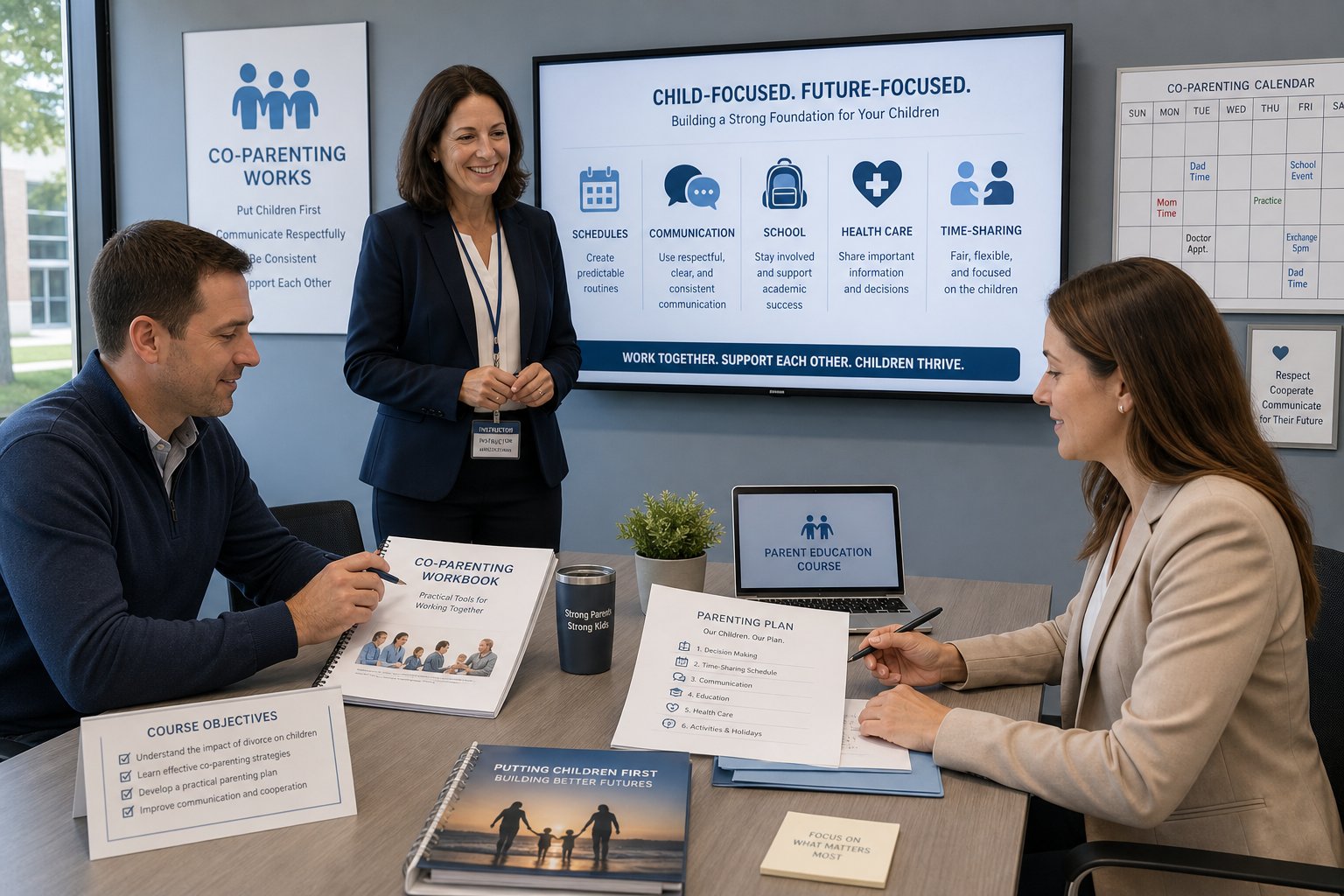
What A Divorce Parenting Class Is And Who Usually Has To Take It
A divorce parenting class is a short course for parents who are ending a marriage or dealing with other family court cases. In Florida, the common name is the Parent Education and Family Stabilization Course. It teaches parents how family change affects children and how to lower conflict.
Florida law generally requires this course when parents with minor children are involved in a dissolution of marriage case. Courts may also require it in some paternity, support, or time-sharing disputes. The goal is simple: help parents make better choices for children during a stressful time.
The course is not the same as therapy. It is also not a legal strategy class. Instead, it focuses on practical topics such as:
- How divorce affects children at different ages
- How to support a stable routine
- How to improve co-parent communication
- How to reduce conflict around exchanges and schedules
- How a parenting plan works in real life
In Florida, you may see terms like parental responsibility, parenting plan, and time-sharing in your court papers. Those terms matter because the class often connects directly to those issues. If your case involves decisions about school, health care, routines, or where children stay, the course helps explain how courts expect parents to keep children out of the middle.
Because rules can vary, your next step is to read your court order or filing packet closely. Then compare that information with the provider details before you register.
How To Find Court-Approved Divorce Parenting Classes Near You
The fastest way to find the right class is to start with your own court, not a search ad. Many Florida parents search for divorce parenting classes near me, but the better question is whether the provider meets state and local requirements.
First, check the county court or Clerk of Court website for your case. Some counties post local family law instructions, filing packets, or approved resource pages. You can also review the broader Florida Courts system at Florida Courts.
Next, confirm whether the provider is a DCF-approved provider. In Florida, the Florida Department of Children and Families sets approval standards for parent education courses. You can review state information through Florida DCF.
When you compare providers, look for clear answers to these points:
- Is the course approved for Florida?
- Does the provider say it is DCF-approved?
- Is the course online, in person, or both?
- Will you receive a certificate of completion?
- Does the provider explain how to use that certificate with your court?
Then verify local instructions. A provider may be approved in Florida, but your county or judge may still give specific filing directions. That is why county-level review matters.
If you want an online option, DivorceParentingClass.net offers a Florida Parent Education and Family Stabilization Course built for this requirement. Still, you should match the course to your local court instructions before enrolling.
Online Vs In-Person Classes: Which Option Makes More Sense
For many Florida parents, online makes more sense because it is flexible and easier to fit around work, child care, and travel. But in some cases, an in-person class may still be the better choice if your court gives that instruction.
Online classes can help when:
- You need a class that works on your schedule
- You live far from a courthouse or class site
- You need to use a phone, tablet, or computer at home
- You want to finish without waiting for a set class date
In-person classes can help when:
- Your judge or county prefers face-to-face attendance
- Your paperwork points to a local provider
- You are more comfortable learning in a classroom
- You need live help with forms or local filing steps
The biggest issue is not convenience. It is acceptance by your court. In Florida, many parents can use an online course from a DCF-approved provider, but local instructions still matter. Some courts care about how the certificate is filed, the exact provider name, or when the course must be finished before a hearing.
So, do you need an in-person class near you? Usually, no. But you do need the right class for your court. If your papers do not clearly answer that question, check the county court website or call the clerk for guidance on filing rules.
What Florida Parents Should Know About The Parent Education And Family Stabilization Course
In Florida, this course is not just a general parenting seminar. It is a specific state-recognized program tied to family law cases involving children. The full name matters: Parent Education and Family Stabilization Course.
Florida generally requires parents with minor children in divorce cases to complete an approved course. The rule may also apply in some paternity or other family cases that involve parental responsibility or time-sharing. You can review Florida family law resources through Florida Courts Family Courts.
A valid course should cover the topics required by Florida standards. That usually includes:
- The needs of children during family change
- The effect of conflict on children
- Ways to support healthy parent-child bonds
- Co-parent communication skills
- Problem-solving around schedules and routines
- Information related to a parenting plan
The phrase DCF-approved provider is important because it signals that the provider meets Florida approval standards. Still, approval status does not erase local court instructions. Your judge may still control deadlines, filing steps, or whether both parents must file separate proof.
That is why the safest path is to do two checks. Confirm the provider’s Florida approval status. Then confirm your county court’s instructions on how and when the certificate of completion must be filed.
Cost, Registration, And How Completion Certificates Work
Most Florida parenting course costs fall within a modest range, but price should not be your only filter. A cheaper class is not helpful if it does not match your court’s instructions.
In many cases, online parent education courses cost less than in-person classes. Costs can vary by provider, format, and support features. Some providers let you register online in a few minutes, while in-person classes may require you to pick a date and location first.
Before you pay, check these basic points:
- Total price and whether fees are listed clearly
- Device access on phone, tablet, or computer
- Whether the course is self-paced or scheduled
- What kind of certificate of completion you receive
- Whether you print it yourself or request delivery
The certificate is the proof that you finished the course. In Florida, that certificate may need to be filed with the court, kept for your records, or shown to your lawyer. Some counties give filing directions through the clerk or local family law packet. For county-specific details, start with your local Clerk of Court site.
If you want a simple online path, DivorceParentingClass.net’s Florida course is built for Florida parents who need an approved class and a completion certificate. Review the provider details, then follow your local court filing steps carefully.
What The Class Covers For Co-Parenting, Communication, And Children’s Well-Being
A good Florida parenting class teaches skills that matter right away. The point is not to memorize court terms. The point is to help you make choices that support your children.
Most courses cover how children react to separation at different ages. Younger children may show stress through sleep or behavior changes. Older children may worry about loyalty, school, or daily routines.
You can also expect lessons on co-parenting basics, including:
- Keeping adult conflict away from children
- Using calm, direct communication
- Following the parenting plan consistently
- Handling schedule changes with less conflict
- Supporting the child’s bond with both parents when safe
Another common topic is how to talk with children about divorce without making promises you cannot keep. That matters because children often blame themselves for family change, even when no one says that out loud.
The course may also explain how parental responsibility works in practice. For example, parents may need to share information about school events, medical care, and activities even when they disagree.
These lessons help beyond the case itself. They can lower confusion, reduce stress around time-sharing, and support steadier routines at home. If you still need to meet your requirement, compare your court instructions with a Florida-approved online course and register once the match is clear.
Special Situations, Waivers, And Questions About County Acceptance
Some cases do not follow the usual path. If you have a hardship, language issue, health issue, domestic violence concern, or a question about online acceptance, do not guess. Check your court’s written instructions and ask the clerk what filing resources are available.
Waivers or alternate arrangements may exist in some situations, but they are case-specific. The court, county, judge, and case type can all affect what happens next. That is why broad promises are not reliable here.
County acceptance questions often come up when parents find a provider online and want a fast answer. A provider may be approved for Florida, yet the court may still have local rules about:
- When the course must be completed
- How the certificate must be filed
- Whether each parent files separately
- Whether extra steps apply in a special case
If you are trying to act fast, use this order:
- Read your court papers.
- Check your county court or clerk website.
- Confirm the provider is a DCF-approved provider.
- Enroll in the option that fits both state approval and local instructions.
FAQ
Do I need an in-person divorce parenting class near me?
Usually not. If your Florida court accepts a DCF-approved online Parent Education and Family Stabilization Course — and many do — an online class satisfies the same requirement. Confirm your court’s instructions to be sure.
Is the online class the same as the in-person one?
Yes. Both are the same four-hour Parent Education and Family Stabilization Course. The difference is format and schedule, not the requirement or the certificate you receive.
When does an in-person class make more sense?
If you prefer a classroom setting, or if your specific court requires an in-person format. Otherwise, a DCF-approved online course is usually more flexible.
How do I find a class that my court will accept?
Look for a DCF-approved provider and check your court papers or the Clerk of Court for any local format rules. Approval plus your court’s instructions determine acceptance.
Conclusion
The near-me-versus-online question usually resolves in favor of whatever fits your life, because both formats satisfy the same DCF-approved requirement when your court accepts them. Online tends to win on flexibility; in-person suits those who want a classroom. Confirm your court’s instructions, pick the format that fits, and the comparison stops being a hurdle.
If online fits your schedule, you can take the DCF-approved Parent Education and Family Stabilization Course and complete the same requirement from home.
Related Articles
- Court-Ordered Parenting Class Online: Why State Approval Matters
- Parenting Classes Approved by Court: Questions to Ask Before You Enroll
- Accredited Parenting Courses: What Does Accredited Mean for Florida Divorce?
- Parenting Classes for Court vs. Voluntary Parenting Classes
Sources
Billy Forte is the founder of Divorce Parenting Class, which offers a Florida DCF-approved online Parent Education and Family Stabilization Course. The brand focuses on clear, supportive, plain-English guidance to help Florida parents complete the court-required class and file their certificate.
This article is general information, not legal advice. Florida family-law requirements and certificate acceptance can vary by court, county, judge, and case type, so review your court papers and official Florida sources, or consult a family-law attorney, before acting.