
Updated June 2026 · Reviewed by Billy Forte
In Duval County, the divorce parenting class is the statewide DCF-approved Parent Education and Family Stabilization Course required across Florida, while filing the certificate follows the Duval Clerk of Court’s instructions. The course is the same anywhere in Florida; the local filing logistics can differ. This guide explains the statewide requirement and how to confirm Duval County’s filing steps.
Applies to the Florida Parent Education and Family Stabilization Course (Fla. Stat. 61.21). Requirements and acceptance can vary by court, county, judge, and case type, so review your court papers and official Florida sources.
Key Facts
- Statewide course: The DCF-approved, four-hour course applies in Duval just as across Florida.
- Local filing: Certificate filing follows the Duval Clerk of Court’s instructions and your case.
- Both parents: Each parent generally completes the course separately and files a certificate.
- Confirm steps: Check your court papers or the Duval Clerk for the current filing process.
- DCF approval matters: Confirm your provider is DCF-approved so the certificate counts.
What The Florida Parenting Class Is And Why Courts Require It
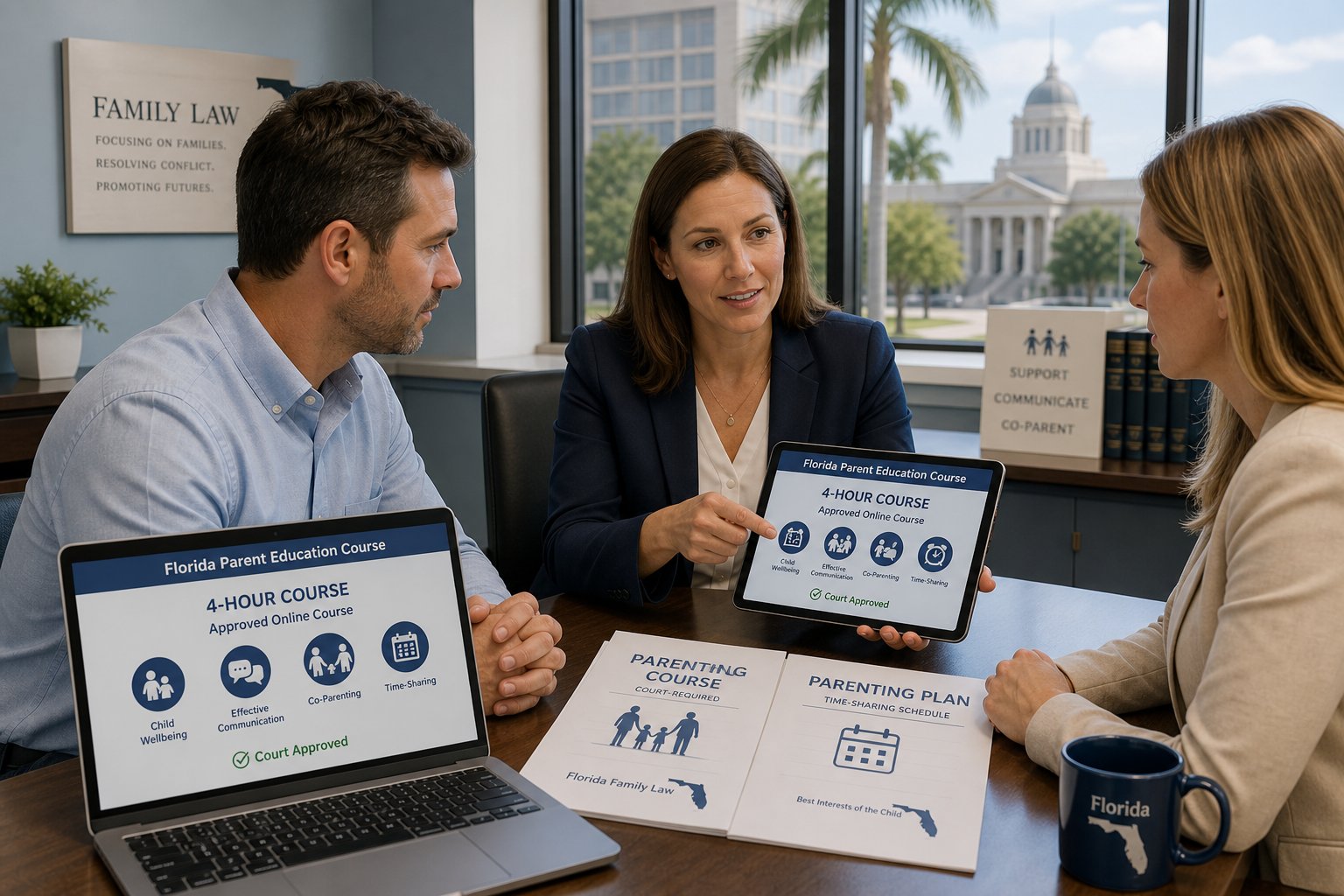
The Florida parenting class is the state’s Parent Education and Family Stabilization Course. Florida law uses this course to help parents reduce harm to children during divorce and other family changes.
Under Florida Statute 61.21, the course must be at least 4 hours long. The program is regulated through the Florida Department of Children and Families. That matters because not every online class is accepted. A DCF-approved provider has met the state standard for this type of course.
Courts require it for a simple reason: family breakups can raise conflict, confuse children, and make co-parenting harder. The class is meant to lower that risk. It teaches parents how divorce or separation can affect children, how to communicate better, and how to support healthy adjustment.
For Jacksonville and Duval County families, the key point is practical. The course is not just “nice to have.” In many Florida cases, it is part of meeting court requirements. It can connect to issues like a parenting plan, parental responsibility, and time-sharing because courts want parents to understand how their actions affect minor children.
The next step is to confirm whether your case requires the course and, if so, choose a provider listed by the state rather than guessing.
Who Must Take The Parent Education And Family Stabilization Course
Florida generally requires both parties to take the course in a dissolution of marriage case when there are minor children. The requirement also commonly applies in some paternity or family law matters that involve parental responsibility or time-sharing.
That means the rule is not only for the person who filed the case. If you are the petitioner, you may need it. If you are the respondent, you may need it too. The focus is on the child and the case type, not on which parent started the court action.
Common situations where the course may apply include:
- Divorce involving minor children
- Certain paternity actions
- Cases involving parenting issues tied to time-sharing
- Matters where the court addresses a parenting plan
Still, not every family law case works the same way. Requirements can depend on the court, county, judge, and case type. That is why Florida parents should read their court papers closely and check official instructions.
If you live in Jacksonville, use trusted sources first. Review the Florida Courts family law resources and your local Duval County Clerk of Court information. If your paperwork says you must complete the course, do not wait until the last minute. Early completion gives you more time to handle your certificate of completion and any filing steps the court expects.
How Long The Course Takes, When To Complete It, And What Happens If You Miss The Deadline
The standard Florida course takes 4 hours. That is the minimum course length set by state law for the Parent Education and Family Stabilization Course.
In many Florida cases, deadlines matter almost as much as completion. The petitioner often must complete the course within 45 days of filing, and the respondent often must complete it within 45 days of service. But local practice can differ, so your court order or case papers control.
Missing the deadline can create real problems. Depending on the case and court, failure to complete the class may:
- Delay the case from moving forward
- Delay entry of a final judgment
- Lead to court sanctions or contempt issues
- Affect how the court views compliance with parenting requirements
Some sites make this sound dramatic. The better way to think about it is simple: if the court says the course is required, finish it on time and keep proof.
Online classes can help because you can usually work at your own pace. Many parents split the course into shorter blocks instead of doing all 4 hours at once. That can make it easier if you are working, caring for children, or juggling court dates.
If your deadline is close, pick a DCF-approved provider, complete the class, save your records, and follow your county’s directions for the certificate.
What The Florida Parenting Class Covers For Co-Parenting, Communication, And Child Well-Being
The course covers how separation affects children and how parents can lower stress during the process. Its goal is not to assign blame. Its goal is to help children stay as steady and secure as possible.
Most Florida programs include topics like:
- The effects of divorce on children and parents
- Age-based child needs and child development
- Better co-parenting habits
- Ways to reduce conflict
- Communication between parents
- Communication with children about family change
- Problem-solving around schedules and transitions
A good class explains that children often do best when parents keep adult conflict away from them. That means no using children as messengers, no putting them in the middle, and no making them choose sides. Even small changes in tone can matter.
The course also supports better planning. If your case involves a parenting plan, the class can help you think more clearly about routines, school needs, exchanges, and decision-making. Those choices connect to parental responsibility and time-sharing, which are central terms in Florida family law.
For many parents, the most useful part is practical communication. Short messages. Clear facts. Fewer emotional triggers. When parents do that more often, children usually face less stress.
That is the real reason courts require this class. It is education aimed at protecting child well-being while the legal case moves forward.
How Online Florida Parenting Classes Work And What To Look For In An Approved Provider
Many Florida parenting classes are fully online. That means you can log in from home, move at your own pace, and finish the course on a phone, tablet, or computer if the provider supports those devices.
Online delivery is useful, but approval matters more than convenience. Before you sign up, make sure the provider is a DCF-approved provider listed by the Florida Department of Children and Families. If the provider is not approved, your certificate may not meet court requirements.
When comparing providers, look for these basics:
- Clear proof of DCF approval
- A course made for Florida, not a generic national class
- Access on phone, tablet, or computer
- Simple account access if you need to pause and return
- Clear certificate instructions
- Support if you have login or completion issues
DivorceParentingClass.net offers a Florida course that is 100% online and designed for flexible access. That can help if you need to complete the class around work or child care.
Still, one point matters a lot: some counties or judges may have rules about distance learning or certificate acceptance. So even with an approved provider, you should confirm any local limits before you rely on an online option alone.
If you want to move forward, you can review the Florida online course options at DivorceParentingClass.net and compare them with your court instructions.
Certificates, Court Acceptance, And County-Specific Requirements
After you complete the course, you receive a certificate of completion. That certificate is the document you may need to file or present, depending on what your court or Clerk of Court requires.
This is where parents often get tripped up. A certificate from a DCF-approved provider is a strong starting point, but it does not erase local rules. Florida counties, judges, and case types can differ in how they handle course proof, online acceptance, and filing instructions.
For Jacksonville families, that means you should verify local requirements with official sources such as the Duval County Clerk of Court and the Fourth Judicial Circuit. Do not assume that what worked in another Florida county will work the same way in Duval County.
A few practical points can help:
- Keep a digital copy of your certificate
- Print a paper copy if needed
- Match the name on the certificate to your court records
- Follow any order that tells you how or when to file it
- Save emails or receipts tied to course completion
Most parents want one simple answer: will the court accept it? The honest answer is that acceptance depends on approved provider status plus local court instructions. Check both before you count on your certificate being enough.
Common Questions About Cost, Final Exams, And Access From Phone, Tablet, Or Computer
Online Florida parenting classes for the 4-hour format vary in price by provider, so it’s worth comparing a few DCF-approved options. Lower cost can help, but approval and local acceptance matter more than a bargain that does not fit court rules.
Many parents also ask about tests. Some providers include short quizzes and a final exam. Others use section checks. Rules vary by provider, so read the course details before you enroll.
Common questions include:
- Can I take the class on my phone? Often yes, if the site is mobile friendly.
- Can I switch devices? Many providers allow you to start on one device and finish on another.
- Is there a final exam? Some courses have one: some allow more than one attempt.
- Do I get the certificate right away? Some providers offer instant download, while others may have a short processing step.
DivorceParentingClass.net states that its Florida course works online and is built for phone, tablet, or computer access. That kind of flexibility can make compliance easier when your schedule is tight.
If you are ready to take the next step, review the course details and start the Florida Parent Education and Family Stabilization Course at DivorceParentingClass.net.
FAQ
Is the Duval County parenting class different from other counties?
No. It’s the same statewide DCF-approved Parent Education and Family Stabilization Course. What’s specific to Duval is how you file the certificate with the local Clerk of Court.
How do I file my certificate in Duval County?
Generally with the Duval Clerk of Court, or through your attorney, following the county’s process. Confirm the current steps on the clerk’s official site or your court papers.
Can I take the course online in Jacksonville?
Usually yes, if the provider is DCF-approved and your court accepts the online format. Confirm acceptance with your court, since local practice can vary.
How much does it cost?
Prices vary by provider, so compare a few DCF-approved options. Approval and local acceptance matter more than finding the lowest price.
Conclusion
Duval County parents take the same statewide DCF-approved course, with filing handled through the local Clerk of Court. Complete an approved course, confirm Duval’s filing steps from the clerk or your court papers, and submit your certificate. The course stays the same statewide; the filing is what you verify for Jacksonville.
You can complete the DCF-approved Parent Education and Family Stabilization Course online and file your certificate with the Duval clerk.
Related Articles
- Florida Parenting Class by County: Court Certificate Guide
- Orange County / Orlando Parenting Class for Divorce
- Lee County / Fort Myers Parenting Class Guide
- Hillsborough County Parenting Class for Divorce
Sources
Billy Forte is the founder of Divorce Parenting Class, which offers a Florida DCF-approved online Parent Education and Family Stabilization Course. The brand focuses on clear, supportive, plain-English guidance to help Florida parents complete the court-required class and file their certificate.
This article is general information, not legal advice. Florida family-law requirements and certificate acceptance can vary by court, county, judge, and case type, so review your court papers and official Florida sources, or consult a family-law attorney, before acting.