
Updated June 2026 · Reviewed by Billy Forte
A Florida parenting plan and the Parent Education and Family Stabilization Course are two separate requirements that often get confused: the parenting plan is a written document setting out time-sharing and parental responsibility for your children, while the course is a four-hour class parents complete and file a certificate for. The plan is specific to your family and approved by the court; the course is a standardized educational requirement. This guide explains what each one is, why you need both, and how they fit together in a case with minor children.
Applies to the Florida Parent Education and Family Stabilization Course (Fla. Stat. 61.21). Requirements and acceptance can vary by court, county, judge, and case type, so review your court papers and official Florida sources.
Key Facts
- Parenting plan: A written document covering time-sharing, decision-making, and parental responsibility for your children.
- The course: The DCF-approved, four-hour Parent Education and Family Stabilization Course, completed by each parent.
- Different purposes: The plan governs your specific family arrangement; the course educates parents broadly.
- Both are usually required: Cases with minor children generally need a parenting plan and the completed course.
- Court approval: The parenting plan is reviewed and approved by the court; the course produces a certificate you file.
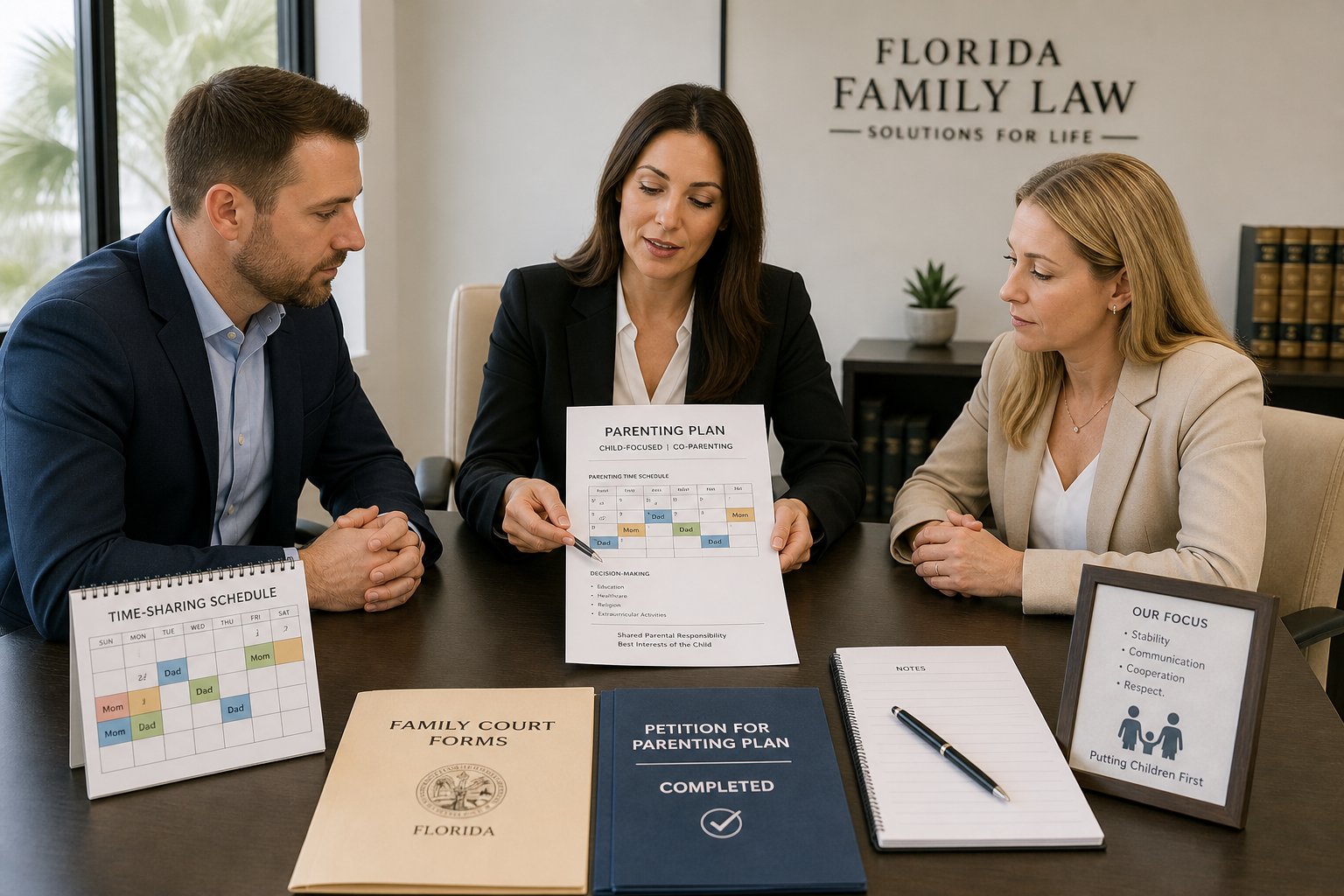
What A Florida Parenting Plan Is And When You Need One
A Florida parenting plan is the written plan that explains how you and the other parent will raise your child after separation or divorce. It replaces old terms like custody and visitation. In Florida, the key terms are parental responsibility and time-sharing.
The plan tells the court who will make major choices for the child and when the child will be with each parent. It must focus on the child’s best interests. And in cases with minor children where time-sharing is at issue, the court expects a parenting plan.
You may need a parenting plan in cases such as:
- Divorce with minor children
- Paternity cases
- Cases asking to change an old time-sharing order
- Other family law cases involving time-sharing
Florida Courts provide approved family law forms, including parenting plan forms, through the Florida Courts Family Law Forms page.
The parenting plan is not the class. That point causes a lot of confusion. The Parent Education and Family Stabilization Course is an education step. The parenting plan is a court document. If your case requires the course, you usually must complete it through a DCF-approved provider and keep your certificate of completion for filing or proof, based on local instructions. You can review state information from the Florida Department of Children and Families.
In many Florida cases, you will need to do both things:
- Complete the required course, if ordered or required
- Prepare and file a parenting plan
- Follow any instructions from your judge, court, or Clerk of Court
If you are unsure what your county requires, check your local clerk or court website before you file anything.
How Parental Responsibility Is Decided In Florida
Florida courts decide parental responsibility under the best interests of the child standard. The main law is Florida Statutes section 61.13. The court looks at the facts of your family, not just what one parent wants.
Judges may look at many things, including:
- Each parent’s ability to support the child’s needs
- Each parent’s role in school, health care, and daily care
- Stability in the child’s routine
- Each parent’s willingness to communicate
- Safety concerns, including domestic violence
- Each parent’s ability to put the child first
The court also decides time-sharing. That means the schedule for overnights, weekdays, weekends, holidays, school breaks, and vacations. Time-sharing and parental responsibility are linked, but they are not the same thing.
Shared Parental Responsibility
Florida usually prefers shared parental responsibility. That means both parents keep full parental rights and must confer on major decisions about the child. These decisions often include education, non-emergency health care, and other important matters.
But shared responsibility does not always mean a 50/50 schedule. One parent may have more overnights while both still share major decisions. That point matters because many parents mix up equal decision-making with equal time-sharing, and the law does not treat them as identical.
Sole Or Shared Responsibility With Ultimate Decision-Making Authority
In some cases, the court may order sole parental responsibility. That means one parent makes major decisions alone. Courts may do this when shared decision-making would harm the child.
The court may also order shared parental responsibility with ultimate decision-making authority in a specific area. For example, one parent may get final say on school issues or health care after both parents consult. Florida courts do not treat this as a blank check over every issue. The order must be clear about what final authority covers.
What A Florida Parenting Plan Must Cover
A Florida parenting plan must be specific. Vague plans often create more conflict later. The court wants clear terms that people can follow.
At a minimum, a plan should cover the child’s daily life and major decisions. Under Florida law and court forms, your plan should address:
- Time-sharing schedule for regular weeks
- Holiday and vacation schedules
- School break schedules
- Parental responsibility for major decisions
- Health care decisions
- School-related matters and the address used for school boundary purposes
- How parents will communicate with each other
- How the child will communicate with each parent
- How parents will handle exchanges
- Rules for activities, travel, and other practical issues
The strongest plans answer real-life questions before they become arguments. For example, where will pick-up happen? What time does each exchange start? How much notice is needed for schedule changes? What happens if the child is sick?
A plan can also explain:
- How you will share school records and medical updates
- How you will split responsibility for extracurricular schedules
- How far in advance you must request travel
- How you will resolve small disputes before going back to court
Florida Supreme Court forms help you cover these topics. Still, forms are only the starting point. Your facts matter. A plan for parents who live close together may look very different from one for parents who live far apart or have safety concerns.
Be careful with broad phrases like “reasonable time-sharing.” Those words may sound easy, but they often create fights. Clear dates, times, and duties usually work better for both parents and for the child.
Parenting Plan Options, Forms, And Changes After Divorce
Florida offers several parenting plan forms. The right one depends on your facts. The Florida Supreme Court family law forms include standard, safety-focused, and long-distance options.
Common forms include:
- Form 12.995(a) Standard Parenting Plan
- Form 12.995(b) Safety-Focused Parenting Plan
- Form 12.995(c) Relocation/Long-Distance Parenting Plan
You can find official forms through Florida Courts. Some circuits or counties may also provide local packets or instructions through the court or Clerk of Court.
If your family has safety issues, a safety-focused plan may fit better than a standard form. If parents live more than 50 miles apart, a long-distance plan may be needed. Local rules can still matter, so always check the court handling your case.
After divorce, a parenting plan does not change just because both parents start doing something different. A court order stays in place until the court changes it. To modify a plan, a parent usually must ask the court and show a substantial, material, and unanticipated change and that the change is in the child’s best interests.
That standard is not minor. A small disagreement or short-term problem usually is not enough.
And remember the separate course requirement. In many Florida cases with minor children, parents must complete a Parent Education and Family Stabilization Course from a DCF-approved provider. If you still need that step, you can take the Florida course online at DivorceParentingClass.net. After completion, keep your certificate of completion and follow your county’s filing or submission rules.
For case-specific procedures, review your local court or clerk website and any orders from your judge.
FAQ
Is the parenting plan the same as the parent education course?
No. The parenting plan is a written document about time-sharing and parental responsibility for your children. The course is a four-hour educational class. They’re separate requirements that often both apply.
Do I need both a parenting plan and the course?
In most Florida cases with minor children, yes. The parenting plan sets your family’s arrangement, and each parent completes the course and files a certificate.
What does a Florida parenting plan cover?
It typically covers time-sharing schedules, how parental responsibility and decisions are shared, and arrangements for the children’s care. The court reviews and approves it.
Does completing the course create my parenting plan?
No. The course is educational and doesn’t produce your parenting plan. The plan is drafted for your specific family and approved by the court.
Conclusion
The simplest way to keep them straight: the parenting plan is about your children’s specific arrangement, while the course is a standardized class every affected parent completes. Both typically apply in a Florida case with minor children, and they serve different roles. Knowing the difference helps you handle each one without assuming finishing the course covers the plan, or vice versa.
You can complete the educational requirement with a DCF-approved Parent Education and Family Stabilization Course online, separate from drafting your parenting plan.
Related Articles
- How to File for Divorce in Florida With Minor Children: The Parent Course Step
- Florida Time-Sharing and the Parent Education Course
- Divorce in Florida With Kids: Deadlines, Course, and Certificate
- Florida Divorce Checklist for Parents With Minor Children
Sources
Billy Forte is the founder of Divorce Parenting Class, which offers a Florida DCF-approved online Parent Education and Family Stabilization Course. The brand focuses on clear, supportive, plain-English guidance to help Florida parents complete the court-required class and file their certificate.
This article is general information, not legal advice. Florida family-law requirements and certificate acceptance can vary by court, county, judge, and case type, so review your court papers and official Florida sources, or consult a family-law attorney, before acting.