
Updated June 2026 · Reviewed by Billy Forte
A Florida parenting class typically costs a modest fee, but the exact amount varies by provider, so there’s no single statewide price. What matters more than the lowest price is that the course is the DCF-approved Parent Education and Family Stabilization Course your court will accept. This guide explains what affects the cost, how to compare providers, and why “counts for court” should outweigh “cheapest” when you choose.
Applies to the Florida Parent Education and Family Stabilization Course (Fla. Stat. 61.21). Requirements and acceptance can vary by court, county, judge, and case type, so review your court papers and official Florida sources.
Key Facts
- Cost varies by provider: There’s no single statewide price; fees differ between DCF-approved providers.
- Approval over price: The course must be DCF-approved to satisfy your Florida case, regardless of cost.
- Watch ‘free’ results: Some free or very cheap classes are general education, not the required course.
- Compare what’s included: Look at the certificate, format, and support, not just the headline price.
- Same requirement: Whatever you pay, it’s the same four-hour Parent Education and Family Stabilization Course.
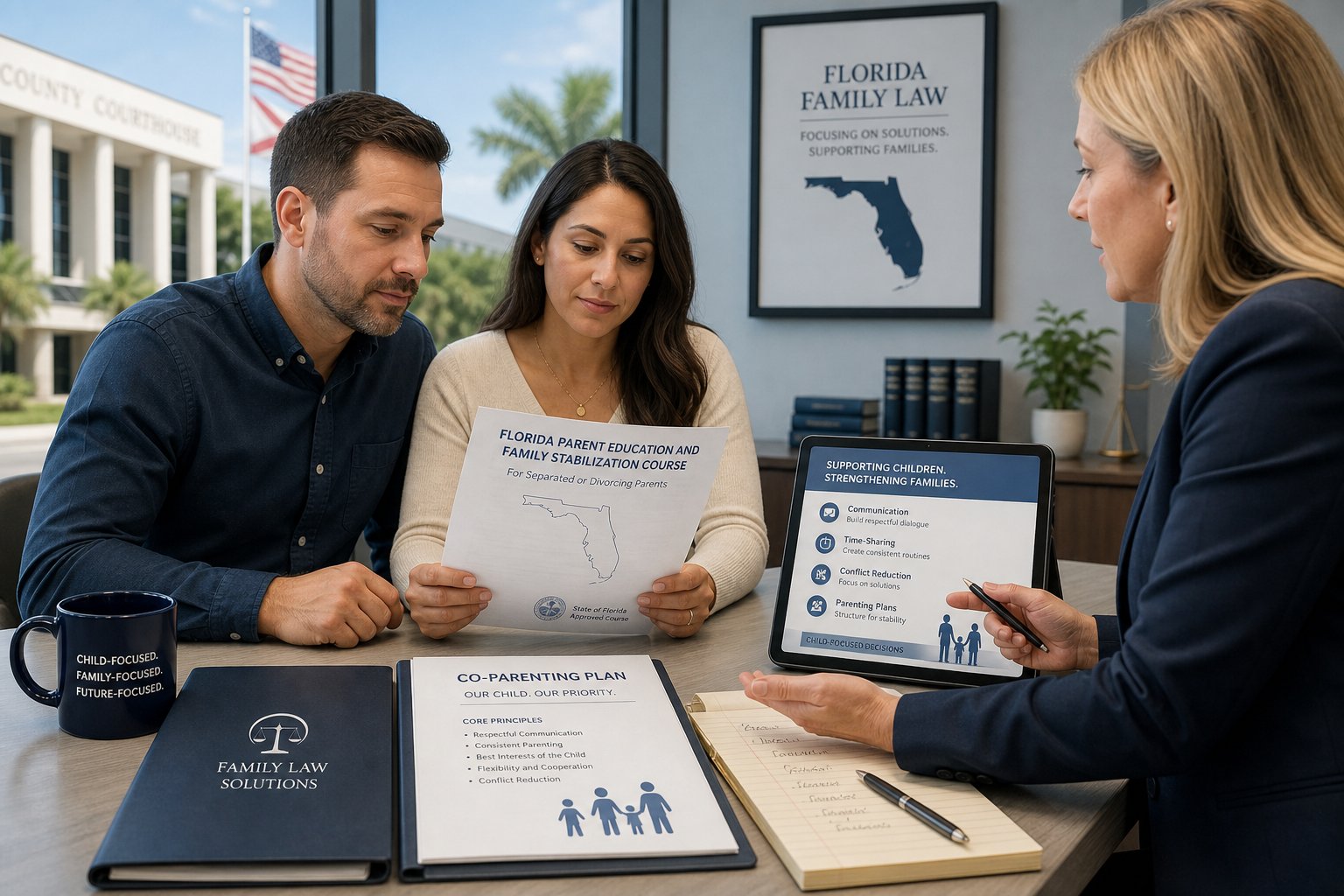
What The Florida Parenting Class Is And Why Courts Require It
Florida’s parenting class is usually called the Parent Education and Family Stabilization Course. It is a court-related class for parents with minor children who are in certain family law cases.
The main goal is simple. The class teaches parents how family change can affect children. It also teaches skills that support safer, calmer co-parenting.
Florida law connects this course to cases involving divorce and some other family matters. A key source is Florida Statutes section 61.21, which addresses parent education and family stabilization in certain proceedings. Courts use the class to help parents focus on the child’s needs during conflict, schedule changes, and court planning.
This matters because Florida courts make decisions about parental responsibility, time-sharing, and the child’s best interests. A parenting class does not decide your case. But it is often one of the steps the court expects before the case moves forward.
The course is not just about rules. It usually covers:
- The effect of divorce or separation on children
- Communication between parents
- Problem solving and conflict reduction
- Co-parenting skills
- The role of a parenting plan
Florida DCF sets approval standards for providers. That is why you should look for a DCF-approved provider and then check local court instructions too.
Who Needs To Take The Parent Education And Family Stabilization Course
In Florida, both parents usually need to take the class when a divorce case involves minor children. The same issue can come up in some paternity and family cases that involve child-related rights, support, or parenting issues.
That said, the exact requirement can depend on:
- Your case type
- Your county
- Your judge
- The orders entered in your case
For example, a divorce with minor children often triggers the course requirement. A paternity case may also require it when the court is deciding child-related issues. Florida Courts and local court instructions often explain this, but the wording can vary from one circuit to another.
You should not assume that only the parent who filed the case must do it. In many cases, the petitioner and the respondent must both complete the course. If one parent lives out of state, the court may still require a course that meets Florida standards or a local equivalent accepted by the court.
If you are unsure, check these sources:
- Your summons or court order
- Your local family court website
- Your county Clerk of Court
- The judge’s case management order, if one was entered
If your paperwork says you must complete a parent education course, follow that order and verify what kind of certificate the court wants.
How To Choose A Florida DCF-Approved Online Class
Start with approval status. A Florida parenting class should come from a DCF-approved provider if you need it for a Florida family court case.
That is the first screen, not the last one. A provider may meet state approval rules, but your local court may still have its own filing steps or accepted formats. So, after you confirm state approval, check your county court or clerk page.
When you compare providers, look for clear answers to these questions:
- Is the course approved by the Florida Department of Children and Families?
- Is it the full Parent Education and Family Stabilization Course?
- Is it at least 4 hours long?
- How do you get the certificate of completion?
- Can you take it online on a phone, tablet, or computer?
- Does the site explain what to do with the certificate in Florida?
A good provider should also explain its process in plain language. You should be able to see how registration works, how the course is delivered, and what support is available if you have trouble.
If you want an online option, DivorceParentingClass.net offers a Florida Parent Education and Family Stabilization Course designed for flexible online completion. Still, you should match the course to your local court instructions before you enroll.
Be careful with “free” or very low-cost search results. Some may be general parenting classes, not the Florida course your case requires. Low price alone does not make a class court-ready.
What The Course Covers And How It Helps With Co-Parenting
A Florida parenting class usually covers the impact of divorce or separation on both parents and children. The focus is not on blame. The focus is on helping parents make better choices for their children.
Most approved courses include topics like:
- Children’s emotional reactions to family change
- Ways parents can reduce conflict
- Communication skills
- Problem solving between homes
- Co-parenting boundaries
- The purpose of a parenting plan
- The meaning of time-sharing and parental responsibility in daily life
This can help in practical ways. For example, parents often need to move from couple conflict to task-based communication. That means talking about school pickup, health visits, or activity schedules without turning each message into a fight.
The class may also explain how children respond at different ages. A younger child may show stress through behavior changes. A teen may pull away or act like they do not care, even when they do.
That is one reason courts require the course. Judges want parents to understand that legal conflict often spills into the child’s routine. A child-focused class can support better decisions around exchanges, assignments, holidays, and school contact.
In short, the course is meant to help you build a more stable co-parenting pattern while your case moves through court.
How Long The Class Takes, When To Finish It, And What Happens If You Miss The Deadline
Florida’s Parent Education and Family Stabilization Course must be at least 4 hours long. Some online courses may take a bit longer, depending on reading pace, breaks, and quizzes.
The deadline is not always the same in every case. Some Florida court materials and providers state that petitioners may have 45 days from filing, and respondents may have 45 days from service, but you should treat your own court papers as the rule for your case. Local orders can differ.
That is why timing matters. If your court order gives a deadline, do not wait until the last minute. Technical issues, payment issues, or filing confusion can cause avoidable problems.
Missing the deadline can create serious case issues. Depending on the court and order, consequences may include:
- Delay in moving the case forward
- A court order to complete the class by a new date
- Possible contempt concerns
- Effects on decisions tied to parenting matters
The exact result depends on the judge, county, and case posture. So the safest step is to complete the course early enough to handle the certificate and any filing step your court requires.
After you register, put your deadline on your calendar and save a copy of the order that mentions the class.
How Certificates, Court Acceptance, And County Requirements Work In Florida
When you finish the course, you should receive a certificate of completion. That certificate shows that you completed the required program, but it is not the same as automatic court filing or automatic court acceptance in every county.
This is where many parents get confused. State approval matters, but local process matters too. Your judge or county may have rules about:
- What form of certificate is accepted
- Whether you or the provider must file it
- Whether it goes to the Clerk of Court
- When it must be filed or presented
You should read your local court instructions carefully. Helpful starting points include Florida Courts, your circuit court website, and your county clerk site through the Florida Court Clerks & Comptrollers directory.
Also, keep a copy of the certificate for your records. Save a digital copy and, if possible, print one. If your name, case details, or completion date are wrong, ask the provider to correct the issue before you file or submit it.
If a site promises acceptance everywhere without local limits, be cautious. Florida family court practice can vary by county and judge. The best approach is a DCF-approved provider plus a quick check of your local court’s instructions.
What To Expect From Registration Through Completion
Most online Florida parenting courses follow a simple path. You register, complete the lessons, finish any required checks or quizzes, and then get your certificate.
The usual steps look like this:
- Choose a Florida DCF-approved course.
- Create an account with your name and contact details.
- Pay the course fee listed by the provider.
- Work through the course modules.
- Complete any quizzes or final review required by that provider.
- Download, print, or receive your certificate of completion.
A few practical tips can make this easier. Use your legal name as it appears in court records. Double-check your email address. Save screenshots or receipts in case you need support later.
If you want a flexible online option, you can take the Florida Parent Education and Family Stabilization Course at DivorceParentingClass.net. Before you sign up, compare the provider details with your county court instructions so you know how your certificate should be used.
If you are still asking, what should I expect to pay, the safest answer is this: expect a provider fee, compare approved options, and verify local acceptance before you choose the lowest price. A cheap class that does not match your court’s rules can cost more time later.
FAQ
How much does a Florida parenting class cost?
It’s typically a modest fee, but the exact amount varies by provider — there’s no single statewide price. Focus on choosing a DCF-approved course your court will accept, not just the lowest cost.
Why do prices differ between providers?
Providers set their own fees and bundle different features, like certificate delivery, support, and format. Because the course requirement is standardized, the main difference is service and price, not the four-hour content.
Is the cheapest class the best choice?
Not necessarily. The most important thing is that the course is DCF-approved so it counts for your case. A slightly higher price from an approved provider is better than a cheaper option that won’t satisfy the court.
Are there free options?
Some free classes exist, but many are general parenting education rather than the DCF-approved course your case requires. If a class is free, confirm it’s DCF-approved before relying on it for court.
Conclusion
The honest answer on cost is that it’s usually affordable but provider-dependent, so the smarter question is whether the course is DCF-approved and accepted by your court. Compare what each provider includes, not just the price tag, and treat “free” results with extra caution. Choosing an approved course is what guarantees the fee you pay actually counts toward your case.
You can complete the DCF-approved Parent Education and Family Stabilization Course online and know it’s built to meet Florida’s requirement.
Related Articles
- Low-Cost Florida Parenting Class Options: What to Check Before Enrolling
- Cheapest Court-Approved Parenting Class in Florida: What Matters Besides Price
- Free Parenting Classes Online With Certificate: Will a Court Accept Them?
- Free DCF Approved Parenting Classes vs. Court-Ordered Divorce Classes
Sources
Billy Forte is the founder of Divorce Parenting Class, which offers a Florida DCF-approved online Parent Education and Family Stabilization Course. The brand focuses on clear, supportive, plain-English guidance to help Florida parents complete the court-required class and file their certificate.
This article is general information, not legal advice. Florida family-law requirements and certificate acceptance can vary by court, county, judge, and case type, so review your court papers and official Florida sources, or consult a family-law attorney, before acting.