
Updated June 2026 · Reviewed by Billy Forte
To submit your parenting class certificate to a Florida court, you generally file the certificate of completion with the Clerk of Court in your case, or give it to your attorney to file for you. Some counties accept filing through the Florida Courts E-Filing Portal, while others want it delivered with your case packet or by the clerk’s specific instructions. This guide explains where the certificate goes, what to confirm before filing, and how to handle the county-by-county differences.
Applies to the Florida Parent Education and Family Stabilization Course (Fla. Stat. 61.21). Requirements and acceptance can vary by court, county, judge, and case type, so review your court papers and official Florida sources.
Key Facts
- File with the Clerk of Court: The certificate generally goes to the clerk in your case, or through your attorney.
- E-filing in some counties: Many Florida counties use the Florida Courts E-Filing Portal; others follow local steps.
- Match your case: Confirm your name and case number are correct so the filing connects to your case.
- Keep a copy: Save your own copy in case the court or clerk requests it again.
- Steps vary: Exact submission differs by county clerk, circuit, judge, and case type — check your court papers.
What A Florida Parenting Class Certificate Is And Why The Court Requires It
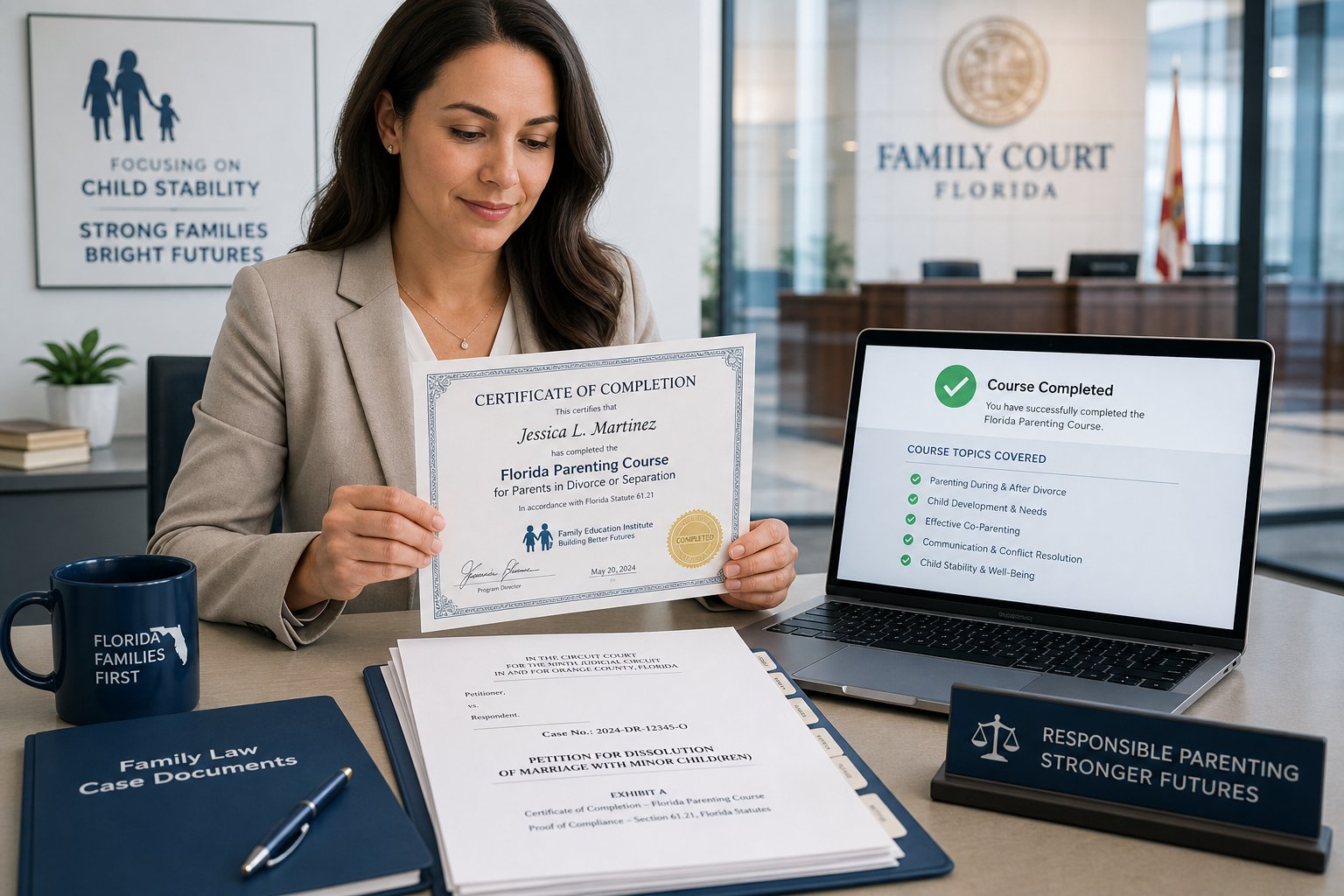
A Florida parenting class certificate is the paper or digital proof that you finished the state-required Parent Education and Family Stabilization Course. The class and the certificate are not the same thing. You take the course first. Then you use the certificate of completion to show the court you met the requirement.
Florida generally requires this course in divorce and some other family law cases that involve minor children. The rule exists because the state wants parents to learn how family change can affect children. The course also covers communication, co-parenting, conflict, and the child’s need for stability.
Under information published by the Florida Department of Children and Families, the course must be at least 4 hours long and must come from an approved provider. You can review program details through the Florida Department of Children and Families. Court materials across Florida also tie the course to decisions involving parental responsibility, time-sharing, and the larger parenting process.
That is why the certificate matters. The court often wants proof before moving forward to final steps in the case. In many counties, the judge may expect both parents to finish the course before a final hearing or final judgment.
So if you are asking where the certificate goes, remember this simple split:
- Taking the course satisfies the education requirement
- Filing the certificate shows the court you satisfied it
- Both steps matter
You can also read the broader family law framework through Florida Courts and the family law statutes in Florida Statutes.
Who Needs A Florida Parenting Class Certificate In Florida Family Law Cases
In Florida, both parents often need the certificate when a family law case involves minor children. That usually includes divorce cases with children. It can also include certain paternity and custody-related matters, depending on the court and case type.
Florida courts commonly require each party to complete the Parent Education and Family Stabilization Course. That means the petitioner and the respondent may both need separate proof of completion. One parent finishing the class does not cover the other parent.
This requirement often appears in cases that affect:
- Parenting plans
- Parental responsibility
- Time-sharing
- Child-related court orders
The safest source is your own court paperwork. Look for language in the summons, standing order, case management order, or local family law instructions. Some counties publish local guidance on their clerk or court website. For county-specific filing information, start with your local Clerk of Court page and the family division of your circuit court.
Florida law and local practice do not always work exactly the same way in every case. A court may handle deadlines, filing steps, or online course acceptance a little differently based on the judge or county.
If you are not sure whether your case needs the certificate, check:
- Your court order
- Your county clerk website
- Your lawyer, if you have one
- The family law self-help materials from Florida Courts
That one check can save you from filing the wrong proof or missing a required step.
How To Know Whether An Online Florida Parenting Class Will Be Accepted
An online class may be accepted in Florida if the provider is approved by the Florida Department of Children and Families, but local court rules still matter. That is the key point. A class being online does not make it invalid by itself. What matters most is whether it is from a DCF-approved provider and whether your court allows that format.
Before you sign up, verify three things:
- The provider says it is DCF-approved for Florida
- The course is the Parent Education and Family Stabilization Course
- Your county court or judge does not require something different
This matters because some Florida courts or local procedures may add their own instructions. A judge may want the certificate filed a certain way. A county may post family law directions on the clerk site. And some courts may be stricter than others about proof.
For example, DivorceParentingClass.net offers a Florida course that states it is DCF-approved and fully online. That can be a practical option if your local court accepts online completion and your case paperwork does not say otherwise.
When you compare providers, look for clear answers about:
- Approval status
- Course length
- How the certificate is issued
- Whether the certificate includes the right Florida course name
- Support if the court asks for more details
Use official sources for the final check. Start with Florida DCF and your county clerk or court website. If the court gave you a written order, follow that order.
What To Expect From The Parent Education And Family Stabilization Course
The Florida course is usually a 4-hour class about how separation and divorce affect parents and children. The goal is not to test your parenting worth. The goal is to give you basic tools and information the court wants parents to have.
Most approved courses cover topics like:
- The effect of divorce or separation on children
- Child development and behavior
- Co-parent communication
- Ways to reduce conflict
- Building and following a parenting plan
- Issues tied to time-sharing and parental responsibility
Some providers include short quizzes during the class. Some also use a final exam. Course format can vary, so read the provider’s details before you enroll.
A good online course should let you move through the lessons in a simple order. It should also make it easy to stop and return later if the provider allows self-paced access. Many parents use a phone, tablet, or computer.
The course does not replace legal advice or a judge’s order. It is a required education step. Your case still depends on your filings, your deadlines, and your court’s decisions.
If you want a Florida-specific online option, you can take the Parent Education and Family Stabilization Course at DivorceParentingClass.net. Read the provider information first, then compare it with your local court instructions.
How Long The Course Takes, When To Finish It, And What Happens If You Miss The Deadline
The course itself is generally at least 4 hours long in Florida. The deadline to finish it is separate. In many Florida family law cases, parents are told to complete the course within about 45 days of filing or service, but your actual deadline depends on your court papers and local practice.
That difference is easy to miss:
- Course length = how many hours the class takes
- Court deadline = when the court wants proof filed
If you are the petitioner, your deadline may run from filing. If you are the respondent, your deadline may run from service. But do not guess. Read your summons, standing order, or case management papers.
Missing the deadline can cause problems. Depending on the court and the facts, a judge may delay hearings, delay final judgment, or raise concerns about compliance in issues involving time-sharing or parental responsibility. Some court materials and providers also warn that noncompliance can lead to contempt issues.
The best way to avoid that is to finish early enough to leave time for filing the certificate with the Clerk of Court or through your lawyer. Completing the course the night before a hearing may not help if the court has not received proof.
Check your deadline now in your case papers and on your county court website.
How You Receive Your Certificate And What To Do After Completion
After you complete the class, the provider usually gives you a certificate of completion. How fast you receive it depends on the provider. Some issue it right away through your account or email. Others may take longer.
Then comes the step many parents ask about: Where do I send the certificate after completing the course? In most Florida cases, you file it with the Clerk of Court in the county where your case is pending, unless your lawyer files it for you or your judge gives different instructions.
That means the next steps are often:
- Download or print your certificate
- Check that your name and course details are correct
- File it with the Clerk of Court, or send it to your lawyer for filing
- Keep a copy for your records
Do not assume the course provider files it for you unless the provider clearly says that service is included. In many cases, the provider’s job is to issue the certificate. Your job is to make sure the court gets the proof in the right way.
Because filing rules vary, confirm whether your county wants e-filing, in-person filing, or another method. Start with your local clerk website and any order in your case. If you use an attorney, ask whether the office wants the certificate sent by portal, email, or upload.
Common Questions About Cost, Devices, Exams, And Taking The Class At Your Own Pace
Most Florida parenting courses charge a fee, but the price is not the only thing to compare. You also want to know if the course is approved, easy to use, and clear about the certificate process.
Here are common questions parents ask:
Can I take the class on my phone?
Often, yes. Many online providers let you use a phone, tablet, or computer. Still, check the provider’s tech page before you start.
Can I work at my own pace?
Many online courses are self-paced. That means you may be able to log out and come back later. Provider rules can differ, so confirm before you enroll.
Is there a test?
Sometimes. Some providers use quizzes during the course. Some have a final exam. The exam format, passing score, and number of attempts depend on the provider.
How much does the certificate cost?
Usually, the certificate is part of the course fee, but not always. Some providers may charge extra for rush handling, printed copies, or shipping.
What should I look for before I pay?
Use this checklist:
- DCF-approved provider status
- Clear Florida course name
- Device compatibility
- Simple certificate access
- Stated support options
If you want a flexible online option, review the Florida course at DivorceParentingClass.net. It offers a DCF-approved online class built for Florida parents who need court-ready proof.
FAQ
Where do I submit my parenting class certificate in Florida?
Generally to the Clerk of Court in your case, or through your attorney. Some counties accept the Florida Courts E-Filing Portal; others have their own filing steps, so check your court papers.
Can I e-file the certificate?
In many Florida counties, yes, through the Florida Courts E-Filing Portal. Whether that’s the right method for your case depends on your county and court, so confirm before filing.
What should the certificate include before I file?
Your correct legal name and, where requested, your case number, so the filing matches your case. Confirm your provider’s certificate has the details your court expects.
What if I’m not sure how to file it?
Check your summons or court order, your county clerk’s website, or your attorney’s instructions. Filing steps vary by county, so your court papers are the most reliable guide.
Conclusion
Submitting the certificate is usually simple, but the exact method depends on your county: some courts want e-filing, others a clerk drop-off or inclusion in your case packet. The reliable approach is to confirm your name and case number are correct, then follow your court’s specific filing instructions. Keep a copy for yourself, and the requirement is handled.
Once you complete the DCF-approved Parent Education and Family Stabilization Course online, you’ll have a certificate ready to file with your court.
Related Articles
- How to Get Your Florida Parenting Class Certificate
- What Information Goes on a Florida Parenting Class Certificate?
- What If the Court Rejects My Parenting Class Certificate?
- Does a Florida Parenting Class Certificate Expire?
Sources
Billy Forte is the founder of Divorce Parenting Class, which offers a Florida DCF-approved online Parent Education and Family Stabilization Course. The brand focuses on clear, supportive, plain-English guidance to help Florida parents complete the court-required class and file their certificate.
This article is general information, not legal advice. Florida family-law requirements and certificate acceptance can vary by court, county, judge, and case type, so review your court papers and official Florida sources, or consult a family-law attorney, before acting.