
Updated June 2026 · Reviewed by Billy Forte
Before you enroll in a court-approved parenting class in Florida, the most important question is whether the provider is DCF-approved and whether your specific court will accept it. Asking about approval, court acceptance, certificate details, and format up front protects you from paying for a course that won’t count, since course approval and your court’s acceptance aren’t always the same thing. This guide lists the key questions to ask before enrolling and explains why each one matters.
Applies to the Florida Parent Education and Family Stabilization Course (Fla. Stat. 61.21). Requirements and acceptance can vary by court, county, judge, and case type, so review your court papers and official Florida sources.
Key Facts
- Is it DCF-approved? The baseline question — only a DCF-approved course satisfies the Florida requirement.
- Will my court accept it? Acceptance can vary by court and county even for approved courses.
- What’s on the certificate? Confirm it shows your name and any case details your court needs.
- How fast is the certificate? Many online courses issue it immediately after completion.
- What’s the format and cost? Confirm online or in-person and the full price before enrolling.
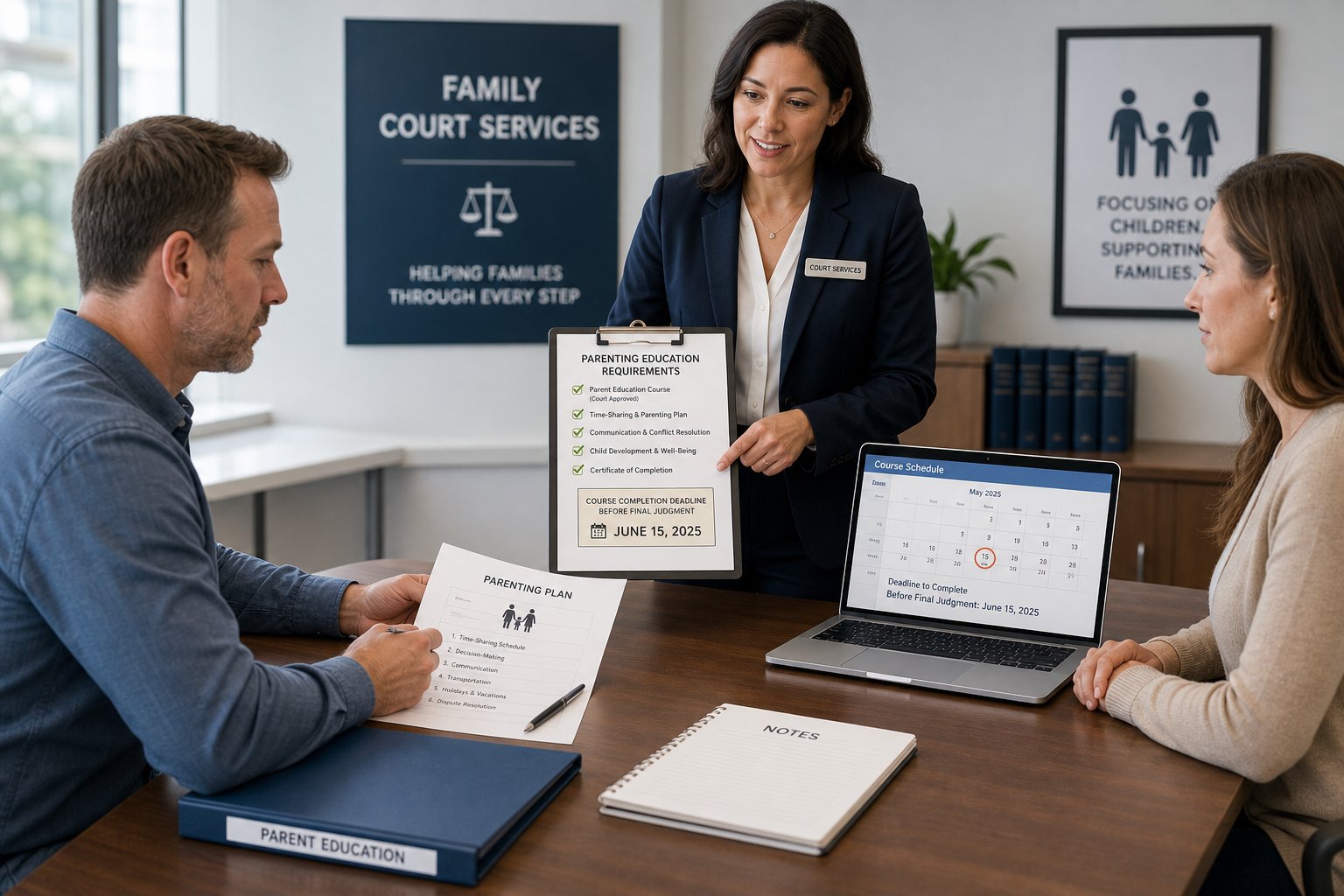
What A Court-Approved Parenting Class Is And When Florida Parents Must Take It
A court-approved parenting class in Florida is usually the Parent Education and Family Stabilization Course. Florida law generally requires this class in certain family cases with minor children. The course must be at least 4 hours long and must be offered by a DCF-approved provider.
The rule most often applies in a dissolution of marriage case when the parents have minor children. It also often applies in paternity actions that involve parental responsibility or time-sharing. In some counties, the court may also order the course in related matters, such as modification cases or high-conflict disputes.
Timing matters. Florida courts often require each parent to complete the course within 45 days of filing or being served. Even when local timing differs, the course usually must be finished before final judgment. If you wait too long, your case can slow down.
Possible results of missing the requirement can include:
- A delayed hearing or delayed final judgment
- A court order to complete the class by a set date
- In some cases, contempt issues or limits tied to pending requests
Because practice can vary, check both state rules and local court instructions. Good starting points are the Florida Courts self-help resources and your county clerk or circuit website.
Who Usually Needs The Parent Education And Family Stabilization Course
Usually, both parents must take the course. That includes the person who filed the case and the person who was served.
You will often need it if your case involves:
- Divorce with minor children
- Paternity with time-sharing issues
- Cases about parenting plans or parental responsibility
If you are not sure, read your court papers closely. Then check your county court or ask the Clerk of Court what your case type requires.
How To Tell Whether An Online Parenting Class Is Approved In Your County
Start with the provider. An online class should be from a DCF-approved provider for Florida’s Parent Education and Family Stabilization Course. If the provider is not on the state list, do not assume the court will accept it.
You can verify approval through the Florida Department of Children and Families. Then check your local court site because some counties or judges may give extra directions about online learning, filing steps, or approved vendors. State approval is important, but local instructions still matter.
Before you pay, confirm these points:
- The provider is DCF-approved for this exact Florida course
- The class meets the 4-hour minimum
- Your county or judge allows the online format
- You will receive a valid certificate of completion
- The provider explains how the certificate is delivered
This is the key answer to what should I verify before buying. Verify provider approval, local court acceptance, and certificate handling first.
For local rules, use your judicial circuit website, county court page, or Clerk of Court site. If the instructions are unclear, ask the clerk how certificates are filed in your county. If you have a lawyer, confirm with that office before enrolling.
A Florida online course from DivorceParentingClass.net may fit if your county accepts the format and you confirm it meets your case needs. The next step is simple: check the provider status and your local court instructions before you enroll.
What The Course Covers, How Long It Takes, And What To Expect
The Florida Parent Education and Family Stabilization Course is built to teach basic co-parenting and child-centered skills. It is not just a box to check. The course gives parents a common set of rules and terms during a hard period.
Florida law sets a minimum of 4 hours. Many programs are self-paced online, so you can stop and restart if the provider allows it. The exact format can vary, but the core subjects are similar across approved programs.
Most courses cover:
- How separation or divorce affects children
- Common child reactions by age and stage
- Parental responsibility and time-sharing
- How to reduce conflict with the other parent
- Better ways to talk with children
- Safety issues, including abuse and domestic violence
- Family court basics and local resources
You may see videos, reading sections, short quizzes, and a final knowledge check. Some courses make you complete each module in order. Others let you move at your own pace.
What should you expect as a student? Expect direct lessons, plain examples, and reminders to focus on the child’s needs. The best programs avoid legal jargon and explain practical issues, such as how to support a child before exchanges or how to keep adult conflict out of parenting decisions.
If your case involves a parenting plan, the course can help you understand why courts value steady routines, calm communication, and child-focused decisions.
How To Register, Complete The Class, And Get Your Certificate
The process is usually simple, but each step matters. First, pick a DCF-approved provider that fits your county’s rules. Then register, pay the fee, complete all required parts, and save your certificate of completion.
A common order looks like this:
- Confirm the provider is approved in Florida.
- Check your county or judge instructions.
- Create an account and enter your case details carefully.
- Finish all modules, quizzes, and any final test.
- Download or receive your certificate.
- File it with the court if your county requires that step.
Be careful with names and case information. Your certificate should match your court records as closely as possible. A simple mismatch can cause filing issues or delays.
Also, do not assume the provider files the certificate for you. Some courts want you to file it with the Clerk of Court. Other programs may give upload or email instructions, but local practice differs.
If you want a Florida course that is online and built for this requirement, DivorceParentingClass.net’s Parent Education and Family Stabilization Course is one option to review after you confirm your local court rules. Keep a copy of your certificate in more than one place, including a downloaded file and a printed copy if possible.
Common Questions About Cost, Acceptance, And Deadlines
Most Florida parenting classes cost far less than a court filing fee, but price should not be your first test. Approval and local acceptance matter more than a low fee. Many Florida courses fall in a common range of about $20 to $50, though fees can vary by provider.
A cheap class is not useful if the court will not accept it. That is why the first thing to verify before buying is still the same: DCF-approved provider status, local court instructions, and certificate process.
Here are the most common questions:
- Will any online class work? No. It should match Florida’s required course and come from a DCF-approved provider. Some local courts may add limits.
- When is it due? Often within 45 days of filing or service, and usually before final judgment.
- Do both parents need it? In many cases, yes.
- What if I wait? Your case may be delayed, and the court may order compliance before moving forward.
- Is statewide approval enough? It helps a lot, but county and judge instructions can still control details.
For deadlines and forms, review the Florida Courts family law forms page and your county clerk website. If cost is a hardship, check whether your local court or provider lists low-income or indigency options. Follow your court deadlines closely.
How Parenting Classes Support Co-Parenting And Children During Separation
The class is required by law in many Florida cases, but it also serves a practical purpose. It helps parents make better choices when stress is high. That can support children during a time that often feels uncertain.
A good course explains how conflict affects children. It also shows ways to lower that conflict. Small changes matter, such as shorter messages, clearer exchange plans, and fewer arguments in front of the child.
The course often supports better co-parenting by teaching you to:
- Focus on the child instead of the adult dispute
- Build or follow a workable parenting plan
- Understand the basics of time-sharing
- Keep communication calm and direct
- Notice signs of stress in children
This matters because Florida family cases often turn on the child’s best interests. Parents who understand routines, emotional needs, and respectful communication are better prepared to meet those needs.
If you need to complete the Florida Parent Education and Family Stabilization Course online, you can review the course options at DivorceParentingClass.net. Make sure the course fits your county instructions, complete it on time, and keep your certificate ready for filing.
FAQ
What should I ask before enrolling in a court-approved parenting class?
Ask whether the provider is DCF-approved, whether your court accepts it, what the certificate includes, how quickly you receive it, and the format and cost. These confirm the class will actually count.
Why isn’t DCF approval enough on its own?
DCF approval is the baseline, but acceptance can still vary by court and county. Confirming your court’s instructions ensures the approved course also satisfies your specific case.
What certificate details should I confirm?
That it shows your legal name and any case information your court requires, so the filing connects to your case without being questioned.
How can I tell a course is legitimate?
Verify the provider against the Florida DCF approved-provider list, and be cautious of courses that can’t clearly show their approval status.
Conclusion
A short list of questions — approval, court acceptance, certificate, speed, format, and cost — is the simplest protection against enrolling in a class that won’t count. Because approval and acceptance aren’t identical, confirming both before you pay is the smart move. Ask first, verify the provider, and you can enroll with confidence that the course satisfies your case.
You can verify and enroll directly in the DCF-approved Parent Education and Family Stabilization Course online.
Related Articles
- Divorce Parenting Class Near Me vs. Online Class in Florida
- Accredited Parenting Courses: What Does Accredited Mean for Florida Divorce?
- Court-Ordered Parenting Class Online: Why State Approval Matters
- Parenting Classes for Court vs. Voluntary Parenting Classes
Sources
Billy Forte is the founder of Divorce Parenting Class, which offers a Florida DCF-approved online Parent Education and Family Stabilization Course. The brand focuses on clear, supportive, plain-English guidance to help Florida parents complete the court-required class and file their certificate.
This article is general information, not legal advice. Florida family-law requirements and certificate acceptance can vary by court, county, judge, and case type, so review your court papers and official Florida sources, or consult a family-law attorney, before acting.