
Updated June 2026 · Reviewed by Billy Forte
The Florida Parent Education and Family Stabilization Course covers how divorce and separation affect children, plus co-parenting, communication, and ways to reduce conflict during a family case. The required curriculum centers on the children’s well-being and on giving parents practical tools for the transition. This guide walks through the main topics you can expect and why Florida requires them.
Applies to the Florida Parent Education and Family Stabilization Course (Fla. Stat. 61.21). Requirements and acceptance can vary by court, county, judge, and case type, so review your court papers and official Florida sources.
Key Facts
- Children first: How divorce and separation affect children emotionally and developmentally.
- Co-parenting: Building a workable co-parenting relationship after separation.
- Communication: Reducing conflict and communicating effectively with the other parent.
- Practical tools: Strategies for stability, routines, and supporting children through change.
- Four-hour, DCF-approved: The topics are delivered in the minimum four-hour DCF-approved course.
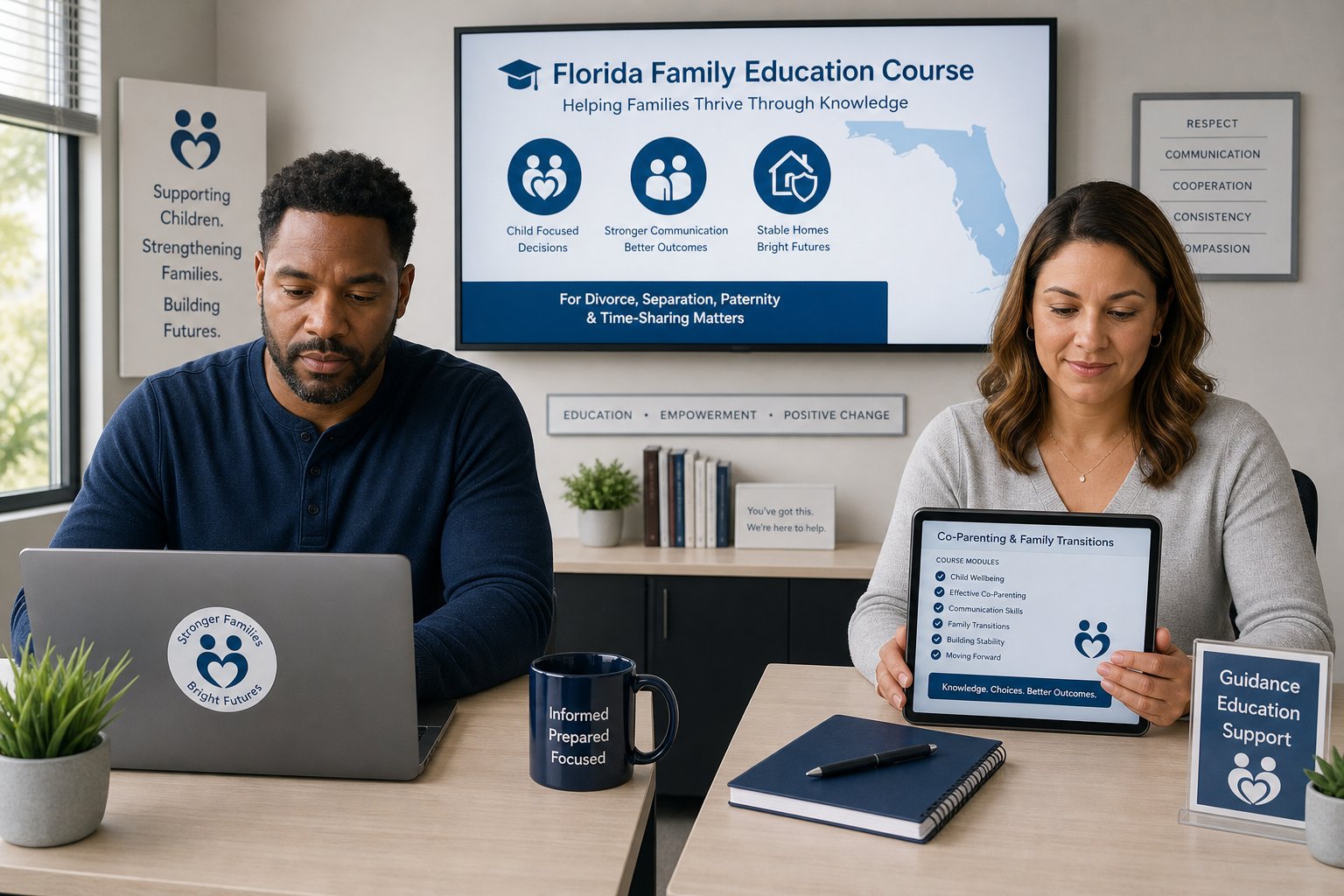
What The Parent Education And Family Stabilization Course Is
The Parent Education and Family Stabilization Course is a court-related class for Florida parents with minor children in certain family law cases. Its purpose is simple: help parents understand how family change affects children and how to reduce harm during divorce, separation, paternity, or time-sharing disputes.
Florida law describes the course as education and training for divorcing parents about the impact of divorce on both parents and children. The legal basis is Florida Statutes section 61.21. The state approves providers through the Florida Department of Children and Families.
A few points matter most:
- The course is not the same as legal advice
- The course is meant to support better parenting decisions
- The course focuses on children’s needs during family change
- The provider should be a DCF-approved provider or otherwise accepted by your court
Many parents call it a Florida divorce parenting class. That is common language, but the course can also apply in cases beyond divorce. The exact rule can depend on your court, county, judge, and case type.
If you want a flexible option, DivorceParentingClass.net offers a Florida Parent Education and Family Stabilization Course online through a DCF-approved format described on the site. That can help if you need to complete the class on your own schedule.
Who Must Take The Course In Florida Family Law Cases
In Florida, both parents usually must take the course when they have minor children and are involved in a divorce. The requirement often also applies in some paternity, parental responsibility, and time-sharing cases.
Florida Courts and local court materials often state that the filing parent must complete the course within 45 days after filing, and the other parent within 45 days after service of process or acknowledgment. Still, local practice can vary. Always read your court papers and county instructions.
This usually matters in cases involving:
- Divorce with minor children
- Some paternity actions
- Cases involving time-sharing
- Cases involving parental responsibility
The best source for your exact next step is usually a mix of:
- Your court order
- Your county Clerk of Court website
- Your judicial circuit family court page
- The provider rules for filing your certificate of completion
For statewide court information, start with Florida Courts. You can also check your local clerk’s website for filing instructions.
Because local rules differ, do not assume that one county handles filing the same way as another county. Check your own county before you submit anything.
What The Course Covers For Parents And Children
The course covers the main topics Florida parents ask about: how children react to divorce or separation, how parents can lower conflict, and how to support a stable parenting plan. The goal is practical education, not punishment.
Most approved courses include lessons on:
- The emotional, social, and physical effects of divorce on children
- How children understand family change at different ages
- Ways to talk with children without adding stress
- Co-parenting skills and conflict reduction
- Time-sharing transitions between homes
- Shared parental responsibility and related family terms
- Domestic violence, child abuse, and safety concerns
- Community resources and support services
A strong class explains that children often need routine, calm communication, and less exposure to adult conflict. It may also show how common parent behaviors affect children after separation. For example, arguing during exchanges, using children to send messages, or discussing court fights in front of them can raise stress.
Some courses also explain basic court-related terms in plain language. That may include parenting plan, parental responsibility, and time-sharing. These lessons do not replace a lawyer, but they can help you understand the family changes your child is living through.
This is the heart of what topics are covered: the child’s experience, the parent’s role, and the skills that support a more stable home in two households.
Online Vs Local Options: How To Choose A Court-Accepted Format
Florida parents often can choose between an online course and a local in-person class. The right option is the one your court accepts and that you can complete on time.
Online classes work well for many parents because they are self-paced and easier to fit around work, school, and child care. A local class may feel better if you prefer face-to-face instruction. Either way, the key issue is approval.
Check these points before you register:
- Is the provider on a DCF-approved list or clearly accepted by your court?
- Does the course meet Florida’s 4-hour minimum?
- Will you receive a certificate of completion?
- Are there clear filing or submission instructions?
- Does your county or judge have extra rules?
You can review provider and family support information through the Florida Department of Children and Families. You can also confirm local instructions through your county court or clerk.
If you want a fully online option, DivorceParentingClass.net provides a Florida course you can take by phone, tablet, or computer. Before you enroll, match the course with your local court instructions so your format, certificate, and deadline all line up.
Course Length, Certificate, And When To Complete It
In Florida, the Parent Education and Family Stabilization Course is generally at least 4 hours long. That is the basic time requirement tied to approved course standards.
Some providers divide the class into short modules. Some also include a quiz or final exam. Not every provider uses the same setup, so read the provider details before you begin.
After you finish, you should receive a certificate of completion. This certificate is important because the court may require you to file it with the Clerk of Court or submit it in another way listed by your county or judge.
Keep these timing points in mind:
- Complete the course as early as you can
- Watch for deadlines in your case papers
- Save a digital copy of your certificate
- Print a copy if your court uses paper filing
- Confirm whether the clerk, court, or lawyer must receive it
Many delays happen for simple reasons, like waiting too long, using the wrong provider, or not following local filing rules. Early completion gives you more time to fix any issue before a hearing or final judgment.
If you are ready to act, you can take the Florida Parent Education and Family Stabilization Course online at DivorceParentingClass.net.
What Happens If You Do Not Complete The Required Course
If the course is required in your case and you do not complete it, the court can treat that as noncompliance. That can create serious problems in a Florida family law case.
Local court materials commonly warn that failure to complete the course may lead to contempt of court. In some cases, it may also affect the court’s handling of time-sharing or shared parental responsibility issues. The exact result depends on the court, county, judge, and case facts.
Problems can include:
- Delays in moving the case forward
- Extra hearings or compliance steps
- Court sanctions
- Trouble before final judgment
- Risks related to parenting issues the court is deciding
That does not mean every case is handled the same way. It means the requirement matters, and ignoring it can make a hard process harder.
The safest approach is to read your court order, follow your deadline, use a DCF-approved provider, and keep your certificate of completion ready. If you are unsure about local filing steps, check your county Clerk of Court or court website rather than guessing.
How To Make The Most Of The Class During Divorce Or Separation
The class helps most when you use the ideas right away. Even though the course is required, it can still give you practical tools for daily parenting.
Start with the lessons on children’s needs. Those sections often explain how children react by age, why routine matters, and how conflict between parents can spill over onto school, sleep, and behavior. That information can help you make better choices during exchanges, calls, and schedule changes.
Try to focus on a few habits:
- Keep messages brief and calm
- Do not ask children to carry adult messages
- Avoid conflict in front of the children
- Follow the parenting plan as closely as possible
- Use transitions between homes in a steady, predictable way
Resource lists in the course can help too. Some classes point parents to court resources, support services, and child-focused tools. You can also review family information from Florida Courts if your case raises process questions.
FAQ
What topics does the Florida parenting course cover?
It covers how divorce affects children, co-parenting, communication, and reducing conflict, with practical tools for supporting children through the transition. The focus is the children’s well-being.
Is the course about my specific case?
Does every provider cover the same topics?
DCF-approved providers cover the required core topics, though presentation and examples vary. The required educational content is consistent because the course is approved to Florida’s standard.
Will the course help with co-parenting after the case?
That’s a core goal. Much of the material focuses on communication and reducing conflict, which are useful well beyond the court process.
Conclusion
At its heart, the course is about your children and giving you tools to help them through a hard change, with topics spanning child well-being, co-parenting, and communication. Knowing the subject matter ahead of time makes the four hours feel purposeful rather than procedural. Complete a DCF-approved course and you’ll meet the requirement while picking up skills that outlast the case.
You can complete the DCF-approved Parent Education and Family Stabilization Course online and cover all the required topics.
Related Articles
- How Long Is the Florida Parenting Class for Divorce?
- Are There Quizzes in the Florida Parent Education Course?
- How to Finish a Florida Parenting Class Quickly Without Missing Requirements
- Can You Fail the Florida Parenting Class? Retakes and Passing Score
Sources
Billy Forte is the founder of Divorce Parenting Class, which offers a Florida DCF-approved online Parent Education and Family Stabilization Course. The brand focuses on clear, supportive, plain-English guidance to help Florida parents complete the court-required class and file their certificate.
This article is general information, not legal advice. Florida family-law requirements and certificate acceptance can vary by court, county, judge, and case type, so review your court papers and official Florida sources, or consult a family-law attorney, before acting.