
Updated June 2026 · Reviewed by Billy Forte
If a Florida court rejects your parenting class certificate, it’s usually fixable, and the common causes are a provider that wasn’t DCF-approved, mismatched name or case information, or a local filing step that wasn’t followed. Course approval and filing acceptance are related but not identical, so a certificate can be valid yet still need a correction to be accepted. This guide covers the common reasons a certificate is rejected and the practical steps to resolve each one.
Applies to the Florida Parent Education and Family Stabilization Course (Fla. Stat. 61.21). Requirements and acceptance can vary by court, county, judge, and case type, so review your court papers and official Florida sources.
Key Facts
- Check DCF approval: Make sure the provider was DCF-approved; an unapproved course is a common rejection reason.
- Match your case: Confirm your name and case number match your court papers exactly.
- Follow local steps: Some rejections come from missing a county-specific filing step, not a bad certificate.
- Approval vs acceptance: A course can be approved yet still need a filing correction to be accepted.
- Ask the clerk: If you’re unsure why it was rejected, the Clerk of Court can usually point to the issue.
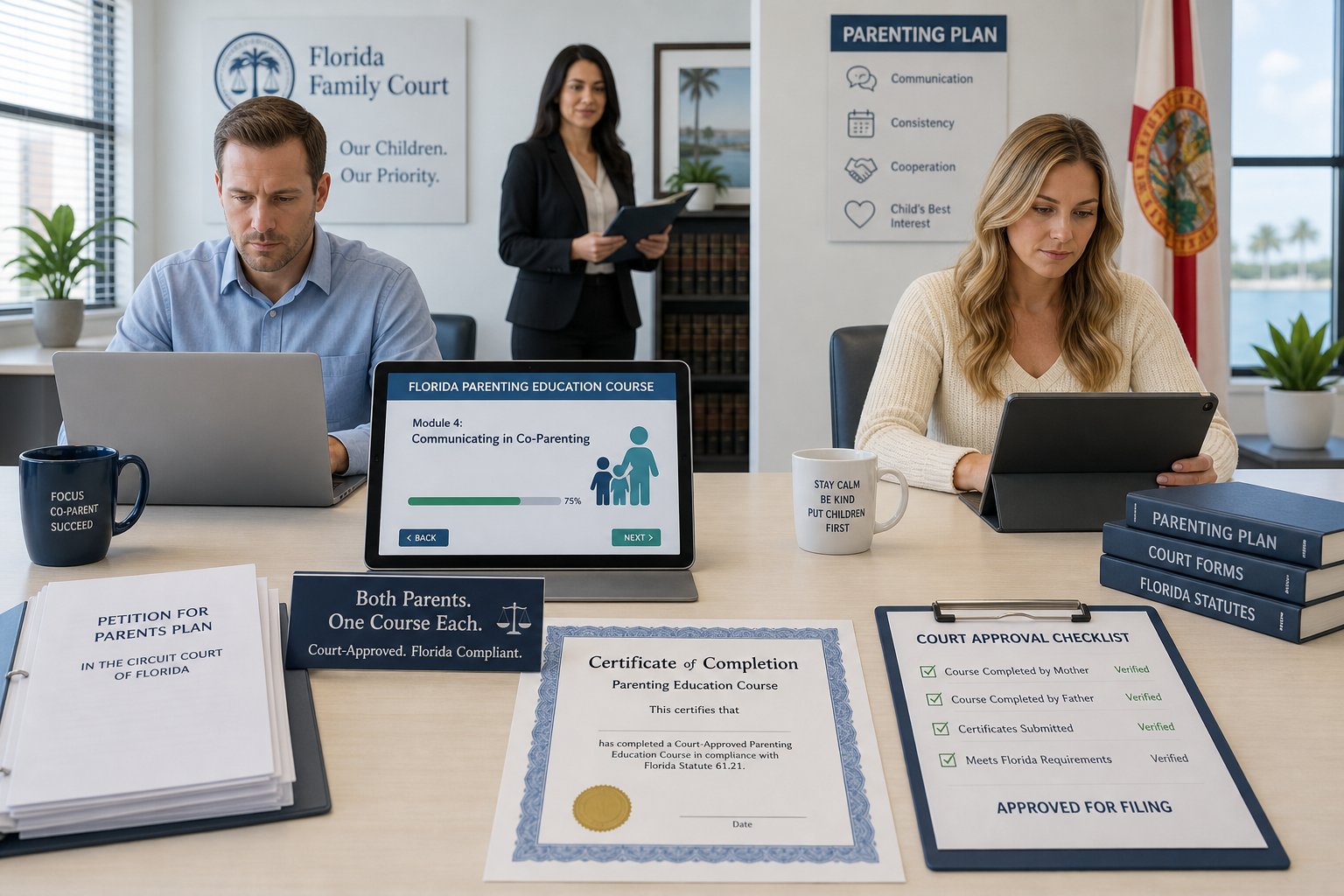
Who Must Take A Court-Approved Parenting Class In Florida
Florida uses a specific name for the class most parents mean when they search for court approved parenting classes Florida: the Parent Education and Family Stabilization Course. In general, Florida law requires this course in a dissolution of marriage case with minor children. It also often applies in paternity cases that involve parental responsibility or time-sharing.
That means both sides usually need to pay attention. If you are the petitioner, you may need to complete the course soon after filing. If you are the respondent, your deadline may start when you are served. And in many cases, both parents must take the class separately. One parent cannot attend for both, and one certificate does not cover both parties.
The rule comes from Florida law and court practice, but local handling can still vary. Some courts are strict about timing. Some may have their own filing instructions. So before you buy a class, confirm three things:
- Your case type requires the course
- Your provider is approved by the Florida Department of Children and Families
- Your county or judge accepts the format you chose, especially if it is online
A good first stop is the Florida statute on parent education and family stabilization, section 61.21. You can also review Florida court resources through Florida Courts.
If your case involves children but you are not sure whether the class applies, check your court papers, ask your attorney if you have one, or review your local family court instructions before you enroll.
What The Parent Education And Family Stabilization Course Covers
This course is not just a box to check. A Florida Parent Education and Family Stabilization Course is meant to help parents reduce conflict and make better choices for children during a family law case.
The Florida Department of Children and Families approves providers for this course. Under state rules, the class is at least 4 hours long. It focuses on how separation, divorce, and conflict can affect children and parents.
Most approved courses cover topics like these:
- How family conflict affects children at different ages
- Co-parenting and communication skills
- Time-sharing and parenting plans
- Problem solving and conflict control
- How to support a child during family change
- Parental responsibility and healthy decision-making
That matters because the course and the certificate serve different purposes. Completing the course means you finished the required class content. Submitting proof means you gave the court the certificate in the way your court requires. A parent can finish the class and still have a problem if the certificate is not filed correctly.
You can review approved course information through the Florida Department of Children and Families. If your case is active, also look for local family law instructions on your circuit court or Clerk of Court website. Those local pages often explain whether you must e-file, mail, upload, or hand-deliver your certificate of completion.
How To Choose A Florida DCF-Approved Online Or Local Class
The safest choice is a DCF-approved provider that clearly offers the Florida Parent Education and Family Stabilization Course. Do not assume a general parenting class, co-parenting seminar, or out-of-state course will work.
Before you pay, check the provider against the Florida DCF approval list and read the course description closely. You want the exact Florida course, not something that only sounds similar.
Use this checklist before buying:
- Confirm the provider is DCF-approved
- Make sure the course is for Florida, not another state
- Check that it is the Parent Education and Family Stabilization Course
- Verify the class length is at least 4 hours
- See whether your local court allows online classes
- Review how the certificate is issued
- Read whether you must print, download, or file it yourself
For many parents, an online class is easier because it can be done from a phone, tablet, or computer. DivorceParentingClass.net offers a Florida DCF-approved online course designed for this requirement. But even with an approved provider, you should still confirm any local filing rule from your county court.
That point is easy to miss. Approval of the course and acceptance of your filing are related, but they are not identical. A course may be approved, yet your certificate can still be rejected if the wrong person files it, if pages are missing, or if your court wants a different submission method.
Check your county court or clerk website before you enroll. That simple step can prevent trouble later.
Will Your Certificate Be Accepted By Florida Courts
Usually, a certificate from a DCF-approved provider is the right starting point. But court acceptance can still depend on local rules, your case details, and whether you filed the proof the right way.
Here is the key point: finishing the class is not the same as filing the certificate. Many parents complete the course and think the provider sends everything to the court automatically. Sometimes that is not how it works. In many cases, you must file the certificate of completion with the Clerk of Court yourself or give it to your attorney for filing.
If the court rejects your parenting class certificate, check these common issues first:
- The provider was not on the Florida DCF-approved list
- The course was for the wrong state
- The class was not the Parent Education and Family Stabilization Course
- The certificate name did not match the court case name
- The filing was incomplete, late, or sent to the wrong office
- Your county or judge had a separate rule about online classes or proof
Florida courts generally accept certificates from approved providers, but local practice still matters. Review your circuit court page and your Clerk of Court page for filing instructions. If needed, contact the clerk to ask what was missing and what to submit next. Then correct the problem fast so your case can keep moving.
When To Take The Class And What Happens If You Miss The Deadline
In many Florida family cases, you should not wait. Courts often expect the course to be completed early in the case, and missing the deadline can create delays.
Under Florida practice, many circuits use a 45-day window:
- Petitioner: often within 45 days after filing
- Respondent: often within 45 days after service
Those dates are common, but you still need to read your court order, local rules, and any notices in your case. Some judges may set a different deadline. The safest move is to take the class as soon as you know it applies.
If you miss the deadline, the court may respond in more than one way. Depending on the case and the judge, the court may:
- Delay the final judgment
- Require proof before moving forward
- Hold a parent in contempt
- Treat the missed class as a problem in issues tied to compliance
In cases involving time-sharing or parental responsibility, courts want to see that parents followed required steps. That does not mean every missed deadline leads to the same result, but it can slow your case and create extra stress.
So if your deadline is close, do not guess. Check your order, confirm the class is approved, finish it, and make sure the certificate gets filed in the correct place.
How Course Completion Works From Registration To Certificate
Most Florida courses follow a simple path. You register, complete at least 4 hours of approved content, finish any required quizzes or exam, and then receive a certificate of completion.
In many online programs, you can work in parts instead of one sitting. That helps if you are balancing work, school pickups, or court deadlines. But keep your login details and use your legal name so the certificate matches your case records.
The usual steps look like this:
- Register with a Florida DCF-approved provider.
- Confirm the course matches your case and local court rules.
- Complete the required course time and lessons.
- Pass any quiz or final exam if the provider requires one.
- Download or receive your certificate.
- File the certificate with the Clerk of Court, or give it to your attorney if they handle filing.
That last step matters most. Some parents think the provider files the form for them. Some providers may offer help or instructions, but you must know your own court process. Keep a copy of the certificate and any filing confirmation.
If you still need a Florida course, DivorceParentingClass.net offers a Florida Parent Education and Family Stabilization Course online. You can review the program and start the class at DivorceParentingClass.net.
Common Questions About Cost, Length, Exams, And Whether Both Parents Must Attend
Most Florida parents ask the same basic questions first: how much, how long, is there a test, and do both parents need their own class? The short answer is that the course is usually 4 hours minimum, the price varies by provider, many courses include quizzes or an exam, and each parent usually must complete it separately.
Here are the basics:
- Cost: Online courses may start around $19.95 to $25, while some charge more than $60
- Length: Florida requires a minimum 4-hour course
- Exams: Some providers use quizzes, and some require a final exam
- Both parents: Yes, in most cases each parent must take the course and get their own certificate
A lower price does not help if the provider is not approved. A quick class is not enough if it does not meet the Florida standard. And one parent cannot file one shared certificate for both parties.
If you are comparing options, focus on these points first:
- DCF approval status
- Florida-specific course title
- Certificate format
- Local court acceptance rules
- Clear filing instructions
If you want a flexible online option, you can review the Florida course offered by DivorceParentingClass.net. It is built for Florida parents who need the Parent Education and Family Stabilization Course and want a clear path from registration to certificate.
FAQ
Why would a Florida court reject my parenting class certificate?
Common reasons include a provider that wasn’t DCF-approved, a name or case number that doesn’t match your case, or a missed local filing step. Many rejections are correctable once you identify the cause.
Is a rejected certificate the same as a bad course?
Not necessarily. Course approval and filing acceptance are related but separate. A valid certificate can still be rejected over a filing detail, so check the specific reason before assuming you need to retake the course.
How do I fix a rejected certificate?
Identify the reason — approval, matching details, or filing method — and correct it. If it’s a detail or filing-step issue, you may just need to refile correctly; the Clerk of Court can often clarify.
Who can tell me why it was rejected?
The Clerk of Court or your attorney can usually explain the specific issue. Reviewing your circuit court’s instructions also helps you spot a local filing requirement you may have missed.
Conclusion
A rejected certificate is more often a fixable detail than a dead end: confirm the provider was DCF-approved, make sure your name and case information match, and follow your county’s filing steps. Because course approval and filing acceptance aren’t the same thing, pinpoint the actual reason before retaking anything. The Clerk of Court is usually the fastest way to find and fix the issue.
To be sure your course is recognized statewide, complete the DCF-approved Parent Education and Family Stabilization Course online and keep your certificate for filing.
Related Articles
- How to Submit Your Parenting Class Certificate to a Florida Court
- What Information Goes on a Florida Parenting Class Certificate?
- How to Get Your Florida Parenting Class Certificate
- Does a Florida Parenting Class Certificate Expire?
Sources
Billy Forte is the founder of Divorce Parenting Class, which offers a Florida DCF-approved online Parent Education and Family Stabilization Course. The brand focuses on clear, supportive, plain-English guidance to help Florida parents complete the court-required class and file their certificate.
This article is general information, not legal advice. Florida family-law requirements and certificate acceptance can vary by court, county, judge, and case type, so review your court papers and official Florida sources, or consult a family-law attorney, before acting.