
Updated June 2026 · Reviewed by Billy Forte
The Florida parent education course requirement can only be waived by a judge, and only for good cause — it isn’t automatic, and no provider or agreement between parents can waive it. Florida law lets the court excuse a party in limited circumstances, but you’d generally need to follow court procedure and show a valid reason. This guide explains who can waive the requirement, when, and how to request it properly.
Applies to the Florida Parent Education and Family Stabilization Course (Fla. Stat. 61.21). Requirements and acceptance can vary by court, county, judge, and case type, so review your court papers and official Florida sources.
Key Facts
- Judge only: Only the court can excuse the requirement — a provider cannot waive it.
- Good cause required: A judge may excuse a party for good cause; it isn’t granted automatically.
- Not by agreement: Parents can’t waive the requirement by agreeing between themselves.
- Follow procedure: Requesting an exemption generally means following court procedure and showing your reason.
- Default is required: Unless the court excuses you, the course remains required before final judgment.
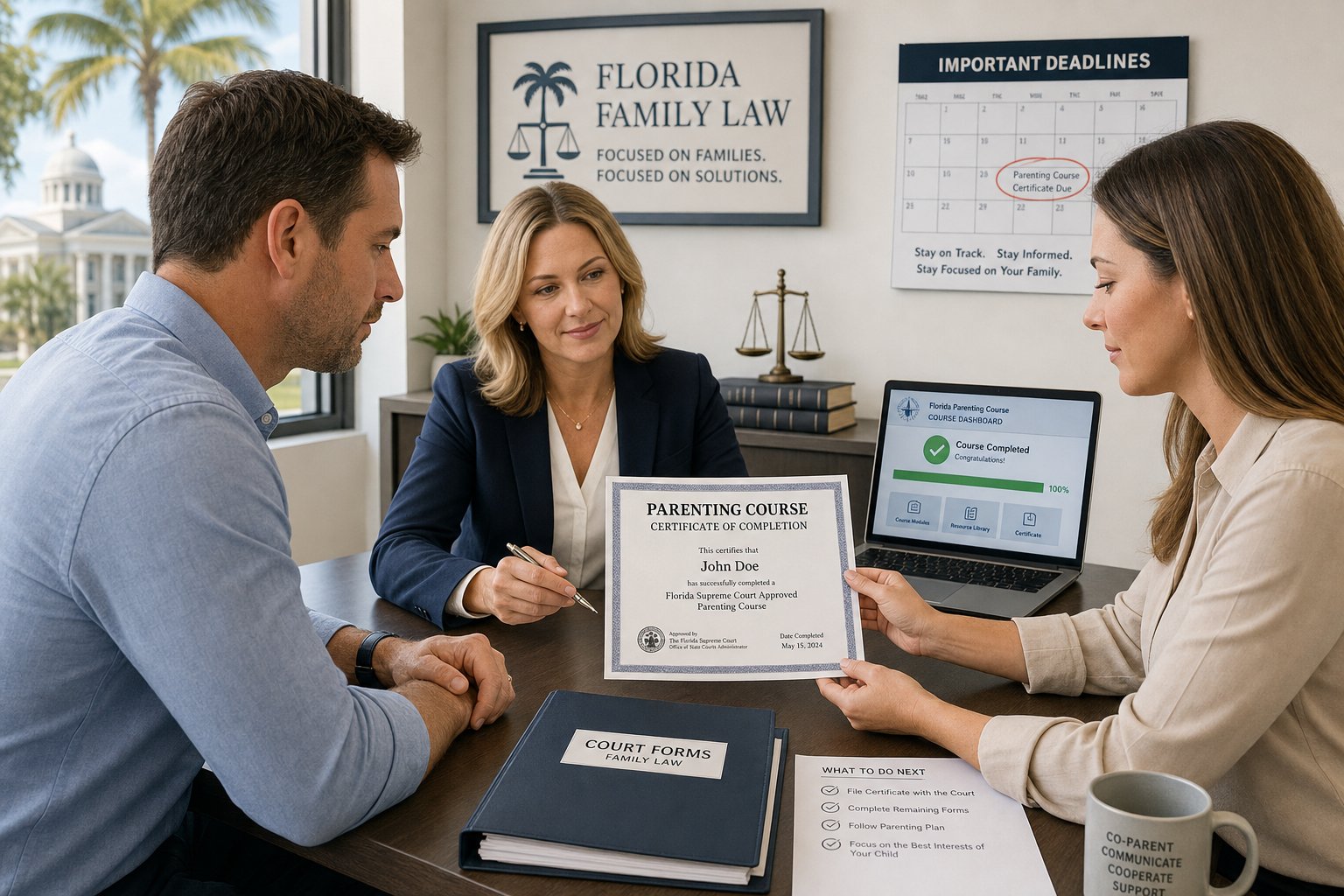
What The Florida Parenting Class Requirement Is
Florida has a parenting class rule for many family law cases with minor children. The course is called the Parent Education and Family Stabilization Course. Under Florida Statute 61.21, the state requires a course of at least 4 hours that is approved by the Florida Department of Children and Families.
The goal is simple. The class helps parents understand how separation, divorce, and family conflict can affect children. It also teaches basic co-parenting skills, communication, and child-focused decision making.
This is not just a general life-skills class. It is a specific Florida course tied to family court cases. In many counties, the court expects each parent to file a certificate of completion with the Clerk of Court or follow local filing instructions.
A key point matters here: the course requirement is usually mandatory unless the court excuses it. That means a provider cannot waive it. The Clerk cannot waive it. Even if both parents agree, that does not automatically remove the requirement. Only the judge can excuse or waive it for good cause, based on the law and the facts in your case.
Because local practice can differ, you should also review your circuit court or county family court instructions. Florida law sets the base rule, but courts may have their own forms, deadlines, or filing steps.
Who Must Complete The Course In Florida Family Cases
In Florida, both parties usually must complete the course in a dissolution of marriage case that involves minor children. That means the rule often applies to both the petitioner and the respondent.
The requirement also commonly applies in paternity actions when the case involves issues like:
- Parental responsibility
- Time-sharing
- Child support connected to parenting issues
- A parenting plan for a minor child
This is why many parents hear about the class early in the case. If your court must decide where a child will live, how parents will share time, or how they will make decisions, the course is often part of the process.
Still, not every family case works the same way. Requirements can depend on the court, county, judge, and case type. Some local courts publish family law packets or standing orders that explain who must complete the course and when.
And this brings us back to the waiver question. Can a judge waive the course requirement? Yes, but only the court can do so for good cause. Florida law allows the court to excuse a party. That does not mean waivers are automatic, common, or informal. If you want the requirement excused, you need to follow court procedure and provide support for your request from official records or other proof.
When To Take The Class And What Happens If You Do Not
In many Florida courts, timing matters a lot. A common rule is that the petitioner must finish the class within 45 days after filing, and the respondent must finish within 45 days after service. Local orders may state the exact deadline, so you need to read your court papers closely.
If you do not complete the course on time, the case may slow down. Courts often will not enter a final judgment until both parents complete the course, unless the judge has excused a party. That can delay orders affecting divorce, paternity, a parenting plan, or time-sharing.
In some cases, failure to complete the class can also lead to stronger court action. Depending on the court and facts, that may include:
- A hearing about noncompliance
- A finding of contempt of court
- Delay of final relief
- Possible effects on time-sharing or shared parental responsibility decisions
So what should you do if you think you cannot finish by the deadline? Do not ignore the order. Check your local court rules, keep track of all dates, and act early. If you believe there is a real reason the requirement should be excused, gather documents that support your position and ask the court for instructions.
If you are able to take the course, finishing it early is often the safest step.
What The Parent Education And Family Stabilization Course Covers
The Florida course covers more than one topic. State law says the class should help parents understand the effects of separation and divorce on both adults and children. It also covers practical parts of co-parenting after a case begins or ends.
Topics commonly include:
- The effect of divorce or separation on children
- The emotional impact on parents and children
- Child-related legal decisions
- Family relationships and changing family roles
- Financial duties that affect children
- Abuse, neglect, and safety concerns
- Issues involving children with special needs
- Communication and co-parenting skills
That mix matters because Florida courts want parents to focus on the child, not just the court fight. A good course helps you think about routines, conflict, school issues, and how children react when parents argue or stop communicating well.
The class is educational, not therapy. It does not decide your case. It does not replace legal advice. But it can help you understand the basics behind a parenting plan, child-centered communication, and the kind of behavior courts often expect from parents who share parental responsibility.
If you choose an online provider, make sure it clearly states that the class is the Florida Parent Education and Family Stabilization Course and that it meets the 4-hour minimum set by state law.
How To Choose A Florida-Approved Online Parenting Class
The first thing to check is DCF approval. A provider should be approved by the Florida Department of Children and Families for this specific course. You can review provider information through Florida DCF.
Next, check whether your local court accepts the online format. DCF approval is important, but some counties or circuits may have extra rules, approved lists, or local preferences. You can confirm details through your circuit court, family division, or Clerk of Court.
When comparing providers, look for these basics:
- The course is labeled for Florida
- It is a DCF-approved provider
- It meets the 4-hour minimum
- It provides a certificate of completion
- It explains device access and support clearly
For many parents, online learning is the easiest path. DivorceParentingClass.net offers a Florida Parent Education and Family Stabilization Course online with mobile access and a completion certificate. Even so, you should still follow any local court instructions about filing or acceptance.
Before you enroll, review the provider page, then confirm your county’s rules if anything seems unclear. That small check can prevent problems later.
Court Approval, Certificates, And County Acceptance
A lot of parents mix up state approval and court acceptance. They are related, but they are not the same thing. A course may be approved by DCF, yet your local court may still have filing rules, preferred providers, or format rules you need to follow.
That is why you should verify both points:
- Is the provider approved by Florida DCF?
- Does your county or judge accept that provider or online format?
Some courts publish lists of accepted or court-certified programs. For example, some family divisions provide local instructions on county court or clerk websites. Helpful places to check include Florida Courts, your county clerk, and your local circuit court family law page.
After you finish the class, you usually receive a certificate of completion. Then you must follow local directions for filing it. In some places, you may file with the Clerk of Court. In others, your lawyer may upload it, or the court may require a different process.
If you are asking whether a judge can waive the requirement, remember this rule: only the court can excuse it for good cause. A certificate proves completion. It does not replace a waiver order, and a provider cannot issue one.
What To Expect From Course Length, Format, And Completion
Florida law sets the minimum course length at 4 hours. Many online programs meet that minimum and let you work at your own pace. That means you can often start, stop, and return later on a phone, tablet, or computer.
Most courses use short modules. These may include reading, videos, simple review questions, or quizzes. Some providers also use a final test. Exact format can differ, so read the provider details before you sign up.
Common features include:
- Self-paced access
- Multiple sections or modules
- Progress saved between sessions
- Downloadable or instant certificates after completion
- Help or customer support if you have account issues
If your main goal is to comply fast and correctly, choose a course that is clearly built for Florida cases. DivorceParentingClass.net offers an online Florida course designed for parents in divorce and related family cases, with a certificate issued after completion. You should still confirm any county-specific instructions before filing your proof with the court.
If you need to complete the Florida Parent Education and Family Stabilization Course online, you can review the course options at DivorceParentingClass.net.
FAQ
Can the Florida parent education course be waived?
Only a judge can excuse it, and only for good cause. It isn’t automatic, a provider can’t waive it, and parents can’t waive it by agreement. Unless the court excuses you, the course remains required.
How do I request a waiver?
Generally by following your court’s procedure and providing a valid reason for the request. Documentation supporting your position helps, and the decision rests entirely with the judge.
What counts as good cause?
That’s for the court to decide based on your circumstances. There’s no automatic category, so if you believe an exception applies, present your reasons to the judge through the proper procedure.
What happens if a waiver isn’t granted?
The course remains required, and the case generally can’t be finalized until you complete it. If you’re unsure, complete the DCF-approved course to avoid delaying your case while you wait.
Conclusion
Waivers exist but are narrow: only a judge grants them, only for good cause, and never automatically or by the parents’ agreement. If you think your situation qualifies, follow your court’s procedure and make the request properly. Otherwise, the safest path is to complete the DCF-approved course so an unresolved waiver request doesn’t stall your case.
If you can’t count on a waiver, you can complete the DCF-approved Parent Education and Family Stabilization Course online and keep your case moving.
Related Articles
- What Happens If You Do Not Complete the Florida Parenting Class?
- Florida Divorce Parenting Class Requirement: Who Has to Take It and When
- Is the Florida Parenting Class Required for an Uncontested Divorce?
- Do Parents Still Need the Florida Parenting Class If They Agree on Everything?
Sources
Billy Forte is the founder of Divorce Parenting Class, which offers a Florida DCF-approved online Parent Education and Family Stabilization Course. The brand focuses on clear, supportive, plain-English guidance to help Florida parents complete the court-required class and file their certificate.
This article is general information, not legal advice. Florida family-law requirements and certificate acceptance can vary by court, county, judge, and case type, so review your court papers and official Florida sources, or consult a family-law attorney, before acting.