
Updated June 2026 · Reviewed by Billy Forte
The Florida parenting class applies to more than divorce: parents in many paternity, custody, and time-sharing cases involving minor children are also commonly required to complete the Parent Education and Family Stabilization Course. The requirement under Florida Statute 61.21 centers on cases affecting minor children, not solely on divorce. This guide explains how the course applies across these case types and who is typically required to take it.
Applies to the Florida Parent Education and Family Stabilization Course (Fla. Stat. 61.21). Requirements and acceptance can vary by court, county, judge, and case type, so review your court papers and official Florida sources.
Key Facts
- Not just divorce: Paternity, custody, and time-sharing cases with minor children commonly require it.
- Focus on the children: The requirement applies because the case affects minor children.
- Both parents: Each parent generally completes the course separately and files a certificate.
- Same course: It’s the same DCF-approved Parent Education and Family Stabilization Course.
- Confirm your case: Whether it applies can depend on your case type and court — check your papers.
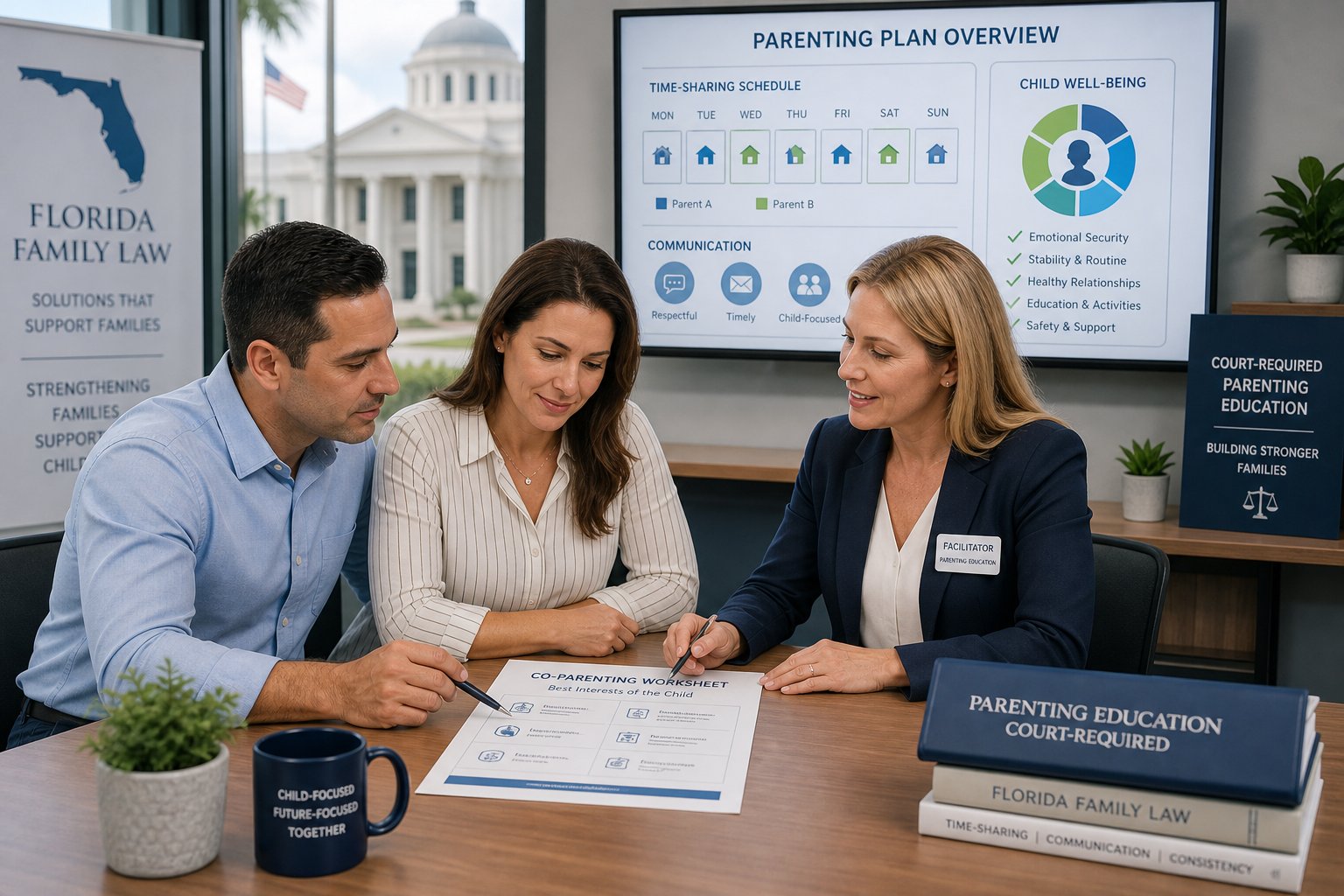
What The Florida Parenting Class Is And Why Courts Require It
The Florida parenting class is the state’s Parent Education and Family Stabilization Course. In most cases, it is a minimum 4-hour course approved by the Florida Department of Children and Families.
Florida courts use this course to help parents reduce harm to children during family changes. The point is not to punish you. The point is to teach skills that support children while parents deal with divorce, separation, paternity, and parenting disputes.
Under Florida Statutes section 61.21, courts generally require the course in cases involving minor children and a divorce or paternity action. The law says the course should educate, train, and assist parents about the effects of conflict and family change on children and on parents.
That matters because Florida courts focus on the best interests of the child. A court may expect parents to understand:
- how conflict affects children
- how to build a workable parenting plan
- how parental responsibility works
- how time-sharing decisions affect daily life
- how to communicate without making things worse
The class is also practical. It gives common rules for co-parenting conduct, stress control, and child-focused decision-making. If your case involves minor children, the course may be one of the first court requirements you need to handle.
Who Needs To Take The Parent Education And Family Stabilization Course
In Florida, all parties usually must take the course in a divorce case with minor children. The same is often true in a paternity case that includes parental responsibility or time-sharing issues.
So, the answer to the main question is simple: it is not just for divorce. It can also apply when parents were never married but need the court to decide a parenting plan, parental responsibility, child-related issues, or time-sharing.
Common case types where the course may be required include:
- dissolution of marriage with minor children
- paternity actions involving child-related orders
- some custody or time-sharing disputes tied to family court orders
Still, local practice matters. A court in one county may give very clear filing instructions. Another may address the course in a case management order. Some judges are strict about timing and proof of completion.
Because of that, check three places:
- your court order or summons
- your county Clerk of Court website
- your local circuit court family law page
You can also review general court information through Florida Courts. If your papers say you must complete the course, follow that order and keep proof. If your case involves children but the rule is not clear, confirm the requirement with the court before you enroll.
How The Florida Parenting Class Works Online
Many parents take the Florida course online. A DCF-approved provider may offer a self-paced format that works on a phone, tablet, or computer.
In most online programs, the process is simple:
- Create an account.
- Pay the course fee.
- Complete the lessons.
- Finish any quizzes or final test if required.
- Download your certificate of completion.
The law sets the minimum course length, not your reading speed. That means the course must still meet the required hours even if you move fast. Some providers break the class into short lessons so you can stop and come back later.
At DivorceParentingClass.net, the Florida course is offered online through a Florida DCF-approved format. That can be helpful if you need a flexible schedule and do not want to attend an in-person class.
Before you sign up, make sure the provider clearly states:
- it is approved for Florida
- it meets the 4-hour requirement
- it provides a certificate after completion
- it explains any testing rules
And one more step matters. Check whether your local court accepts online completion in your case. Many do, but local instructions still control.
What The Course Covers For Co-Parenting, Children, And Family Stability
The course covers how family conflict affects children and how parents can reduce that harm. Even though providers may organize lessons in different ways, approved courses usually cover the same core topics.
You can expect lessons on:
- the emotional and behavior effects of divorce or separation on children
- child growth and age-based needs
- co-parenting communication skills
- conflict reduction between parents
- parenting plans, time-sharing, and parental responsibility
- stress, grief, and coping skills
- safety topics, including domestic violence and child abuse awareness
These topics matter in daily life. For example, a child may react very differently at age 5 than at age 15. A good course explains how school issues, routine changes, handoffs, and parent conflict can shape a child’s behavior.
The course also supports better decision-making. Instead of treating a case like a fight to win, the class pushes parents to think about stability, routines, and clear communication. That fits Florida’s child-focused court system, where the goal is a workable plan for minor children.
If you are looking for a Florida parenting class online, choose one that explains these topics in plain language and gives a usable certificate at the end.
Approval, Court Acceptance, And How To Make Sure Your Certificate Counts
Your certificate only helps if the course meets Florida rules. That is why approval matters first.
The safest path is to use a provider listed or recognized through the Florida Department of Children and Families. You can review official information through the Florida DCF. A DCF-approved provider is much more likely to meet the legal course requirement.
But approval alone may not answer every local question. Some counties or judges may have their own instructions about format, filing, or proof. That is why you should also check:
- your county circuit court family law page
- your county Clerk of Court page
- any standing order in your case
To help your certificate count, confirm these details before you enroll:
- the provider is approved for the Florida Parent Education and Family Stabilization Course
- the course length meets the state minimum
- your court accepts that format for your case
- the certificate shows your name and completion details clearly
If you need county-specific information, look for local family court resources such as circuit court provider lists. Official county and circuit pages are the best place to confirm local rules before you spend money on a course.
Deadlines, Completion Rules, And What Happens If You Do Not Finish On Time
In many Florida family cases, timing matters almost as much as completion. Courts often expect the course to be done early in the case, not right before the end.
A common rule is:
- petitioner: within 45 days after filing
- respondent: within 45 days after service
Florida courts also generally require completion before final judgment. That means waiting too long can delay your case. In some situations, failure to complete the course may lead to court sanctions, including contempt. A judge may also consider noncompliance when dealing with requested child-related relief.
Because case facts differ, your exact deadline may come from:
- a statute
- a local administrative order
- a judge’s written order
- your case paperwork
Do not assume your county will handle this like another county. And do not assume a late certificate will be ignored. If your case papers require the course, finish it as soon as you reasonably can and keep a copy of the certificate.
If you still need to complete an approved online course, you can review the Florida option at DivorceParentingClass.net.
How To Get Your Certificate And Find Florida County Resources
After you complete the course, the provider should issue a certificate of completion. Many online providers make it available as a PDF you can download and print.
Some providers also email the certificate or keep it in your account for later access. If the course includes a final test, you may need to pass it before the certificate appears.
Once you have the certificate, follow your court’s instructions. Depending on local practice, you may need to:
- file it with the Clerk of Court
- upload it through an e-filing system
- give it to your lawyer for filing
- keep it ready for a hearing or case review
For Florida county information, start with official sources:
- Florida Courts
- Florida DCF
- your county circuit court website
- your county Clerk of Court website
Those sites may list local family law forms, filing rules, and provider information. If you want a flexible online course from a Florida-approved provider, you can start the Parent Education and Family Stabilization Course at DivorceParentingClass.net.
FAQ
Does the Florida parenting class apply to paternity cases?
Commonly, yes. Paternity cases involving minor children typically require the Parent Education and Family Stabilization Course, because the requirement focuses on cases affecting children, not only divorce.
What about custody or time-sharing cases?
Cases that decide parental responsibility or time-sharing for minor children generally require the course as well. The same DCF-approved course applies across these case types.
Is it a different course for non-divorce cases?
No. It’s the same DCF-approved Parent Education and Family Stabilization Course regardless of whether the case is a divorce, paternity, or custody matter.
How do I know if it applies to my case?
Check your court order or local rules, or ask the Clerk of Court. Whether the course applies can depend on your specific case type and court.
Conclusion
The parenting course follows the children, not the label on the case — so paternity, custody, and time-sharing matters involving minor children generally trigger the same requirement as a divorce. It’s the same DCF-approved course in each instance. Confirm your case type against your court papers, then complete the course so each parent’s certificate is ready to file.
Whatever your case type, you can complete the DCF-approved Parent Education and Family Stabilization Course online.
Related Articles
- Who Has to Take the Florida Parent Education and Family Stabilization Course?
- Florida Divorce Parenting Class Requirement: Who Has to Take It and When
- Why Are Parenting Classes Required for Divorce in Florida?
- When Should You Take the Florida Parenting Class During Divorce?
Sources
Billy Forte is the founder of Divorce Parenting Class, which offers a Florida DCF-approved online Parent Education and Family Stabilization Course. The brand focuses on clear, supportive, plain-English guidance to help Florida parents complete the court-required class and file their certificate.
This article is general information, not legal advice. Florida family-law requirements and certificate acceptance can vary by court, county, judge, and case type, so review your court papers and official Florida sources, or consult a family-law attorney, before acting.