
Updated June 2026 · Reviewed by Billy Forte
“Free DCF-approved parenting classes” and “court-ordered divorce classes” can overlap, but they aren’t automatically the same thing: your court-ordered requirement is the DCF-approved Parent Education and Family Stabilization Course, and whether a free or reduced-cost version satisfies it depends on approval and your court. Some parents may find reduced-cost options or fee considerations, but a free class only counts if it’s DCF-approved and accepted in your case. This guide untangles the terms so you choose a class that actually meets your court order.
Applies to the Florida Parent Education and Family Stabilization Course (Fla. Stat. 61.21). Requirements and acceptance can vary by court, county, judge, and case type, so review your court papers and official Florida sources.
Key Facts
- Court-ordered = the requirement: Your case requires the DCF-approved Parent Education and Family Stabilization Course.
- Free only counts if approved: A free class satisfies the order only if it’s DCF-approved and accepted.
- Reduced-cost may exist: Some parents find lower-cost options; confirm approval before relying on them.
- Fee questions go to the court: If cost is a hardship, ask the Clerk of Court about any available options.
- Approval is the throughline: Whatever the price, DCF approval is what makes it count for your case.
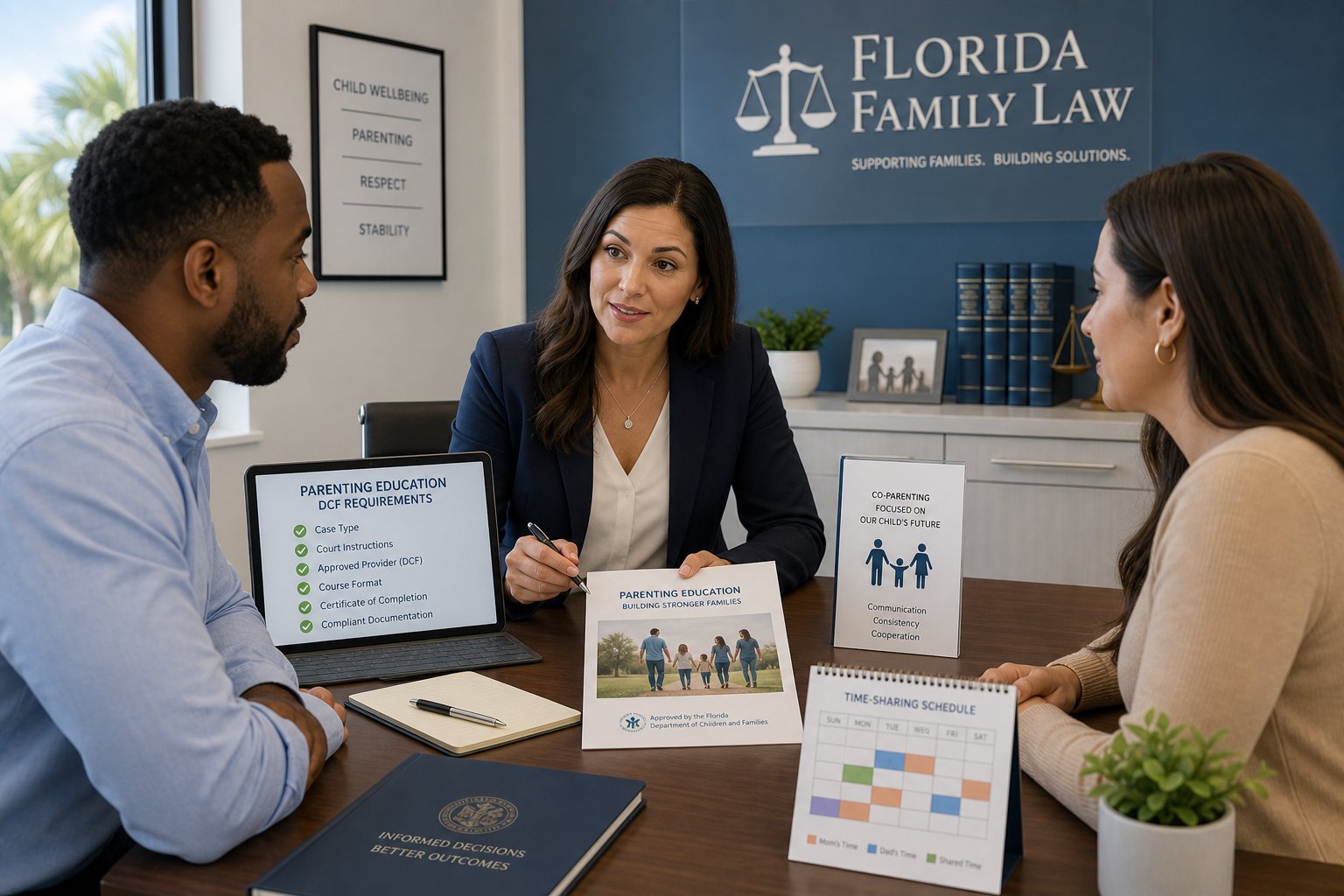
What A DCF-Approved Parenting Class Is And Who Usually Needs It
A DCF-approved parenting class in Florida usually means the Parent Education and Family Stabilization Course approved by the Florida Department of Children and Families. For many Florida family law cases, this is not optional. It is often required when parents with minor children are divorcing, and it can also come up in some paternity, custody, and time-sharing cases.
Under Florida law, both parents may need to complete the course. That often includes the parent who files the case and the other parent who is served later. The goal is simple: help parents understand how separation affects children and how to make better choices around co-parenting, communication, and conflict.
The course is at least 4 hours long. It is designed to cover child-focused issues, not just court paperwork. So even if you and the other parent agree on a parenting plan, the court may still require the class.
A key point matters here: DCF-approved provider status is not the same thing as automatic acceptance in every situation. Florida has statewide rules, but local practice can still vary by court, county, judge, and case type. Some courts allow online classes broadly. Others may have stricter instructions on provider format or filing steps.
Before you enroll, check three things:
- Your case type
- Your court order or local instructions
- Whether the provider is on the DCF-approved list
You can review Florida court information through Florida Courts and confirm local filing details with your county Clerk of Court.
Can You Take A Florida Parenting Class For Free Or At Reduced Cost?
Yes, free dcf approved parenting classes do exist in some cases, but you still need to confirm that the course fits your court’s rules. The best-known example is Florida State University’s Successful Co-Parenting After Divorce program, which has been described as a free DCF-approved option for users. Even then, you should still verify whether your county and judge accept that format for your case.
Reduced-cost options may also exist. Some providers mention:
- Indigent waivers for people the court has declared indigent
- Sliding-scale fees from some in-person programs
- Lower-cost online options compared with classroom programs
But be careful with broad promises. A low price or free enrollment does not prove court acceptance. And no provider can truthfully promise acceptance in every county and case unless your local court rules clearly allow it.
If you are searching for a free or low-cost class, compare these points:
- Is the provider DCF-approved?
- Is the class online or in person?
- Does your county allow online completion?
- How is the certificate of completion delivered?
- Do you need a court indigent form for any waiver?
A smart next step is to check the DCF-approved provider list and then compare it with your local court’s family law instructions. That extra check can save time and prevent a rejected certificate later.
How Online DCF-Approved Classes Work From Registration To Certificate
Most online Florida parenting classes follow a simple path. You choose a provider, register, complete the lessons, and then get a certificate of completion if you meet the course rules.
In many cases, the steps look like this:
- Pick a provider from the DCF-approved list.
- Create an account online.
- Pay the fee, unless the class is free or waived.
- Complete the 4-hour course.
- Finish any quiz or final exam if the provider requires one.
- Download or receive your certificate by email.
Many online providers let you work at your own pace. That means you can start, stop, and return later. You can often use a phone, tablet, or computer. For parents managing work, school pickups, and court deadlines, that flexibility can help.
Still, the details differ by provider. Some issue an instant PDF certificate. Others may email it later. Some courses include short quizzes in each section. Others use a final test. The provider’s site should explain those rules before you enroll.
If you want a fully online option, DivorceParentingClass.net offers a Florida Parent Education and Family Stabilization Course built for phone, tablet, or computer access. Even so, you should still confirm your local court’s instructions on online acceptance and filing.
Also check whether your court wants you to file the certificate yourself or present it at a hearing. Local practice can differ.
What The Parent Education And Family Stabilization Course Covers
The course focuses on how family change affects children and how parents can reduce harm. It is not just a box to check for court. The class is meant to support better decisions during divorce, separation, and related parenting cases.
Most Florida-approved courses cover topics like these:
- The effects of divorce or separation on children
- Children’s emotional, social, and physical needs
- Communication with the other parent
- Communication with children during change
- Parental responsibility and child-centered decision making
- Time-sharing and planning issues
- Stress, conflict, and ways to reduce fights
- Awareness of domestic violence and child abuse
Some courses also explain basic court-related ideas in plain language. That may include how a parenting plan works and why courts want parents to focus on the child’s best interests.
A good course should feel practical. It should help you think about schedules, handoffs, school communication, and what children need to hear from each parent. It should also explain what children should not be asked to carry, such as adult conflict or messages between parents.
Because the course is statewide, the main topics are similar across providers. But each provider may present them in a different style, with videos, reading sections, quizzes, or examples. That is why format matters, especially if you learn better on a phone or need to pause often.
Will Your Certificate Be Accepted By Florida Courts And Counties?
Maybe, but acceptance depends on more than the word “approved.” A certificate from a DCF-approved provider is a strong starting point, yet you still need to follow local court rules.
Here is the core issue: Florida has statewide approval of providers, but some counties or judges may set extra rules about online learning, filing method, or case eligibility. So a course can be valid in general and still raise a problem if it does not match your court’s instructions.
To reduce risk, verify these points before you enroll:
- The provider appears on the DCF-approved list
- Your county accepts online classes, if you want online learning
- Your judge has not ordered an in-person course
- The certificate includes the details your court expects
Useful official sources include:
- Florida Department of Children and Families
- Florida Courts self-help and family law resources
- Your county court or Clerk of Court website
If your local court page has family law packets or standing orders, read those carefully. They often explain whether each parent must file the certificate before final judgment. If anything is unclear, ask the clerk about local process or ask your attorney whether a specific provider meets the court’s direction.
Do that before you spend time on a free class that may not fit your case.
Deadlines, Completion Rules, And What Happens If You Do Not Finish On Time
Florida courts often set firm deadlines for this course. In many cases, the petitioner must finish within 45 days after filing, and the respondent must finish within 45 days after service. Courts may also require completion before the final judgment is entered.
That means delay can create real problems. If you wait too long, the court may move your case more slowly or take other action.
Possible consequences can include:
- Court warnings or orders to complete the class
- Findings of contempt in some cases
- Delay of final steps in the case
- Problems related to time-sharing or shared parental responsibility
The exact result depends on the court, the judge, and the facts of your case. But the safest approach is simple: read your paperwork early and complete the course well before your deadline.
Keep a copy of your certificate of completion once you finish. If your provider emails a PDF, save it in more than one place. If your court requires filing, follow the local instructions from the Clerk of Court. Some courts may place that information in family law packets or online checklists.
If you already have a deadline, do not assume a free class will be faster. Check the provider’s timing, the certificate process, and your local court rules first.
How To Choose The Right Florida Parenting Class For Your Situation
The right class is the one that meets Florida requirements and your local court’s rules. Cost matters, but acceptance matters more.
Start with a short checklist:
- Confirm the provider is a DCF-approved provider
- Confirm your court allows the class format you want
- Review certificate delivery details
- Check whether the course works on your device
- Look for clear support if you have filing questions
If you want an online option, compare ease of use as well as price. A class that works well on a phone may fit better if you have a busy schedule. Also check whether the provider explains the course length, quizzes, and certificate steps in plain language.
For parents who want a Florida-focused online option, DivorceParentingClass.net offers the Florida Parent Education and Family Stabilization Course in a self-paced format. Before you enroll, match that option against your county’s rules and any court order in your case.
And if you are trying to use a free provider, do one extra check: make sure your local court accepts that specific course or online format. That small step can prevent a second class, extra filing work, or a missed deadline.
FAQ
Can a free DCF-approved class replace a court-ordered divorce class?
If the free class is genuinely DCF-approved and your court accepts it, it can satisfy the court-ordered requirement. If it isn’t approved, it won’t, regardless of any certificate.
Are there free or reduced-cost approved options?
Some parents find lower-cost options, and availability varies. The key is confirming the provider is DCF-approved before relying on a free or reduced-cost class for your case.
What if I can’t afford the class?
If cost is a hardship, ask the Clerk of Court or your attorney whether any fee options apply to your case. Don’t assume a free, unapproved class will satisfy the requirement.
How do I make sure a free class counts?
Verify the provider on the Florida DCF approved-provider list and confirm your court accepts it. Approval, not price, is what determines whether it satisfies your order.
Conclusion
Free and court-ordered classes can line up, but only when the free option is DCF-approved and accepted in your case. Treat approval as the deciding factor, and if cost is a real hardship, ask the court about options rather than risking an unapproved class. That way you meet the order without paying twice or missing a deadline.
To be certain it meets your court order, complete the DCF-approved Parent Education and Family Stabilization Course online.
Related Articles
- How Much Does a Florida Parenting Class Cost?
- Free Parenting Classes Online With Certificate: Will a Court Accept Them?
- Low-Cost Florida Parenting Class Options: What to Check Before Enrolling
- Cheapest Court-Approved Parenting Class in Florida: What Matters Besides Price
Sources
Billy Forte is the founder of Divorce Parenting Class, which offers a Florida DCF-approved online Parent Education and Family Stabilization Course. The brand focuses on clear, supportive, plain-English guidance to help Florida parents complete the court-required class and file their certificate.
This article is general information, not legal advice. Florida family-law requirements and certificate acceptance can vary by court, county, judge, and case type, so review your court papers and official Florida sources, or consult a family-law attorney, before acting.