
Updated June 2026 · Reviewed by Billy Forte
Yes, the Florida parenting class is usually still required in an uncontested divorce when the case involves minor children, because agreeing on terms doesn’t remove the Parent Education and Family Stabilization Course requirement. The court still generally needs both parents to complete the DCF-approved course before the final judgment, unless a judge excuses someone for good cause. This guide explains why agreement doesn’t exempt you and how to handle the requirement in an uncontested case.
Applies to the Florida Parent Education and Family Stabilization Course (Fla. Stat. 61.21). Requirements and acceptance can vary by court, county, judge, and case type, so review your court papers and official Florida sources.
Key Facts
- Still required: An uncontested divorce with minor children generally still requires the course.
- Agreement isn’t exemption: Agreeing on terms doesn’t remove the statutory requirement.
- Both parents: Each parent generally completes the course separately and files a certificate.
- Before final judgment: The certificate is typically needed before the court finalizes the case.
- Waiver is limited: Only a judge can excuse it for good cause, and it isn’t automatic.
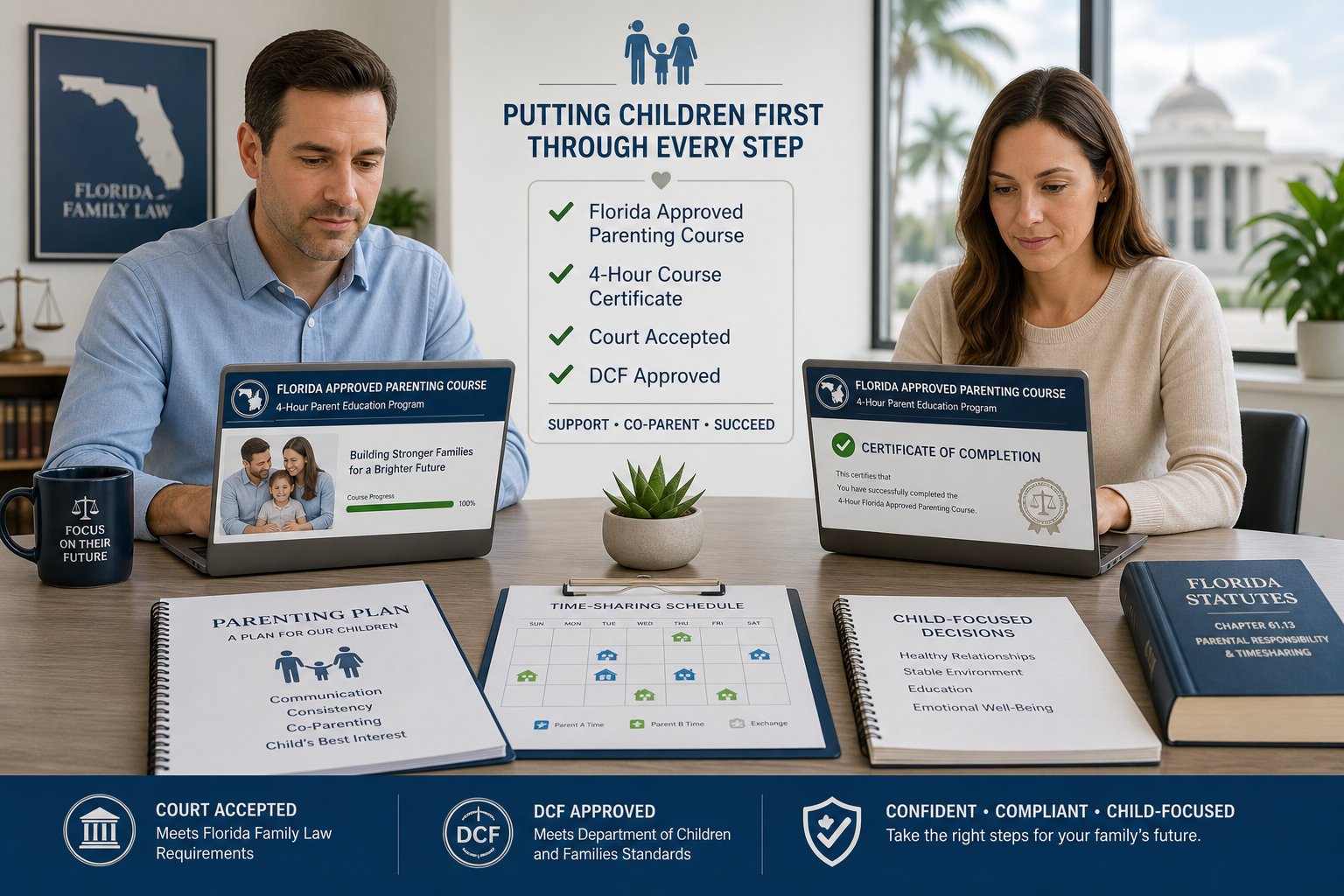
What The Florida Divorce Parenting Class Requirement Means
Florida’s divorce parenting class requirement means the court usually wants each parent to finish a Parent Education and Family Stabilization Course before the case reaches final judgment. That is true even if you and the other parent agree on everything and plan to file an uncontested divorce.
The key point is simple: uncontested does not usually mean exempt. If your case involves minor children, the parenting class is often part of the process because Florida focuses on the child’s needs, not just the parents’ agreement.
Under Florida Statute 61.21, the course is meant to help parents understand:
- How separation and divorce can affect children
- How conflict between parents can harm children
- How to support a healthy parenting plan
- How to handle time-sharing and parental responsibility in a better way
The course must be DCF-approved and at least 4 hours long. In practice, that means you should not pick a general co-parenting class from anywhere online and assume it will work. Florida courts usually want a course that meets the state’s specific rules.
The safest next step is to confirm two things before you enroll:
- The provider is approved by the Florida Department of Children and Families
- Your local court accepts that format, especially if it is online
Who Must Take The Parent Education And Family Stabilization Course
In Florida, both parents usually need the class in a divorce case with minor children. It does not matter that the divorce is friendly, agreed, or uncontested. If you are a party to the case, the rule generally applies to you.
This requirement commonly covers:
- All parties in a dissolution of marriage with minor children
- All parties in a paternity case involving parental responsibility, time-sharing, or child support
- Some parties in a modification case involving a parenting plan or time-sharing, if the court orders it
That first point answers the main question most clearly: yes, both parents still usually need it if the divorce is uncontested.
There are limited exceptions. A judge may excuse a parent for good cause, but that is a court decision, not something you should assume on your own. Also, court practice can vary by county, judge, and case type.
Another point that matters: simplified dissolution is not available when you have minor children. So if you share minor children, your case is usually handled through a regular family law process where the parenting course requirement can apply.
If you are unsure whether your case falls under divorce, paternity, or modification rules, check your local Clerk of Court or review materials from Florida Courts.
When You Need To Complete The Class And What Happens If You Do Not
Florida law generally says parents should start the course as expeditiously as possible. In most divorce cases, the timing is tied to the filing or service date.
For many cases, the common deadlines are:
- Petitioner: within 45 days after filing the petition
- Other parent: within 45 days after being served
Similar 45-day timing may apply in paternity cases after the filing, acknowledgment, adjudication, or a support or time-sharing order, depending on the case posture.
Do not wait until the final hearing is close. If you delay, you can create problems even in an uncontested case. A court may refuse to move forward until both parents meet the requirement or until the judge decides whether an excuse applies.
If you do not complete the course, the court may:
- Hold you in contempt of court
- Delay parts of the case
- Deny or limit time-sharing
- Affect decisions tied to shared parental responsibility
- Impose other sanctions allowed by the court
Because county practice can differ, it is smart to read your local family court instructions and any administrative orders on the county court or clerk website. If your case is already filed, check the deadline now and make a plan to finish before it becomes an issue.
What The Course Covers And How Long It Takes
The Florida course must be at least 4 hours long. It is not just a formality. The class is meant to give parents practical information that can lower conflict and help children adjust.
Most approved courses cover topics such as:
- The effects of divorce or separation on children and parents
- Child development and stress signs
- Co-parenting and communication skills
- Ways to reduce conflict
- The basics of a parenting plan
- How time-sharing affects family routines
- Why children should be kept out of adult disputes
Some families may need a more specific course. Under the statute, parents of children with special needs or emotional concerns may need a course designed for that situation.
A good online class breaks the material into short lessons, quizzes, or checkpoints so you can complete it on your schedule. But the key is not speed alone. The key is whether the class is the right Florida Parent Education and Family Stabilization Course for your case.
If you are comparing options, check the provider’s course description for the exact Florida approval status, the 4-hour length, and how the certificate of completion is issued.
How To Choose A Florida-Approved Online Parenting Class
Start with approval status. A Florida-approved class should be approved by the Florida Department of Children and Families as a Parent Education and Family Stabilization Course provider.
You can review state information through the Florida Department of Children and Families and then compare that with your local court instructions. This second step matters because some courts or judges may have extra rules about online or distance learning.
When you compare providers, look for:
- Clear Florida DCF-approved provider status
- A course length of at least 4 hours
- A simple certificate of completion process
- Mobile access if you want to use a phone or tablet
- Plain pricing and any refund or indigent policies
- Help options if you need support
For parents who want an online option, DivorceParentingClass.net offers a Florida DCF-approved course that can be completed online. Even so, you should still follow any county or judge-specific instructions in your case.
That balance matters. A provider can be state approved, but your local court may still have filing or format rules you need to follow.
How Certificates, Court Acceptance, And County Rules Work
After you finish the course, you should receive a certificate of completion. That certificate is the document you may need to file with the court or keep for your records, depending on local procedure.
Many providers let you download, print, or email the certificate. Some may offer to send it where needed. Still, court acceptance depends on the court handling your case. That is why you should not assume every online certificate is accepted everywhere in the same way.
Local rules may affect:
- Whether online classes are accepted
- How the certificate must be filed
- Whether you file it yourself or bring it to a hearing
- Whether the clerk wants a paper copy or an electronic filing
Use county court or clerk resources when possible. For general court information, start with Florida Courts. For county-specific filing details, check your local Clerk of Court website.
If you are taking an online parenting class for divorce, the safest approach is to verify the provider first, then verify your county rules, then keep a copy of your certificate in a place you can find quickly if the court asks for it.
Special Situations: Paternity, Simplified Dissolution, And Fee Issues
Some Florida cases raise extra questions. The biggest ones are paternity, simplified dissolution, and cost.
Paternity cases
The course may also be required in a paternity action if the case involves parental responsibility, time-sharing, or support. In many of those cases, both parties must complete the class, and similar 45-day deadlines can apply.
Simplified dissolution
If you have minor children, you cannot use simplified dissolution of marriage in Florida. So parents with minor children usually go through a regular dissolution process where the parenting course requirement remains relevant.
Fee issues and indigency
Florida law allows a reasonable fee for the course. Some courts or providers may offer help if you have an indigency finding or another approved fee waiver, but policies differ.
If cost is a concern, check:
- Whether the provider lists an indigent or reduced-fee option
- Whether your court has local instructions on fee waivers
- Whether you need to show an indigency order or form
If you need a Florida course option, you can review the online program at DivorceParentingClass.net and then confirm local filing and acceptance rules with your court.
FAQ
Is the parenting class required for an uncontested Florida divorce?
Usually yes, if there are minor children. An uncontested divorce still requires the Parent Education and Family Stabilization Course — agreeing on terms doesn’t remove the requirement.
If we agree on everything, do we still both take it?
Generally yes. The requirement applies to each parent regardless of agreement, so both typically complete the course separately and file individual certificates before the final judgment.
Does ‘uncontested’ mean exempt?
No. Uncontested refers to agreement on the terms, not exemption from the course. The requirement still applies unless a judge excuses a parent for good cause.
Could a judge waive it in an uncontested case?
A judge may excuse a parent for good cause, but that’s a court decision and isn’t automatic — agreement between the parents doesn’t create a waiver.
Conclusion
Even the smoothest, fully agreed divorce generally still requires the parenting course when minor children are involved, because the requirement is about the children, not about whether the parents disagree. Plan on both parents completing the DCF-approved course and filing certificates before the final judgment. If you believe your situation warrants an exception, that’s a request for the judge — not something agreement alone can decide.
You can complete the DCF-approved Parent Education and Family Stabilization Course online so an uncontested case isn’t held up.
Related Articles
- Do Parents Still Need the Florida Parenting Class If They Agree on Everything?
- Florida Divorce Parenting Class Requirement: Who Has to Take It and When
- Can the Florida Parent Education Course Requirement Be Waived?
- What Happens If You Do Not Complete the Florida Parenting Class?
Sources
Billy Forte is the founder of Divorce Parenting Class, which offers a Florida DCF-approved online Parent Education and Family Stabilization Course. The brand focuses on clear, supportive, plain-English guidance to help Florida parents complete the court-required class and file their certificate.
This article is general information, not legal advice. Florida family-law requirements and certificate acceptance can vary by court, county, judge, and case type, so review your court papers and official Florida sources, or consult a family-law attorney, before acting.