
Updated June 2026 · Reviewed by Billy Forte
The difference between a court-required parenting class and a voluntary one comes down to two things: whether a court ordered it, and whether the provider is DCF-approved so the certificate counts. A voluntary parenting class can be valuable, but if your Florida case requires the Parent Education and Family Stabilization Course, only a DCF-approved course will satisfy the court. This guide explains the distinction so you take the class your case actually needs.
Applies to the Florida Parent Education and Family Stabilization Course (Fla. Stat. 61.21). Requirements and acceptance can vary by court, county, judge, and case type, so review your court papers and official Florida sources.
Key Facts
- Court-required: Ordered in your case and must be the DCF-approved Parent Education and Family Stabilization Course.
- Voluntary: Taken by choice for personal benefit; not necessarily DCF-approved or court-recognized.
- Approval is the dividing line: Only a DCF-approved course satisfies the Florida court requirement.
- Don’t assume overlap: A helpful voluntary class may not count toward your case if it isn’t approved.
- Check your order: Your court papers confirm whether the class is required for your case.
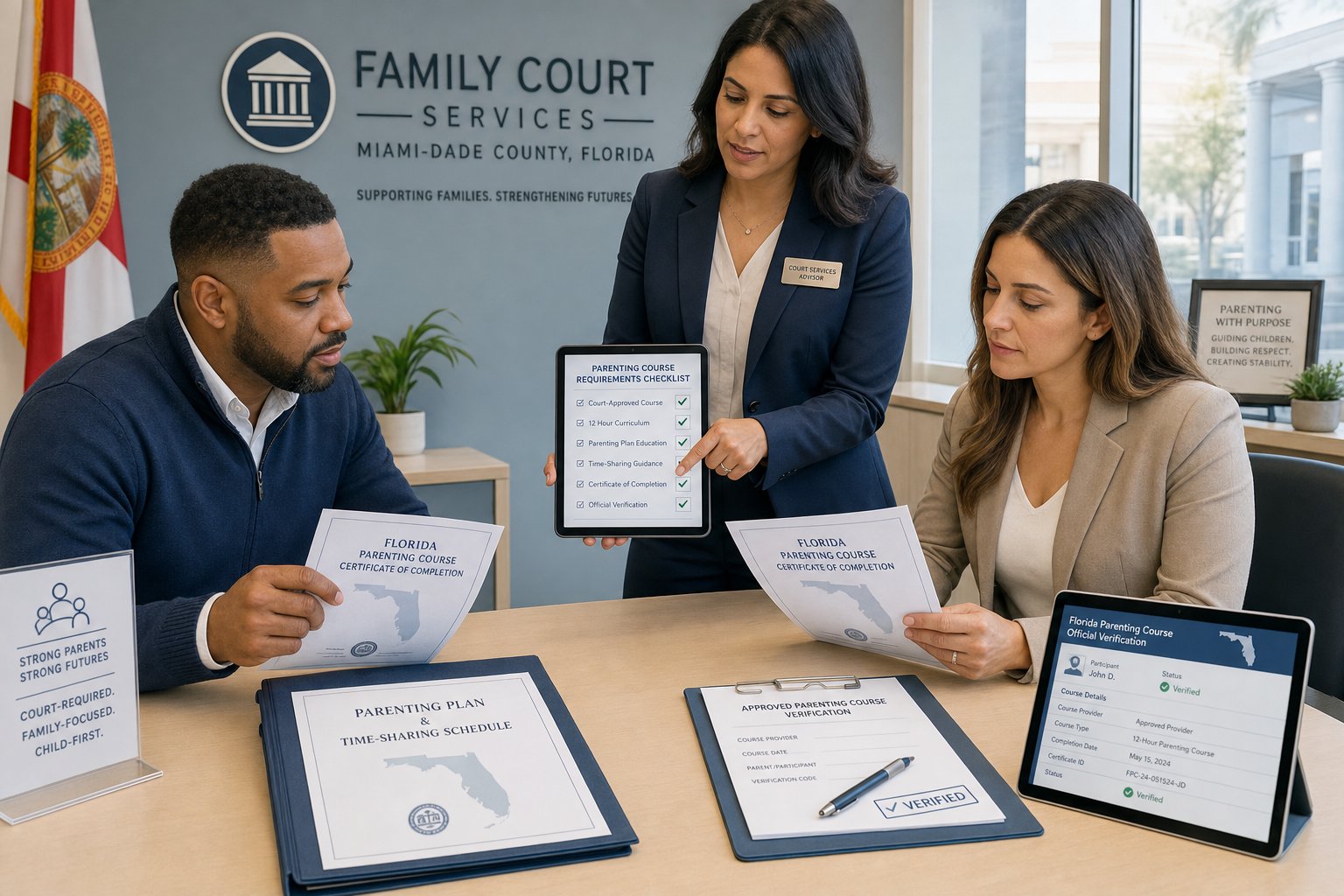
Who Needs A Court-Required Parenting Class In Florida
Florida generally requires parents with minor children in a divorce case to complete a Parent Education and Family Stabilization Course. That is the standard parenting class for court in Florida.
The rule often applies to both parents. That means the person who filed the case and the other parent usually must each complete the class. Florida court materials also show that some courts use the course in other case types, such as certain paternity, time-sharing, modification, temporary custody, adoption, or child welfare matters.
Still, the exact requirement can depend on the court, county, judge, and case type. So if you are not sure, do not guess.
Check these sources in this order:
- Your court order or case papers
- Your county family court or Clerk of Court website
- Any instructions from the judge
- The approved course list from the Florida Department of Children and Families
Florida courts use this course because it focuses on children during family change. It is not the same as a general parenting course or a private coaching class. If your case calls for the Florida course, you usually need the state-approved one, not just any class with a similar name.
If your papers mention a parenting plan, parental responsibility, or time-sharing, that is another sign to verify the requirement right away.
What The Parent Education And Family Stabilization Course Covers
The Florida course covers how separation and divorce affect children and how parents can reduce harm. State-approved programs are built to teach practical skills, not just legal terms.
The class is generally at least 4 hours long. Florida court and provider materials commonly describe topics such as:
- The effect of divorce or separation on children
- Children’s common emotional and behavior responses
- Shared parental responsibility and child-focused decisions
- Better parent-to-parent communication
- Conflict reduction
- Time-sharing and routine planning
- Safety issues, including abuse or domestic violence concerns
- Building or supporting a child-focused parenting plan
A good course explains these ideas in plain language. For example, it may show why children do better when parents do not use them to carry messages, hear fights, or choose sides.
It also helps you think about daily issues. School pickup, bedtime, phone contact, holidays, and schedule changes can all become conflict points if parents do not have clear rules. The class pushes you back to one basic goal: make choices that support your child’s stability.
For Florida background, you can review Florida Courts family law resources and the state law sections on parenting issues through the Florida Legislature.
How Online Parenting Classes Work And Whether They Are Accepted
Many Florida parents take the course online. That can make compliance easier when you are working, caring for children, or living far from an in-person option.
An online Florida Parent Education and Family Stabilization Course usually lets you:
- Register on a phone, tablet, or computer
- Work at your own pace
- Stop and start as needed
- Finish the required lessons and any final quiz or exam
- Download or print a certificate of completion
But online access does not mean automatic acceptance in every case. Some counties or judges may have local rules about distance learning, live classes, or approved providers. That is why DCF-approved matters, but local court instructions matter too.
Before you enroll, confirm two points:
- The provider is listed as a DCF-approved provider.
- Your court accepts that format for your case.
That second step is important. A provider may be valid at the state level, yet your court may still want you to follow a local instruction. You can confirm details through your county court or Clerk of Court page before you pay.
What To Look For In A Florida DCF-Approved Course Provider
The first thing to check is simple: Is the course provider approved by the Florida Department of Children and Families? If not, the class may not meet the court requirement.
After that, look for clear, practical details. A solid provider should tell you:
- Its Florida approval status
- The name of the course
- How long the course takes
- How the certificate of completion is issued
- What devices you can use
- Where to get help if you have a problem
You should also look for plain answers about acceptance. No provider should promise court acceptance in every county or every case without limits. The safer statement is that the provider is state approved and that you should still follow your local court instructions.
For Florida parents, DivorceParentingClass.net offers a Florida Parent Education and Family Stabilization Course online and explains the course format, support options, and certificate process in a clear way. That can help if you want a simple path that fits around work and child care.
Also check whether the site has county or help pages. Those can save time when you need basic answers fast.
Registration, Cost, And Getting Your Certificate
Registration is usually quick. Most online providers ask for your basic contact details and payment before you begin the course.
Florida court and provider materials often show class prices in the range of about $18 to $39, though costs can vary by provider. Some court materials also note that fee waivers may exist for people who meet federal poverty guidelines.
Before you register, have these details ready:
- Your full legal name
- Your case number, if your court paperwork shows one
- The county where your case is filed
- A working email address
- A printer or save option for your certificate, if needed
After you finish the course, the provider usually issues a certificate of completion. Some courts want you to file it with the Clerk of Court. Others may want you to bring it to a hearing or submit it in another way. Do not assume the filing step is automatic.
If you need an online option, you can review and register for the Florida course at DivorceParentingClass.net. Check your local court instructions first, then complete the course and keep a copy of your certificate for your records.
How The Class Helps With Co-Parenting, Communication, And Reducing Conflict
The class is meant to help you parent better during a hard change. Its main purpose is to protect children from adult conflict.
That matters because small choices shape daily life for children. A missed pickup, a hostile text, or a fight at exchange can raise stress fast. The course teaches ways to lower that stress.
Common lessons include:
- Keep children out of adult disputes
- Share basic information clearly and briefly
- Follow the parenting plan when possible
- Focus on the child’s routine, school, and health
- Avoid blaming language in front of children
This kind of training also supports better decisions about time-sharing and parental responsibility. When parents communicate in a calmer way, children often have more stable routines and fewer loyalty conflicts.
The class will not solve every disagreement. But it can give you a shared starting point. That is useful when both parents must complete the same course and hear the same child-focused message.
For many parents, the most helpful part is practical. It turns broad ideas like “co-parent well” into specific habits you can use this week.
Common Situations That Affect Deadlines, County Rules, And Case Compliance
Deadlines and compliance rules can vary in Florida. That is why you should always read your own court papers closely.
Some Florida court and provider materials say the filing parent may need to complete the class within 45 days of filing, and the other parent may have 45 days after service or a similar case event. But that is not a universal rule for every case. Local practice can differ.
A few common issues can affect what you need to do:
- Your case is in a county with special filing steps
- Your judge gives a separate deadline
- Your case is not a divorce, but a paternity or modification case
- Your court has rules about online versus in-person classes
- You finished the course but did not file the certificate correctly
Missing the deadline can create problems in your case. So it is smart to verify the steps early through your judge’s order, county court page, or Clerk of Court office. Useful starting points include Florida Courts, the Florida DCF, and your county clerk website.
FAQ
What’s the difference between a court parenting class and a voluntary one?
A court-required class is ordered in your case and must be the DCF-approved Parent Education and Family Stabilization Course. A voluntary class is taken by choice and may not be approved or count toward your case.
Will a voluntary parenting class satisfy my court?
Only if it’s the DCF-approved course your case requires. A voluntary class can be valuable personally, but if it isn’t approved, it generally won’t satisfy a Florida court requirement.
How do I know which one I need?
Check your court order or case papers. If your case requires the Parent Education and Family Stabilization Course, choose a DCF-approved provider so the certificate counts.
Can a class be both?
Yes — a DCF-approved course can satisfy a court requirement and still be useful personally. The key is that it’s approved so it counts for your case.
Conclusion
The court-versus-voluntary distinction is really about approval: if your case requires the parenting course, only a DCF-approved class will satisfy it, no matter how good a voluntary alternative might be. Check your court order to confirm what’s required, then choose an approved course if it is. That way the class counts and still delivers the practical co-parenting benefits.
If your case requires the course, you can complete the DCF-approved Parent Education and Family Stabilization Course online so it counts toward your case.
Related Articles
- Divorce Parenting Class Near Me vs. Online Class in Florida
- Parenting Classes Approved by Court: Questions to Ask Before You Enroll
- Court-Ordered Parenting Class Online: Why State Approval Matters
- Accredited Parenting Courses: What Does Accredited Mean for Florida Divorce?
Sources
Billy Forte is the founder of Divorce Parenting Class, which offers a Florida DCF-approved online Parent Education and Family Stabilization Course. The brand focuses on clear, supportive, plain-English guidance to help Florida parents complete the court-required class and file their certificate.
This article is general information, not legal advice. Florida family-law requirements and certificate acceptance can vary by court, county, judge, and case type, so review your court papers and official Florida sources, or consult a family-law attorney, before acting.