
Updated June 2026 · Reviewed by Billy Forte
Florida requires parenting classes for divorce to help parents understand how separation affects their children and to give them tools to reduce conflict and co-parent effectively. The Parent Education and Family Stabilization Course is mandated under Florida Statute 61.21 specifically because the state treats supporting children through family change as part of the process. This guide explains the reasoning behind the requirement and what the course aims to accomplish.
Applies to the Florida Parent Education and Family Stabilization Course (Fla. Stat. 61.21). Requirements and acceptance can vary by court, county, judge, and case type, so review your court papers and official Florida sources.
Key Facts
- Children-focused: The requirement exists to help children adjust to divorce or separation.
- Reduce conflict: The course teaches communication and conflict-reduction between co-parents.
- State mandate: Florida Statute 61.21 requires it in many cases with minor children.
- Stabilize the family: The goal is a more stable transition for the whole family.
- Practical tools: Parents gain co-parenting strategies that help beyond the court process.
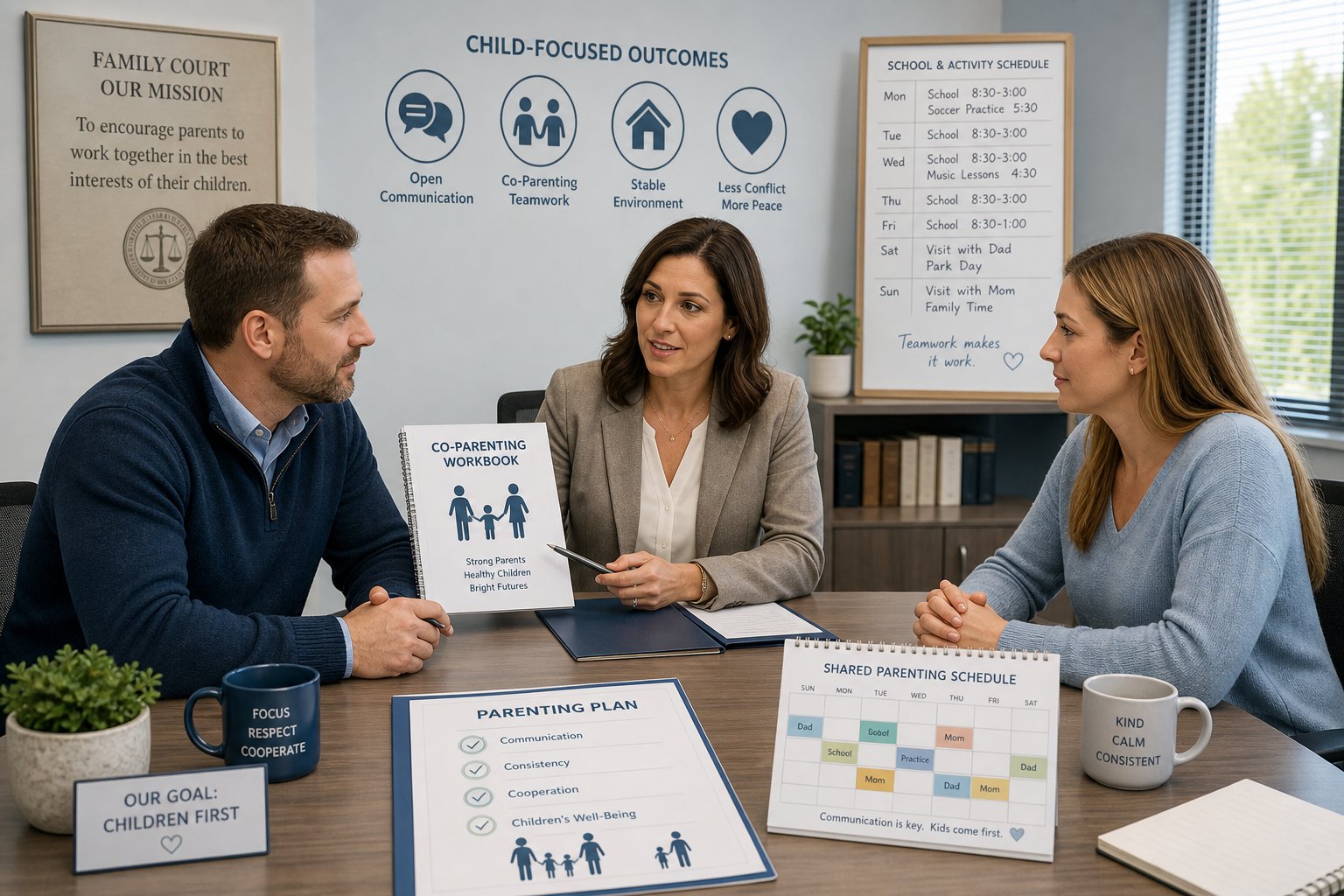
Why Courts Require Parenting Classes During Divorce
Florida courts require parenting classes because the goal is not only to end a case, but also to reduce harm to children. When parents separate, children often feel stress from changes in home life, routines, school schedules, and contact with each parent. Conflict between parents can make that stress worse.
That is the main answer to why are parenting classes required for a divorce. The class gives parents basic tools to lower conflict, communicate better, and focus on their children’s needs instead of the court fight.
Florida uses the Parent Education and Family Stabilization Course to support the child’s best interests. The course is tied to family cases that involve minor children because children do better when parents can manage change with less conflict. Courts also want parents to understand how their actions can affect a child’s emotional health, behavior, and adjustment.
Under Florida law, this course is generally required in qualifying cases before final judgment. You can review the state rule in Florida Statutes section 61.21.
In simple terms, the court is trying to do three things:
- Protect children from adult conflict
- Teach co-parenting skills
- Support family stability during a major change
The class does not decide your case for you. It does not replace legal advice either. But it can help parents understand parental responsibility, communication, and the kind of cooperation that supports a workable parenting plan and healthier time-sharing arrangements.
Who Has To Take The Florida Parent Education And Family Stabilization Course
In Florida, all parties in certain family law cases involving children generally must take the course. That usually includes both parents in a dissolution of marriage case when they have minor children together. It also often applies in paternity cases that involve parental responsibility or time-sharing issues.
The key point is that the requirement is about the child, not about which parent filed first. So if you are the petitioner or the respondent, the court may still require you to complete the course.
Florida Courts explain the family law forms process and many county courts repeat this requirement on their local pages. You can also check Florida Courts family law resources for general court information.
Still, the exact requirement can depend on:
- Your case type
- Your county
- Your judge
- Local court instructions
That matters because one county may give detailed filing steps through the Clerk of Court, while another may give those steps in a standing order or case management notice.
If your case involves children, do not assume the class is optional. Check your court papers, your county court website, and the provider list from the Florida Department of Children and Families. Then make sure you use a DCF-approved provider and follow any local filing rule for your certificate of completion.
What The Parenting Class Covers And How It Helps Children
The Florida parenting class teaches skills that support children during family change. It usually covers how separation affects children, how parents can reduce stress, and how to make better choices when emotions run high.
Most approved courses address core topics such as:
- How divorce or separation affects children at different ages
- Children’s emotional and developmental needs
- Ways to talk with children without putting them in the middle
- Co-parent communication skills
- Conflict reduction and problem-solving
- Changes in routines, homes, and transitions
This matters because children often do better when parents avoid using them as messengers, avoid hostile exchanges, and keep routines more stable. A class cannot remove all stress. But it can help you spot harmful patterns early.
For example, a child may feel torn when one parent asks questions about the other home. Another child may act out after tense drop-offs. The course helps parents see those moments from the child’s side.
Florida’s approved course model focuses on education, not punishment. It is meant to teach practical habits that support a stronger parenting plan and better time-sharing transitions. You can review provider information through the Florida Department of Children and Families.
In many cases, the value of the class is simple: less conflict around children usually means less stress for children.
How The Course Works In Florida
In Florida, you usually complete the course through a state-approved provider and then submit proof to the court as required. The course length is commonly listed in the 4 to 8 hour range, depending on the provider and course format.
The first step is to confirm that the provider is approved by the Florida Department of Children and Families. Approval matters because the court may expect a valid certificate of completion from an approved provider, not just any parenting class.
The second step is to check local court instructions. Some courts tell you when the class must be finished, where the certificate goes, and whether you or the provider should file it with the Clerk of Court.
The third step is to complete the course in full and keep your records. If the court asks for proof later, you will want easy access to your certificate.
If you want a flexible option, DivorceParentingClass.net offers a Florida Parent Education and Family Stabilization Course online through a DCF-approved provider. That can be helpful if you need to work around job hours, child care, or transportation limits.
Online Vs In-Person Options
Florida may allow both online and in-person options through approved providers. But local practice can differ, so you should always confirm that your court accepts the format you choose.
Online courses can be easier if you need to work at your own pace or use a phone, tablet, or computer from home. In-person classes may fit better if your local court lists a community provider or if a judge gives specific directions.
Before you enroll, verify three things:
- The provider is DCF-approved
- The format is accepted in your case
- The certificate meets local court requirements
Deadlines, Cost, And Proof Of Completion
The court usually wants the class finished before final judgment, and proof of completion is a key part of that process. If you wait too long, your case may not move as expected.
Florida law generally requires completion before entry of final judgment in qualifying cases. Still, each court may handle scheduling and filing details a little differently. That is why local instructions matter.
Cost is often modest compared with other case expenses. Many Florida-approved courses fall in a range often cited around $18 to $39 per person, though price can vary by provider and format.
After you finish, you should receive a certificate of completion. The court may require that certificate to be filed with the Clerk of Court, uploaded through an e-filing system, or brought to a hearing, depending on local procedure.
To avoid problems, check:
- Your court order or case papers
- Your county court or clerk website
- Your provider’s certificate instructions
You can look up local filing details through your county court or clerk page, and broader family court information is available from Florida Courts.
If you have not enrolled yet, choose a DCF-approved provider and verify what your county expects before you complete the course.
Exceptions, Waivers, And Domestic Violence Situations
Some parents may be able to request an exception or waiver, but that depends on the court. Florida requirements can vary based on the court, county, judge, and case type, so there is no single answer that fits every case.
In some family situations, safety concerns matter a great deal. A domestic violence history, serious hardship, disability-related access issue, or other good-cause reason may affect how the requirement is handled. In some places, the court may change the format, adjust the process, or consider a waiver request.
But you should never assume that a waiver applies automatically. Courts often require a formal request, and the outcome depends on the facts and the judge’s order.
That is especially important in domestic violence situations. A court may try to protect safety while still addressing the education requirement in a way that fits the case. For court structure and family resources, Florida Courts family law resources.
If your case does require the course, a clear next step is to use an approved option that matches local rules. You can take the Florida course online through DivorceParentingClass.net if that format is allowed in your case and county.
FAQ
Why does Florida require a parenting class for divorce?
To help parents understand how divorce affects their children and to give them tools to reduce conflict and co-parent effectively. Florida Statute 61.21 mandates it in many cases with minor children.
Is the class meant to judge my parenting?
No. It’s educational, not evaluative. The course focuses on supporting children through the transition and improving co-parenting, not on assessing or grading parents.
Does it actually help?
Many parents find the co-parenting and communication tools useful well beyond the case. The state’s aim is a more stable transition for children, which the course is designed to support.
Is the requirement the same statewide?
The statewide requirement comes from Florida law, though specific deadlines and filing steps can vary by court and county. The underlying purpose is consistent across Florida.
Conclusion
The requirement isn’t bureaucratic box-checking — Florida mandates the course because divorce is hard on children, and the state wants parents equipped to ease that transition. The class centers on the kids, co-parenting, and reducing conflict. Seen that way, completing it is less an obligation and more a practical head start on parenting well after the case ends.
You can complete the DCF-approved Parent Education and Family Stabilization Course online and gain tools that help your family through the change.
Related Articles
- Florida Divorce Parenting Class Requirement: Who Has to Take It and When
- Who Has to Take the Florida Parent Education and Family Stabilization Course?
- Florida Parenting Class for Paternity, Custody, and Time-Sharing Cases
- Florida Divorce With Minor Children: Parent Education Course Checklist
Sources
Billy Forte is the founder of Divorce Parenting Class, which offers a Florida DCF-approved online Parent Education and Family Stabilization Course. The brand focuses on clear, supportive, plain-English guidance to help Florida parents complete the court-required class and file their certificate.
This article is general information, not legal advice. Florida family-law requirements and certificate acceptance can vary by court, county, judge, and case type, so review your court papers and official Florida sources, or consult a family-law attorney, before acting.